

You’re finishing residency. It’s late on a post-call afternoon, your brain is fried, and your inbox dings: “Happy to write your chief letter—send me a draft by Friday.”
You stare at the screen and think:
What actually makes a good chief letter? What do fellowship PDs or hiring committees look for? And how do I avoid sending them something generic that says absolutely nothing?
Let me walk through exactly what makes a chief letter of recommendation stand out—and what makes it useless.
First: What Is a “Chief Letter” Really Doing?
A chief letter isn’t just “another LOR.” It has a very specific job.
It’s supposed to answer three questions programs care about but can’t ask directly:
- What were you like as a resident when no one was watching?
- How did you impact the culture and functioning of the program?
- Would the chiefs trust you as a future colleague and leader?
Most other letters (from attendings, division chiefs, etc.) focus on clinical acumen, knowledge, and maybe a project or two.
A strong chief letter focuses on:
- Day-to-day behavior over years
- Team dynamics
- Reliability under pressure
- How you handled conflict, feedback, and leadership moments
If the letter doesn’t clearly address those, it’s not doing its job.
The Core Anatomy of a Strong Chief Letter
Here’s the structure I’ve seen work best—and what selection committees actually read for.
1. Immediate context up front (no mystery)
Within the first 2–3 sentences, a strong chief letter makes these things obvious:
- Who the chief is (role, program, year)
- How they know you (direct supervision? schedules? remediation? wellness? peer feedback?)
- How long they’ve observed you (one rotation vs. three years)
Weak version:
“Dear Selection Committee, I am writing on behalf of Dr. X who is applying to your fellowship program.”
Good version:
“I’m the Internal Medicine Chief Resident for Education at University Hospital, and I’ve worked closely with Dr. X over the last three years as their senior, then chief—scheduling them, reviewing evaluations, and supervising their work on our busiest inpatient services.”
See the difference? The second version tells the reader: “I’ve actually seen this person across multiple contexts. I’m qualified to judge.”
If that context isn’t clear by the end of the first paragraph, the letter is already losing value.
2. A clear, strong overall judgment
A standout chief letter doesn’t dance around the main point. Somewhere very early, it plants a flag.
Things like:
- “Top 5% of residents I’ve worked with in 7 years at this program.”
- “If I were building a new residency program, Dr. X would be one of the first people I’d hire.”
- “One of our most trusted seniors—attendings routinely requested them for complex teams.”
Programs read dozens of letters that say “strong resident,” “a pleasure to work with,” or “would do well in your program.” That’s useless fluff.
The question PDs actually ask when they read your chief letter:
“Where does this person sit relative to your other residents?”
A strong chief letter answers that—explicitly.
If your chief can honestly rank you (top 1–2 residents, top quartile, etc.), that’s powerful. If they can’t, they should at least compare you to concrete benchmarks: handling the heaviest teams, trusted with the sickest patients, chosen for high-stakes roles.
3. Concrete leadership and professionalism examples
This is where most letters fail. They list adjectives and no evidence.
Bad pattern:
“Dr. X is hardworking, empathetic, and a strong leader. They are a great team player and always go above and beyond.”
Translation to a PD: “I didn’t have time to think about this.”
Better pattern: pick 2–3 specific scenarios and unpack them briefly.
Example of something that actually stands out:
“On our COVID surge service, Dr. X volunteered for extra nights when three interns were out sick. Instead of just surviving, they reorganized team workflow—cohorting admissions, standardizing notes, and building an on-call checklist that we still use. Nursing staff specifically told me, ‘It felt calmer when Dr. X was on.’”
“We had a struggling intern with repeated communication complaints. Dr. X, as senior, requested to keep working with him rather than swapping out. They met with him weekly, practiced patient interviews together, and built a simple script for difficult conversations. By the end of the year, his evaluations had normalized—he specifically named Dr. X as the turning point.”
Those details show:
- Initiative
- Emotional intelligence
- Real leadership, not just being “nice”
As a rule: for every major claim (“great teacher,” “culture-builder,” “role model”), the letter should give at least one concrete example.
4. How you handle pressure, conflict, and bad days
Good chief letters don’t just say, “They’re great when things are good.” They talk about the ugly stuff.
Selection committees want to know:
- Do you melt down when the ED calls with four admissions at once?
- Do you shut down or get defensive when corrected?
- How do you treat nurses and consultants at 3 a.m.?
Strong letters mention:
- Calm decision-making in chaos
- Owning mistakes and improving
- Professionalism with staff and peers, especially when things go wrong
Example:
“On a busy MICU night, a handoff miscommunication led to a delayed antibiotic dose. Dr. X immediately notified the attending, called the family, documented clearly, and then led a brief huddle with the team the next day to redesign how we track time-sensitive orders. No blaming, no minimizing—just clear accountability and system-level thinking.”
That’s the kind of paragraph that makes a PD circle your name.
5. Real insight into your role in the residency culture
The chief has a different vantage point than attendings. They see:
- Who shows up early to help on bad days
- Who everyone wants (or doesn’t want) as senior
- Who quietly mentors the interns and medical students
- Who gossips, stirs drama, or erodes trust (and conversely, who calms it down)
A strong chief letter talks about your impact on the program, not just your performance.
Look for things like:
- “Consistently chosen by interns as the senior they learned the most from.”
- “Frequently volunteered for unglamorous shifts when the schedule blew up.”
- “One of a small handful of residents I trusted to tell me the truth about program problems without exaggeration or drama.”
If a chief can credibly say, “The program is better because this resident was here,” that’s gold.
Style and Tone: How Chiefs Signal “I Really Mean This”
Programs can smell a mail-merge letter from a mile away. Here’s what makes a chief letter feel strong even before content kicks in.
Specific, vivid, not flowery
You don’t need three-syllable adjectives. You need specifics.
Better:
“On call, they were the one who would step in, take ownership of the sickest patient, and calmly divide the rest of the work.”
Worse:
“Dr. X exemplifies professionalism and clinical excellence in all circumstances.”
If a sentence could be copy–pasted into 200 other letters, it’s not helping you.
Honest, not artificially perfect
The best letters read as believable. That sometimes includes mentioning growth or minor weaknesses—framed with trajectory.
Example:
- “Early in residency, Dr. X occasionally tried to shoulder too much alone instead of escalating. Over the last year, I’ve watched them mature into someone who seeks input early and then leads the plan. They’ve turned that initial tendency into a strength—balancing initiative with humility.”
That kind of line actually increases credibility. Programs don’t trust letters that pretend you’ve never had to grow.
Clear recommendation at the end
A strong close doesn’t waffle.
Bad:
“I recommend Dr. X to your program and am confident they will do well.”
Good:
“I give Dr. X my strongest possible endorsement for your cardiology fellowship. If I had the chance to hire them as a junior faculty member here, I would do so without hesitation.”
That last line is what PDs want to see: “Would you hire this person yourself?”
What Makes a Chief Letter Mediocre (Or Actively Harmful)
Let’s be blunt: some chief letters hurt more than they help.
Red flags that programs notice:
- Vague, generic praise with no ranking or comparison
- No concrete examples—just adjectives
- Short letters (one page or less) that look rushed
- Obvious template recycling (“As I stated earlier…” when they didn’t)
- Backhanded compliments: “With continued mentorship, they could be successful”
- Weird omissions: no mention of teamwork, professionalism, or reliability
And the biggest one: faint support.
If the strongest line in the letter is “I believe Dr. X would be able to meet the challenges of fellowship,” that’s basically a soft no.
You want either a clearly positive signal—or a different letter writer.
How To Help Your Chief Write a Great Letter (Without Writing Fiction)
You can’t (and shouldn’t) script your own letter. But you can make it easy for your chief to write something strong and specific.
Here’s what to send them (in a short, organized email):
- Your updated CV
- Your personal statement or a short paragraph about your goals
- 4–6 bullet points of specific cases/situations they might remember:
- “Night float MICU shift when we handled 3 simultaneous codes”
- “Work with struggling intern on Blue service – weekly coaching + improved evals”
- “QI project on reducing sign-out errors – huddles and checklist”
- A quick reminder of your formal or informal leadership contributions:
- “Resident wellness committee co-chair”
- “Led new handoff template rollout”
- “Created teaching deck used in intern bootcamp”
You’re not telling them what to say. You’re jogging their memory and giving them raw material. A good chief will take that and write in their own voice.
If they ask you to “just draft something and I’ll sign it,” that’s a red flag. Push back gently:
“I can send you a detailed list of examples and experiences—I think it’ll sound much more authentic in your own voice.”
They’ll usually accept that.
Quick Comparison: Strong vs Weak Chief Letters
| Aspect | Strong Chief Letter | Weak Chief Letter |
|---|---|---|
| Overall judgment | Clear ranking / hire-them statement | Vague “will do well anywhere” |
| Examples | 2–4 detailed, memorable stories | Generic adjectives, no specifics |
| Culture impact | Describes role in program environment | Ignores team dynamics entirely |
| Length & effort | 1.5–2 pages, tailored | 1 page or less, obviously templated |
| Closing line | “Strongest endorsement / would rehire” | “Recommend without reservation” and nothing more |
When You’re the Chief: How To Write One That Actually Matters
If you’re the chief and you’re the one stuck writing these, here’s the fast framework I’d use:
- First paragraph: who you are, how you know them, big-picture judgment.
- Two middle paragraphs: specific clinical / leadership examples that show character and capability.
- One paragraph: culture, professionalism, how others experience them.
- Short final paragraph: clear, strong endorsement, would-you-hire-them answer.
And one rule: if you can’t confidently recommend someone, don’t write the letter. Say you’re not the best person, or that your perspective is limited. A lukewarm letter is worse than no letter.
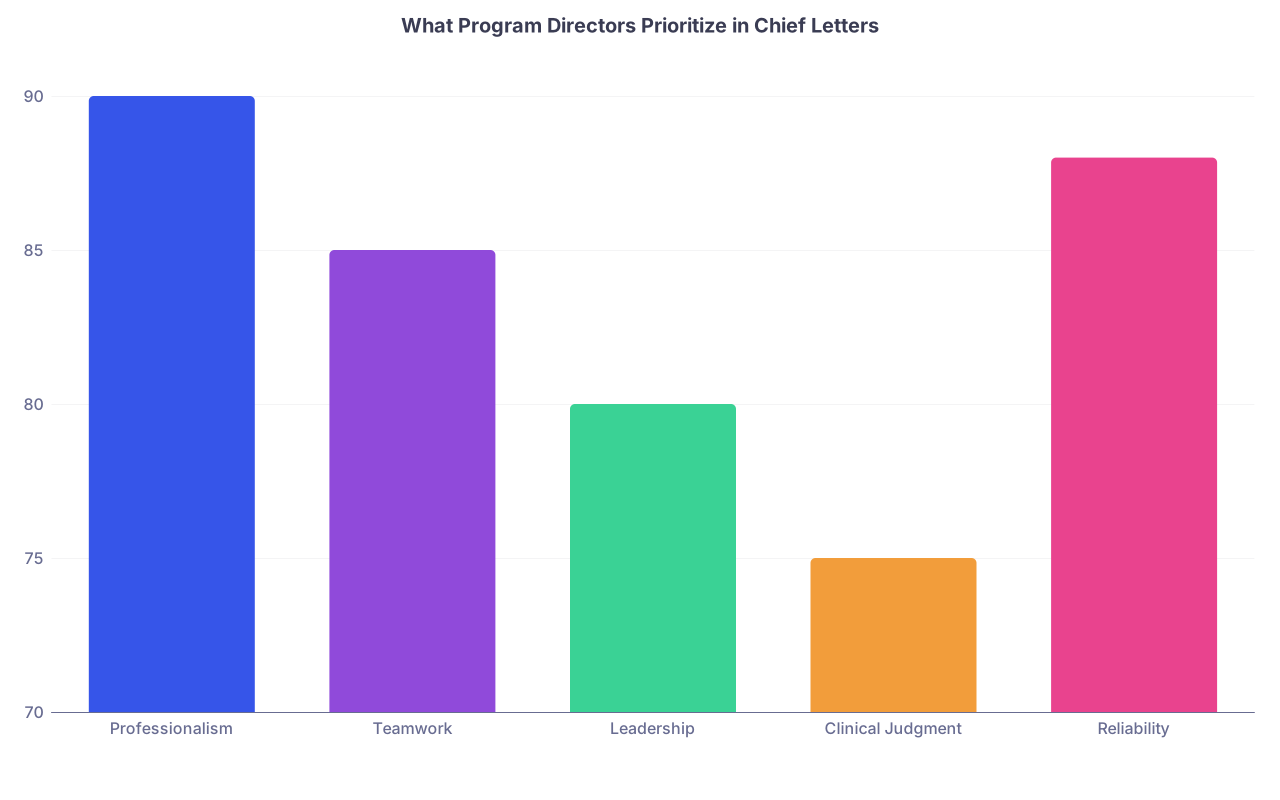
| Category | Value |
|---|---|
| Professionalism | 90 |
| Teamwork | 85 |
| Leadership | 80 |
| Clinical Judgment | 75 |
| Reliability | 88 |

| Step | Description |
|---|---|
| Step 1 | Need Chief Letter |
| Step 2 | Ask for letter |
| Step 3 | Consider different chief or faculty |
| Step 4 | Send CV and bullet points |
| Step 5 | Secure alternate strong writer |
| Step 6 | Follow up once before deadline |
| Step 7 | Which chief knows you best |

If You’re Applying Soon: What To Do This Week
Here’s how to move this from theory to action:
- Decide which chief actually knows you best—by observation, not by title.
- Email them a clear, respectful request with:
- Why you’re applying
- Why you value their perspective
- Your CV, personal statement, and concrete bullet points
- Ask early. Chiefs drown in these if all requests come two weeks before deadlines.
- If you get the sense they’re lukewarm or too busy, pivot. Better a strong attending letter than a half-hearted chief letter.

FAQ: Chief Letters of Recommendation
1. Is a chief letter required for fellowship?
Often? Yes. Officially required? Depends on the specialty and program. Many IM, EM, and surgery fellowships expect one resident leadership letter (chief or PD) because it covers professionalism, teamwork, and reliability better than most faculty letters.
2. Who should write my chief letter if there are multiple chiefs?
Pick the chief who’s seen you the most and can speak to you as a person, not just a name on a schedule. Someone who has watched you run teams, handle bad nights, deal with conflict, or lead something. Title (admin vs education vs VA chief) matters less than real familiarity.
3. My chief barely worked with me—should I still get a letter from them?
No. A generic “I know them from schedules and didactics” letter is almost useless. Better to get a program director letter or a senior faculty letter who’s seen you repeatedly, plus one strong chief letter from someone who actually knows you—even if they’re an associate chief or prior chief resident.
4. What if my performance improved a lot over residency—will a chief letter hurt me?
A good chief can frame that as growth, not damage. If they can say, “They had a rough start, here’s what they changed, and here’s where they are now,” that often helps you. If they can’t authentically endorse you even after improvement, you’re better off with a different writer.
5. How long should a strong chief letter be?
Usually 1.5–2 pages. Long enough to include 2–4 real examples and clear comparative language, short enough that a PD doesn’t hate you while reading it. A one-paragraph or single-page, generic letter screams “afterthought.”
Open your email right now and draft a short message to the chief who actually knows you best. Attach your CV and jot down 4–6 bullet points of real situations you handled. Hit send. That single step dramatically increases the odds that your chief letter ends up being the one PDs actually remember.


