
The way most residents “wing” fellowship applications is a guaranteed way to burn their lifestyle twice—during residency and after.
If you want a lifestyle-oriented subspecialty, you cannot treat the timeline casually. The laid‑back image of these fields hides the truth: the best lifestyle gigs go to the most organized applicants.
Below is a chronological, “at this point you should…” guide specifically for lifestyle-friendly fellowship paths: think outpatient-heavy, procedural-light or controlled, predictable call, and sane hours.
We’re talking tracks like:
- GI with mostly outpatient and ASC work (yes, it can be lifestyle if you choose right)
- Endocrinology
- Allergy/Immunology
- Rheumatology
- Sleep Medicine
- Palliative Care (in certain practice models)
- Non-invasive Cardiology (in some groups)
- Outpatient-focused Pulm or ID (less common, but exists)
Use this as your master timeline from late MS4 through submitting ERAS and interviewing.
Big Picture: Multi-Year Fellowship Timeline
You cannot start in PGY-3 and “fix” a weak file. By then, it’s mostly locked.
Here’s the high-level arc:
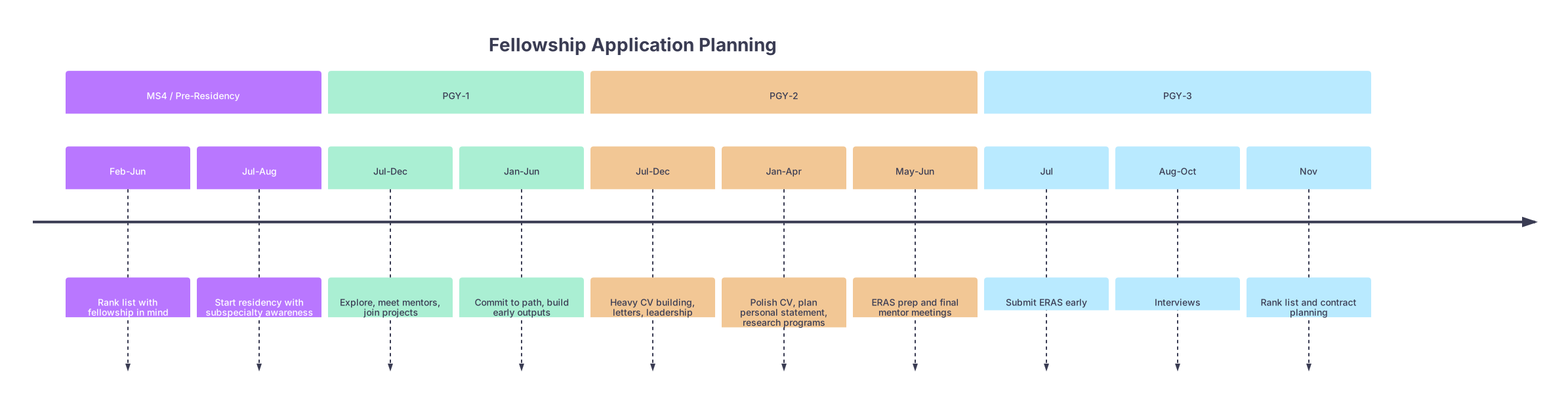
| Period | Event |
|---|---|
| MS4 / Pre-Residency - Feb-Jun | Rank list with fellowship in mind |
| MS4 / Pre-Residency - Jul-Aug | Start residency with subspecialty awareness |
| PGY-1 - Jul-Dec | Explore, meet mentors, join projects |
| PGY-1 - Jan-Jun | Commit to path, build early outputs |
| PGY-2 - Jul-Dec | Heavy CV building, letters, leadership |
| PGY-2 - Jan-Apr | Polish CV, plan personal statement, research programs |
| PGY-2 - May-Jun | ERAS prep and final mentor meetings |
| PGY-3 - Jul | Submit ERAS early |
| PGY-3 - Aug-Oct | Interviews |
| PGY-3 - Nov | Rank list and contract planning |
If your specialty applies later (e.g., some cardiology or heme/onc cycles), shift this one year, but the relative order stays the same.
MS4 – Early Residency: Setting Up the Lifestyle Win
MS4 Spring (Before Match Day)
At this point you should:
- Be brutally honest about what you actually want your life to look like.
- Use that to choose BOTH residency and likely fellowship path.
Concrete moves:
- When ranking residencies, give bonus points for:
- Strong outpatient subspecialty clinics (allergy, endo, rheum, sleep, palliative).
- Visible, approachable faculty in your target lifestyle fields.
- Program culture that doesn’t glorify malignant hours “for the love of the game.”
Red flag I’ve seen repeatedly: Residents who say “I want a chill lifestyle specialty” but match at the most research-heavy, malignant academic IM program in the region because of the name. Three years later, they’re exhausted and scrambling for letters from attendings who barely know them.
PGY-1: Exploration Without Wasting Time
Your intern year is not for hardcore fellowship polishing. But it is for not wasting social capital and opportunities.
PGY-1, July–September (First 3 Months)
At this point you should:
- Pay attention to which rotations fit your personality and energy.
- Start a list: “Possible lifestyle subspecialties for me.”
Actions:
- Notice:
- Do you enjoy chronic disease management and clinic continuity? (Endo, rheum, allergy)
- Do you like systems, ACP, family meetings? (Palliative)
- Do you like procedures but on your schedule? (GI in certain practice setups, sleep)
- Keep a running note on your phone of:
- Attendings you click with.
- Rotations that feel sustainable.
PGY-1, October–December
At this point you should:
- Start casual networking with potential mentors.
- Position yourself for one or two small, realistic projects.
What to do:
- Ask chiefs/seniors: “Who are the lifestyle-friendly attendings in endo/allergy/rheum/sleep/palliative who work well with residents?”
- Set up:
- 2–3 brief coffee chats or post-clinic check-ins with those attendings.
- The ask is simple: “I’m exploring subspecialties that are clinic-heavy and lifestyle-friendly. Can I sit in your clinic for a half day?”
- Get on one small project:
- Chart review, QI, or case report—anything that can yield a poster by early PGY-2.
- Do not sign up for a massive RCT unless you’re truly research-oriented; you need quick wins.
PGY-1, January–June
By now you should:
- Have narrowed to 1–2 realistic subspecialty targets.
- Be visible to at least one attending in each of those fields.
Tactical steps:
- Lock in relevant electives for early PGY-2:
- Endo clinic, allergy clinic, rheum, palliative consults, sleep lab, GI clinic, etc.
- Clarify the lifestyle reality:
- Ask attendings bluntly (after you’ve built some rapport):
- “What’s your weekly schedule actually like?”
- “What’s call like here vs community practice?”
- Ask attendings bluntly (after you’ve built some rapport):
- Aim to have by end of PGY-1:
- 1 project underway.
- 1–2 attendings who know your name and face.
- A working idea: “I’m likely going for X or Y.”
PGY-2: The Make-or-Break Fellowship Year
This is when your file gets built. Most of what PDs see on ERAS is decided here.
PGY-2, July–September: Visibility and Trust
At this point you should:
- Treat your lifestyle subspecialty electives like month-long interviews.
- Build “champions,” not just letter writers.
During each elective:
- Show up early. Be prepared. Help with annoying EMR tasks. It’s not glamorous, but attendings remember:
- “Who always had their notes done?”
- “Who called back that difficult patient without complaining?”
- Tell them clearly:
- “I’m strongly considering X as a fellowship because I like Y. I’d love feedback on how competitive I am and what I should focus on this year.”
Start a simple “wins” document:
- Keep track of:
- Cases you managed well.
- Compliments from patients or staff.
- Teaching you did for interns/med students.
- Any QI/research milestones.
That document will feed your future personal statement and LOR talking points.
PGY-2, October–December: CV and Letter Strategy
Now you should:
- Lock in your primary subspecialty choice.
- Strategically build toward 2–3 strong letters.
Target CV elements for lifestyle-friendly subspecialties:
| Fellowship Type | Top 3 Application Priorities |
|---|---|
| Allergy/Immunology | Outpatient eval skills, communication, research or QI in allergy/asthma |
| Endocrinology | Chronic disease management, continuity clinic, QI in diabetes/thyroid |
| Rheumatology | Diagnostic reasoning, longitudinal care, autoimmune exposure |
| Palliative Care | Communication, interprofessional teamwork, family meeting leadership |
| Sleep Medicine | Interest in physiology, outpatient clinic interest, some data/QI work |
Now your moves:
- Identify 3–4 likely letter writers:
- 1–2 from your chosen subspecialty.
- 1 from general IM or your core field (for credibility).
- Optional: a research mentor if they know you well as a worker, not just a name on a PDF.
- Have explicit conversations:
- “I’m planning to apply to [X] fellowship next year. My goal is to be a strong candidate for programs that value work–life balance and outpatient-heavy practice. What would you want to see on my CV over the next 6–9 months?”
Push at least one project toward completion:
- Aim for:
- Poster at a regional or national meeting (AAAAI, AACE, ACR, ATS, etc., depending on field).
- A QI project you can describe in interviews: process, outcome, your role.
PGY-2, January–April: Program Research and Narrative Building
At this point you should:
- Start mapping which fellowships actually support the lifestyle you want.
- Draft the story you’ll sell on ERAS.
Program research checklist:
- Use fellowship websites, alumni lists, and direct questions to answer:
- Where do their grads end up? (Academic, community, private practice?)
- Are there community/ambulatory-heavy tracks?
- Is there flexibility for part-time, job-sharing, or tailored schedules?
- Talk to:
- Current fellows: “How often are you here past 6 pm? What’s weekend call really like?”
- Recent graduates (if you can find them).
Build your narrative:
- Your pitch should sound like:
- “I’m drawn to [X] because I like long-term patient relationships, chronic disease management, and outpatient structure. I’ve built skills in [Y], and my career goal is [Z lifestyle-compatible practice model].”
- Note: PDs in lifestyle subspecialties usually like hearing explicit long-term goals. “I want a balanced, outpatient-focused practice” is not a sin; it’s aligned.
PGY-2, May–June: Pre‑ERAS Lock-In
By the end of PGY-2 you should:
- Have your CV essentially finished.
- Have your letter-writer lineup confirmed.
- Know your program list tiered by competitiveness and lifestyle fit.
Tactical moves:
- Update your CV completely:
- Education, training, leadership, teaching, QI, research, presentations.
- Send each letter writer:
- Updated CV.
- Short “brag sheet” with 4–6 bullet points:
- Specific patients or scenarios they saw you in.
- Projects you worked on together.
- Traits you hope they can highlight (clinical reasoning, reliability, communication).
- Ask clearly:
- “Do you feel you can write a strong, supportive letter for my application to [X] fellowship?”
Program list planning:
- Divide into:
- “Lifestyle-aligned academic” (e.g., strong outpatient tracks, palliative programs with protected time).
- “Lifestyle-heavy community” programs.
- “Name-brand, more intense but good training” as reach options.
You want a mix. Applying only to the chillest programs is how you end up unmatched.
PGY-3: Application, Interviews, and Ranking
Assuming a standard IM-based subspecialty cycle (adjust a year as needed for others).
PGY-3, July: ERAS Submission Month
At this point you should:
- Be finalizing, not starting, your application.
ERAS checklist:
- Personal statement:
- One primary statement for your subspecialty.
- Tone: grounded, specific, not melodramatic.
- Hit:
- Why this subspecialty.
- What you’ve done to explore it (specific electives, projects).
- Where you see yourself (e.g., “Outpatient-heavy community allergy practice with time for teaching”).
- CV/Experiences:
- Put QI and projects that show systems thinking and outpatient care near the top.
- Teaching and mentorship look very good for lifestyle fields that value communication.
- Letters:
- Confirm all are uploaded by late July.
Submit early:
- Do not wait for the “deadline.”
- Submitting in the first wave helps at many programs, especially smaller lifestyle-heavy ones that review as they go.
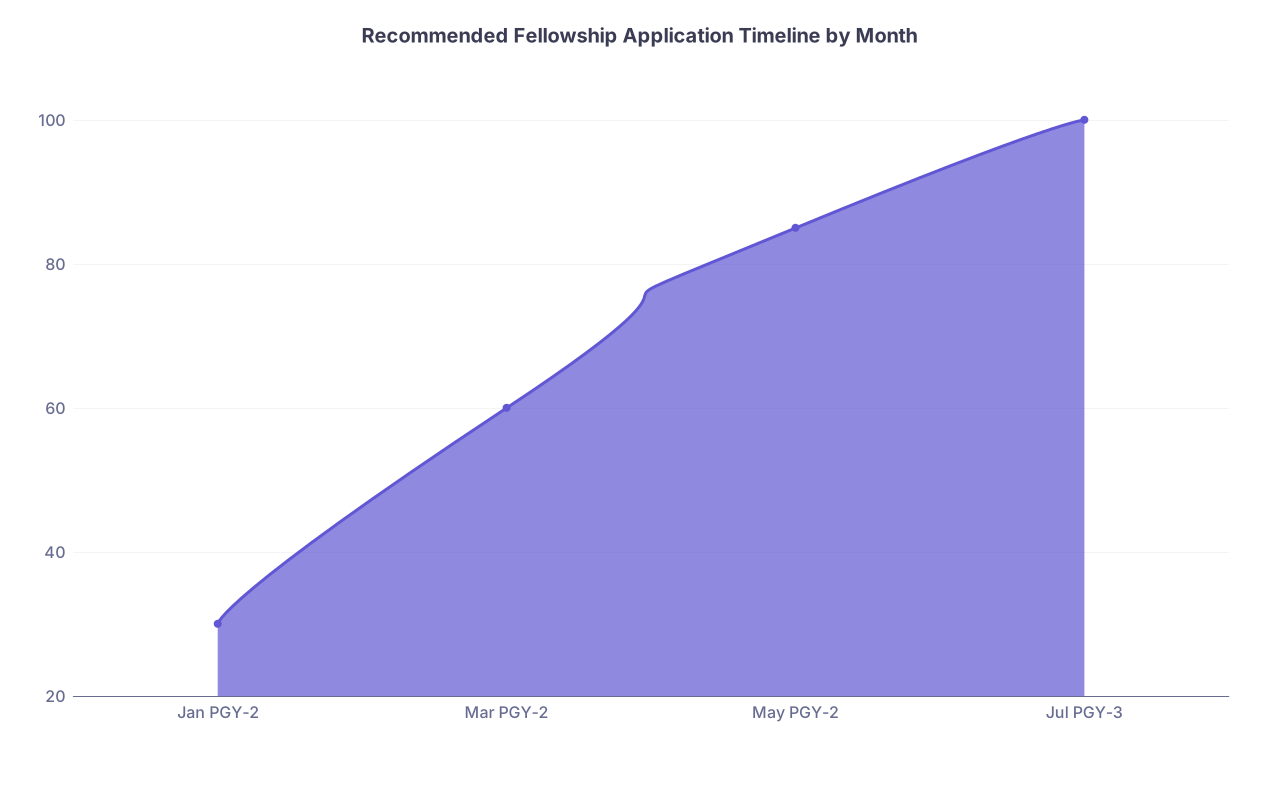
| Category | Value |
|---|---|
| Jan PGY-2 | 30 |
| Mar PGY-2 | 60 |
| May PGY-2 | 85 |
| Jul PGY-3 | 100 |
(Think of that as “percent application readiness.” You want to hit 85% by May, not July.)
PGY-3, August–October: Interview Season
Now you should:
- Protect your schedule as much as possible.
- Tailor your message to each program’s culture and lifestyle reality.
- Work with chiefs/PD early (late PGY-2/early PGY-3) to:
- Front-load heavier inpatient rotations.
- Keep some ambulatory/clinic months flexible during peak interview season.
- Put all potential interview dates into a tracking sheet so you’re not double-booking or burning weekends suppressing panic.
Interview prep for lifestyle subspecialties:
- You will be asked:
- “Why this field, not cardiology/critical care/oncology/etc.?”
- “What kind of practice do you see yourself in?”
- “What do you do outside of medicine?”
- Have examples that show:
- You’re reliable and competent.
- You understand the lifestyle realities (you’re not naïve).
- You have interests beyond work but don’t sound checked-out.
Program-specific research:
- Before each interview:
- Know at least 2–3 specific features:
- “I saw you have an embedded diabetes education team.”
- “I noticed your allergy clinic has a strong food allergy program; I’d want to be involved in that.”
- Be ready to ask:
- “How do you protect fellow well‑being here?”
- “What does a typical week look like in terms of clinics vs admin time?”
- Know at least 2–3 specific features:
PGY-3, November: Ranking and Job Reality
At this point you should:
- Rank based on your real life, not ego.
Ranking priorities if lifestyle actually matters:
- Higher priority to programs where:
- Fellows looked sane and not utterly destroyed.
- Faculty were approachable and realistic.
- Graduates have the jobs you want (outpatient-heavy, flexible).
- Lower priority to programs where:
- Fellows said things like, “You just grind for 2–3 years and then your life gets better. Maybe.”
- Call sounded vague or overbearing.
- They bristled when you mentioned lifestyle or work–life balance.
This is also the time to:
- Start watching the job market in your subspecialty:
- Check postings for allergy, rheum, endo, palliative, etc. in regions you’d consider.
- Notice patterns: many jobs are 100% outpatient, 4-day workweeks, or have flexible FTE. Those should guide your eventual practice expectations.
Quick Snapshot: When Key Tasks Should Be Done
| Time Point | What Should Be Done |
|---|---|
| End of PGY-1 | Subspecialty narrowed to 1–2 options, 1 project started |
| Fall of PGY-2 | Electives completed, 1–2 mentors identified |
| Winter of PGY-2 | Letter writers lined up, project nearing poster |
| Late Spring of PGY-2 | Program research, narrative clear, CV updated |
| July of PGY-3 | ERAS ready and submitted early |
FAQ (Exactly 3 Questions)
1. What if I decide on a lifestyle subspecialty “late,” like mid‑PGY-2?
You’re not doomed, but you lose margin. At that point you should:
- Immediately schedule a targeted elective in that field.
- Bust it on that rotation—show up early, ask for feedback, and let them know your plans.
- Get on one quick-turnaround project (case report, QI).
- Have frank talks with program leadership about your timeline and competitiveness.
You may need to apply a cycle later if your file is thin. That’s not a failure; that’s strategy.
2. Do lifestyle subspecialties still care about research?
Yes, but differently than heme/onc or cards. They want:
- Evidence you can complete what you start.
- Some engagement with the field (poster, QI, small study). You don’t need an R01 or 6 first-authors. A solid QI project and 1–2 posters is usually enough, especially if your clinical performance and letters are strong.
3. How many programs should I apply to for lifestyle-oriented fellowships?
Depends on competitiveness and your profile, but general ranges:
- Strong candidate at a solid program: 15–25.
- Average candidate or from smaller program: 25–35.
- Late decider or weaker application: 35+ with a wide geographic net.
Key point: do not only apply to a handful of “chill” city programs everyone wants. Mix in smaller, less flashy programs that actually deliver the lifestyle you’re aiming for.
Bottom line:
- Decide early what kind of life you want, then choose subspecialty and programs that match.
- PGY-2 is the make-or-break year—by the end of it, your file should basically be done.
- Apply and rank based on real fellow and graduate lifestyles, not reputation alone.