
The default advice that “more training always pays off” is wrong. The data show a lot of physicians quietly lose seven figures in lifetime earnings by doing the wrong fellowship for the wrong specialty.
You are not choosing “fellowship vs no fellowship” in a vacuum. You are choosing between different cash-flow curves, different ages at peak income, and very different lifestyles in your 30s and 40s. Let’s quantify it.
1. The core math: when fellowship actually pays
Strip away the emotion. Fellowship is a delayed-compensation decision.
In simple financial terms you are trading:
- Extra years at resident salary (say $70–80k)
- For later years at higher attending salary (say +$100–300k per year)
- Under heavy discounting (money now ≈ more valuable than the same money later)
Let me put rough but realistic numbers on the table. I will assume:
- Residency start age: 26
- Residency length: 3 years (FM, IM, peds) or 4 years (anesthesia, psych, EM)
- Fellowship length: 1–3 years
- Resident income: $75k / year
- Attending income (generalist lifestyle-friendly fields): $230–350k
- Subspecialist income in those same lanes: $280–500k
- Real discount rate: 3% per year (conservative)
- Career end age: 65
You can quibble with exact values, but the break-even patterns do not move much.
A quick earnings comparison: generalized model
Let us compare a 3-year residency with no fellowship vs. a 3-year residency plus 2-year fellowship.
Scenario A (No fellowship):
- Residency years 1–3: $75k
- Attending years 4–39 (36 years): $300k
Scenario B (Fellowship, +2 years):
- Residency years 1–5: $75k
- Attending years 6–39 (34 years): $400k
Undiscounted lifetime gross:
Scenario A:
3 * 75k + 36 * 300k = 225k + 10.8M = 11.025MScenario B:
5 * 75k + 34 * 400k = 375k + 13.6M = 13.975M
On paper, fellowship “wins” by about $2.95M gross. That is the kind of naive math people throw around on forums.
Now adjust for time value. Very roughly, starting 2 years earlier at attending income level is like giving yourself a 6–8% boost to lifetime present value. Once you discount future dollars, the gap shrinks.
More importantly: that math totally collapses if the fellowship premium is small (say +$50–80k) or the fellowship is 3 years long.
So the right question is not “fellowship vs no fellowship.” The right questions are:
- What is the realistic after-tax income premium for this specific fellowship in this specialty?
- How many additional years of training am I adding?
- How much earlier could I hit attending-level lifestyle and start serious investing or debt paydown?
Let us get specific and specialty-focused.
2. Lifestyle-friendly specialties: where fellowship changes the game
I am going to focus on specialties generally considered “lifestyle friendly”:
- Dermatology
- Radiology
- Anesthesiology
- Psychiatry
- Emergency Medicine
- Allergy & Immunology
- PM&R
- Some outpatient-focused IM/Fam Med tracks
For each, the question is: Does fellowship add enough income or lifestyle boost to justify extra years?
| Specialty | Typical Residency | Common Fellowship Length | Approx Generalist Income | Approx Subspecialist Income |
|---|---|---|---|---|
| Dermatology | 4 years | 1 year (cosmetic/proced.) | $350–450k | $450–800k+ |
| Radiology | 4 years | 1 year | $400–450k | $450–600k |
| Anesthesiology | 4 years | 1 year | $350–420k | $400–550k |
| Psychiatry | 4 years | 1–2 years | $260–320k | $300–400k |
| Emergency Med | 3–4 years | 1–2 years | $300–400k | $320–450k |
These are market-level ballparks, not academic salaries. Big-city academic jobs will run lower with different lifestyle tradeoffs.
3. Dermatology: fellowship is often a pure lifestyle and leverage play
Derm is an outlier in every direction: short hours, high pay, and ridiculous private practice leverage.
No fellowship derm
- Training: 4 years (after prelim)
- Income: $350–450k in many markets; private practice partners can push $500–700k with strong cosmetic volume
- Lifestyle: 4–4.5 day weeks, low call, very few emergencies
Derm with cosmetic / Mohs / procedural fellowship (1 year)
- Training: 5 years total
- Income ranges:
- Academic Mohs: maybe $350–450k, heavy case mix, less cosmetic
- Private Mohs + cosmetics: $600k+ is absolutely realistic in the right markets
- Pure cosmetic / aesthetic focus: earnings driven by business skills more than fellowship title
Here the math often strongly favors doing procedural training if your goal is income expansion.
Assume:
- General derm: $380k
- Mohs / procedural: $550k
- Extra training: 1 year at $75k
Undiscounted 35-year career post-residency:
- General: 35 * 380k = 13.3M
- Mohs: 34 * 550k + 4*75k (during residency) = 18.7M + 300k = ~19.0M
Difference ≈ $5.7M gross. Even with aggressive discounting, the net present advantage is massive.
Lifestyle hit? Mild. You trade a bit of OR time and sometimes more complex cases versus more clinic flexibility and often better control over your schedule once you are established. For derm, fellowship is one of the rare cases where money and lifestyle can both go up.
4. Radiology: fellowship is almost the default, but does it move lifestyle?
In radiology, the data show a very high proportion of residents do at least one fellowship—neuroradiology, MSK, IR, breast, etc. In many markets you are basically “expected” to have fellowship for competitive jobs.
General diagnostic radiology (no fellowship)
- Training: 5 years (1 prelim + 4 DR)
- Income: $400–450k general
- Lifestyle: High; shift-based work, telerad options, nights/weekends often distributed
Radiology with fellowship (1 year)
- Training: 6 years total
- Income: Subspecialty DR (neuro, MSK, body): $450–550k
- IR: more procedural, call-heavy, $500–700k+ in some private groups, but lifestyle strain higher
In practice:
- For straight diagnostic subspecialties, fellowship may add $50–100k and better job security in your niche.
- For IR, income jumps can be large but lifestyle is measurably worse: more call, procedures, emergent cases.
Over a 30+ year horizon, a $75k–100k annual premium can justify one year of extra training financially. But the real value of fellowship in radiology is labor market positioning—getting into the higher-paying, partner-track groups or flexible telerad arrangements you want.
From a pure lifestyle view:
- General DR, no fellowship: arguably the most lifestyle-friendly.
- Fellowship DR (except maybe breast) tends not to improve lifestyle; it mostly improves job selection and income slightly.
5. Anesthesiology: generalist vs pain / ICU
Anesthesia is one of the most flexible specialties for lifestyle. It can be a cushy 7–3 OR job. It can be brutal call-heavy cardiac. Or it can be an outpatient pain practice.
General anesthesiology (no fellowship)
- Training: 4 years
- Income: $350–420k typical W2; partnership tracks can exceed $500k
- Lifestyle: OR schedules, variable call; plenty of high-lifestyle private practice groups exist
Pain fellowship (1 year)
- Training: 5 years total
- Income: $450–600k+ depending on procedure mix and ownership
- Lifestyle: Clinic-based, fewer nights/weekends. But business and regulatory headaches (opioids, procedures, payors).
Critical care, cardiac, peds fellowships (1 year)
- Income: maybe +$20–80k vs general in many environments
- Lifestyle: usually worse than general; more nights, sicker patients, more stress.
Financially:
- Pain fellowship is often clearly accretive. 1 fellowship year for +$100–200k/year over 30 years is a straightforward win.
- ICU/cardiac/peds are often neutral or net-negative in lifestyle terms, and only modestly positive (if at all) on earnings. Many people do them for interest, not for pay.
So from a “lifestyle-friendly specialties” lens: if you want maximum free time and flexibility, general anesthesia or pain with a controlled, outpatient-heavy setup both work. ICU/cardiac fellowships almost never improve lifestyle.
6. Psychiatry: the most under-analyzed fellowship decision
Psych is a quiet lifestyle monster. Demand is off the charts. Telepsychiatry, cash-pay options, and low overhead all change the equation.
General adult psychiatry (no fellowship)
- Training: 4 years
- Income: $260–320k W2; $350k+ easily achievable with outpatient, telepsych, or cash-pay models
- Lifestyle: Often 4-day weeks, low acuity, minimal call
Common fellowships: child & adolescent, addiction, consult-liaison, forensics (1–2 years)
Income data are more variable than people admit.
- Child & adolescent psychiatry: sometimes +$20–70k depending on region (peds populations, underserved demand)
- Addiction: can add value, but many addiction-focused practices build on general psych without fellowship, compensated by volume and demand
- Forensic: extremely niche, can be very high hourly, but work is irregular
The critical reality: general adult psych has such insane demand that many psychiatrists self-create “subspecialty” practices just by market choice, not credential.
So the math:
- 2 extra years of child fellowship for an extra $30–50k/year over 30-year career is break-even at best once you discount.
- But if you strongly prefer working with kids, or want academic/leadership roles, the non-financial utility may dominate.
From a lifestyle standpoint, most psych fellowships do not dramatically worsen lifestyle. They shift your case mix. The risk is overtraining for a job market that is already wide open for generalists.
7. Emergency Medicine: fellowships rarely rescue lifestyle
Emergency medicine used to be the “work 12 shifts a month and ski” specialty. The data are changing.
- Shift intensity is high.
- Burnout rates are among the worst in medicine.
- Night/weekend work never goes away.
- Market saturation and corporate groups are pressuring compensation.
EM without fellowship
- Training: 3–4 years
- Income: $300–400k depending on region, acuity, employer model
- Lifestyle: High flexibility, but circadian punishment. Lifestyle friendliness decays with age.
EM fellowships: critical care, ultrasound, admin, peds EM, sports, etc. (Usually 1–2 years)
These fellowships often:
- Add modest income or none at all
- Shift job type (academic, ICU, admin roles)
- Do not meaningfully reduce nights/weekends for many physicians
For example, EM–critical care:
- Training: +2 years
- Income: often similar or slightly higher than EM alone, but with ICU-level stress and still plenty of nights
- Lifestyle: different flavor of hard
For a lifestyle-first physician, EM fellowship rarely makes things better financially or in lived experience. The best “fellowship” in EM is often developing non-clinical revenue streams (admin, informatics, telehealth leadership) rather than formal training.
8. The big blind spot: investing horizon and compounding
Most residents underestimate one silent variable: starting serious investing early.
Two or three extra years as an attending at even “only” $250–300k, with high savings rate, can create a substantial compounding advantage.
Let us compare:
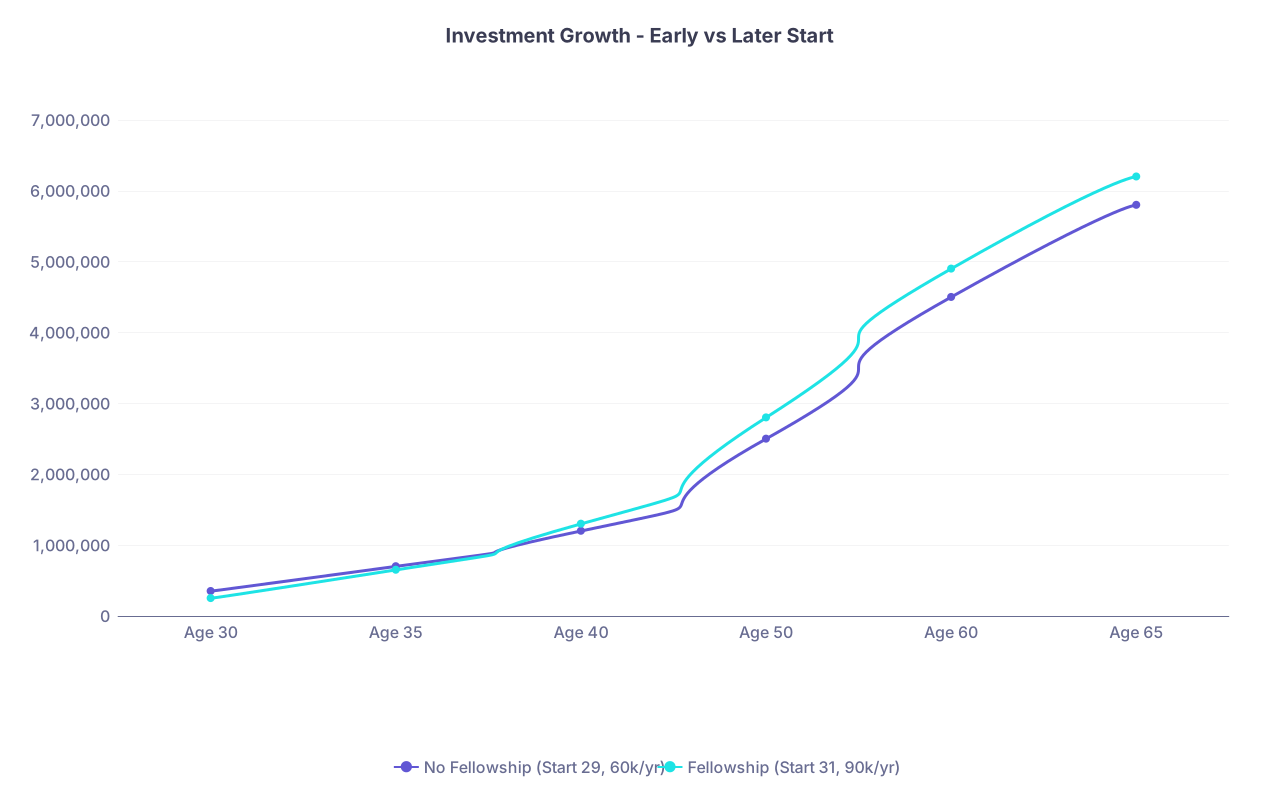
- Path 1: No fellowship; start attending at 29, invest $60k/year from 29–65
- Path 2: 2-year fellowship; start attending at 31, invest $90k/year from 31–65
Assume 5% real return.
| Category | No Fellowship (Start 29, 60k/yr) | Fellowship (Start 31, 90k/yr) |
|---|---|---|
| Age 30 | 350000 | 250000 |
| Age 35 | 700000 | 650000 |
| Age 40 | 1200000 | 1300000 |
| Age 50 | 2500000 | 2800000 |
| Age 60 | 4500000 | 4900000 |
| Age 65 | 5800000 | 6200000 |
Roughly:
- The fellow eventually catches up and slightly surpasses in net worth, assuming strict discipline and a large enough income bump.
- But if the real fellowship premium is only +$40–50k, that advantage vanishes.
Key point: the more “lifestyle” and lower-paying your subspecialty relative to the core field, the harder it is for fellowship to justify lost early-investing years.
9. Lifestyle: schedule, autonomy, and energy at different ages
Pure income does not capture why people call some specialties “lifestyle friendly.” The data that matter:
- Nights / weekends per month
- Control over clinic schedule
- Ability to cut FTE (0.8, 0.6) without career penalty
- Cognitive vs physical fatigue curves in your 40s and 50s
Fellowship can:
- Increase control and niche leverage (derm procedures, pain, telerad neuro/MSK)
- Or trap you in high-acuity, high-stress niches (ICU, EM–CC, IR) that age poorly
Here is a rough qualitative comparison:
| Base Specialty | No Fellowship Lifestyle | Common Fellowship Effect |
|---|---|---|
| Dermatology | Already excellent | Often improves income and autonomy; lifestyle similar or better |
| Radiology | Very good | Income boost; lifestyle similar or slightly worse (IR) |
| Anesthesia | Good, variable call | Pain can improve schedule; ICU/cardiac often worsen lifestyle |
| Psychiatry | Very good, flexible | Case mix change; lifestyle usually similar |
| Emergency Med | Flexible but harsh hours | Often neutral or worse; little rescue of nights/weekends |
So if your priority is truly “lifestyle-friendly,” fellowships that increase clinic-based, daylight work with high leverage (derm-procedural, pain, selected radiology niches) make sense. Fellowships that increase nights, ICU time, or procedural emergencies are lifestyle-negative, regardless of pay.
10. Decision framework: when fellowship is clearly good, clearly bad, or a toss-up
You can reduce this to a simple rule set.
Fellowship is usually a good financial and lifestyle bet when:
- Fellowship adds ≥ $100k/year on realistic, not aspirational, numbers
- Extra training is 1 year (occasionally 2 if premium is very high)
- Lifestyle is equal or better (more clinic days, fewer nights, more autonomy)
- The subspecialty has robust demand and non-academic job options
- Examples:
- Derm Mohs/procedural in private settings
- Anesthesia–pain with outpatient/interventional focus
- High-demand radiology subspecialties in private practice
Fellowship is usually a bad bet (financially or lifestyle-wise) when:
- Annual income premium is ≤ $50–60k
- Extra training is 2+ years for only modest pay bump
- Lifestyle is clearly worse (more nights, ICU, emergent procedures)
- The job market is narrow and academic-heavy
- Examples:
- Many EM fellowships if your core goal is lifestyle
- Some psych fellowships if general psych practice would already give you a tailored case mix
- IM → low-paying niches when hospitalists/outpatient IM can already hit high $200ks–$300ks with flexible schedules
Toss-up / personal-utility dominated
- You love a specific patient population or disease area enough that mild financial loss is acceptable.
- You want academic/leadership roles that essentially require fellowship (child psych directors, derm academic leadership, ICU chiefs).
This is where lifestyle becomes subjective utility, not just hours and dollars.
11. A quick process map: how to decide for yourself

| Step | Description |
|---|---|
| Step 1 | Identify Base Specialty |
| Step 2 | Estimate Generalist Income and Lifestyle |
| Step 3 | Identify Target Fellowship |
| Step 4 | Estimate Subspecialist Income and Lifestyle |
| Step 5 | Likely Financially Worthwhile |
| Step 6 | Do Fellowship for Interest or Role |
| Step 7 | Skip Fellowship |
| Step 8 | Income Premium >= 100k and Lifestyle not worse |
| Step 9 | Non Financial Motives Strong |
Do that honestly with real local numbers, not generic Medscape tables. Actual offers in your region can differ by $100k+ from national medians.
12. The bottom line for “most lifestyle friendly specialties”
For truly lifestyle-friendly careers—derm, psych, radiology, anesthesia, some outpatient-heavy IM/FM—the data say:
- You often do not need fellowship to have excellent lifestyle and strong earnings. The base specialties already deliver.
- The fellowships that really pay (derm-procedural, pain, some rads) usually:
- Are 1 year
- Offer a clear six-figure annual premium in many settings
- Either keep lifestyle stable or improve autonomy
- The fellowships that “sound prestigious” but undermine schedule and add little income are where people quietly burn 2+ prime years and reduce lifetime flexibility.
Fellowship vs no fellowship is not a moral or prestige question. It is a discounted cash flow, lifestyle, and autonomy question. Run the numbers honestly, then ask if you actually want the day-to-day life of that subspecialist at age 45.

FAQs
1. Does doing a fellowship always increase lifetime earnings?
No. The data show that if your income premium is small (≤ $50–60k/year) and the fellowship is 2 or more years, the lost early attending years and delayed investing can erase or even reverse the financial benefit. This is common in some psych and EM fellowships and in certain internal medicine subspecialties with lower pay.
2. For lifestyle-friendly specialties, which fellowships are most financially attractive?
The consistently high-yield ones are procedural derm (Mohs, cosmetic-heavy practices), pain management after anesthesia, and certain radiology subspecialties that command higher private practice compensation. These typically add one extra year of training with a realistic six-figure income bump and strong market demand.
3. How much should lifestyle vs income matter in deciding on fellowship?
If you are already in a high-lifestyle base specialty (derm, psych, general rads, anesthesia in a good group), lifestyle should matter a lot. You are starting from a good baseline. A fellowship that marginally improves pay but clearly worsens schedule, call, or stress is usually a poor trade. If you are naturally low-spend and value time over money, leaning away from lifestyle-negative fellowships is rational.
4. What is the biggest financial mistake residents make about fellowships?
They overestimate the income premium based on outlier stories, underestimate the impact of 1–3 “lost” attending years, and ignore taxes and burnout. They look at gross salary differences and forget that starting to invest and pay debt down at 29 instead of 32 can quietly shift their net worth trajectory by seven figures over a full career—especially in already well-compensated lifestyle specialties.