
Is Locum Tenens Worth It if You Want Geographic Stability?
What if you actually like where you live, want your kids in the same schools, and still keep hearing people say, “You should really look into locums — the money is insane”?
Let me be blunt: locum tenens and geographic stability are not mutually exclusive. But they are absolutely in tension. You have to be strategic or you’ll end up on a plane every week wondering how you got tricked into being a “travel doc” when you just wanted a higher hourly rate.
Here’s the real answer you’re looking for.
The Core Question: Can Locums and Stability Coexist?
Yes, locum tenens can be compatible with geographic stability — if you structure it right and accept a few tradeoffs.
Locums is not one thing. There are at least four very different flavors:
- Classic “travel locums”: hopping states, short blocks, flights and hotels
- Local/regional locums: driving distance, repeat sites, long-term
- Hybrid: part-time W-2 job + part-time local locums
- “Try before you buy”: locums used to test markets before settling
If what you care about is staying rooted — same home base, same city or at least same region — you’re basically looking at options 2–4.
So the real question becomes:
Is the upside of locums (money, schedule control, less politics) worth the tradeoffs (less job security, benefits, ramp-up time) when you mostly want to stay put?
For a lot of physicians, especially post-residency, the answer is yes — but only if you’re realistic about:
- How competitive your local market is
- Your specialty
- Your actual risk tolerance and family situation
Let’s go piece by piece.
What “Geographic Stability” Actually Means in Practice
You need to define what stability means for you, not what someone on a forum says.
For most physicians, it’s one (or a mix) of these:
- Same city long-term (no big moves)
- Same house and school district for years
- No weekly flights or constant hotel living
- Predictable enough schedule that your partner can plan their own career and childcare
Locum tenens threatens that when you:
- Chase the highest-pay gigs nationwide
- Take very short assignments (1–2 weeks here and there)
- Let agencies push you toward “just one assignment out of state” every month
If you want real geographic stability, you should be thinking in this direction:
- Driveable jobs only (your own bed most nights)
- Longer assignments (3–12 months) at repeatable sites
- Possibly multiple local clients so you’re not hostage to one hospital’s census
So you’re not actually asking “Locums or stability?” — you’re asking “Can I build a local locums career that doesn’t wreck my home life?”
Short answer: yes, in many markets. Not all.
When Locum Tenens Works Well for Stability
Here’s where locums tends to pair nicely with geographic stability.
1. Your city or region is a known shortage area
If you’re in or near:
- Rural Midwest
- Many parts of the South
- Certain Western states with only a few large health systems
…locum companies and hospitals are constantly looking for people who can drive in and cover ongoing needs. They’d love someone stable and nearby.
You can often negotiate:
- Recurring blocks (e.g., 7 on / 7 off, every month)
- Long-term commitments (6–12 months renewable)
- Premium pay compared to local employed gigs
This can end up feeling almost like a staff job — same place, same team — just on a 1099 with better hourly money and less administrative leash.
2. You’re in a locums-friendly specialty
Some specialties are tailor-made for local or regional locums:
| Specialty | Local Stability Potential | Notes |
|---|---|---|
| Hospitalist | Excellent | Block schedules, repeatable |
| Anesthesiology | Excellent | OR coverage, predictable |
| EM | Good | Shifts, flexible sites |
| Psychiatry | Excellent | Telehealth + local clinics |
| Radiology | Excellent | Remote + on-site options |
If you’re in one of these, you can realistically:
- Anchor yourself in one home base
- Work at 1–3 hospitals or groups within a 1–2 hour radius
- Negotiate higher rates with less desperate travel
3. You want control, not just more money
Locums gives you:
- The ability to say “no” to bad schedules
- The freedom to take whole months off
- Less entanglement in hospital politics, committees, and unpaid admin
For someone trying to stabilize their life — kids, elderly parents nearby, spouse’s career — having that schedule control often matters more than squeezing an extra $30/hour.
You can live in one metro area, cobble together:
- 10–12 shifts a month at one hospital
- 3–4 shifts at another
- Block time at an ASC
…all within driving distance. No flights. Minimal hotel nights.
When Locums is a Bad Fit If You Want to Stay Put
Now the other side. Here’s when I tell people flat out: pure locums is probably going to fight your desire for stability.
1. You live in a saturated urban market
Think: Boston, San Diego, Seattle-proper, Manhattan.
If jobs are already competitive and colleagues are fighting for decent employed positions, you’re not going to find a dozen cushy, high-paying local locums gigs just lying around.
What usually happens:
- Most locums opportunities are 2–4 hours away or in other states
- Local per-diem roles may pay less than travel locums
- Agencies push you toward “best money is in X state, just travel”
If you’re dead set on never leaving your metro area, you may end up making less with more uncertainty than just taking a solid employed job.
2. You want full-time equivalent income from day 1
Locums income is lumpy.
Look at a realistic year for someone trying to stay local:
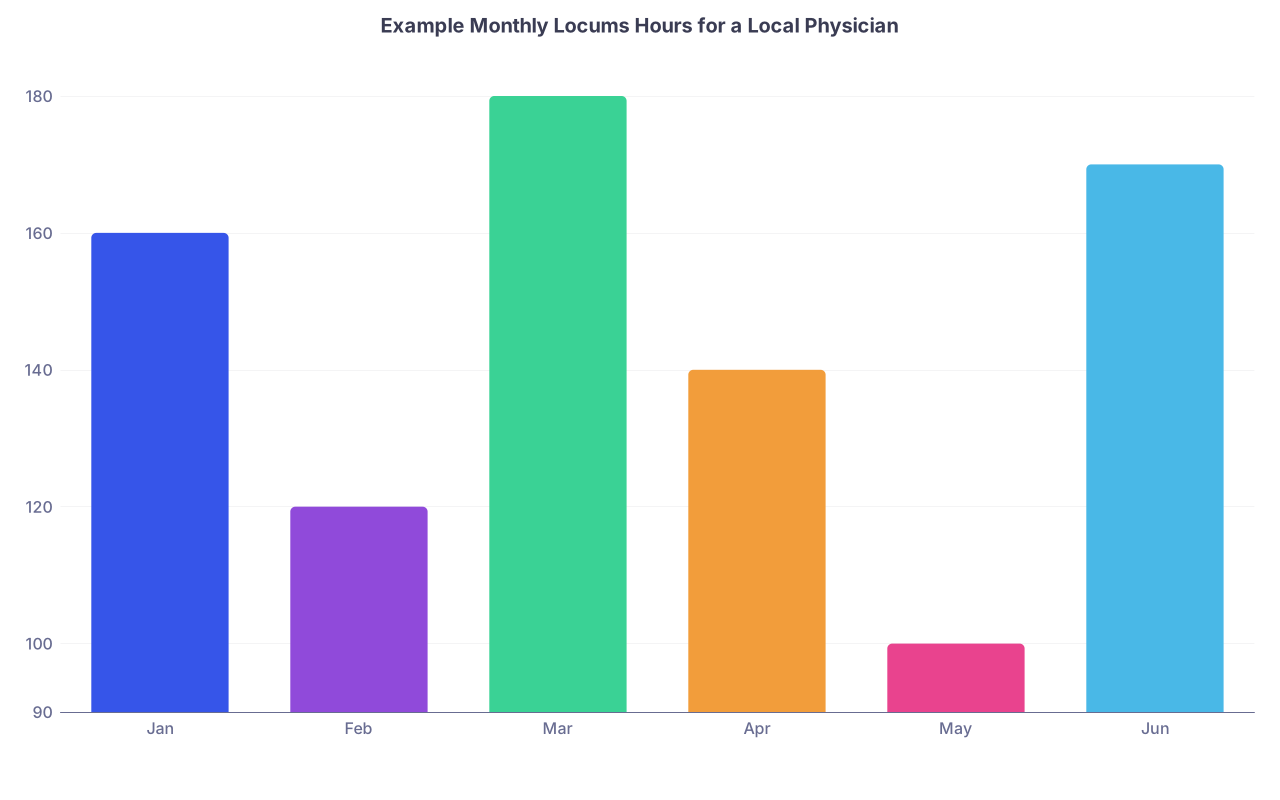
| Category | Value |
|---|---|
| Jan | 160 |
| Feb | 120 |
| Mar | 180 |
| Apr | 140 |
| May | 100 |
| Jun | 170 |
You’ll have months where a hospital is desperate and throws you all the shifts. Then census drops or they hire a full-timer and your hours vanish.
If:
- You’re the sole breadwinner
- You just bought an expensive house
- You absolutely need consistent 1.0 FTE paychecks
…then a hybrid setup (W-2 core job + local 1099 side locums) is usually safer than going 100% locums while staying in one area.
3. Benefits and retirement matter a lot to you
Locums is 1099. Which means:
- No employer-sponsored health insurance
- No 401(k) match
- You handle malpractice (often covered per assignment, but not always tail)
- You manage taxes, quarterly payments, and potentially an S-corp
You can absolutely build a great benefits package on your own — I’ve seen independent physicians max solo 401(k)s, SEP-IRAs, HSAs, etc. But it requires initiative and planning.
If you crave the simplicity and security of a single employer handling all that, locums may feel like constant administrative noise.
A Practical Decision Framework: Is Local Locums Worth It For You?
Here’s how I’d walk through this with you in clinic if you asked between patients.
Step 1: Define your non-negotiables
Write down, clearly:
- Max travel radius from home (e.g., 90 minutes driving, no flights)
- Max nights per month you’re okay being away from home
- Minimum annual income you actually need, not “want”
- How much schedule control you want compared to now
If your answers are:
- “No more than 30 minutes from home”
- “Need $450K minimum”
- “I want 3–4 guaranteed days off each week”
…then 100% locums may not hit all three in many markets. You might need a hybrid model.
Step 2: Test your local market reality
Call agencies and also bypass them:
- Talk to 2–3 locum agencies and ask specifically:
“What ongoing needs do you have within X miles of ZIP code Y?” - Call local hospitals and groups directly to ask about:
- Per-diem
- PRN
- Short-term coverage
- “Locums-to-perm” options
You’re looking for patterns:
- Are there 2–3 hospitals that always seem short-staffed?
- Are they within your driving radius?
- Are they open to longer-term commitments?
If all the “good” offers are on airplanes, you have your answer.
Step 3: Compare realistic numbers to a local employed gig
Don’t just look at the hourly rate. Make a side-by-side.
| Factor | Employed Job | Local Locums Setup |
|---|---|---|
| Pay (annual) | $300K | $350K–$450K (variable) |
| Benefits | Strong, turnkey | DIY, tax-advantaged |
| Schedule control | Moderate | High (if enough sites) |
| Travel | Minimal | Short drives, rare hotels |
| Job security | High | Medium (dependent on demand) |
Once you see this side by side with real quotes from your area, the right direction usually becomes obvious.
Smart Ways to Use Locums Without Losing Stability
Let’s get tactical. Here are concrete models that work well for physicians who want one home base.
Model 1: Hybrid W-2 + Local 1099
You:
- Take a 0.6–0.8 FTE employed job in your city
- Fill in extra income with 3–6 local locums shifts per month
Upsides:
- Baseline benefits and steady income
- You test locums without betting your entire life on it
- You build local relationships for future full locums if you ever want it
This is especially good in the first 2–3 years post-residency when you’re still figuring out what you actually want.
Model 2: Regional Block Locums from a Home Base
You live, for example, in a mid-sized city. Within 2–3 hours’ drive there are:
- Two rural hospitals
- One community hospital in a smaller city
- An ASC or two
You:
- Take 7-on/7-off blocks at one site for 6 months
- Fill some off-weeks with occasional shifts at the other sites
- Arrange housing for blocks, but drive home for off days
You’re technically away some nights, but your home base never changes, and you know your schedule months ahead.
This is extremely common for hospitalists and anesthesiologists.
Model 3: Locums-to-Perm in One City
This is the “try before you buy” strategy.

| Step | Description |
|---|---|
| Step 1 | Start Residency Graduation |
| Step 2 | Short Term Locums in Target City |
| Step 3 | 3 to 6 Months Evaluation |
| Step 4 | Negotiate Permanent Role |
| Step 5 | Try Different Local Group |
| Step 6 | Long Term Stability |
| Step 7 | Good Fit |
You:
- Pick the city or metro where you want to settle
- Work locums at 1–3 practices there over 6–12 months
- Actually see how the staff, leadership, and workload feel
- Then convert to a permanent role at the best of the bunch (or stay locums if it’s truly better)
This gives you geographic stability and protects you from signing a 3-year contract with a group you’ve never actually worked inside.
Common Myths That Confuse This Decision
Let me clear up a few bad takes I see constantly.
“Locums is only for people who want to travel constantly”
Wrong. That’s just the most visible version.
I’ve known physicians who:
- Have not gotten on a plane for work in five years
- Work exclusively in a 90-minute radius
- Earn more than their staff colleagues and sleep in their own bed most nights
The “travel warrior” is optional, not required.
“You can’t have stability on 1099 income”
Also wrong. You can’t have stability if you treat 1099 like free play money and never plan.
Plenty of full-time partners in private practice are effectively 1099 in spirit: variable income, no hard guarantee, high upside. They manage.
With locums, if you:
- Keep a 3–6 month cash buffer
- Maintain 2–3 active client hospitals
- Stay in a moderate-need region
…you can have very predictable income. Just not as automated as a staff job.
“Locums is only good early career”
It’s often easier early career (fewer roots, more mobility). But local locums models actually work extremely well mid-career when:
- Kids are in school
- You value your time more than your title
- You’re sick of hospital politics
Some of the happiest 45–55-year-old physicians I’ve met were doing exactly this: local/regional locums with strict rules about travel.
A Quick Reality Check: Who Should Absolutely Not Go Full Locums for Stability?
If any of these are you, go slower:
- You’re extremely anxious about income dips
- Your partner is already job-unstable or underemployed
- You’re in a hyper-saturated metro and refuse to drive farther than 20 minutes
- You want employer-funded retirement and ironclad benefits with minimal effort
For you, locums is a side tool or a short experimental phase, not the main strategy.
Visual Snapshot: Is Locums Worth It for Stability?

| Category | Value |
|---|---|
| Strong regional demand | 90 |
| Flexible family situation | 70 |
| Locums-friendly specialty | 85 |
| Tolerance for income variability | 60 |
| Low need for traditional benefits | 55 |
If you score high on at least three of those factors, exploring local/regional locums is very likely worth your time.
Key Takeaways
- Locum tenens can align with geographic stability if you focus on local/regional, longer-term assignments and avoid chasing every high-paying gig on a plane.
- The decision comes down to your local market, specialty, income needs, and risk tolerance — for many physicians, a hybrid model (part W-2, part local locums) hits the sweet spot.
- Do not guess. Talk to agencies and local hospitals, map your realistic options, then compare them line-by-line to an employed job in the same area.
FAQ (Exactly 5 Questions)
1. Can I do locum tenens and never get on a plane?
Yes. You can structure a “drive-only” locums practice. Many physicians do this by limiting themselves to a 1–3 hour driving radius and working with 2–3 repeat hospitals. You might occasionally stay in a hotel during block weeks, but you don’t have to fly if you make that a hard boundary up front.
2. Is local locums pay still better than a permanent job?
Usually, yes, on an hourly basis. But you must subtract the value of lost benefits (health insurance, retirement match, paid time off) and factor in gaps between assignments. When you run the math honestly, you’ll often still come out ahead, but not as dramatically as agency reps promise.
3. How long do local locums assignments typically last?
For geographically stable setups, the best scenarios are 3–12 month recurring contracts, often with specific blocks (e.g., one week a month, or fixed days each week). Shorter “just a weekend” gigs exist, but they’re not reliable enough to build a stable lifestyle unless you already have a core income elsewhere.
4. What contract red flags should I watch for if I want stability?
Big ones: vague schedule commitments (“as needed”), non-competes that block you from working at nearby hospitals, unclear malpractice tail coverage, and cancellation clauses that let the facility cut your shifts with almost no notice. If you care about stability, you want clear minimum hours and reasonable cancellation terms.
5. Is it smart to start with locums right after residency if I want to settle in one city?
It can be, if you use it intentionally. A 6–12 month period of local locums in your target city is an excellent way to sample different groups before you sign a long-term contract. Just avoid the trap of chasing random high-paying travel gigs during that time if your real goal is to build a life in one place.