
The usual visa advice for doctors completely breaks when you start doing locums.
If you’re a non‑US citizen thinking, “I’ll just do locum tenens for flexibility,” and you do not understand how your visa constrains that, you can absolutely blow up your status, your income, and your path to a green card.
Let me walk you through what actually happens when visas collide with locums—and what to do if you’re already in deep.
1. The brutal truth: most visas and locums do not mix
Locums is built on flexibility. US immigration is built on rigidity. Those two don’t like each other.
Here’s the basic tension:
- Locum work = multiple sites, changing schedules, gaps between assignments, often 1099 independent contractor.
- US physician visas (H‑1B, J‑1, O‑1, TN, E‑2) = employer‑specific, location‑specific, strict rules on who you can work for and how.
So you have to start with one question, not “Do I want to do locums?” but:
“On my current or anticipated status, are locums even legally possible, and in what form?”
Let’s set the playing field.
| Status | Can Do True Multi-Site Locums? | Typical Path |
|---|---|---|
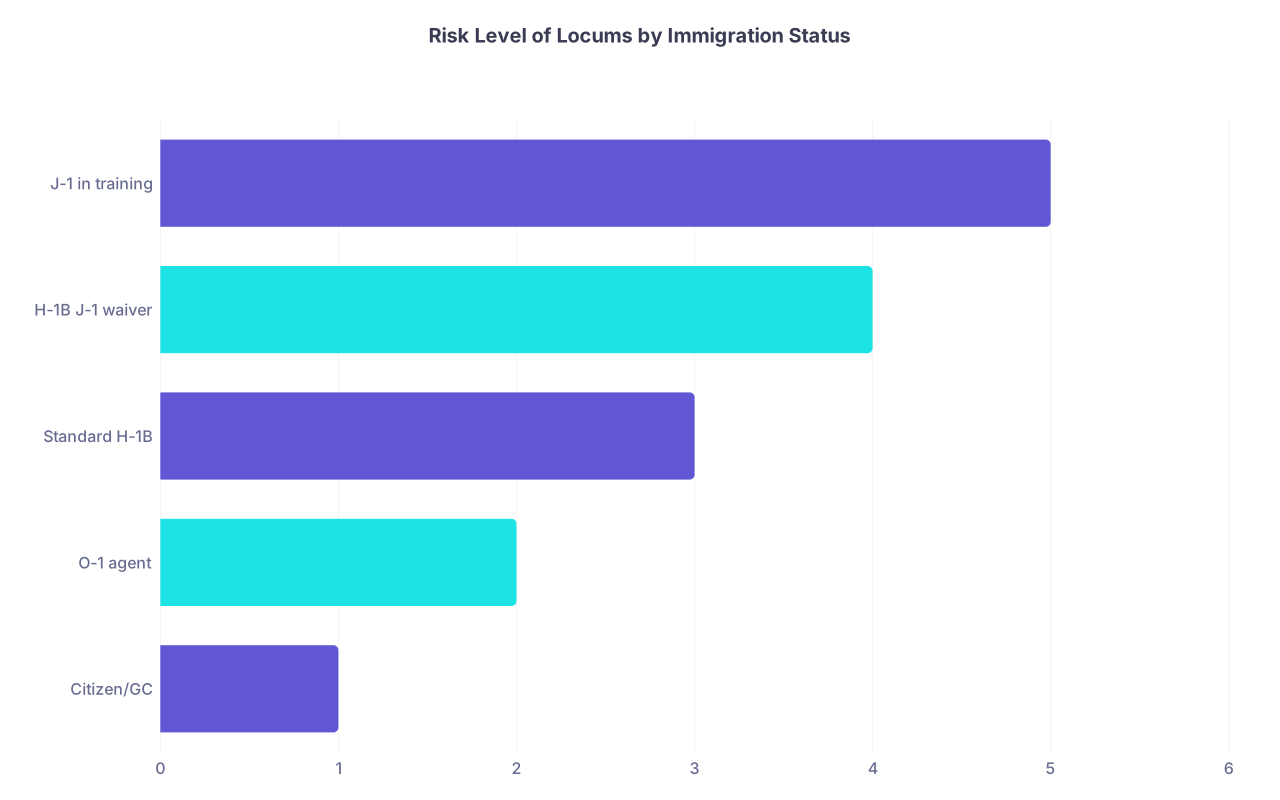
| J-1 (in training) | No | Finish training or change status |
| J-1 waiver H-1B | Very limited | 3-year obligation at waiver site |
| Standard H-1B | Possible with extra steps | Amendments for each work site |
| O-1 | Best for locums | Multiple concurrent employers allowed |
| TN | Limited & risky for 1099 | Structured W-2 jobs only |
| Green card / Citizen | Yes | No immigration constraints |
If you’re in training (J‑1) or just out (H‑1B waiver), you aren’t really doing locums. You’re doing “picking up extra shifts” at best, and often even that’s illegal without proper filings.
2. If you’re still in training (J‑1 / H‑1B resident) and “eyeing” locums
If you’re PGY‑2, PGY‑3, chief, whatever, on a J‑1 or H‑1B for residency/fellowship and dreaming of moonlighting, here’s the hard line:
- J‑1 in training: You work only for the GME‑approved training program under the ECFMG sponsorship. Locums as people imagine it (separate employers, multiple hospitals) = no.
- H‑1B for residency: You can only work for the H‑1B sponsoring program, at the locations and duties they filed. Any extra clinical work elsewhere requires another H‑1B or amendment.
What you can do, realistically:
Plan ahead for your post‑training status, now.
Decide: Are you going J‑1 waiver? Direct H‑1B? Trying for O‑1? Direct employment with green card sponsorship?Stop telling recruiters “I can do locums right after fellowship” if you’re J‑1.
If you have a two‑year home residency requirement, you cannot just walk into random locums gigs in the US. You either:- Go home for two years, or
- Get a J‑1 waiver first (Conrad 30, federal waiver, VA, etc.), then usually serve in H‑1B for 3 years in that waiver job.
Use your last year of training for immigration strategy calls, not just “CV polishing.”
If you think you’ll ever want locum tenens flexibility, you should be talking to:- An immigration attorney who actually knows physician locums (not generic employment counsel who thinks you’re a software engineer).
- Locums agencies and employers about who’s willing to sponsor what and when.
This isn’t theoretical. I’ve seen fellows sign “locums contracts” they couldn’t legally perform a single shift under because their visa made it impossible. Do not be that person.
3. Just finished training on a J‑1 waiver H‑1B? Your locum options are tiny (for now)
If you did J‑1, got a waiver job (often in an underserved area), and now want to “do locums on the side,” here’s the rule everyone tries to ignore:
The waiver is for a full‑time clinical job in a specific location.
Your primary obligation: 3 years (often 40 hours/week, direct patient care) at that site.
Most waiver applications and state contracts are very clear: this is not designed for you to bounce around as a traveling doc. Some states explicitly discourage or restrict outside moonlighting. Others don’t mention it but the immigration filing itself is fragile.
Your actual options:
Pure focus: serve your 3 years, then open the floodgates.
Safest path. No messing around. Once you hit 3 years:- You’re generally free to change employers without new waiver obligations.
- You can seek H‑1B with locum agencies or multiple hospitals.
- You can also be far along or already done with green card steps.
Structured, pre‑approved extra work (if at all).
If your waiver state and employer are open to it, and an attorney is brave enough, you might:- Add on another H‑1B concurrent employment petition with a specific number of hours at a defined second site.
- Everything must be filed and approved before you start a single shift.
This is not “true locums.” This is “two H‑1B jobs, both rigidly defined.” But some of you want extra income more than freedom.
Do not quietly “just pick up some locum shifts” on 1099.
No one may notice for a while. Until:- An audit happens.
- You file for a green card and your work history and tax returns don’t match your immigration filings.
- You need to extend status and suddenly there’s scrutiny.
If your long‑term goal is a US green card, protecting the integrity of those first few post‑residency years matters more than one extra locums paycheck.
4. Standard H‑1B and locums: technically possible, practically annoying
Once you’re on a regular H‑1B (not tied to J‑1 waiver obligations anymore), things open up—but not wide.
On H‑1B you can:
- Work for multiple employers simultaneously, but
- Each employer needs its own H‑1B petition (or concurrent H‑1B) approved, and
- Each worksite must be properly listed and covered by an LCA (Labor Condition Application).
That kills a lot of classic “go wherever the shift board has openings” locums.
Realistic H‑1B locums structures I’ve seen work:
Single locums company as your H‑1B employer.
They:- Sponsor your H‑1B.
- List a set of known hospitals/regions as worksites (this has to be realistic).
- Amend as needed when new long‑term sites are added.
The tradeoff: You’re not fully free to work for every client of every agency. You’re essentially a W‑2 employee of one locums firm with some pre‑defined sites.
Primary hospital employer + one structured locums employer.
For example:- 0.8–1.0 FTE at a community hospital on H‑1B.
- A concurrent H‑1B with a locums agency to work at 1–2 defined sites, maybe a few shifts per month.
This works best for predictable, ongoing extra coverage at the same hospital(s). It’s not ideal for “I’ll do a weekend here, a week there, state to state.”
Things that don’t work (legally) on H‑1B:
- Classic 1099 independent contractor locums where you “just sign up and show up” in random states.
- One H‑1B petition listing 12 states and 30 hospitals as vague “possible” worksites. That’s how you flag yourself for an RFE or denial.
- Doing telemedicine locums from a random vacation home that’s not listed as a worksite. Yes, USCIS has caught this.
So if you’re H‑1B and want locums, step one isn’t “upload your CV to five agencies.” It’s:
- Find the 1–2 agencies with real H‑1B experience.
- Ask direct questions: “Do you actually sponsor H‑1B and file LCAs for each worksite? How many physicians are you currently carrying on H‑1B?”
- Get an immigration attorney to vet the specific structure before anybody files anything.
5. O‑1: the closest thing to “locum friendly” status
If you’re a strong academic or high‑achieving clinician, O‑1 can be the key that unlocks real locum flexibility.
Why O‑1 plays nicely with locums:
- It can be filed by a US agent (not just a single employer).
- That agent can represent multiple actual employers (hospitals, groups, agencies).
- You can show in the petition that you’ll work for a range of institutions, with contracts or offer letters bundled together.
Is it a magic “go anywhere, do anything” card? No.
You still need:
- A documented itinerary of proposed work (even if it’s broader: “hospitalist shifts at X, Y, Z over 3 years”).
- Clear evidence of your “extraordinary ability” in medicine (publications, invited talks, key roles, awards, etc.).
- An agent or primary employer who’s willing to sign on and coordinate.
But compared to H‑1B, O‑1 is:
- Less strict about full‑time vs part‑time.
- More forgiving of multi‑employer setups.
- Re‑file‑able and extendable as long as you remain “extraordinary enough.”
If you’re in fellowship with a strong CV (research, leadership, national society activities) and want a locum‑heavy career, you should at least ask a good attorney:
“Is O‑1 viable for me, and how could we set it up to support multi‑site locums?”
6. TN, E‑2, and other oddballs: yes, you need to be boring
If you’re Canadian or Mexican on TN, or on something like E‑2 tied to a spouse’s business, let me be blunt:
These categories are not built for “I work everywhere, for everyone, as an independent contractor.”
TN:
- Must be for a specific employer, role, and location(s).
- 1099 independent contractor arrangements are red‑flag territory.
- Locums can be possible only as structured W‑2 employment with clearly defined sites, like a long‑term hospitalist role.
E‑2 spouses (and some others) can have work authorization, but:
- Locums agencies may freak out because they don’t understand the status.
- You still need to be able to show clean tax and employment records if you ever adjust status.
If your immigration foundation is fragile or temporary, your locums setup needs to be boring and well‑documented, not “creative.”
7. The green card question: locums can help or hurt
You’re post‑residency, maybe already doing locums, and you’re asking: “Does this help or hurt my green card?” The answer: it depends how you structure it.
Employment‑based green cards (EB‑2, EB‑2 NIW, EB‑1) care about:
- Do you have a permanent job offer (for employer‑sponsored routes)?
- Do your credentials and work history support the category (especially NIW / EB‑1)?
- Can you show you’re continuing to work in your field in a meaningful way?
Where locums hurt you:
- Pure short‑term gigs with no long‑term relationship to any employer.
- All 1099 with messy tax returns and no clear “permanent” job.
- Gaps of months between assignments that look like unemployment.
Where locums help you:
- Robust portfolio of work across underserved areas (fantastic for NIW arguments).
- Well‑documented clinical impact, leadership in hospital systems you rotate through.
- Strong letters from multiple institutions describing your importance to patient care locally.
If you’re thinking NIW (National Interest Waiver) as a hospitalist, EM doc, psychiatrist, etc., a strategic locums practice across rural or high‑need areas can actually strengthen your case. But only if you:
- Keep meticulous contracts, schedules, and proof of service.
- Maintain consistent practice in your specialty (not random part‑time for years).
- File taxes cleanly and show steady income.
8. The mess you might already be in (and how to fix it)
Let me describe what I see too often:
You’re a newly minted attending on H‑1B. Your primary job is legit. Then:
- A locums recruiter says, “We’ve got shifts, we’ll just 1099 you, nobody checks.”
- You start picking up weekend gigs in a different state because the pay is amazing.
- No H‑1B filing, no amendment, nothing.
Two years later, you want a green card. Or you need to extend H‑1B. Or you get an RFE asking about your work history. And suddenly:
- Your pay stubs, W‑2, and 1099s don’t match your USCIS‑approved employment.
- There’s evidence you’ve been violating status by unauthorized employment.
If this is you, here’s the triage:
Stop digging.
Don’t add more unauthorized work. Pause all extra gigs that aren’t clearly filed and approved.Get a real immigration attorney, not advice from recruiters or colleagues.
Show them:- Every W‑2 / 1099 from the last 3–5 years.
- All contracts, offer letters, and proof of locums engagements.
- Your current I‑797 approvals and underlying filings.
Stabilize your future first.
Often the strategy is:- Get you into a clean, fully compliant primary job.
- File for H‑1B extension or a green card as soon as realistically possible.
- Craft a narrative and documentation that emphasizes compliant employment and minimizes exposure.
Do not casually admit violations in emails to employers or agencies.
Everything you say can and will show up in some future file or reference letter.
You can recover from quite a bit, but it’s a lot easier if you stop adding to the mess now.
9. How to structure locums safely by status
Let’s make this very practical. You’re asking: “On my current status, what’s the smartest way to do this?”

If you’re H‑1B (no J‑1 waiver obligations)
Best‑case structure:
- One primary W‑2 job that sponsors your H‑1B and maybe your green card.
- One concurrent H‑1B with a locums agency or second hospital, for a small, stable amount of extra work at well‑defined sites.
Practical points:
- Your total hours need to be plausible. If filings suggest you’re working 1.8 FTE worth of hours, someone may raise eyebrows.
- Every physical site you work from must be covered in filings. Hospital A, Hospital B, telemedicine office, etc.
If you’re O‑1
Ideal approach:
- Use an agent‑based O‑1 that bundles multiple employers and sites.
- Keep a folder with:
- All locums contracts.
- Letters from hospitals stating your role and importance.
- Updated itineraries whenever big changes happen.
Locums here can be relatively fluid, but don’t assume “I’m O‑1 so anything goes.” Always check major changes with counsel.
If you’re TN
Most realistic:
- Long‑term “locums‑style” W‑2 roles: 3–12 month full‑time contracts at a single hospital or system.
- Avoid 1099 independent contractor setups like the plague. TN is not built for that.
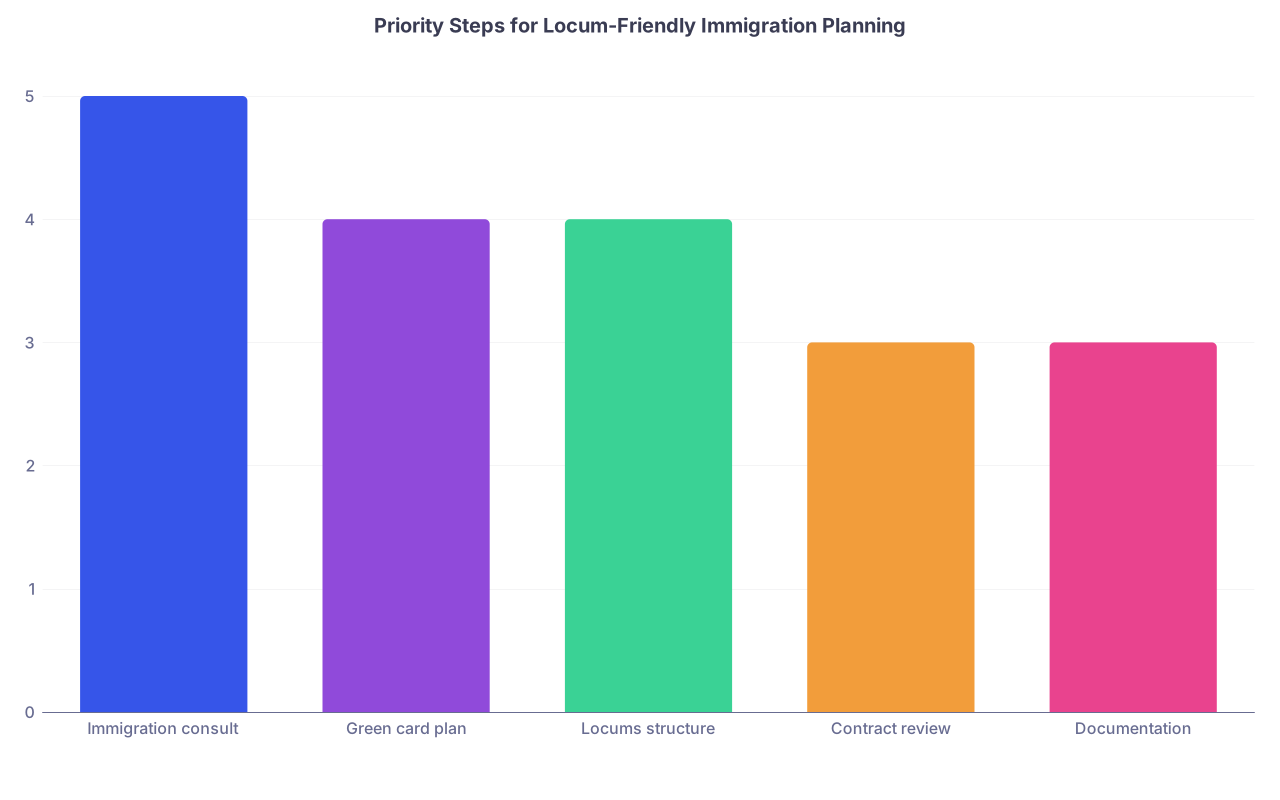
10. Concrete moves to make this year if you want a locums‑friendly future
Let’s assume you’re within 2 years of finishing training or already out, and you know you want locum flexibility long‑term.
Here’s the playbook.
| Category | Value |
|---|---|
| Immigration consult | 5 |
| Green card plan | 4 |
| Locums structure | 4 |
| Contract review | 3 |
| Documentation | 3 |
Pay for one solid immigration consult. Alone. Not with the recruiter on the line.
Walk in with:- Your full immigration history.
- Realistic career goals (“I want 6 months work / 6 months off per year,” or “I want to do rural hospitalist locums in 3 states”).
- Your specialty and CV (for O‑1 / NIW analysis).
Decide on your visa strategy, not just your next job.
That might be:- “I’ll suffer through a rigid J‑1 waiver job for 3 years, get my green card started, then go full locums.”
- Or, “I’ll aim for O‑1 and build a portfolio of locums across hospital systems.”
- Or, “I’ll prioritize a single, stable employer for EB‑2 and only layer in locums after I get my green card.”
Use your first attending job as your immigration anchor.
Boring is good:- Clear W‑2 income.
- Employer sponsorship.
- Clean, predictable status.
While you build that, you can:
- Gather evidence of impact.
- Work with an attorney on NIW / EB‑1 if applicable.
- Then open the door to real locums once your green card is in hand or close.
When you negotiate any “locums‑like” offer, ask immigration‑specific questions.
Not:- “Do you sponsor visas?”
But: - “Have you successfully sponsored H‑1B/O‑1 for locum physicians in the last 2–3 years?”
- “Who is your immigration counsel, and can I speak with them before signing?”
- “Will you list all intended worksites in the petition and keep them updated?”
- “Do you sponsor visas?”
Document everything like you’re building a court case. Because you kind of are.
Keep:- All contracts and amendments.
- Schedules and proof of shifts.
- Emails about duties and sites.
- Every approval notice and filing receipt.
This is what saves you later when USCIS asks, “So where exactly have you been working all these years?”
11. Two scenarios so you can see the difference

Scenario A: The chaos route
- J‑1 fellow finishes and jumps on a waiver job in rural Kansas.
- Secretly starts weekend locums in another state, 1099, no filings.
- Year 2: Takes on telemedicine shifts from home for a startup, also 1099.
- Year 3: Applies for EB‑2 with new employer, USCIS looks at tax returns and work history, sees years of unauthorized work.
Outcome: Long RFEs, potential denials, a ton of legal fees, and living in constant anxiety that something will unravel.
Scenario B: The controlled route
- J‑1 fellow finishes, accepts waiver job with explicit promise of green card sponsorship in year 1.
- No locums for 3 years. Just clean W‑2 work.
- Year 1: PERM/EB‑2 process started.
- Year 3: I‑140 approved, H‑1B extended beyond 6 years.
- Once I‑485 is pending or green card arrives, moves to a mix of:
- Half‑time core hospital job, plus
- True locum work at multiple sites as a permanent resident.
Outcome: 3 years of less freedom, followed by decades of maximum flexibility with no immigration anxiety.
The second route is objectively better, even if it bruises your pride for a bit.
12. Final blunt advice
| Category | Value |
|---|---|
| Citizen/GC | 1 |
| O-1 agent | 2 |
| Standard H-1B | 3 |
| H-1B J-1 waiver | 4 |
| J-1 in training | 5 |
You’re a doctor, not a test case for creative visa interpretations. Here’s how to not wreck your future:
- Treat immigration like another subspecialty you need to respect.
- Assume recruiters either don’t understand your visa or don’t care.
- Make your first few post‑training years as clean and predictable as possible, even if your ego wants instant locum freedom.
Once you have a green card (or a well‑structured O‑1 with a clear strategy), you can do all the creative locum setups you want. Until then, your job is simple:
Stay in status. Build a strong immigration foundation. Let the freedom come after.
Key takeaways:
- Most visas are fundamentally incompatible with casual, multi‑site, 1099 locums. You have to engineer around that, not ignore it.
- Use your first attending job to lock down stable status and a green card path, then layer locums on top—don’t reverse that order.
- Pay for proper immigration advice before you accept any “flexible” role; it’s cheaper than fixing a broken status three years from now.