
What if you show up to your first locum tenens assignment and realize, within 24 hours, “I hate this place and I want out”?
Let’s just say the quiet part out loud: yes, that can happen. And yes, it’s terrifying when you’ve already signed a contract, maybe moved to a new city for a month or three, and your recruiter is texting you cheery emojis while you’re internally screaming.
I’m going to walk through the exits. The real ones. The “how bad can this get?” and “what’s actually likely?” versions. Not the glossy recruiter brochure.
You’re not the first person to land in a nightmare locums gig. You won’t be the last.
Step 1: Figure out how bad this actually is
Before you start imagining lawsuits and being blacklisted from medicine forever, you need to sort out what kind of “hate” we’re talking about.
There’s a huge difference between:
- “I’m uncomfortable and this is not what I pictured”
versus - “This is unsafe, misrepresented, and I feel trapped.”
The anxious brain treats them the same. Contract law does not.
Here’s how I roughly divide it in my head:
| Situation Type | Practical Risk Level |
|---|---|
| Annoying / disappointing | Low |
| Miserable but safe | Moderate |
| Ethically sketchy | High |
| Clinically unsafe | Very high |
| Personally unsafe (harassment, threats) | Critical |
If it’s “I don’t like the EHR, call is heavier than I thought, people are cold,” that’s misery, but usually survivable.
If it’s “they’re asking me to practice outside my scope, staffing is dangerously low, charts are falsified, I’m being harassed,” that’s a different category. That’s when “how do I leave early?” becomes more like “how quickly can I get out without burning my license down?”
Your first job, painfully, is to be honest with yourself about where you’re at on that spectrum.
Step 2: Pull out the contract (yes, actually read it now)
I know. You skimmed it when you signed because you just wanted to get started and they said, “This is our standard contract, everyone signs it.”
Now you need to find three things:
- The term of the assignment (start/end dates).
- Any termination clause (look for “termination,” “without cause,” “with cause”).
- Any penalties or damages for early termination (travel reimbursement, cancellation fees, “liquidated damages”).
Most locum contracts fall into one of these buckets:
- You can terminate without cause with X days’ notice (often 14–30 days).
- Only the hospital has a without-cause termination; you can only leave “for cause.”
- There’s vague “mutual agreement” language that basically means “we’ll negotiate if this blows up.”
If you see a clear “You may terminate this agreement without cause with 30 days’ written notice” line, you actually have a defined exit ramp. It might still be awkward and expensive. But it’s there.
If you don’t see that? Then legally, you’re more boxed in on paper. But real-life practice is often more flexible than the scary sentence in the contract. Hospitals don’t usually want a furious, burned-out locums doc seeing patients against their will.
You’re worried about “what if they sue me?” The usual reality: if you’re professional, document issues, and give reasonable notice, most groups and agencies don’t want the drama. They want coverage and quiet, not a public fight.
Step 3: Document what’s actually wrong (protect yourself)
Your malpractice risk brain should kick in here.
Even if you think, “I’ll just tough it out,” you still need a paper trail if:
- staffing is unsafe
- they’re asking you to do things you’re not privileged or trained to do
- there are clear misrepresentations from what you were told (schedule, support, call, scope)
- you’re being harassed, threatened, or undermined
Write it down. Dates, names, specific incidents. Not a stream-of-consciousness rant—factual, short, clear. Email yourself from a personal account. Save everything.
Why? Because if this gets ugly later (board complaint, malpractice case, or a contract dispute), you don’t want it to be your anxious memory vs. their nice clean narrative.
And yes, this is where the “I feel crazy, maybe I’m overreacting” voice kicks in. You can still be overreacting and document. No one ever regrets having too much contemporaneous documentation.
Step 4: Who to talk to first – and how not to blow yourself up
Here’s the order I usually recommend, roughly:
- Your recruiter / agency contact
- A trusted colleague (not at that site)
- Possibly: a healthcare lawyer (if it’s really bad)
Who I wouldn’t start with: the hospital CMO or medical director in a furious monologue about how everything is unsafe and you’re leaving tomorrow.
Start with your agency. This is literally what they get paid for. That said, remember: their client is technically the hospital, not you. They don’t want a reputation for sending “difficult” docs. So you want to sound clear, reasonable, and focused on patient safety and contract misalignment, not just “I hate this.”
Concrete example of what to say:
“I’m concerned because what I’m experiencing on site is very different from what we discussed. I was told call would be Q4 with an in-house NP, but it’s been Q2 with no advanced practice support, and I’m being asked to cover ICU patients solo overnight. I don’t feel this is safe or aligned with my training. What are our options?”
That sounds very different from, “I hate it here, I want to leave.”
One gets you problem-solving. The other gets you quietly put on the “maybe don’t send them again” list.
If what you’re dealing with is truly unsafe or clearly outside your scope, say that. Calmly. Repeatedly. Put it in writing after the call: “Per our conversation today, I expressed concerns about X, Y, Z…”
Step 5: The exit options you actually have
Let’s lay out the main exits, from “least scorched earth” to “I’m done, get me out.”
Option A: Finish the contract, then never go back
This is often the path of least damage if:
- it’s miserable but not unsafe
- you don’t want drama
- you’re terrified of being “that locums doc who walked out”
You grin, you chart, you vent to your friends, you sleep in your call room between pages, you finish the block, then you calmly tell your agency, “I won’t be extending or returning to this site.”
Downside: your mental health might take a beating. Upside: you’re clean, no broken contract, and you’ve just learned a lot about what you won’t tolerate in the future.
Option B: Use the notice clause (if you have one)
If your contract says “30 days’ notice,” that doesn’t mean you’re evil if you use it.
You email your recruiter:
“After serious consideration, I’ve decided I’d like to exercise the 30-day without-cause termination clause in our agreement. I’ll continue to provide safe, professional care during that period, but I’d like my last working day to be [date].”
They may push. They may ask “Is there anything we can fix?” Sometimes they can fix things: change call, adjust patient load, talk to the site. Sometimes they can’t. You don’t owe your sanity to a hospital that lied to get coverage.
Often the worst that happens here financially is you may need to pay back housing or travel costs for unused time, or you just don’t get paid for days you don’t work. Read the contract to see if there are penalties, but many agencies are reasonable if you handle it like an adult and not like a meltdown.
Option C: “For cause” termination – the nuclear option
This is where you say, “This is unsafe / unethical / materially misrepresented, and I can’t ethically continue.”
Use this when:
- Patient safety is clearly at risk on a systemic level
- You’re being asked to do things that risk your license
- The site fundamentally misrepresented what you’d be doing and refuses to correct it
- There’s harassment or a hostile environment and leadership refuses to act
You’ll want to:
- Put your concerns in writing (specific, not emotional).
- Offer a realistic short transition (a few days, maybe a week) if it’s not immediately dangerous.
- Make it about patient safety, not personal comfort.
Example:
“I was credentialed as a hospitalist but am now being asked to manage ventilated ICU patients alone overnight without critical care backup. I’ve explained that this is outside my training and I don’t feel I can safely provide that care. Since this issue hasn’t been resolved, I don’t feel I can continue in this assignment without risking patient safety and my license.”
Does the site like this? No.
Can they come after you? They can threaten to. But if your paper trail shows you raising legitimate safety concerns and trying to work with them, they usually just want you gone quietly.
This is a good time to at least talk to a healthcare attorney, especially if your gut is screaming “board complaint risk.”
Option D: Immediate walk-out (very rare, very serious)
This is the “I’m leaving now, I cannot safely work another shift.” Think:
- Physical safety threats
- Clear criminal or fraudulent activity
- Severe, unresolvable immediate danger (e.g., no backup, grossly unsafe ratios)
This should be your last resort. Boards do take abandonment seriously. But they also care about context. If staying means you’re knowingly practicing in truly dangerous circumstances, that can be just as bad or worse if a case goes sideways.
If you truly have to walk immediately:
- Notify leadership in writing that you’re unable to safely continue and why.
- Notify your agency.
- Offer whatever brief, realistic coverage you can (even a few hours) while they scramble.
- Document, document, document.
This is not common. But you asked for worst-case scenarios. This is one.
Step 6: What this does to your “reputation” and future gigs
This is the part that keeps people frozen: “If I leave this assignment early, will I ever get another job?”
Short answer: You’re not that powerful.
I’ve seen physicians:
- Cancel mid-assignment for legit safety concerns and still get tons of work
- Get quietly blackballed by one hospital system but work happily everywhere else
- Switch agencies and start fresh because one recruiter painted them as “high maintenance”
Locums is a small world in some ways, but not that small. Programs remember chronic, unprofessional behavior. They don’t blacklist someone for one bad-fit assignment handled professionally.
If you:
- Communicate early and clearly
- Focus on safety and scope, not just comfort
- Give realistic notice when you can
- Don’t rage-email or trash the site all over the internet
…you’re probably fine. Will this site want you back? No. Do you want to go back? Also no.
Where reputations really get torched is:
- No-showing shifts
- Walking with no notice and no communication
- Screaming matches with staff or leadership
- Charting disasters that create messes after you’re gone
Be better than that and your career survives.
Step 7: Use this misery to protect future-you
This is the part that actually helps the anxiety long term: turn this disaster into data.
Before your next locum tenens assignment, you’ll ask very specific questions:
- “What’s the average daily census? Max census? Admit volume per shift?”
- “Who’s in-house at night? Is there an NP/PA? Residents? ICU coverage?”
- “What types of patients am I not expected to manage?”
- “How often does backup actually come in, in practice?”
- “Can I speak to a current locums physician at the site, not just staff?”
You’ll push for:
- A clear termination clause with reasonable notice
- Clarification in writing of anything that sounds hand-wavy on the phone
- A shorter initial commitment (2 weeks instead of 3 months) at new sites
You’re anxious right now because it feels like this one bad assignment = your entire career is doomed. It doesn’t. It just means your filters weren’t tuned yet. That gets better.
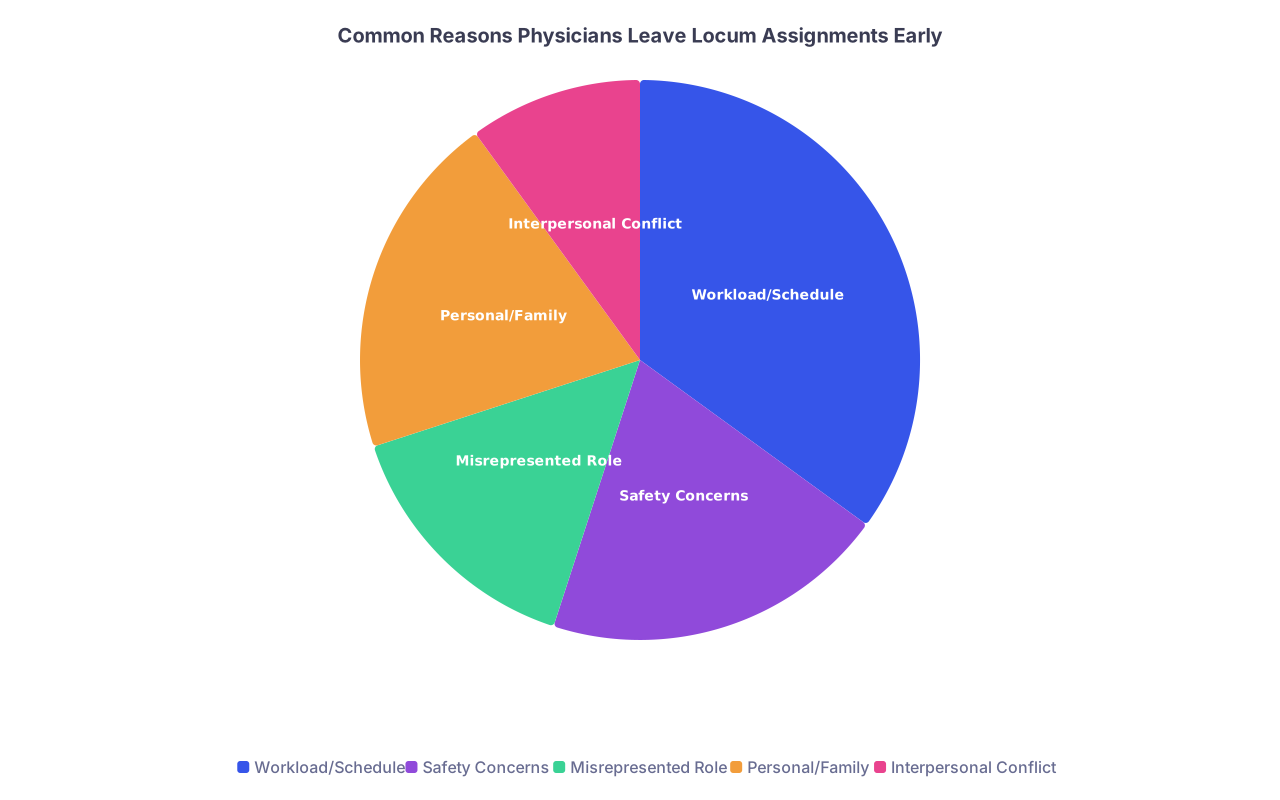
| Category | Value |
|---|---|
| Workload/Schedule | 35 |
| Safety Concerns | 20 |
| Misrepresented Role | 15 |
| Personal/Family | 20 |
| Interpersonal Conflict | 10 |

| Step | Description |
|---|---|
| Step 1 | Hate Assignment |
| Step 2 | Review Contract |
| Step 3 | Document Concerns |
| Step 4 | Talk to Agency |
| Step 5 | Give Notice and Finish |
| Step 6 | Negotiate Early Exit |
| Step 7 | Consider Lawyer |
| Step 8 | Unsafe or Just Miserable |
| Step 9 | Notice Clause Exists |

Let’s be brutally honest about the worst-case fears
You’re probably cycling through all of these:
- “What if they sue me for breach of contract?”
- “What if they report me to the board?”
- “What if no one ever hires me again?”
- “What if I’m just weak and can’t handle normal work?”
Reality check:
- Lawsuits cost money. Hospitals and agencies rarely spend it on short-term locums who left with documented safety concerns and some notice. Is it possible? Sure. Common? No.
- Boards care about patient harm, fraud, criminal issues, and patterns of gross unprofessionalism. One bad locums fit, handled professionally, is not their priority.
- There are hundreds of hospitals desperate for coverage. If you’re reasonably competent, show up, don’t scream at people, and chart, you are not unemployable because one assignment went sideways.
- You might be tired, burned out from residency, or genuinely sensitive to chaos. That doesn’t make you weak. It means you need to be more aggressive about choosing environments that match your bandwidth.
If anything, recognizing, “This is not okay, I can’t safely do this,” is stronger than white-knuckling through and hoping nothing explodes.

FAQs: Hating Your First Locum Assignment
1. Can I really leave a locum assignment early without destroying my career?
Yes. If you handle it professionally—communicate with your agency, give whatever notice you reasonably can, document safety or misrepresentation issues—you’re not destroying your career. You might burn a bridge with that specific site. Fine. Most physicians who’ve done locums for a while have at least one “never again” hospital.
2. Will they sue me if I break the contract?
They can threaten to, but it’s rare for a short-term locum who leaves with some notice and a documented, reasonable concern. The more you look like a rational physician acting to protect patient safety and your license, the less attractive you are as a legal target. Worst case is usually financial: repaying housing/travel or losing pay for unworked shifts. If the contract has scary “liquidated damages” language, that’s when a brief consult with a healthcare attorney is worth it.
3. Could this lead to a board complaint?
Anything could, but the question is how likely and how bad. Boards look harder at patient abandonment, gross negligence, substance issues, or hostile behavior than “this doctor used a contract termination clause after reporting safety concerns.” If you’re going to leave early, don’t just vanish. Communicate your reasons, offer a transition if possible, and document your attempts to mitigate harm. That’s what boards look at if a complaint ever did happen.
4. What if I’m just overreacting? I can’t tell if it’s “unsafe” or just “hard.”
This is the mind trap. Ask yourself: “If a resident I cared about were working these conditions, what would I tell them?” If your honest answer is “I’d tell them this isn’t okay,” then you’re not overreacting. You can also sanity-check with an outside colleague: describe the situation, numbers, expectations. If two or three physicians say, “Yeah, that’s bad,” believe them. Remember that being exhausted, new, and anxious makes everything feel catastrophic, but it doesn’t magically create unsafe ratios or bait-and-switch roles out of thin air.
5. Should I just finish it so I don’t look bad to the agency?
Sometimes yes, sometimes no. If it’s miserable but safe, finishing the block and quietly refusing future dates is often the cleanest path. If it’s truly unsafe or misrepresented in a way that risks your license, “finishing it” just to look good can backfire badly if something goes wrong clinically. Agencies respect physicians more who can calmly say, “This is not what was described, and here’s why I can’t continue.” They may be annoyed, but they also don’t want their doctors in dangerous situations.
6. How can I avoid ending up in another awful locum assignment?
Use this experience like a checklist of red flags. Before the next gig, ask detailed questions about census, call, support staff, procedures, and scope limits. Ask to speak with a current locums physician at the site, not just perm staff. Push for a termination clause that gives you an exit with notice. Start with shorter commitments for new sites. And pay attention to how honest the recruiter is when you press them—if they dodge and say “It’s usually fine,” that’s a no.
Key takeaways:
First, hating your first locum assignment doesn’t mean you picked the wrong career; it means you hit a bad fit or a bad actor. Second, you almost always have options—from quietly finishing to invoking notice to, in extreme cases, walking for safety reasons—if you document and communicate like a professional.