
The way most doctors approach locums in year 3 is lazy—and expensive—because they never stopped operating like it was year 1.
You are not supposed to do locums the same way forever. Year 1 is about survival and optionality. Year 3 should look like a deliberate business strategy. If it doesn’t, you’re leaving five figures (or more) on the table every year.
Let’s walk it chronologically—what you should be doing in:
- Your first 12 months in locums
- Your second year transition
- Your third year and beyond
I’ll call out exact months and checkpoints so you can see where you are on the curve and what needs to change.
Big Picture: How Your Locums Strategy Should Shift

| Category | Income Stability | Rate Optimization | Lifestyle Control | Skill/Network Building |
|---|---|---|---|---|
| Year 1 | 20 | 15 | 20 | 45 |
| Year 2 | 30 | 25 | 25 | 20 |
| Year 3 | 35 | 35 | 20 | 10 |
By year:
- Year 1 – Try sites. Learn the system. Protect yourself from bad contracts. Build a “locums CV.”
- Year 2 – Consolidate to your best sites. Start dictating terms. Clean up your financial life.
- Year 3 – Run it like a business. Pre‑negotiate annual blocks. Fire bad agencies/sites. Optimize tax + schedule.
Most physicians get stuck in “forever Year 1”: chasing every offer, saying yes to chaos, and never leveraging their track record.
Let’s fix that, step by step.
Year 1: Survival, Sampling, and Systems
Months 0–3: Launch and First Assignments
At this point you should be:
- Just out of residency/fellowship or just left your first employed job
- Unsure how many shifts or weeks of locums you actually want
- Still figuring out which agencies and sites are not a nightmare
Focus for the first quarter is volume of information, not volume of shifts.
Concrete steps:
Month 0–1: Set your non‑negotiables
- Max call burden you’ll tolerate
- Settings you will not touch (e.g., solo coverage ICU if you’re not comfortable)
- States you’re willing to license in
- Minimum acceptable effective hourly rate
Month 1: Talk to multiple agencies
- Have calls with at least 3 different locums agencies
- Ask very direct questions:
- “What are your best current rates for my specialty?”
- “Average credentialing time for your main clients?”
- “Who pays travel, rental car, and malpractice tail?”
Month 1–2: Take 1–2 short assignments
- Choose assignments ≤ 2–4 weeks if possible
- Purpose: learn how hospitals run locums, not to maximize your annual income yet
- Keep a running document with:
- EMR used
- Call structure
- Support staff quality
- How they treated you as a human being
Month 2–3: Build operational systems
- Open a separate checking account for locums income/expenses
- Start a simple spreadsheet:
- Dates worked
- Site and agency
- Gross pay, net pay
- Travel reimbursements
- Pain points / red flags
This first 90 days is about experiments with guardrails. Do not lock yourself into a 6‑month assignment before you even know what you like.
Months 4–6: Pattern Recognition and Risk Control
By 6 months, you should have seen at least 2–3 sites and worked with 2 agencies. Now the job is to start recognizing patterns—and tightening risk.
At this point you should:
- Stop signing anything without reading cancellation and extension clauses carefully
- Start filtering out bad fits aggressively
Key moves in Months 4–6:
Audit what you’ve done so far
- Which site paid on time, had reasonable expectations, and didn’t treat you like disposable labor?
- Which agency rep actually followed up, and which ghosted you once you signed?
Refine your minimum rate (with real data)
- Calculate your true hourly for each assignment:
- Include charting after shift, commute, and unpaid call
- Adjust your “do not go under” floor accordingly
- Calculate your true hourly for each assignment:
Get your compliance stack tight
- Build a “locums packet” PDF folder on your computer with:
- License(s)
- DEA, CSR
- Board cert
- Immunization records
- ACLS/BLS/other certs
- CV updated with locums roles
- Aim so that when a recruiter says, “Can you send me…” you send one email with everything
- Build a “locums packet” PDF folder on your computer with:
Introduce basic tax planning
- Talk to an accountant who actually understands locums / 1099 life
- Decide whether you’ll:
- Stay as sole proprietor for now
- Or set up an LLC / S‑Corp in the next 6–12 months
- Start tracking:
- Travel costs
- CME
- Licensing fees
- Home office
Year 1 mistakes I see all the time: doctors working 10–20 extra unpaid hours a month because they never calculated their true hourly rate; or signing a contract with a 30‑day cancellation clause and no guaranteed minimum shifts. Fix that now.
Months 7–12: Intentional Portfolio Building
By the end of year 1, your goal is clarity:
- These 1–2 sites: “good / tolerable”
- These: “never again”
- This agency rep: “reliable”
- This EMR: “fine, I can live with it”
At this point you should:
-
- Purpose: less credentialing chaos, more familiarity, smoother shifts
- Choose based on:
- Rate
- Staff dynamics
- Ease of travel
- Malpractice coverage terms
Start thinking in 3–6 month blocks
- Instead of piecemeal weekends, negotiate:
- “I can give you 7–10 shifts/month for the next 3 months at $X/hour.”
- This is optional in Year 1, but just starting to think like this sets you up for Year 2.
- Instead of piecemeal weekends, negotiate:
Eliminate low‑yield chaos
- Drop:
- Sites with frequent last‑minute schedule changes
- Agencies that habitually “lose” your paperwork
- Assignments with unpredictable census and no backup
- Drop:
End of Year 1 review (do this on paper)
- Income by agency and site
- Hours worked vs what you actually wanted to work
- Burnout signs: dreading certain facilities, chronic sleep wreckage from call
That written review is the bridge into Year 2. Without it, you just drift.
Year 2: Consolidation, Negotiation, and Lifestyle Design
Year 2 is where your strategy should stop looking like a panic response to leaving training and start looking like you’re running a professional service business.
Months 13–18: From “Take Whatever” to Selective
At this point you should:
- Have at least one site that would happily keep you indefinitely
- Know what a “good” day vs “awful” day in your specialty looks like
- Feel less terrified about future income
Now you shift from “I’m grateful for any work” to “Let’s improve the mix.”
Key changes:
Negotiate from your actual value
- You now have:
- X months of successful coverage
- Good feedback from staff
- No major complaints or QA issues
- Use that:
- “I’m willing to commit to 8 shifts/month if we can move the rate from $230 to $260 per hour.”
- You now have:
Increase block scheduling
- Push for:
- Week‑on / week‑off
- Or two weeks at a time every month
- Reason:
- Cheaper travel if you fly in/out less
- More predictable off‑time to actually live your life
- Push for:
Drop your worst 20%
- Every 6 months, ruthlessly eliminate:
- Lowest paying
- Most chaotic
- Worst culture
- Free up that time for better‑paying or saner work
- Every 6 months, ruthlessly eliminate:
Start tracking utilization and gaps
- Look at your calendar 3–4 months ahead:
- Are there dead zones? Overloaded weeks?
- Fill selectively; stop reflexively saying yes.
- Look at your calendar 3–4 months ahead:
Months 19–24: Start Running It Like a Business
Late Year 2 is the “quiet pivot” most physicians never consciously make. You should.
At this point you should:
- Have a consistent annual income range
- Know what months are historically busy / slow for your niche
- Have at least one “favorite” facility
Now, you formalize.
Entity and tax optimization
- If your locums income is substantial and stable:
- Finalize that LLC / S‑Corp if you and your accountant agree
- Set up:
- Quarterly estimated taxes
- SEP IRA / Solo 401(k) or equivalent
- This is where a lot of Year‑3 folks regret not having started in late Year 2.
- If your locums income is substantial and stable:
Standardize your negotiation script
- Have phrases ready:
- “My current rate is ___ for days, ___ for nights, and ___ for holiday coverage.”
- “I prioritize sites where I feel supported. At Hospital A I have… how does your site compare?”
- You’re not begging for a shift; you’re offering a professional service.
- Have phrases ready:
Define your annual lifestyle pattern
- Decide:
- How many weeks off per year you want
- Which months you prefer to work heavier (e.g., summer)
- Begin blocking those off before agencies fill your calendar for you.
- Decide:
Refine your clinical niche
- If applicable:
- More telemedicine vs in‑person
- More OB call vs clinic
- More procedural vs cognitive
- If applicable:
That closes the experimental phase. Year 3 should not feel like “we’ll see what comes in.” It should feel like a scripted season.
Year 3: Intentional, Leveraged, and Long‑Term
By Year 3, if you’ve done this right, you’re no longer the nervous new grad trying to prove you belong. You’re a proven solution to staffing problems.
Now the strategy you use should be completely different.

Months 25–30: Lock In Your Core Calendar
At this point you should:
- Have 1–2 “A‑tier” sites and maybe 1 “B‑tier” backup
- Know your personal sustainable workload
- Be clear whether you’re staying locums‑only or mixing with a part‑time employed role
Now, you proactively design the year.
Pre‑negotiate multi‑month commitments
- Example:
- “I can give you 7 shifts/month for all of Q1 and Q2 next year if we agree to $X/hour and reimburse Y for housing.”
- Or:
- “I’ll cover all your Thanksgiving–New Year holiday gaps if we set a holiday premium of ___.”
- Example:
Set and enforce stronger boundaries
- You’re 2+ years in. Stop:
- Accepting constant mid‑shift add‑ons that were never agreed to
- Allowing schedule changes without your consent
- Politely but firmly:
- “That’s outside the scope of what we agreed for this block. If we want to expand the role, we can discuss a revised rate.”
- You’re 2+ years in. Stop:
Build redundancy
- Do not be dependent on a single facility:
- Keep at least one fully credentialed backup site, even if you work there rarely
- Maintain:
- At least 2 active state licenses if your specialty market supports it
- Do not be dependent on a single facility:
Upgrade your personal infrastructure
- Reliable travel systems:
- Airline + hotel statuses and preferred routes
- Better work gear:
- Laptop you trust
- Your own dictation / macros templates
- Streamlined EMR “cheatsheets” for each facility
- Reliable travel systems:
Months 31–36: Optimize, Specialize, or Pivot
Year 3 is also where many physicians either:
- Push locums into a long‑term sustainable model, or
- Use locums as a launchpad into something else (academics, hybrid jobs, entrepreneurship)
Your strategy now should evolve based on what you want the next 3–5 years to look like.
Option A: Deepen Locums as a Long‑Term Career
At this point you should:
- Treat yourself openly as a consultant, not “just a temp doc”
- Think in terms of multi‑year relationships
Steps:
Negotiate beyond rate
- Ask for:
- Priority scheduling
- Consistent housing standards (no more random motels)
- Better call distribution
- Propose win‑wins:
- “If I commit to your high‑need weeks, can we standardize X benefit?”
- Ask for:
Track and improve your personal ROI
- Measure annually:
- Effective hourly rate including travel and admin
- Income per facility
- Burnout cost (which site drains you the most for the least return?)
- Measure annually:
Reduce administrative friction
- Aim to work with fewer agencies, more directly with systems if possible
- Keep:
- A master calendar with all expiration dates: licenses, DEA, CME, privileging
- Renew strategically so you’re never in a “credentialing emergency.”
Option B: Use Year 3 to Transition or Diversify
Some of you will realize locums is a bridge, not the end game. Good. Then use Year 3 intentionally.
At this point you should:
- Have 24–30 months of varied experience
- Know what you absolutely will not tolerate in a permanent job
Moves:
Leverage your locums record in permanent negotiations
- “For the past 2 years I’ve worked at X, Y, Z systems, handled these volumes, and maintained high evaluations.”
- You’re not the standard new hire; you’re bringing proof.
Scale down or focus locums
- Concentrate on:
- A few higher‑paying stretches
- Or locations you genuinely enjoy and might transition into permanently
- Concentrate on:
Explore non‑clinical or hybrid roles
- Use locums flexibility to:
- Take a day a week for admin, consulting, or academic work
- Test leadership roles without locking into a full‑time contract
- Use locums flexibility to:
| Year | Primary Goal | Key Actions |
|---|---|---|
| 1 | Learn and Survive | Sample sites, build systems |
| 2 | Consolidate and Grow | Negotiate, standardize, set patterns |
| 3 | Optimize and Leverage | Pre‑plan calendar, specialize/shift |
Tactical Differences: Year 1 vs Year 3 Moves
Let’s put the evolution side by side so you can sanity‑check your current behavior.
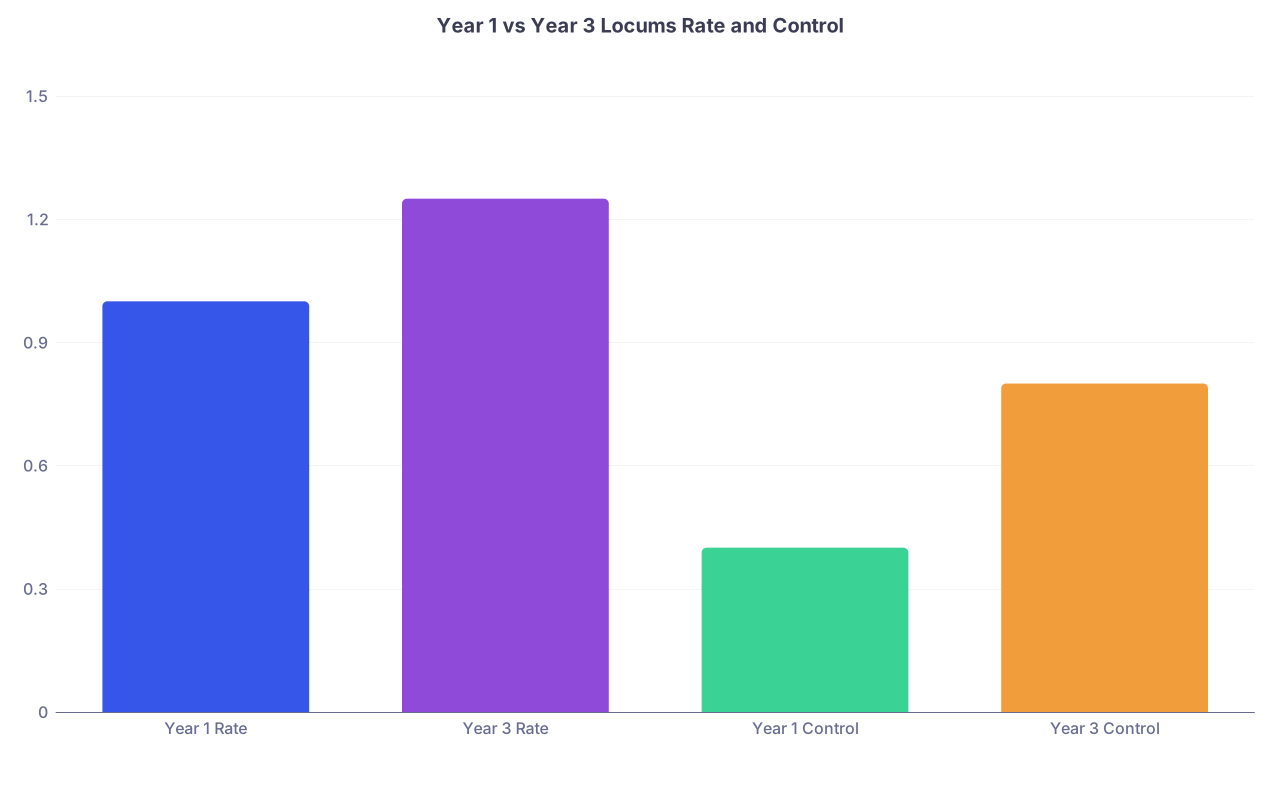
| Category | Value |
|---|---|
| Year 1 Rate | 1 |
| Year 3 Rate | 1.25 |
| Year 1 Control | 0.4 |
| Year 3 Control | 0.8 |
(Values are relative, not absolutes—your numbers will vary, but the direction should look like this.)
Year 1 behaviors (appropriate early, harmful if you’re still doing them in Year 3):
- Saying yes to almost every reasonable offer
- Accepting agency default rates without pushing back
- Letting recruiters decide where to send your file
- Constant re‑credentialing at new sites “just to see”
Year 3 behaviors (that should replace the above):
- Proactively emailing your preferred facilities 3–6 months ahead with your availability
- Countering offers with a clear rate structure and rationale
- Refusing “trial” sites unless they clearly fit your long‑term goals
- Using data from your last 2–3 years to decide where to invest more time

Common Traps That Keep You Stuck in “Permanent Year 1”
Even in Year 3, I see the same three traps:
Fear of saying no
- You overbook, accept bad rates, and never force systems to respect your boundaries.
No written plan
- Your calendar is a random collage of offers instead of a designed year.
No financial or tax optimization
- You’re making solid gross income but bleeding it out in inefficiencies and missed deductions.
Year 3 should be where you clean all of that up. Or you’ll wake up in Year 7 still chasing frantic last‑minute coverage emails.
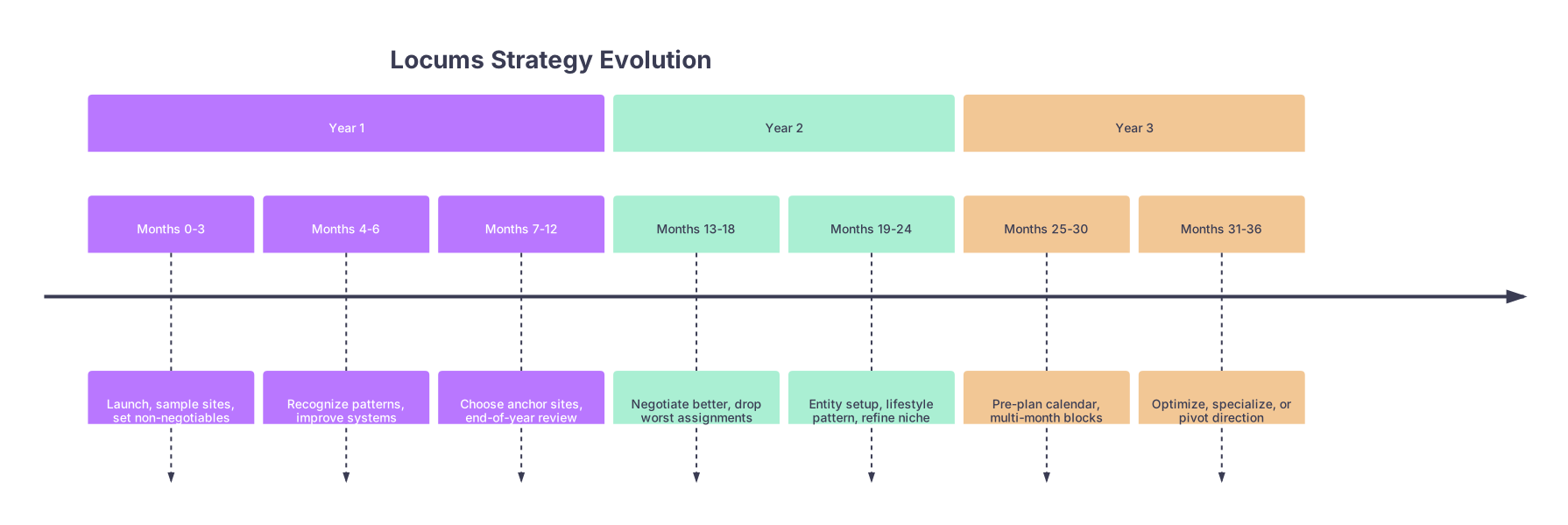
| Period | Event |
|---|---|
| Year 1 - Months 0-3 | Launch, sample sites, set non-negotiables |
| Year 1 - Months 4-6 | Recognize patterns, improve systems |
| Year 1 - Months 7-12 | Choose anchor sites, end-of-year review |
| Year 2 - Months 13-18 | Negotiate better, drop worst assignments |
| Year 2 - Months 19-24 | Entity setup, lifestyle pattern, refine niche |
| Year 3 - Months 25-30 | Pre-plan calendar, multi-month blocks |
| Year 3 - Months 31-36 | Optimize, specialize, or pivot direction |

Your Next Step Today
Do one concrete thing today: write down which “year” you’re actually operating in.
Then, on a single sheet of paper, list:
- 2–3 things you’re doing that belong to an earlier year
- 2–3 moves from the next year that you’re going to implement in the next 30 days
If you do nothing else, that one page will start dragging your locums life forward in time—toward a Year‑3 strategy, even if you’re technically still in Year 1.