
It’s late. You’re replaying that rotation over and over in your head.
The attending who clearly didn’t like you.
The shelf exam you bombed.
That one day you were late and they definitely noticed.
And now you’re thinking: “Great. That was my best shot at a strong letter. Did I just wreck every LOR option I have for residency?”
Let me just say it outright: no, one bad rotation does not automatically destroy your LOR prospects. But I know that answer alone doesn’t shut your brain up at 2 a.m. So let’s walk through this like a real person who’s freaking out, not some fantasy robot who thinks “just relax” is useful.
Reality check: how much power does one rotation actually have?
Here’s the ugly thought in your head:
“If this attending trashes me, every program will think I’m incompetent and I’m done.”
Let’s pull back and look at how residency applications actually get read.
Program directors aren’t sitting there saying, “Did this student have one perfect, flawless rotation with a glowing letter? No? Reject.”
They’re looking at patterns. Consistency. Themes.
This is the rough weighting of what they tend to care about with letters and clinical performance:
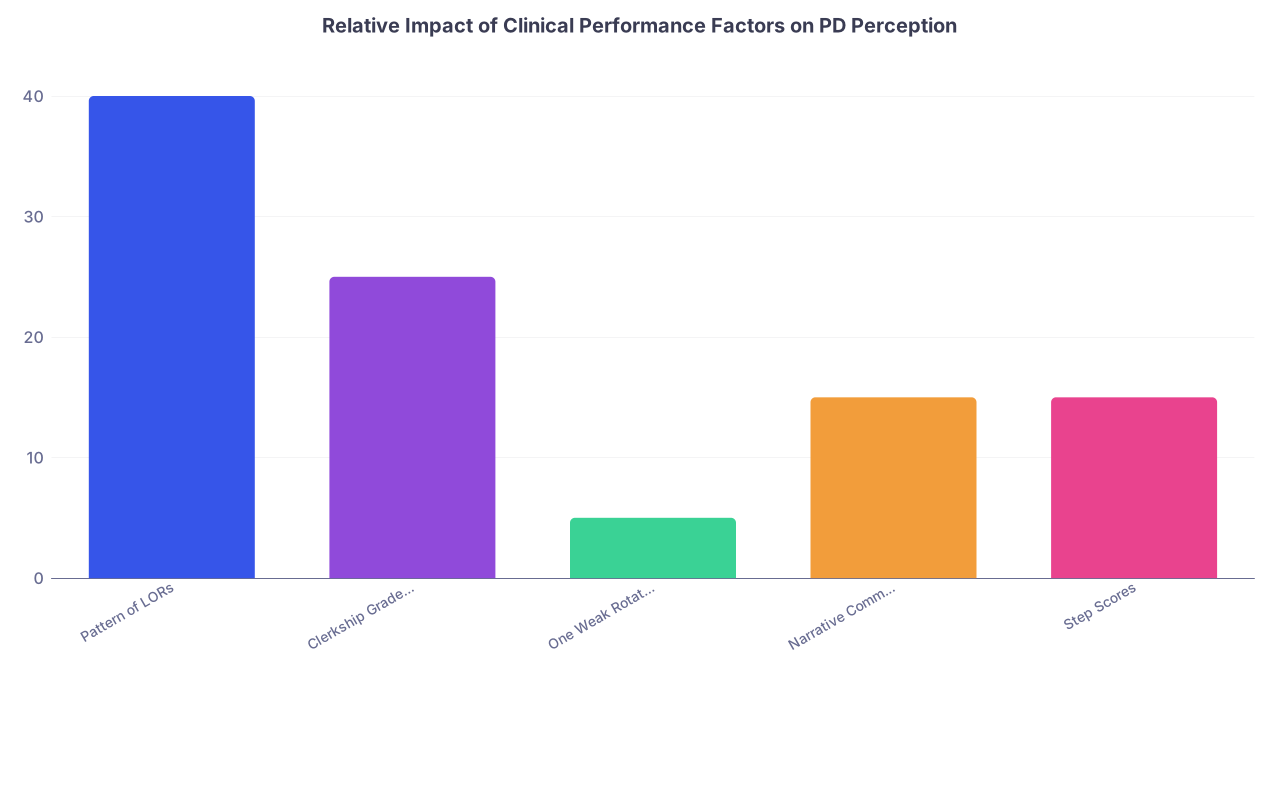
| Category | Value |
|---|---|
| Pattern of LORs | 40 |
| Clerkship Grades Overall | 25 |
| One Weak Rotation | 5 |
| Narrative Comments | 15 |
| Step Scores | 15 |
Plain English: one bad rotation is noise. Multiple weak rotations is a pattern.
Programs see:
- The rotation grades across 3rd/4th year
- How many letters you have and what they generally say
- Whether there’s a consistent story: hardworking vs disengaged, improving vs stagnant
If you’re decent-to-strong on most rotations and one was clearly off, it usually reads as: bad fit, personality mismatch, or just a rough month. Not “doomed applicant.”
But I know what you’re worried about next.
Worst-case scenario: what if that rotation attending was my main LOR plan?
This is the panic scenario:
- You planned on asking that attending for your “big” specialty letter
- Rotation went sideways
- Now you’re scared to even ask them
- And you feel like you suddenly have zero options
Let’s untangle that.
First, the brutal truth:
If the attending clearly disliked you and you suspect they’d write a lukewarm or negative letter, do not use them as a primary letter unless you absolutely have no choice. A bland “met expectations” letter can hurt you more than no letter from that person at all.
Your brain is saying, “But they’re the big name in my specialty at my school. Everyone else is lesser. I have to have their letter.”
No, you don’t. Strong > famous. Every time.
I’ve seen applicants match competitive spots with letters from:
- A community preceptor who wrote a passionate, detailed letter
- A lesser-known assistant professor who actually knew them well
- A non-name-brand subspecialist who clearly believed in them
And I’ve seen “famous name” letters that were basically: “I supervised this student. They were fine.” Useless.
You’re better off with:
- A non-famous but specific, detailed, supportive letter
than - A big-name, political, vague letter that reads like they barely know you
So if that bad-rotation attending is a risk? You’re not automatically screwed. It just means you have to be more intentional with where your strong letters come from.
How many strong letters do I actually need?
This is where people overestimate the damage.
You don’t need every single letter to be life-changing. You need enough solid ones to paint a convincing picture.
For most specialties:
| Specialty Type | Total LORs Needed | Specialty-Specific Needed |
|---|---|---|
| Internal Medicine | 3–4 | 1–2 IM letters |
| Surgery | 3–4 | 2 surgery letters |
| Pediatrics | 3 | 1–2 peds letters |
| EM (SLOEs) | 2 SLOEs + 1 LOR | 2 from EM |
| Psych/Neuro/FM | 3 | 1–2 specialty letters |
You don’t need 6 god-tier letters. You need:
- 1–2 genuinely strong specialty letters
- 1–2 additional solid general clinical letters (IM, surgery, etc.)
So one bad rotation? That might knock one potential letter off your list. Annoying, yes. Fatal, no.
What if the bad rotation is in my chosen specialty?
Okay, this is where the anxiety really spikes.
You’re going into internal medicine, and your IM rotation went badly.
Or you’re going into surgery, and your core surgery month was… not good.
You start spiraling:
- “They’ll think I’m not cut out for this specialty.”
- “I’ll never get a strong letter in my own field.”
- “I’ve exposed myself as a fraud.”
Take a breath. Here’s the play if your core specialty rotation was bad:
Get another shot in that specialty.
Acting internship / sub-I / away rotation / elective with a different attending.
Those become your primary letter sources, not the bad month.Anchor your story in improvement.
Programs like growth.
If your early IM rotation was weak but your sub-I letter says “huge improvement, excellent intern-level performance” — that’s survivable. Honestly, it can even look good.Use other rotations to prove work ethic.
Strong letters from other specialties (IM->cards elective, surgery->ICU, etc.) still matter. They’re all reading you as a future resident, not a temporary student.
Your nightmare scenario is: “One bad core + no later chance to redeem” — that’s where things get harder. But even then, it’s not always fatal. You find your best relative strength and lean hard on it.
Should I still ask for a letter from a “bad rotation” attending?
Let’s be blunt. Here’s when you should NOT ask:
- They directly criticized your professionalism or reliability
- You got written up, had a formal complaint, or needed a remediation
- They seemed actively annoyed by you all month
- You feel a pit in your stomach imagining what they’d write
If you’re 50/50 and really unsure, you can try this script:
“Dr. X, I really appreciated working with you. I’m applying to [specialty] and I was wondering if you’d feel comfortable writing me a strong letter of recommendation.”
That word — “strong” — matters.
If they hesitate, look uncomfortable, or say something like “I can write you a letter” but don’t echo “strong,” that’s usually code for “it’ll be generic and not very helpful.”
Then you say something like:
“I really appreciate your honesty. I may lean on other rotations for letters then, but I’m grateful for the feedback.”
Awkward? Yes. Better than a weak letter? Absolutely.
How to recover strategically after a bad rotation
You can’t rewind that month. But you can absolutely control what happens next.
Here’s what I’d do if I were in your shoes and worried this one bad rotation tanked my LOR plan:
Identify where your best letters can still come from.
Think: Who has actually seen you at your best? People who:- Saw you on call or when things were busy
- Commented on your growth
- Gave you real feedback (not just “you’re fine”)
Front-load strong rotations in your specialty.
Use your fourth-year schedule to fix the narrative:- Early sub-I or acting internship
- Away rotation if your home experience was weak
- Elective with someone known to write detailed letters
Tell a consistent story in your personal statement.
You don’t need to confess every bad day. But you can frame:- “Earlier in third year I struggled with [x], but over time I learned [y], which showed up in [later experience].”
That way, if there’s a weak eval or grade, it fits into “early struggle, later growth” instead of “random unexplained mediocrity.”
- “Earlier in third year I struggled with [x], but over time I learned [y], which showed up in [later experience].”
Double down on reliability from now on.
You really don’t want two bad rotations in the same area.
Things like: being slightly early, doing your notes well, picking up scut without complaining — all boring but very noticeable to attendings.
But what if that bad attending writes something negative anyway?
This is the real terror, right? Not just “no letter” — but “bad letter” that quietly sabotages you.
Good news: truly poisonous letters are rare. Most attendings just… don’t do that. If they dislike you, they’ll usually:
- Decline to write
- Or write a bland, unhelpful letter
Are there horror stories? Sure. I’ve seen a few. But they’re the exception, not the rule.
If, in some worst-case universe, you end up with:
- A formal professionalism concern
- A very negative written evaluation
- Something that gets flagged to your dean’s office
Then you’re not in “single bad rotation” territory anymore. You’re in “needs damage control” territory, which is a different conversation involving:
- Dean’s letter explanation
- Targeting more forgiving or less competitive programs
- Possibly using a trusted faculty advocate to vouch for you
But if your “bad rotation” means: a pass instead of honors, an attending who didn’t click with you, or some lukewarm comments? That’s not fatal. That’s just… being a normal med student.
How programs actually read your application after a bad month
Let’s be honest. You imagine them doing this:
“Hmm. One mediocre eval. Trash the application.”
What usually happens is more like:
“Okay, B+ student overall. One rough IM month, but strong sub-I letter, decent other rotations. Will they survive as an intern in my program?”
They weigh:
- Strength of your best letters
- Whether your weaker rotation is early vs late
- Step scores, transcript, personal statement
- Fit with their program vibe
If your overall file says: “Works hard, got better over time, has at least one attending who clearly loves them” — that matters far more than one rotation where you were off your game.
If you’re reading this while actively spiraling
Let me talk to the part of you that’s catastrophizing.
You’re not the first student who:
- Had a bad month
- Clashed with an attending
- Missed a question in front of the whole team
- Forgot to follow up on something and felt like a clown
Every resident you’ll work with has a story about a rotation they wish they could erase. Many of them still matched great places. Some of them even got letters from attendings they thought hated them — and those letters ended up fine.
So no, this one rotation doesn’t define you. It does, however, give you a crystal-clear signal:
You can’t just float anymore. You have to be intentional — about who you ask, how you recover, and which parts of your story you amplify.
Years from now, you won’t remember every eval comment from that bad month. You’ll remember that you thought it would break you — and then it didn’t.
FAQ (Exactly 6 Questions)
1. What if all my best attendings were from that one bad rotation?
Then your job is to expand your pool. Add an elective, sub-I, or away rotation where you can work closely with a new attending. You’re not limited to the people from that one month. You can also ask senior residents or fellows who know you well to advocate for you with attendings who write letters.
2. Is it better to have a big-name attending with a mediocre letter or a no-name with a strong one?
Take the strong one every time. Program directors care about content, not fame. A detailed, specific letter from a non-famous attending is far more powerful than a vague paragraph from a famous chair who clearly barely remembers you.
3. Can I ask for a letter from an attending even if I think the rotation wasn’t my best?
You can, but use the “strong letter” question as a filter: “Would you feel comfortable writing me a strong letter of recommendation?” If they hesitate, that’s your answer. Don’t chase letters from people who seem lukewarm about you just because they’re prestigious.
4. Will one Pass (instead of Honors) in my specialty kill my application?
No. A single Pass among otherwise solid grades is not fatal. Programs look at your overall trend and your letters. A strong sub-I or away rotation letter can easily offset a less-than-stellar early clerkship grade.
5. Should I explain a bad rotation in my personal statement?
Only if it’s part of a clear growth story, not a defensive excuse. Something like: “Earlier in third year I struggled with efficiency, but feedback from that experience pushed me to improve, which showed in my later sub-I where I…” Don’t dwell on the failure; focus on the change.
6. What if my school forces me to get a letter from the department where I did badly?
Some schools require at least one department letter (e.g., medicine or surgery). In that case, prioritize rotations or electives within that department where you can work with someone different who will see you at your best. Often the “department letter” is compiled by a clerkship director who looks at multiple evaluations, so a single weak eval can be diluted by stronger ones.