
What do you do when the attending you need a letter from is the same one who watched you fumble through that rotation?
Let me be direct: yes, you can ask for a letter of recommendation after a mediocre rotation performance. The real question is whether you should, and if you do, how to do it in a way that does not quietly torpedo your application.
Let’s walk through it like an adult, not like someone hoping “maybe it wasn’t that bad.”
Step 1: Be Honest About How “So-So” You Really Were
Not all “so-so” performances are equal. Sometimes students are harsh on themselves. Other times they’re in complete denial.
You need to sort out which one you are.
Here’s what I look at when a student asks me if they should request a letter from a lukewarm rotation:
| Factor | Green Light | Yellow Light | Red Light |
|---|---|---|---|
| Final eval narrative | Mostly positive, minor notes | Mixed, some concerns | Clearly negative |
| Professionalism notes | No issues | One minor comment | Any serious concern |
| Feedback trend | Improved over time | Up and down | Stayed weak |
| Relationship with attending | Cordial, engaged | Neutral, distant | Conflict, tension |
If your evaluation has any of the following phrases, that’s usually fine to request a letter:
- “Steady improvement throughout the month”
- “Hardworking and receptive to feedback”
- “Average performance, but clear potential for growth”
Phrases that should make you very cautious:
- “Below expected level of training”
- “Difficulty with reliability or professionalism”
- “Required frequent reminders for basic tasks”
- “Did not respond well to feedback”
If your performance was truly weak (not just average), this is not the attending you want writing a LOR unless your improvement from that point is part of a larger, very credible “growth” story with other strong letters to back you up.
Step 2: Decide If This Attending Is Strategically Important
Do not ask for a letter just because “I rotated there, so I guess I should get one.” That’s how you end up with a bland or even harmful LOR.
You prioritize letters from:
- Your specialty of choice
- People who actually saw you work closely
- Faculty with some weight in the field (PDs, APDs, clerkship directors, key subspecialists)
A neutral letter from a big-name academic can still help. A weak letter from anyone can hurt.
So ask yourself:
- Is this rotation in your target specialty or a closely related one?
- Did this attending actually see you manage patients, present, follow through on tasks?
- Is this person likely to be known/respected by programs you’re applying to?
If the answers are mostly “yes,” it might still be worth asking—even if your performance felt middle-of-the-pack.
If the rotation was off-specialty, the attending barely knows your name, and your performance was meh? Do not chase that letter. Spend your energy finding people who genuinely thought you did well.
Step 3: The Single Most Important Question to Ask the Attending
If you remember nothing else from this article, remember this sentence:
“Would you feel comfortable writing me a strong letter of recommendation for residency?”
The word “strong” is doing all the work here.
Here is why this matters:
- Attendings understand that code. “Strong” signals you are asking if they can be more than generic.
- If they hesitate, waffle, or say, “I can write you a letter, but I’m not sure how helpful it will be,” that is your answer. You politely decline.
- If they say, “Yes, I’d be happy to. You worked hard and improved,” you’re in reasonable territory.
Do not ask: “Can you write me a letter?”
They will almost always say yes, because saying no feels mean. You’re not fishing for politeness. You’re screening for enthusiasm.
Step 4: How To Frame the Ask When You Know You Were “So-So”
You do not need to confess every mistake. But pretending you were phenomenal when you were not makes you look disconnected from reality.
Something like this works:
Email or in-person:
“Dr. Smith, I really appreciated working with you on the inpatient medicine rotation. I know I started off a bit shaky with presentations, but I worked hard to improve based on your feedback and felt more comfortable by the end of the month.
I’m applying to internal medicine this fall and am hoping to gather letters from attendings who saw me grow clinically. Would you feel comfortable writing me a strong letter of recommendation for residency?”
You are:
- Acknowledging you weren’t perfect
- Emphasizing growth and responsiveness
- Giving them an easy door to say no if they can’t be strong
If you get a clear “yes,” follow with:
“Thank you, I really appreciate it. I’ll send you my CV, personal statement draft, and a brief summary of the patients I followed with you to help.”
If you get anything less than a confident yes, thank them and move on.
Step 5: Understand What a “So-So” Letter Actually Looks Like
Most students are terrified of some nuclear, career-ending letter. That’s rare. What’s more common is a boring, polite, useless one.
I’ve seen letters that say things like:
- “X met expectations for their level of training.”
- “X was generally punctual and completed assigned tasks.”
- “X will do fine in residency.”
This sounds harmless. It is not. Compared to letters that say:
- “Top 10% of students I’ve worked with in the last five years”
- “I would be thrilled to have X in our own residency program”
- “Demonstrated impressive growth and resilience during a challenging rotation”
Your “met expectations” letter becomes a quiet red flag—especially in a competitive specialty.
Put bluntly: a neutral letter hurts you more than no letter at all.
That’s why the “strong” filter is so important.
Step 6: When a Mediocre Rotation Can Actually Be an Asset
There are cases where a not-amazing rotation and a letter from it can help you. But only under specific conditions.
It can help you when:
- You started weak, then dramatically improved over the month
- The attending directly witnessed that growth
- You have other, clearly strong letters to anchor your application
- Your narrative (in PS or secondary questions) is about resilience, feedback, and upward trajectory
Example:
You were on surgery, got feedback week one that your presentations were scattered and your knowledge base thin. You stayed late, pre-rounded more thoroughly, looked things up, and by week four you were leading presentations and fielding most questions correctly.
If that attending writes, “On day 3 I honestly wasn’t sure they’d keep up. By the end of the month, they were functioning like one of the stronger students I’ve had. I was impressed by the speed and sincerity of their improvement,” that helps you.
Huge difference between “student was mediocre” vs “student showed real growth from weak to solid.”
If your performance was flat mediocre with no clear improvement arc, you don’t get that benefit.
Step 7: If You Decide Not To Ask From a So-So Rotation
You’re not stuck. You still have options.
Look for:
- Another attending on the same service who saw you at your best
- A sub-internship (acting internship) where you can redeem yourself and perform at a higher level
- Outpatient or consult rotations where you clicked better with the faculty
- Research mentors (ideally clinically oriented) who can speak to work ethic, reliability, and collaboration
If one core rotation was a mess, one of the best moves you can make is a strong sub-I with an explicit goal: “I want to show I can operate at a much higher level than my earlier evals suggest.”
And you tell that to the attending. Out loud. It changes how they watch you and how they write.
Step 8: Practical Script Library (Use These)
Here are some plug-and-play scripts you can adapt.
Email Request – So-So but Improved
Subject: Residency LOR Request
Dear Dr. Patel,
I wanted to thank you again for the opportunity to work with you on the MICU rotation in September. I know I had a learning curve early in the month, especially with vent management and organizing my presentations, but your feedback helped me improve significantly by the end of the rotation.
I am applying to internal medicine residency this cycle and am hoping to collect letters from attendings who saw me grow clinically and professionally. Would you feel comfortable writing a strong letter of recommendation on my behalf?
I’d be happy to send my CV, personal statement draft, and a brief summary of the patients we managed together as references.
Best regards,
[Name]
In-Person Ask – Quick Version
“Dr. Lopez, do you have a minute? I really appreciated working with you this month. I know I started off a little rough with time management, but I tried to take your feedback seriously and improve each week. I’m applying to family medicine this year—would you feel comfortable writing me a strong letter of recommendation?”
Then you shut up and listen carefully to the tone of their answer.
Step 9: How Many “So-So” Letters Can You Afford?
Zero, if you can help it.
If you’re applying to a moderately or highly competitive specialty (derm, ortho, neuro, anesthesiology at top programs), you want:
- At least 2 clearly strong specialty-specific letters
- 1–2 additional letters that are at least positive and specific
If one letter is slightly weaker but still positive and growth-oriented, fine. But if your entire LOR set screams “average,” you’re making the rest of your application work twice as hard.
Here’s what a balanced set might look like:
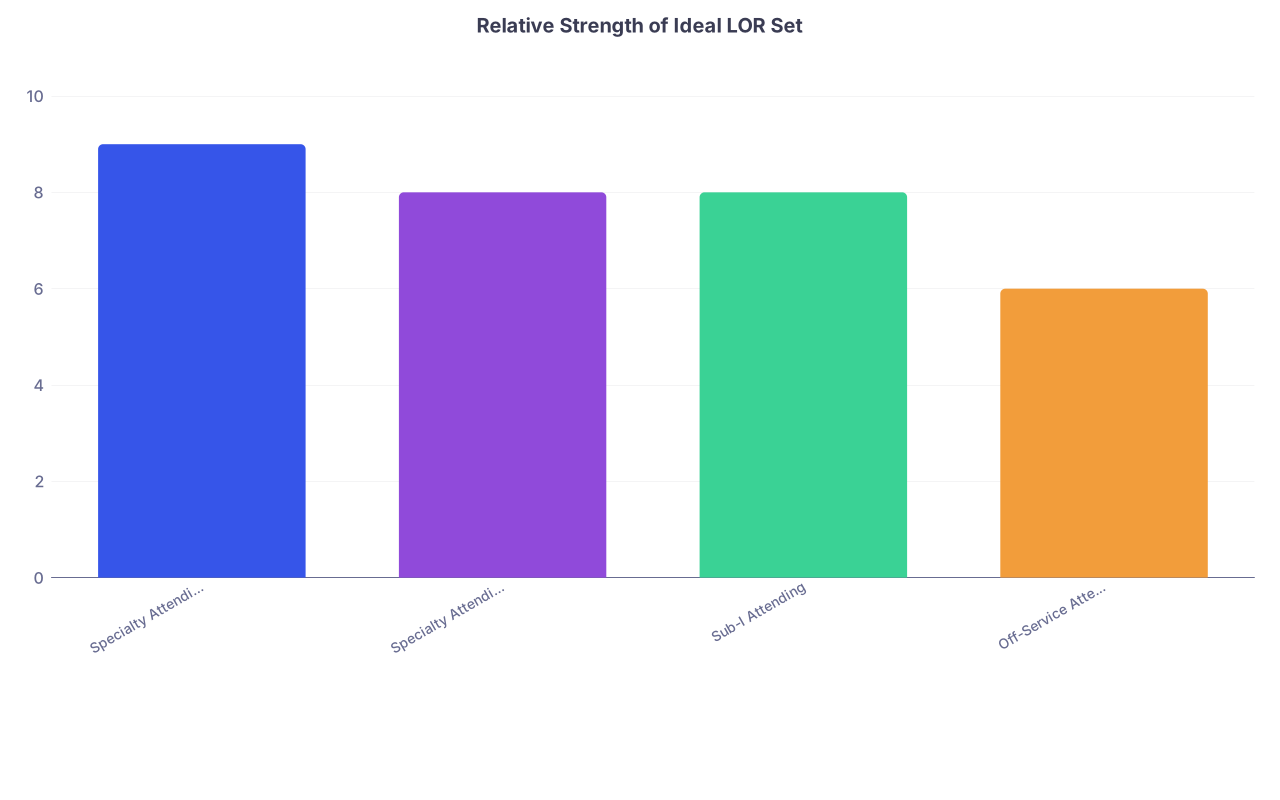
| Category | Value |
|---|---|
| Specialty Attending 1 | 9 |
| Specialty Attending 2 | 8 |
| Sub-I Attending | 8 |
| Off-Service Attending | 6 |
If that off-service attending (the “6”) is from your so-so rotation but speaks to clear improvement and professionalism, that’s acceptable—as long as the others are strong.
Step 10: If You Already Got a Mediocre Letter
If you made the ask before reading this and now suspect the letter was weak, you have two options:
- Leave it and overpower it with better letters
- Replace it if your application system and school allow that before submission deadlines
You cannot see the letter in most systems (and you should waive your right to see them—programs expect that), but the red flags are:
- The attending seemed lukewarm when agreeing
- They submitted very quickly (sometimes a sign they didn’t write much) or extremely late despite reminders (you were not a priority)
- They did not know you well, and your rotation was unremarkable
If you can replace that LOR with someone who is unequivocally enthusiastic, do it.

| Step | Description |
|---|---|
| Step 1 | So-so rotation |
| Step 2 | Do NOT ask |
| Step 3 | Prefer other letter writers |
| Step 4 | Ask using strong letter phrase |
| Step 5 | Use letter |
| Step 6 | Eval mostly positive? |
| Step 7 | Attending know you well? |
| Step 8 | Important for specialty? |
| Step 9 | Enthusiastic yes? |
FAQ: Letters After a So-So Rotation
Will one average letter ruin my entire residency application?
Usually no, if the rest of your application is strong and other letters are clearly enthusiastic. Programs look at the pattern. If you have three excellent letters and one that’s merely fine, that’s survivable. Four “meh” letters? Different story.Should I tell the attending I think I performed poorly?
Don’t dramatize it, but you can briefly acknowledge where you struggled and how you improved. You do not need a confession speech. One line of honest context plus emphasis on growth is enough.Is it better to have a strong letter from a non-core specialty or a lukewarm letter from my target specialty?
In most cases, a strong letter from someone outside the specialty beats a lukewarm in-specialty letter. Programs would rather see someone rave about your work ethic, teachability, and reliability than read a bland note from a random subspecialist in your chosen field.What if my school requires a letter from that specific core rotation?
Then you have to control what you can elsewhere. Crush your sub-I. Get outstanding letters from other attendings. Use your personal statement and experiences to demonstrate growth since that rotation. The required letter becomes one data point, not your entire story.How do I know if my performance was actually ‘so-so’ or just feels that way?
Look at objective data: final evals, comments from residents, direct feedback from the attending. Students with impostor syndrome regularly underestimate themselves. If your eval says “above expectations” or “strong performance,” stop calling it so-so. You’re just anxious.Can I ask for a LOR if I did poorly early but improved at the end?
Yes—and in that case, it might actually be a good idea if the attending noticed and appreciated that improvement. Explicitly reference that growth when you ask. Those “started rough, finished strong” letters can be powerful when they sound credible.How late is too late to ask for a letter from that rotation?
Ideally within 3–6 months, while they still remember you and specific patients. Beyond a year, recall fades and the letter gets generic. If it has been a long time, you must send a very detailed refresher (CV, experiences, specific cases you worked on with them) or it’s not worth it.
Key takeaways:
- Yes, you can ask for a LOR after a so-so performance—but only if your evals are at least neutral-to-positive and you use the “strong letter” filter.
- Mediocre, generic letters quietly hurt you; a smaller set of genuinely strong letters is better than collecting every possible LOR.
- If you had a rough rotation, lean into growth: seek out a sub-I or later rotation where you can clearly outperform and get a letter that proves you are not the same student you were on that “so-so” month.