

The biggest mistake in a dual-application year is pretending you’re doing “one application in two flavors.” You are not. You’re running two full application cycles in parallel—and if you do not run them like two separate projects, your letters of recommendation will be a mess.
Let’s build the timeline so that does not happen.
Big Picture: Dual-Application LOR Strategy at a Glance
You’re applying to two specialties in the same cycle. Maybe EM + IM. Or Neuro + Psych. Maybe you’re hedging a hyper-competitive field (Derm, Ortho, Plastics) with a backup (IM, Prelim Surgery, TY).
At this point, you must treat letters like this:
- Core “generic” letters that can safely go to both specialties.
- Specialty-specific letters that must be siloed to one side only.
- A tracking system that keeps you from sending the wrong letter to the wrong specialty.
Here’s the working target for most dual applicants:
| Letter Type | Count | Used For |
|---|---|---|
| Core Medicine Letter | 1–2 | Both specialties |
| Specialty A Letters | 2–3 | Specialty A only |
| Specialty B Letters | 2–3 | Specialty B only |
| Wildcard / Research | 1 | Stronger fit side by side |
You won’t send all of them to every program, obviously. But you’ll have them available.
Now let’s walk it chronologically—starting almost a year before your ERAS submission.
12–9 Months Before ERAS Opens (Late MS3 / Early MS4): Foundation and Strategy
At this point you should not be collecting letters. You should be planning.
Step 1: Confirm You’re Truly Dual-Applying (9–12 Months Out)
By late MS3 / early MS4:
- You’ve realized your dream specialty is competitive.
- Or you genuinely like two different fields.
- Or your Step/COMLEX scores or clerkship grades put you at risk in your primary field.
At this point you should:
- Pick a primary and secondary specialty.
- Primary = the one you’d choose if every door were open.
- Secondary = realistic, acceptable backup.
- Estimate letter needs for each side.
- Most programs want 3–4 letters total.
- For dual-apps, aim to have ~5–6 letters in the bank.
Step 2: Build Your LOR Map
Sit down one evening and actually map this out. Paper, Notion, Excel—don’t care. But write names.
Create 3 columns:
Column A: Potential “both-sides” letter writers
– Medicine clerkship director
– Sub-I attending in IM or a core rotation
– PD from your home department if broadly supportiveColumn B: Specialty A letter writers
– Attendings from that specialty rotation(s)
– Away rotation attendings
– Research PI strongly tied to that fieldColumn C: Specialty B letter writers
– Same logic as above
At this point you should have at least:
- 2–3 realistic names per column.
- A sense of when you’ll work with each person again (Sub-I? Acting internship? Away?).
8–6 Months Before ERAS (Jan–March): Rotations and Positioning
This is where you stop “hoping” for letters and start engineering them.
Step 3: Choose Rotations With Letters in Mind
At this point you should:
- Front-load rotations that are critical for letters.
- Example: If you’re doing EM + IM
– Do EM rotation(s) in late spring/early summer
– Do an IM Sub-I in a similar timeframe
- Example: If you’re doing EM + IM
- Avoid hiding in electives that won’t help either specialty.
You want:
- At least 1 strong Sub-I or equivalent in each specialty bucket.
- Enough face time with attendings to write meaningful letters.
Step 4: Start Signaling Dual Interest (Quietly and Strategically)
You do not need to advertise to everyone that you’re dual-applying.
At this point you should:
- Be transparent with a few key mentors:
- Home PDs
- Trusted faculty advisor
- A research PI who knows your file
Say something like:
“I’m seriously interested in [Primary], but given competitiveness and my metrics, I’m also preparing a parallel application in [Secondary]. I’d really appreciate your guidance on letters and strategy.”
What you’re doing here is:
- Making sure no one is surprised when you later ask them for a specialty-specific letter.
- Getting advice on whether they feel comfortable supporting one or both sides.
5–4 Months Before ERAS (April–May): Identify Specific Letter Writers
This is your setup phase. You’re still on rotations, but the targets should be getting clearer.
At this point you should:
Lock in your must-have writers.
- For each specialty: aim for 2 attendings who know you well enough to write a strong letter.
- Specifically tell them you’re aiming for a letter later if things continue to go well.
Decide who writes for which side:
- “Dr. A – IM Sub-I → core medicine letter (usable both sides).”
- “Dr. B – EM rotation → EM-only letter.”
- “Dr. C – Neurology Sub-I → Neuro-only letter.”
- “Dr. D – Research mentor → probably primary specialty only, unless generic enough.”
Assess risk.
- If one potential letter writer is lukewarm, you need a backup.
- If you’re clearly stronger in one specialty, you may intentionally overbuild letters there and selectively choose the best ones for the other.
3 Months Before ERAS Opens (Early June): ERAS Opens, Formal Ask Time
This is the real go-time for LOR logistics.
ERAS typically opens in early June; you can start entering writers and assigning them.
At this point you should:
Step 5: Create a Ruthlessly Clear Tracking System
You cannot afford to confuse letters between specialties.
Build a simple sheet with columns:
- Writer name
- Department / specialty
- Letter type (Both / Specialty A / Specialty B)
- ERAS Letter Title (what you will name it)
- Requested date
- Received date
- Notes (e.g., “explicitly mentions applying to EM”)
Example (simplified):
| Writer | Specialty | Type | ERAS Title Label |
|---|---|---|---|
| Smith, MD | IM | Both | Smith – IM – Core Med |
| Lee, MD | EM | EM-only | Lee – EM – Specialty |
| Patel, MD | IM | IM-only | Patel – IM – Specialty |
| Nguyen, MD | Neuro | Neuro-only | Nguyen – Neuro – Spec |
| Garcia, MD | Research | Primary | Garcia – Research – A |
Name them in ERAS so future-you can’t screw up. If you label something “Generic Letter 1,” you will assign it wrong at midnight before a deadline.
Step 6: Ask for Letters Explicitly and Carefully
When you ask, you need to be specific:
For a BOTH-SIDES letter:
“I’m applying in both [A] and [B]. Would you feel comfortable writing a letter focused on my clinical performance and work ethic that could support applications to either field, without specifying a specialty?”For a SPECIALTY-SPECIFIC letter:
“For my [A] application, I’m hoping to have a letter that clearly speaks to my fit for [A]. Would you be willing to write a letter specifically supporting my application to [A] residency programs?”
And here’s the key move in a dual year:
- Don’t ask someone to “keep it vague” if you actually need them to sell you for a specific field.
- Don’t let someone write “Since the day I met them, they’ve been destined to be a surgeon” and then send that to Psychiatry.
Mid-June to Mid-July: Requests Sent, Content Management
At this point you should have:
- Entered all letter writers into ERAS.
- Sent polite, clear requests.
- Given your CV, personal statement drafts (even rough), and a short “here’s what to highlight” bullet list.
Step 7: Give Each Writer the Right Supporting Packet
For BOTH-SIDES letters, send:
- CV
- Short bullet list: “3–5 things I hope this letter can highlight.”
– Clinical reliability
– Work ethic
– Teamwork
– Ability to care for complex patients
For SPECIALTY-SPECIFIC letters, send:
- CV
- Specialty-specific personal statement draft or bullet outline
- Clear note: “I’m applying primarily to [X] programs with a secondary application to [Y]. This letter would be used only for my [X] applications.”
You’re making it easy for them to stay in the right lane.
Mid-July to Early September: Letter Completion and Assignment
This is the danger window. People drag their feet. Faculty go on vacation. You panic.
At this point you should:
Step 8: Nudge Without Becoming a Nuisance
Timeline:
- 2 weeks after initial request: gentle reminder if they haven’t uploaded.
- 4 weeks after: a more direct ping, offer to provide anything else.
- 6+ weeks and no letter: you need a backup plan.
Always keep in mind:
- Some of your “backup” letter writers may become primary if someone flakes.
- It’s better to have an excellent generic medicine letter than a mediocre specialty-specific one.
Step 9: Assign Letters to Each Program Type
Once letters start appearing in ERAS, you must assign them carefully.
You should create two default templates:
Template A – Primary Specialty Programs
- 1 core medicine/broad letter
- 2 specialty-A letters
- 1 research/wildcard (if allowed / relevant)
Template B – Secondary Specialty Programs
- 1 core medicine/broad letter
- 2 specialty-B letters
- 1 research/wildcard or additional broad clinical letter
Then tweak per program requirements.
This is where your naming convention saves you. You’ll see:
- “Smith – IM – Core Med”
- “Lee – EM – Specialty”
- “Nguyen – Neuro – Spec”
…instead of guessing.
September: Submission Month – Locking It In
Most people underestimate how messy this month feels in a dual-app year. You’re finalizing personal statements, program lists, and now letter assignments.
At this point you should:
Step 10: Double-Check for Cross-Contamination
Before you certify and submit:
For every EM program:
- Is every letter either EM-specific or safe generic?
- No “future dermatologist” phrases accidentally going out?
For every backup specialty program:
- Are you sending letters that make sense?
- Did you avoid sending a letter from a PD who would be pissed you’re dual-applying?
Practical tip:
Pick 5 programs from each specialty at random, open their assignments, and read your letter titles line by line. If you catch nothing weird in 10 programs, your system is probably solid.
October–January: Interview Season – Post-Submission Letter Issues
You’re not done with letters when you hit submit. Things still happen.
At this point you might:
- Decide to apply to a few more programs in one specialty late.
- Have a new rotation where someone offers to write you a great letter.
- Realize one of your letters is weak (you hear it indirectly, or you sense it).
Here’s what you should do:
Step 11: Strategic Late Letters
If a late but excellent letter comes in:
- You can add it to programs that haven’t downloaded your previous set yet, depending on timing and system rules that year.
- More realistically, you’ll use it for:
- Programs you apply to later in the season.
- Future fellowship if it’s especially strong.
But do not obsess over swapping letters after interviews are rolling. Programs care far more about the initial set than micro-adjustments done in November.
Step 12: Be Consistent on Interview Day
If you’re dual-applying and interviewers probe:
- Never say you’re “equally passionate” about both to the same interviewer. That lands as dishonest.
- Instead, align your narrative with the specialty you’re talking to, while not lying about the existence of the backup.
Example for a backup specialty interview:
“I explored [Primary] seriously, but as I progressed through my Sub-Is I found that the day-to-day in [Backup] aligned better with how I like to work with patients and teams. I submitted both applications, but I’m here because I see myself very realistically in [Backup].”
Your letters should support that story. Not contradict it.
Common Dual-Application LOR Pitfalls – And When They Happen
Let me be blunt. Here’s where people blow it:
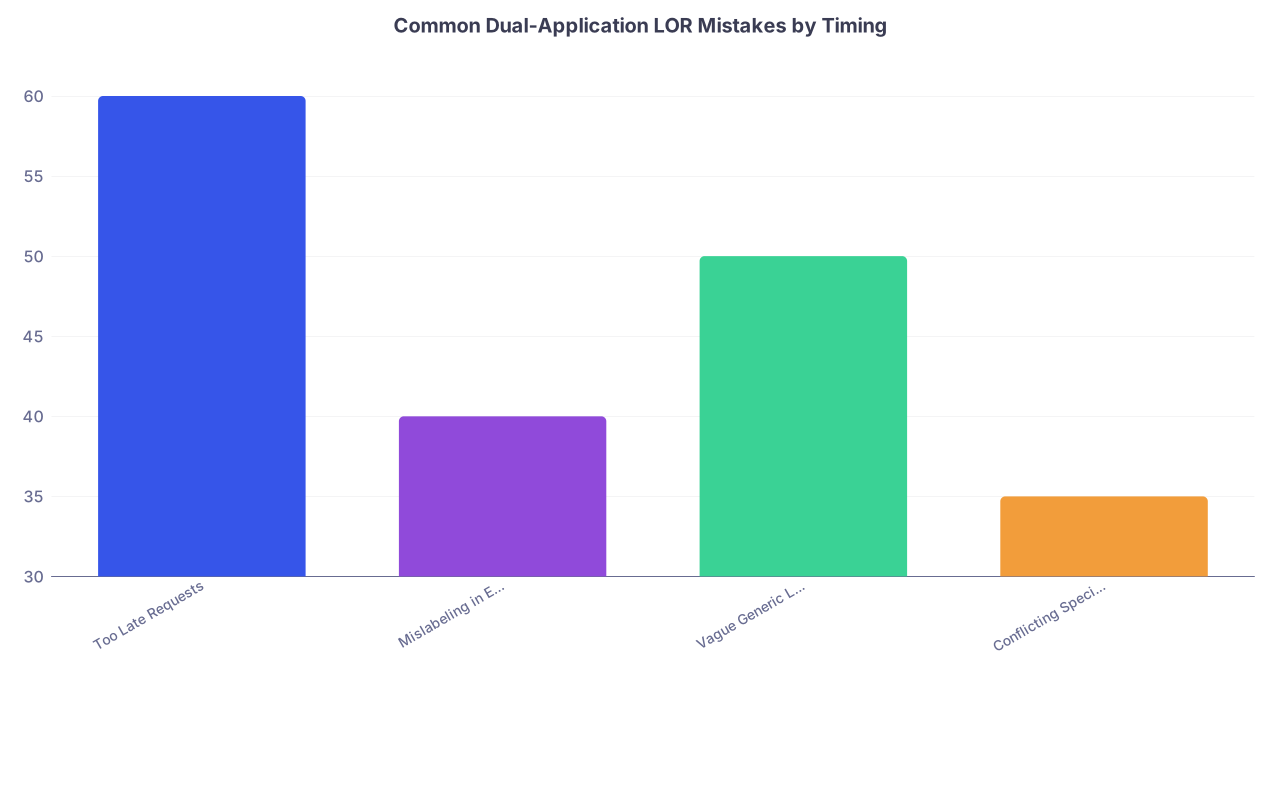
| Category | Value |
|---|---|
| Too Late Requests | 60 |
| Mislabeling in ERAS | 40 |
| Vague Generic Letters | 50 |
| Conflicting Specialty Signals | 35 |
1. Asking Too Late (June/July Instead of April/May)
By that point, attendings are overwhelmed with everyone else’s requests.
Fix: Start asking as soon as a rotation ends, even if you don’t plug it into ERAS until June.
2. Sloppy ERAS Labeling (August)
This is pure user error. I’ve seen people send an “EM Chair Letter” to Internal Medicine programs. Doesn’t kill you every time, but it’s amateur.
Fix: Hard, explicit titles + a tracking sheet. No exceptions.
3. “Generic” Letters That Say Nothing (Anytime)
“Hardworking, dependable, team player” with zero specifics. Useless in competitive specialties. Mildly better than nothing in backup fields.
Fix: When you send your bullet points, prompt writers to comment on:
- Concrete clinical examples.
- Autonomy they gave you.
- How you compare to peers.
Not “nice to work with.”
4. Conflicting Specialty Messaging (Across the Year)
If one letter says you’re born for Ortho, another says you’re meant for Psych, and your personal statement talks about EM, it reads like you don’t know yourself.
Fix:
Use:
- Core letters: focus on clinical ability and character.
- Specialty letters: lean into that field, but don’t trash or over-commit in ways that sound fanatical.
Visual: Month-by-Month Snapshot
Here’s the condensed timeline view.
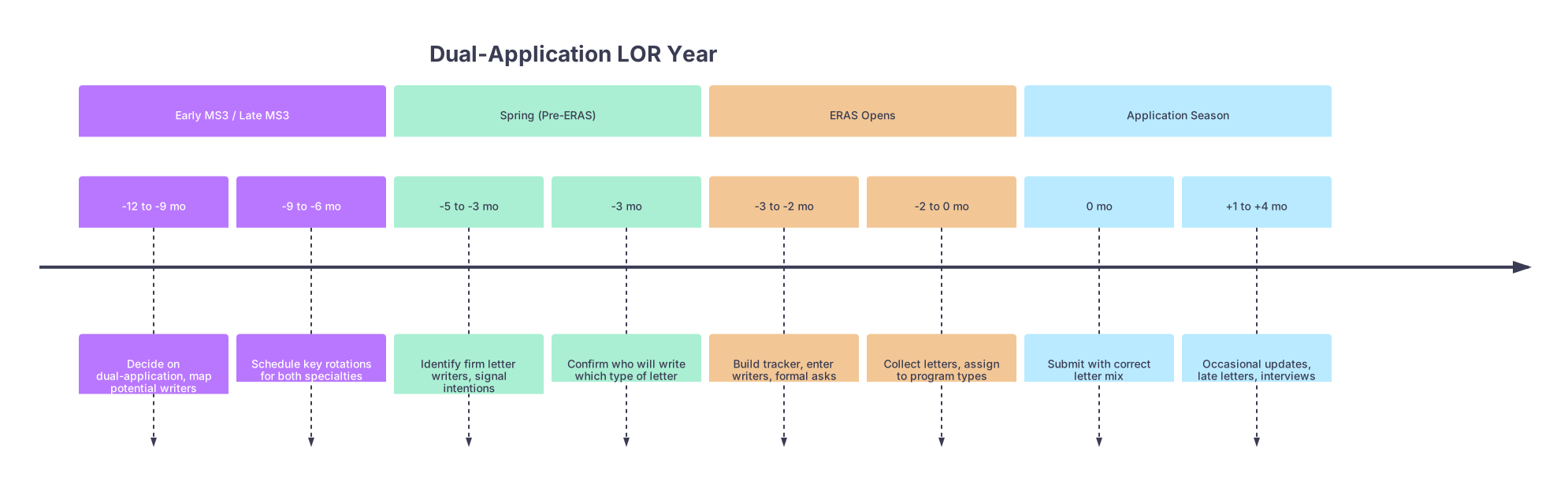
| Period | Event |
|---|---|
| Early MS3 / Late MS3 - -12 to -9 mo | Decide on dual-application, map potential writers |
| Early MS3 / Late MS3 - -9 to -6 mo | Schedule key rotations for both specialties |
| Spring (Pre-ERAS) - -5 to -3 mo | Identify firm letter writers, signal intentions |
| Spring (Pre-ERAS) - -3 mo | Confirm who will write which type of letter |
| ERAS Opens - -3 to -2 mo | Build tracker, enter writers, formal asks |
| ERAS Opens - -2 to 0 mo | Collect letters, assign to program types |
| Application Season - 0 mo | Submit with correct letter mix |
| Application Season - +1 to +4 mo | Occasional updates, late letters, interviews |
Final Checklist by Phase
By ERAS Opening (June), you should already:
- Know your primary and secondary specialties.
- Have at least:
- 1–2 broad clinical letter writers.
- 2 specialty A writers.
- 2 specialty B writers.
- Have a live tracking sheet.
By ERAS Submission (Sept), you should:
- Have 4–6 total letters uploaded.
- Have clear ERAS titles that prevent misassignment.
- Have default letter sets defined for:
- Specialty A programs.
- Specialty B programs.
During Interviews (Oct–Jan), you should:
- Be able to clearly articulate why your letters align with each specialty’s story.
- Stop tinkering with letters unless a truly exceptional new one appears.
Key Takeaways
- A dual-application year is two LOR projects running in parallel. Treat them as separate pipelines with overlap, not one blended process.
- Your survival depends on early planning and clean labeling—who writes for which specialty, how each letter is titled, and where it’s assigned.
- Core clinical letters should be broadly usable; specialty letters must stay siloed. If you get that division right on time, the rest of the cycle gets a lot less chaotic.


