The dual-physician couple match makes normal LOR stress look tame.
You are not just chasing strong letters—you’re coordinating two sets of overlapping faculty, timelines, and politics without stepping on landmines. If you do this casually, you will annoy attendings, confuse coordinators, and risk weaker letters for both of you.
Let’s not do that.
Here’s how to handle letters of recommendation when you’re a dual-physician couple matching—especially when you share letter writers, rotations, or programs.
1. Decide Your Strategy Before You Ask a Single Person
The worst version of this: each of you independently hunting down letters, emailing the same attendings separately, and then realizing in October that one of you has four letters and the other has two…and your “shared” superstar writer only uploaded for one of you.
Before you ask anyone for anything, sit down together and answer five questions:
- What specialties are each of you applying to?
- Are any of those overlapping (IM + cards vs IM + pulm, EM + IM, etc.)?
- Are you both applying to the same set of programs or partially overlapping lists?
- Which attendings know both of you vs only one of you?
- Who are your top 5 potential letter writers each?
Then sketch a simple table like this:
| Attending | Specialty | Knows Applicant A | Knows Applicant B | Strength for A | Strength for B |
|---|---|---|---|---|---|
| Dr. Smith (Cards) | IM | Very well | Slightly | Primary | Backup |
| Dr. Lee (Program Dir) | EM | Very well | Very well | Primary | Primary |
| Dr. Patel (Research PI) | Research | Very well | Well | Primary | Primary |
| Dr. Gomez (Clinic) | IM | Slightly | Very well | Backup | Primary |
You want clarity on:
- Whose “anchor” letters each attending will write
- Where you’re okay sharing a writer
- Where splitting is smarter strategically
Do this once, at the beginning, and you’ll avoid 80% of the headaches.
2. Understand How Overlapping LOR Needs Actually Work in ERAS
People overcomplicate this because they do not understand ERAS mechanics. Let me simplify.
Each of you is a completely separate ERAS application.
That means:
- Each letter writer must upload a separate letter for each applicant.
- They can’t just upload one generic letter and attach it to both of you.
- Program directors will never “accidentally” see the other partner’s letters through ERAS. They only see what’s assigned to that specific application.
So what “overlapping letters” really means is this:
- Same attending, two independent letters, usually uploaded separately.
- Optional: the writer can acknowledge they know you as a couple. Sometimes that helps, sometimes not.
Where overlap creates risk is not in ERAS. It’s in:
- Overburdening attendings and souring their enthusiasm
- Confusing writers (“Wait, which one did I write for already?”)
- Creating obviously copy-pasted letters that sound generic
So your job is to:
- Make their lives easier
- Make your asks clear and spaced out
- Give them clean, separate information packets for each of you
Not complicated. But it must be intentional.
3. Who Should Share Letter Writers—and Who Shouldn’t
This is where couples quietly sabotage each other.
You do not both need letters from every overlapping attending. You need the right attendings for the right person.
Use this framework:
A. Shared letter writer is a clear win when:
- The attending knows both of you well
- You both performed strongly under them (no “one of us was fine, the other was amazing” situation)
- They’re a big name or PD/APD and genuinely enthusiastic about both
Example:
You’re an IM-IM couple, both did sub-I’s on the same service with Dr. Lee, the Associate Program Director. You each rounded with them repeatedly. They clearly liked both of you and said some version of, “You’re both excellent; I’d be happy to support your applications.”
That’s a shared anchor letter. Use it for both.
B. Shared letter writer is a maybe when:
- They know both of you, but clearly liked one more
- One of you had more direct patient responsibility with them
- One of you has another stronger option
In that case:
- The “stronger connection” partner uses them as an anchor letter.
- The other partner can still request a letter—but not at the cost of better options.
C. Shared letter writer is a bad idea when:
- They barely know one of you
- You shared a rotation, but they consistently addressed questions or feedback more to one partner
- You’re relying on them because “they’re a big name” even though the relationship is thin
I’ve seen couples insist on matching their letter lineups one-to-one to “show unity.” That’s foolish. Programs care more that each of you is strong individually than that your letters mirror each other.
Bottom line: optimize for strength, not symmetry.
4. How to Approach Shared Letter Writers Without Being Awkward
This is where people get weird. They either overshare (“we’re soulmates since M1 anatomy lab”) or they pretend the other person doesn’t exist.
Do this like a professional.
Step 1: Decide whether to mention the couple match
For most core letters, I lean yes—briefly. Especially if:
- You’re targeting the same geographic regions
- You’re applying to similar or compatible specialties
- The attending knows you as a couple already
For niche research letters, I do not care if they mention it or not. It’s background.
Step 2: Ask individually, not as a two-for-one package
Bad version:
“Dr. Lee, would you be willing to write letters for both me and my partner?”
Better version (timed within a day or two of each other):
You:
“Dr. Lee, I really valued working with you on my EM rotation and your feedback was very encouraging. I’m applying to EM this cycle and would be honored if you’d be willing to write a strong letter of recommendation on my behalf.”
Your partner (separately):
“Dr. Lee, I wanted to thank you again for the teaching on shift and your guidance about EM. I’m applying this cycle as well and would be grateful if you’d consider writing a strong letter of recommendation for me.”
Optional follow-up in person or email, once they’ve said yes, from either of you:
“We are couples matching in EM this year, so you may see both of our letter requests. We’ll each send you separate CVs and personal statements to make it easy to keep things straight.”
That’s it. Not dramatic. Not begging.
5. What to Give Overlapping Letter Writers (Keep It Clean)
The fastest way to get two mediocre, copy-paste sounding letters is to hand over identical materials.
For each of you, prepare:
- Your own CV
- Your own personal statement (draft is fine)
- A short “one-page summary” tailored to that writer
The one-page summary (per person) should include:
- How you worked with them (dates, rotation, role)
- 3–5 specific cases or moments they might remember
- Your specialty choice and why
- A very brief note on the couples match and what regions/program types you’re targeting
Key: Do not list the exact same talking points for both of you. You want letters that can stand alone, not sound like “Copy…replace name…upload.”
For example, if both of you worked with Dr. Lee in EM:
You:
- Highlight that airway you handled
- The overnight shift where you took ownership of sign-outs
- The teaching you did for an MS3
Partner:
- Highlight the complex social dispo case
- The procedure-heavy trauma shift
- Feedback they got on documentation and follow-through
Give the attending different hooks. Make it easy for them to tell two distinct stories.
6. Handling Timing Conflicts and Writer Burnout
Dual applications mean double the deadlines. Some attendings handle this well. Some barely manage a single letter.
Here is the reality: some of your shared potential writers will fail one of you. You have to plan for that upfront.
Create staggered internal deadlines
For each of you, make a simple timeline:
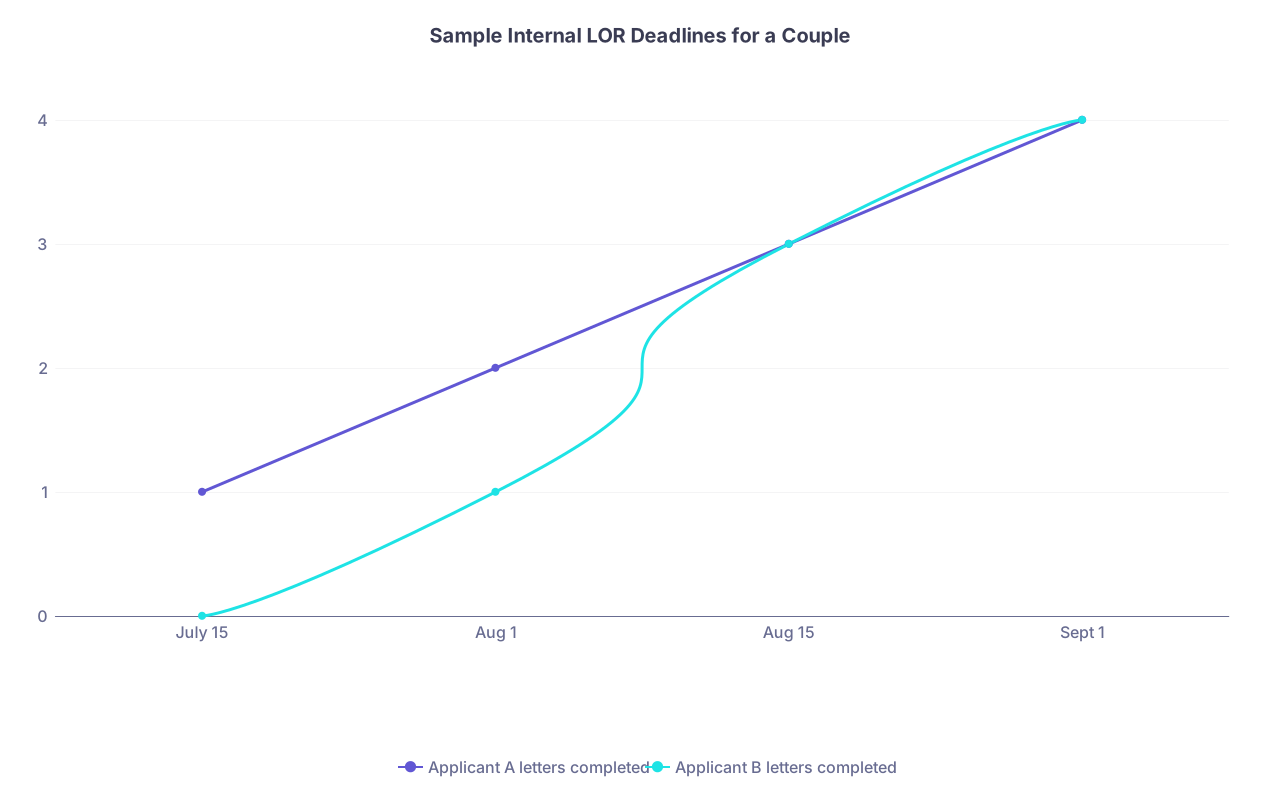
| Category | Applicant A letters completed | Applicant B letters completed |
|---|---|---|
| July 15 | 1 | 0 |
| Aug 1 | 2 | 1 |
| Aug 15 | 3 | 3 |
| Sept 1 | 4 | 4 |
Then:
- Ask your most critical shared writer earlier than others
- Give them the same final deadline, but check in politely at different times
Example check-in:
“Dear Dr. Lee, I hope your month is going well. Just a quick note to say ERAS opens for programs to view applications on [date], so I wanted to confirm that you’re still able to submit my letter by [2 weeks before]. I’m very grateful for your support, and happy to resend my materials if helpful.”
If someone is dragging:
- One of you can nudge by email.
- The other waits a week, then nudges if still nothing.
- If they still do not upload with 1–2 weeks to go, activate a backup writer.
Do not let a shared letter writer hold both of you hostage.
7. Specialty-Specific Couple Scenarios (And How to Adjust Letters)
Not all couples are built the same. Some combinations need more deliberate LOR messaging.
Same specialty, same programs (IM + IM, EM + EM)
Goal: convince programs you’re both excellent independently and a net asset together.
LOR implications:
- At least one shared “anchor” letter from someone who knows both of you and can briefly vouch for you as a couple.
- Other letters should be distinct—different attendings, different angles (wards vs ICU vs clinic, etc.).
- Consider asking one shared writer to include a sentence like:
“I have had the opportunity to work with both [Name] and [Partner Name] and would strongly recommend them individually and as a couple. They function as independent, highly capable trainees who also support one another professionally in a mature and healthy way.”
Programs read thousands of letters. A line like that actually stands out.
Different specialties, same institutions (IM + Neurology, Peds + Med-Peds, etc.)
Goal: show you’re each a fit for your own field and aware of local dynamics if you’re targeting the same hospitals.
LOR implications:
- Each of you leans heavily on specialty-specific writers.
- A shared letter is optional. If it exists, it should be framed around work ethic, communication, and professionalism, not niche specialty skills.
- If you share a research PI or mentor, they’re perfect for acknowledging the couple match, especially if they know your long-term plans.
Very different competitiveness (e.g., Derm + FM, Ortho + IM, ENT + Peds)
This is where people quietly freak out: “Will our weaker specialty hold the other back?”
Letters will not fully solve that, but they can help calibrate expectations and signal realism.
- The more competitive partner should have absolutely bulletproof specialty letters from people who know them well. Fewer shared writers, more laser-focused field advocates.
- The less competitive partner benefits from letters that emphasize reliability, teachability, and being a strong team member—programs want to know they’re not taking on someone coasting on the other partner’s coattails.
Do not try to “equalize” by overusing shared letter writers. That usually just dilutes things.
8. How Much Should Letters Talk About the Couples Match?
Some of you are overestimating how much programs care. Others are underestimating it.
Here’s a sane middle ground:
- 0–1 sentences per letter is usually enough.
- Not every letter needs to mention it.
- The best letter to mention it is from someone who:
- Knows you both
- Understands your geographic goals
- Can vouch for the health and professionalism of your relationship
For example:
“I am aware that [Name] is participating in the couples match with [Partner Name], also a highly capable applicant whom I’ve had the pleasure of supervising. I believe they will each thrive in rigorous training environments and bring mutual support without any compromise to their professionalism or independence.”
That’s all you need. No dramatic love story.
9. What to Do If One of You Has Noticeably Weaker LOR Options
It happens all the time. One partner rotated with stars, the other drew the short straw with disengaged attendings or chaotic services.
Resist the temptation to “fix” this entirely through shared letter writers. A forced shared letter from someone who barely knows the weaker partner is obvious and backfires.
Instead:
Optimize within what you have.
Hunt for the person who actually saw you work, even if they’re not a big name. A strong, specific letter from a mid-level faculty is better than a generic note from a chair.Use non-clinical letters strategically.
Research PI, longitudinal clinic preceptor, student health clinic supervisor, etc. Especially for the weaker portfolio, these people may know them much better.Avoid one-sided “we love Partner A, Partner B is fine I guess” shared letters.
If an attending is clearly more enthusiastic about one of you, let them lean into that and find alternative writers for the other.
If you’re unsure, ask the attending directly after they agree:
“Do you feel you know my work well enough to write a strong letter on my behalf?”
If they hesitate verbally or in body language, that’s a no. Believe them.
10. Coordinate Without Micromanaging Each Other
The couple match can turn into a project management disaster. Do not let letters become a source of resentment.
Here’s how to stay organized without becoming each other’s boss:
Share a simple spreadsheet with:
- Writer name
- Specialty
- For Applicant A (Y/N)
- For Applicant B (Y/N)
- Date asked
- Date materials sent
- Target upload deadline
- Confirmed uploaded (Y/N)
Have a 15-minute “LOR check-in” once a week for one month, then every two weeks.
- Not daily. Not an ongoing argument. Just a status review.
Respect that each of you may prioritize different writers. You can advise each other; you cannot run each other’s careers.
The goal is alignment, not control.
11. Example Email Templates You Can Actually Use
You do not need flowery language. You need clear, respectful, efficient.
Initial ask (shared writer, you’re the first partner)
Subject: Letter of Recommendation Request – [Your Name], [Specialty]
“Dear Dr. [Last Name],
I greatly appreciated the opportunity to work with you on the [rotation/service] from [dates]. Your teaching and feedback were very impactful, and the experience confirmed my interest in [specialty].
I am applying to [specialty] residency this cycle and would be honored if you would be willing to write a strong letter of recommendation on my behalf.
If you’re able, I will send my CV, personal statement draft, and a brief summary of my work on the rotation to make this as easy as possible. ERAS allows you to upload the letter directly with a link you’ll receive by email.
Thank you for considering this,
[Name] [Med School] AAMC ID: [ID]”
Second partner referencing the couples match (after first has asked)
Subject: Letter of Recommendation Request – [Partner Name], [Specialty]
“Dear Dr. [Last Name],
I also wanted to reach out and thank you for the teaching and guidance on our recent [rotation/service]. I learned a great deal from working with you and the team.
I am applying to [specialty] residency this year and would be very grateful if you’d consider writing a strong letter of recommendation for my application as well.
[Partner Name] and I are couples matching this cycle, so you may see letter requests for both of us. If you’re able to support my application, I’ll send a separate email with my CV, personal statement draft, and a brief summary of my work on the rotation.
Thank you very much for your time and consideration,
[Name] [Med School] AAMC ID: [ID]”
Adjust the tone to match your relationship with the writer, but keep the structure.
12. Quick Reality Check: How Programs Actually Read These Letters
Most couple-match applicants wildly overinterpret micro-signals.
Here’s what actually matters from letters, in order:
- Are they clearly strong? (language like “outstanding,” “top 5–10%,” concrete examples)
- Are they specific to you as an individual?
- Are they from appropriate faculty (specialty-aligned, PD/APD when possible)?
- Do any of them quietly raise a red flag?
- For couples: does at least one letter confirm you’re a functional, professional pair?
Nobody is sitting there with your two applications side-by-side scoring how similarly your letter writers describe your communication style.
Good enough is good enough. Perfectionism here just burns time and energy you need for personal statements and program lists.
13. Put It All Together: A Clean Process for Dual-Physician LORs
Here’s the whole thing in a single flow, if you want the 10,000-foot view:

| Step | Description |
|---|---|
| Step 1 | Meet as a couple map writers |
| Step 2 | Classify shared vs solo writers |
| Step 3 | Each drafts own CV & PS |
| Step 4 | Prepare separate one-page summaries |
| Step 5 | Ask key shared writers first |
| Step 6 | Ask solo writers next |
| Step 7 | Track responses & upload status |
| Step 8 | Send polite reminders / activate backups |
| Step 9 | Verify 3-4 strong letters each before ERAS release |
Do that, and you’re miles ahead of most couples who are improvising this on the fly in September.
Open a shared document with your partner tonight and list your top 5 potential letter writers each—then mark which are shared and decide, on purpose, who they should prioritize.