
The way most applicants use letters of recommendation to show “fit” is lazy and ineffective.
You cannot just collect three generic “hard‑working, a pleasure to work with” letters and expect programs—academic or private—to magically infer that you belong there. If you are serious about matching into the right environment, you have to engineer your letters to speak the language of that track.
Let me break this down specifically.
Academic vs. Private Practice: What Programs Are Actually Screening For
Before you worry about letters, you need to understand the two very different “products” you are selling yourself as:
- Future academic faculty or fellow (research, teaching, leadership)
- Future high‑throughput, efficient clinician who will thrive in private practice
Most people mash these together into one generic narrative. That is a mistake.
What Academic Programs Listen For
Academic residencies are hunting for evidence that you will:
- Generate or at least engage with research and quality‑improvement work
- Teach students and junior residents reliably
- Fit a culture where conferences, grand rounds, and scholarly activity matter
- Potentially pursue fellowship or academic faculty positions
They listen for specific signals:
- “She drove a retrospective chart review from IRB submission to manuscript draft.”
- “He presented at our departmental M&M and fielded questions at the level of a PGY‑3.”
- “She mentored two M3s on the clerkship and received top evaluations.”
- “He has the intellectual curiosity and scholarly inclination typical of our best residents who go on to fellowship.”
The tone is: depth, curiosity, initiative, teachability, promise for scholarship.
What Private Practice–Oriented Programs Listen For
Community and private‑practice–leaning programs, even if “university‑affiliated,” are looking for something more immediate and operational:
- Can you see patients efficiently and safely?
- Will you be low‑maintenance and reliable?
- Are you pleasant to work with at 2 a.m.?
- Will attendings be comfortable letting you run a busy service?
Their signals:
- “She independently managed a 15‑patient census and consistently completed notes before sign‑out.”
- “He functioned almost at the level of an intern in the ED, seeing patients quickly and making sound initial plans.”
- “Our nurses specifically requested to work with her again.”
- “He is the type of resident who will keep a private practice running on time.”
The tone is: efficiency, practicality, teamwork, steady judgment, low drama.
If your letters do not clearly skew toward one of those sets of signals, you are wasting an opportunity.
Step 1: Decide What Track You Are Actually Aiming For
You cannot optimize letters for “everything.” Programs smell that.
Ask yourself honestly:
- Are you genuinely interested in research, teaching, or fellowship?
- Or do you primarily want to be a strong clinician in a high‑volume environment with decent work‑life balance?
Your answer dictates how you structure your LOR portfolio. Think portfolio, not isolated letters.
| Target Track | Ideal LOR Mix (3–4 letters) |
|---|---|
| Pure Academic | 2 research/academic attendings, 1 strong clinical educator, +/− 1 PD/chair |
| Academic-leaning hybrid | 2 strong clinical letters, 1 research/academic mentor, +/− 1 PD |
| Private Practice–leaning | 3 strong clinical letters (busy services), ideally 1 from community site |
| Undecided / broad apply | 2 strong clinical, 1 “scholarly” letter, 1 flexible (research or clinical) |
You can apply broadly with the same LOR set, but you should know which letters are doing what for you, and which to upload where if ERAS allows targeting by program (more on this later).
Step 2: Choose Your Letter Writers Strategically
This is where most people go wrong. They pick letter writers by prestige alone.
“Big name” is useful only if the content matches your track.
For Academic‑Track Messaging
Prioritize:
- Research mentors (especially if MD/PhD, NIH‑funded, or known in your specialty)
- Clerkship or sub‑I attendings who saw you present at journal club, M&M, or grand rounds
- Program directors or associate PDs at academic centers
Avoid:
- Famous department chair who barely knows you
- Research PI where you just pipetted for 6 weeks and left
The ideal academic letter writer:
- Has seen your work over time (months, not days)
- Can describe your role in specific projects, papers, or QI work
- Can credibly say you functioned at or above level for your training
If you have a first‑author abstract or poster, your mentor who supervised that needs to write one of your core letters. Period.
For Private Practice / Community‑Oriented Messaging
Prioritize:
- Attendings on busy inpatient rotations (medicine wards, surgery, OB, ED)
- Community preceptors where you saw a high volume of patients
- Hospitalist or ED physicians known for being demanding but fair
These writers must have seen you:
- Manage volume
- Communicate with nurses and staff
- Handle stress without falling apart
- Show up on time, do scut, not complain
A letter that says “she was efficient, thorough, and needed minimal supervision by the end of the rotation” is gold for private‑practice programs.
One More Rule: Duration and Proximity Matter More Than Title
A mid‑career hospitalist you worked with for 4 weeks is better than a world‑famous chair you scrubbed with twice.
If your letter writer cannot comfortably answer: “Give me 3 specific examples of this student’s performance,” they are the wrong writer.
Step 3: Script the Ask – How You Frame Your Request Changes the Letter
You are not just asking for a letter. You are asking for a very specific kind of letter.
You say this explicitly.
For academic‑track emphasis:
“Dr. X, I am applying primarily to academic internal medicine programs with the goal of pursuing a fellowship and staying involved in research and teaching. Would you feel comfortable writing a strong letter of recommendation that highlights my scholarly potential, curiosity, and ability to work in an academic environment?”
For private‑practice emphasis:
“Dr. Y, I am applying broadly, but I am especially drawn to programs with strong clinical training and a busy, hands‑on environment. Would you feel comfortable writing a strong letter that emphasizes my clinical performance, efficiency, and ability to function as an intern on a busy service?”
Do not be vague. Give them the frame.
And yes, say the phrase “strong letter.” If they hesitate even slightly, thank them and ask someone else.
Step 4: Provide Targeted Brag Sheets – Academic vs. Private Practice Content
If you hand every letter writer the same generic CV and personal statement, you are forcing them to guess which aspects to highlight. They will guess wrong.
You create slightly different “one‑pager” packets depending on who is writing.
Academic‑Track Brag Sheet Should Emphasize:
- Research: titles, your role, status (submitted, accepted, in prep)
- QI or scholarly projects
- Presentations: grand rounds, journal clubs, posters, oral talks
- Teaching: tutoring, TA work, M4 teaching electives
- Long‑term academic goals: interest in fellowship, specific fields
You literally write bullets like:
- “On our oncology rotation, I appreciated how you let me take the lead on researching and presenting the management of immune checkpoint inhibitor colitis. This experience reinforced my interest in academic oncology and teaching at the resident level.”
That reminds them of a specific scene they can anchor the letter to.
Private‑Practice–Oriented Brag Sheet Should Emphasize:
- High‑volume clinical experiences (with rough numbers)
- Independent responsibilities you handled
- Feedback from nurses, patients, or interns
- Situations where you handled time pressure or complexity well
- Goals related to being a strong, efficient clinician
Bullets here look like:
- “On your wards team, I averaged 10–12 patients that I followed primarily, and consistently finished my notes and orders before sign‑out. I would be grateful if you could comment on my time management and ability to function at intern level.”
You are not writing the letter for them. You are jogging their memory and giving them the vocabulary.
Step 5: Content Elements That Scream “Academic Fit” vs. “Private Practice Fit”
Let us be precise about what your letters should actually contain. The patterns are predictable.
Academic‑Fit Letter: What It Should Sound Like
Key themes:
- Intellectual curiosity
- Engagement with literature and evidence
- Self‑directed learning
- Teaching and mentorship
- Long‑term scholarly potential
Concrete examples that work:
- “She independently reviewed three RCTs on SGLT2 inhibitors prior to rounds and synthesized the data to guide our patient’s management. This level of preparation is uncommon among students.”
- “He led a journal club on anticoagulation reversal that I would have been happy to see from one of my PGY‑2 residents.”
- “She designed the data collection form for our sepsis QI project and, without prompting, learned basic R to help with the analysis.”
Phrases that help academic programs map you into their mental template:
- “Will excel in a rigorous academic residency.”
- “Has the makings of a future fellow and faculty member.”
- “Among the top X% of students I have worked with in the last Y years in terms of scholarly potential.”
If none of your letters use words like “curiosity,” “academic,” “scholarly,” “fellowship,” “presentation,” or “research,” academic PDs will not automatically infer that from your Step score alone.
Private Practice–Fit Letter: What It Should Sound Like
Key themes:
- Reliability and independence
- Volume handling and efficiency
- Practical clinical judgment
- Teamwork and communication
- Low maintenance, high output
Strong specifics:
- “By the second week of the rotation, he was seeing new ED patients independently, formulating initial plans, and then refining them with me, similar to a new intern.”
- “She rounded on a 16‑patient list, knew every detail of her patients, and was always ready with a plan and backup plan.”
- “On night float, he responded quickly to pages, communicated clearly with nurses, and never needed to be reminded to follow up on critical labs.”
Phrases that trigger confidence in private‑practice–oriented PDs:
- “Will be clinically ready to hit the ground running as an intern.”
- “Functions at or above the level of a first‑year resident.”
- “Someone I would be comfortable hiring in my own practice.”
There is overlap, obviously. But the center of gravity of each letter needs to be deliberately shifted.
Step 6: Using ERAS Strategically – Different Letters for Different Programs
If ERAS allows program‑specific letter assignment in your cycle (this has changed over the years; always confirm the current rules), you should use that.
You can maintain a master pool of 4–5 letters, then select subsets for:
- Pure academic “big university” programs
- Academic‑community hybrids
- Primarily community/private programs
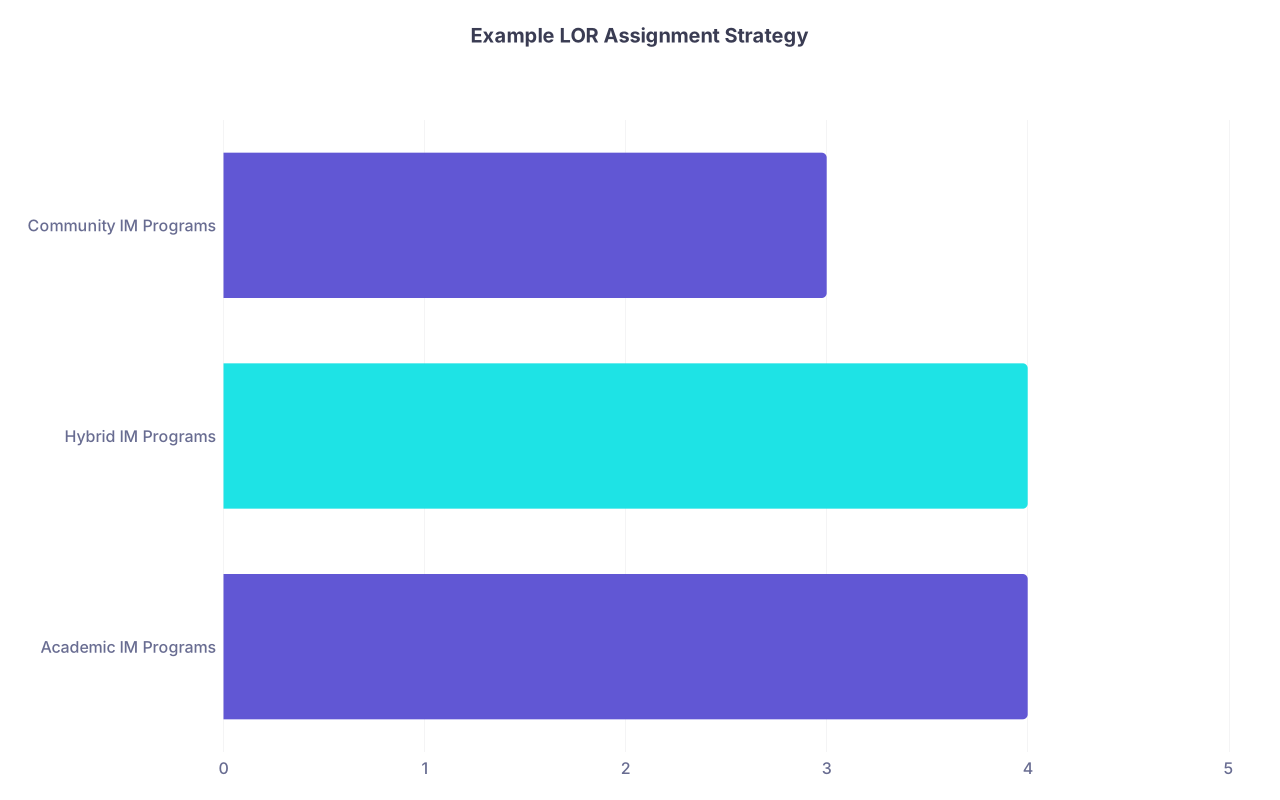
| Category | Value |
|---|---|
| Academic IM Programs | 4 |
| Hybrid IM Programs | 4 |
| Community IM Programs | 3 |
Example pool for internal medicine:
- Dr. A – Research mentor (heavy academic emphasis)
- Dr. B – Academic ward attending (balanced academic/clinical)
- Dr. C – Community hospitalist (strong clinical, busy volume)
- Dr. D – Sub‑I attending with teaching focus
- Dr. E – PD letter (global assessment, somewhat academic)
You might assign:
Academic IM programs:
- A, B, D, E
Hybrid programs:
- B, C, D, E
Community/private‑leaning:
- B, C, E (or B, C, D)
The point: do not send your research‑heavy letter as 1 of only 3 letters to a pure community program that barely does research. They will not care that you did a mouse model study. They want to know if you can run sign‑out smoothly.
Step 7: Aligning Your Personal Statement and ERAS with Your LOR Message
Programs are very good at spotting incoherence.
If your personal statement screams “I want to be a physician‑scientist, pursue T32 funding, and run a lab” but your letters only talk about your work ethic on nights and your love of procedures, that disconnect sets off alarms.
Align the ecosystem:
For an academic focus:
- Personal statement: discuss specific research interests, teaching you enjoyed, mentors who shaped your academic direction
- ERAS activities: emphasize research, QI, posters, teaching awards
- LORs: at least one letter that illustrates those things in real scenes
For a private‑practice emphasis:
- Personal statement: focus on patient care, continuity, real‑world practice interests
- ERAS activities: highlight free clinic work, longitudinal care, heavy clinical electives
- LORs: multiple letters showing efficiency, teamwork, reliability under load
You are telling one coherent story from multiple angles, not improvising three different personas.
Step 8: Pitfalls I See Every Cycle (and How to Avoid Them)
Let me be direct about the most common self‑inflicted wounds.
The “Triple Generic” Problem
Three letters full of: “hardworking, pleasant, team player.” No numbers. No rankings. No specifics. These letters help no one and actively hurt competitive applicants. Push your writers to be concrete by giving them those brag sheets.Prestige Over Substance
A one‑paragraph letter from a famous chair who cannot remember which rotation you were on is worse than a detailed three‑page letter from a rank‑and‑file attending who supervised you for a month.Unintentional Mismatch
An entire portfolio of research‑heavy letters sent to a community‑dominated application list. PDs think: “They will be unhappy here, they will leave for a fellowship immediately, or they are not serious about our kind of medicine.”The “One Weird Letter”
Three strong clinical letters and one ambivalent, lukewarm academic letter that subtly implies you are weak in scholarship. That can sink you with top academic programs. If you suspect a letter may be mediocre, do not use it.Late or Missing Letters
Some exceptional letters arrive in November. Programs have already screened. If a writer is notorious for being late, ask them early (3–4 months), give reminders, and have backups.
A Simple Process Map: From Rotation to Track‑Aligned LOR

| Step | Description |
|---|---|
| Step 1 | Identify Target Track |
| Step 2 | Select Rotations Strategically |
| Step 3 | Perform and Signal Interests |
| Step 4 | Choose Specific Letter Writers |
| Step 5 | Frame the Ask by Track |
| Step 6 | Provide Tailored Brag Sheets |
| Step 7 | Upload to ERAS Letter Pool |
| Step 8 | Assign Letters by Program Type |
If you follow that flow intentionally, your letters start working for you instead of just existing in your file.
FAQs
1. I am genuinely undecided between academic and private practice. How should I balance my letters?
You build a hybrid portfolio. That usually means:
- Two clearly strong clinical letters (busy general rotations)
- One letter that emphasizes academic potential (research mentor or academic attending)
- Optionally a fourth from a PD or sub‑I attending that leans whichever way your final list leans
Then you adjust targeting:
- Academic‑heavy programs: include the academic letter
- Community‑heavy: you may drop the pure research letter in favor of clinical ones, unless the research is very clinically relevant
Your personal statement should be honest: you value strong clinical training first, with openness to academic involvement, rather than pretending you have a 10‑year R01 plan.
2. I do not have any real research. Can I still present as a good fit for academic programs?
Yes, but you need to lean on “academic behavior” rather than formal research output.
That means letters that describe:
- Evidence‑based presentations you gave
- How you incorporated new literature into rounds
- Teaching juniors or medical students
- Participating in at least a small QI or case report project
Academic programs are not expecting every applicant to have 10 PubMed‑indexed papers. But they are absolutely expecting evidence that you think like someone who enjoys academic environments. Make sure at least one letter spells that out.
3. Should I ever coach a letter writer with sample language?
You should not ghost‑write your own letter. That is unethical and often obvious.
However, you can absolutely send:
- A bulleted list of specific cases or projects you worked on together
- A short paragraph reminding them of your goals (“I am applying primarily to academic X programs with interest in Y field…”)
- A sentence like: “If possible, it would help me if you could comment on my [clinical independence / teaching skills / research involvement], since these are important for the programs I am targeting.”
You are guiding emphasis, not dictating prose. Good attendings appreciate this because it makes their job easier.
4. How many “academic” letters do I need for a strongly research‑oriented specialty?
For highly academic specialties (radiation oncology, dermatology at top programs, some neurology/IM programs with heavy research expectation), I recommend:
- At least one letter from a research mentor in that specialty
- One from an academic attending who saw you on a core rotation or sub‑I
- One from a sub‑I or PD that comments on your behavior as a future academic resident
If you have four letters, you can have two clearly academic, one balanced, and one purely clinical. Then you customize which three each program sees based on their profile.
5. My strongest letter is from a community preceptor. Will academic programs look down on that?
No, not if the letter is excellent and detailed.
Academic PDs respect specific, enthusiastic clinical letters. What they do not respect is an entire portfolio that looks like you have never engaged in anything academic. If your best letter is community‑based, use it proudly, but pair it with at least one letter that shows you can function in an academic context: conferences, teaching, some exposure to scholarly work.
Key takeaways:
- You do not “collect” letters; you design a portfolio that either screams “academic potential” or “high‑yield clinician”—on purpose.
- Your ask, brag sheets, and letter selection have to match the track you claim to want, or PDs will smell the inconsistency.
- The best letters give concrete scenes that match the environment you are targeting—research meetings and conferences for academic tracks, busy services and independent clinical work for private practice tracks.