
It is Monday of Match Week, 2:45 pm Eastern. You did not match. The NRMP email is still open on your screen. Your phone is buzzing with group chats and half-panicked messages about SOAP. In less than 24 hours, your SOAP rank list will decide whether you have a residency spot in July—or spend a year explaining “what happened” to every future program director.
You are stressed, tired, and moving fast. That is exactly when people make the kind of SOAP rank list mistakes that quietly kill opportunities they actually could have had.
Let me walk you through the landmines. I have watched people absolutely sabotage themselves here.
Big Picture: How People Blow SOAP Before It Starts
Most applicants think SOAP is about “finding any open spot.” That mindset is how you end up jobless in March with Step 200s, decent letters, and forty applications sent straight into the void.
The real game in SOAP:
- You have very little time
- With limited applications
- To target programs that might actually say yes
- And then rank them in a way that does not trap you into bad outcomes or no outcome
People focus on the first three and neglect that last part. The rank list. The one thing you fully control.
Here are the worst errors I see and how to avoid them.
Error #1: Building Your Rank List Before You Understand the Rules
You would be shocked how many people do not really understand how SOAP matching actually works, yet they are ranking programs like it is a vibe check.
SOAP is not the regular Match, but the matching logic is still applicant-proposing. That means:
You get offers based on:
- Who interviewed you
- How those programs rank you
- How you ranked them
When you accept an offer:
- You are done for that SOAP round
- You cannot “trade up” later in the same round
- You cannot accept another SOAP offer in that specialty in a later round
The mistake: acting like SOAP is a casual, “see what happens” process. It is not. Every rank decision is binding if it hits.
You must avoid:
- Ranking programs in an order that does not reflect what you are actually willing to accept
- Assuming “I can just decline if I change my mind later” – no, you cannot without burning bridges and potentially breaking rules
- Not recognizing that each round is its own match – your rank list for that round matters right now
If you have not read the official NRMP SOAP instructions front to back, do that before you touch your rank list. Not after.
Error #2: Over-Weighting Prestige When You Are Already in SOAP
If you are in SOAP, you are not shopping for prestige. You are trying to secure training, licensure, and a career.
Yet every year I see people rank lists like this:
- “Big-name” university IM program with 1 open spot, historically fills in SOAP with 260+
- Competitive community program in a saturated metro area
- Mid-tier program that often takes unmatched grads
- Less desirable location but solid training and known to be friendly to SOAP candidates
- Rural program that almost always fills through SOAP and accepts IMGs, lower scores
They then act surprised when they go unfilled in SOAP because they ranked “dream” programs higher than the ones that were actually realistic.
Here is what you are forgetting:
- You are not in the main Match anymore
- Any program in SOAP:
- Could not or did not fill
- Is likely getting flooded by desperate applicants
- Big-name programs will be swimming in high-stat, previously unmatched, or switching-specialty candidates
Your rank list needs to be ruthlessly realistic, not aspirational.
Look at something like this breakdown:
| Priority Level | Program Type | Realistic For Most SOAP Applicants? |
|---|---|---|
| 1 | Known SOAP-friendly, open to IMGs, average scores | Yes |
| 2 | Mid-tier community, some SOAP history | Maybe |
| 3 | Academic mid/high-tier, rare SOAP spots | Rarely |
| 4 | Top academic, very competitive locations | Almost never |
| 5 | Programs that explicitly avoid SOAP grads | No |
Mistake to avoid: ranking Level 3–4 ahead of Level 1–2 when your application does not support that jump. Ego kills.
Error #3: Not Updating Your Preferences Between Rounds
SOAP happens in rounds. The match resets each round. Your rank list does not magically optimize itself.
What people do wrong:
- They keep the same order even after:
- A program did not interview them
- An interview went horribly
- They learned new information (malignant culture, rumored loss of accreditation, etc.)
- They never move realistic programs up when high-reach programs clearly are not biting
- They forget to remove programs that clearly are not viable or safe anymore
Your rank list should evolve dynamically. After each round, you need to:
Review:
- Which programs talked to you
- Whether any hinted strong interest
- New red flags you heard from co-applicants or residents
Reorder:
- Move up programs that actually interviewed you and seemed genuinely interested
- Drop or lower programs that ghosted you completely or raised concerns
Reconsider:
- Whether your risk tolerance is changing as rounds pass
- If you still want that one far-away or rough program as much as you did 24 hours ago
A static SOAP rank list is usually a lazy one. Lazy in SOAP is expensive.
Error #4: Ignoring Program Behavior and Signals
You are not the only person under time pressure. Programs are too. Their behavior gives away a lot.
Red-flag mistake: ranking programs based solely on their website, location, or reputation while ignoring how they treated you in SOAP.
Signals that a program should move up your rank list:
- They scheduled a real interview (not a 7-minute checkbox Zoom)
- The PD or APD personally spoke with you, not only residents or a coordinator
- They asked specific questions about your background and seemed to have actually read your file
- They explicitly said things like:
- “We are very interested in you.”
- “You would be a good fit here.”
- “We have taken SOAP candidates before who did very well.”
Signals that a program should move down:
- Interview felt like a formality: 5–10 minutes, no depth, no questions about your goals
- They seemed annoyed you were in SOAP or focused only on “Why did you not match?” in a hostile tone
- Residents text you warnings like:
- “We are all trying to leave”
- “We are on probation”
- “Turnover is insane here”
If you ignore these signals and just rank based on “big city, academic = #1,” do not be surprised when you end up unhappy, or worse, unmatched.
Error #5: Forgetting That SOAP Is Still a Marriage, Not a Date
You would think after years of “It is a binding contract” lectures, people would get this. They do not.
Another common, destructive mindset:
“I just need a job. I will fix it later.”
Reality:
Transferring residencies is:
- Rare
- Politically messy
- Highly dependent on PD support you may never get
A bad fit in an unstable or malignant program can:
- Crush your confidence
- Damage your record with negative evaluations
- End with non-renewal of contract
You should not treat SOAP like you are signing a one-year temp contract. You are committing your early career to that program.
Red-flag rank list behavior:
- Putting programs with serious concerns (lost multiple residents recently, ACGME issues, constant gossip about toxicity) higher than stable, less “sexy” programs
- Ranking a specialty or location you actively dislike above one you would genuinely tolerate for three years, simply because “it sounds better” to others
- Accepting the idea of “I will just survive and switch out later” as a strategy
No. Assume you will have to stay where you SOAP. Build your rank list with that assumption. It will force better decisions.
Error #6: Not Coordinating With Your Advisors, But Listening to Panicked Peers
SOAP week is chaos. Group chats are a firehose of bad ideas.
Common pattern I see:
- You ask your classmates:
- “How are you ranking this community program vs that academic one?”
- You get:
- “I put everything academic and big city at the top”
- “I would never go to an IMG-heavy program”
- You then copy this logic even though:
- Your scores are lower
- You are an IMG or have multiple red flags
- Your actual priority is: “I need a stable place that will graduate me”
The mistake is letting peer anxiety outrun expert advice.
Better approach:
Send your actual SOAP target list + draft ranks to:
- Your home PD or assistant PD
- A trusted faculty mentor
- A dean or advisor familiar with SOAP patterns
Ask specific questions:
- “Is this program realistically within reach for me?”
- “Would you rank Program X above Program Y if my main goal is to complete training without burning out or failing out?”
- “Are there any you would avoid entirely?”
Then listen. Experienced faculty know which programs quietly chew through trainees every year. Your peers do not.
Error #7: Using Location as the Primary Filter… Then Being Shocked When You Do Not Match
Here is the ugly truth: in SOAP, if you hard-limit yourself to one or two major metros, your odds plummet.
I have watched applicants:
- Refuse to apply/rank anything outside:
- NYC
- LA
- Chicago
- Boston
- Ignore:
- Solid Midwest and South community programs
- Great training in less glamorous cities
- End SOAP with:
- No position
- A much harder path next year
If you want to minimize regret, you must be honest with yourself:
- Is “living in X city” more important than:
- Becoming board-certified
- Having a stable income
- Completing training on time
If the answer is no, then your SOAP rank list cannot look like a real estate wish list.
You do not have to rank every rural program first. But if you refuse to rank them at all, do not pretend you are maximizing your match probability.
Error #8: Overreacting to One Bad Experience or One Rumor
On the flip side, some people torpedo reasonable options based on:
- One weird resident
- One harsh SDN/Reddit thread
- One awkward interview
You have to differentiate between:
- Systemic problems
- Normal human variability
Red flags worth serious weight:
- Multiple sources independently reporting:
- PD retaliation
- Chronic understaffing and 100+ hour work weeks
- Residents leaving mid-year
- Public ACGME citations, probation, or loss of accreditation
Yellow flags that people overreact to:
- One resident saying, “It is busy here, but you learn a lot”
- PD with an awkward communication style
- Older facilities, less shiny equipment
- Location that is not glamorous
The mistake: dropping programs lower on your rank list (or off it) entirely over small discomforts, and then later wishing you had that spot instead of a SOAP reattempt next year.
Error #9: Disorganized Data → Sloppy Rank Decisions
SOAP moves fast. Disorganized people lose.
Classic error: trying to build your rank list from:
- Memory of 10–20 quick interviews
- Random sticky notes
- Half-remembered feelings like “I think I liked the second program on Monday?”
You will mis-rank. Guaranteed.
You need a simple, structured way to compare programs. Even in chaos. A basic template helps:
| Program | Interview Vibe (1–5) | Realistic? (Yes/No) | Training Quality (1–5) | Risk Level (1–5) |
|---|---|---|---|---|
| Program A | 4 | Yes | 4 | 2 |
| Program B | 3 | Maybe | 5 | 3 |
| Program C | 2 | Yes | 3 | 4 |
| Program D | 5 | No | 4 | 5 |
You want to avoid ranking:
- “Program D” above “Program A” just because it is in a cooler city, when it is clearly less realistic and higher risk
This does not have to be fancy. But if you try to keep it all in your head, you will make emotional, not rational, rank decisions.
Error #10: Misjudging Your Competitiveness—In Both Directions
Some of you are overconfident in SOAP. Others are catastrophically underconfident.
Overconfident pattern:
- Decent board scores, U.S. MD, no red flags, but did not match because:
- Applied to one ultra-competitive specialty
- Limited number of programs
- During SOAP, they:
- Aim only for “better” IM/FM/EM programs in big cities
- Refuse to rank “less prestigious” community options
- Result:
- They get squeezed out by stronger SOAP candidates in those same big city programs
- They leave solid programs unranked or low-ranked
Underconfident pattern:
- Reasonable overall app with maybe:
- One failed attempt
- IMG status, but with solid scores
- They:
- Assume no one will want them
- Rank only the “bottom of the barrel” options
- Under-apply or under-rank programs where they actually are competitive
- Result:
- They end up in a far worse program than necessary
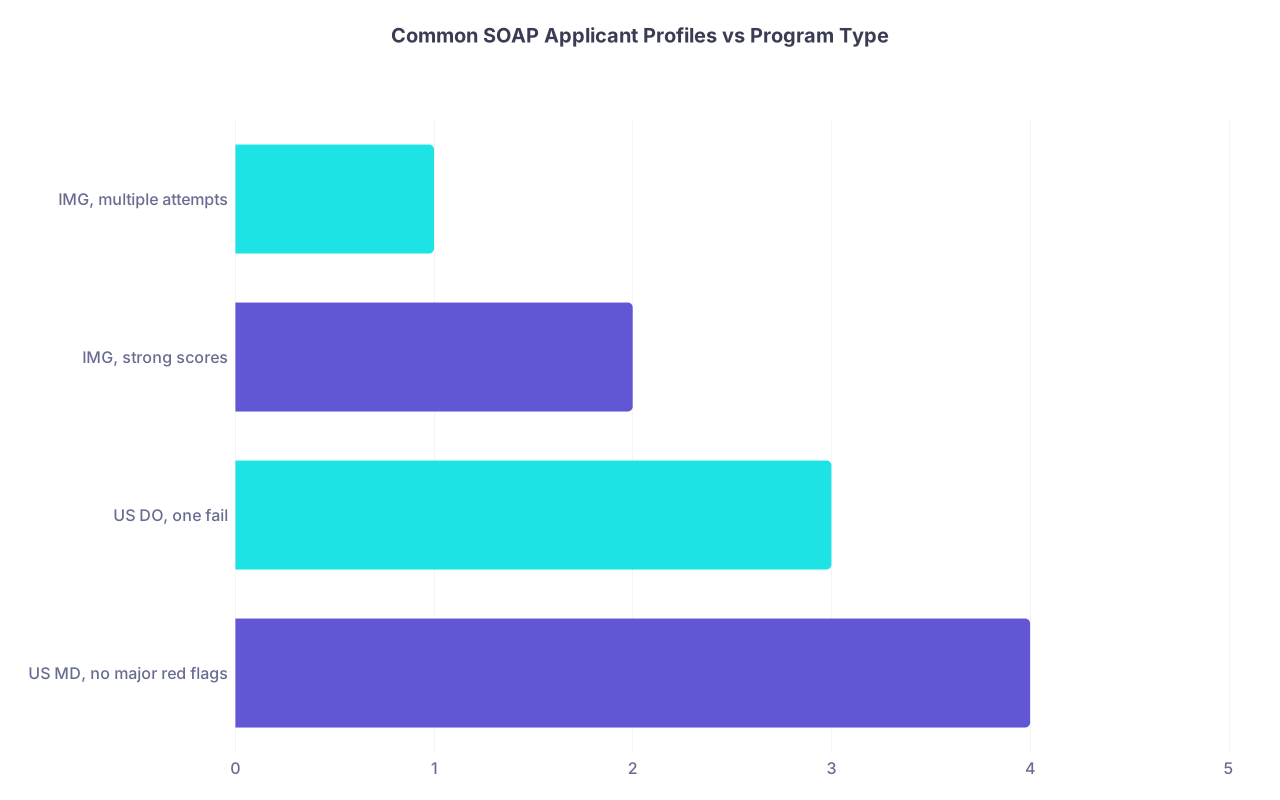
You need accurate calibration. This is where charting your own profile against typical SOAP candidate patterns helps:
| Category | Value |
|---|---|
| US MD, no major red flags | 4 |
| US DO, one fail | 3 |
| IMG, strong scores | 2 |
| IMG, multiple attempts | 1 |
Think of “4” as realistic access to mid-tier academic/community, “1” as mainly lower-tier or IMG-heavy. If you are a 2–3, do not build a rank list like you are a 4 or a 1.
Error #11: Letting Panic Rewrite Your Priorities at the Last Minute
Worst time to reorder your rank list from scratch?
Fifteen minutes before the deadline.
What happens in that last-hour panic:
- You suddenly decide:
- “Actually, I cannot live that far from family”
- “I hate outpatient; why did I rank FM so high?”
- “Maybe anesthesia via SOAP is better than IM anywhere”
- You do a dramatic reshuffle based on:
- Fear
- Fatigue
- A single alarming text from a friend
Then weeks later, when the adrenaline is gone, you realize:
- You reversed your true priorities
- You ranked lower-quality, riskier, or unfit programs above stable, sensible options
You must do your actual reasoning before the last hour:
- Clarify:
- What matters more: specialty vs location vs stability
- Build your rank list around those core values
- Only use the last hour to sanity check, not to reinvent your goals
Visual: How SOAP Decisions Compound Over Time
Here is what applicants think SOAP looks like: short-term damage control. Reality: it shapes the next several years of your life.

| Step | Description |
|---|---|
| Step 1 | SOAP Rank List Choices |
| Step 2 | Matched at Stable Program |
| Step 3 | Matched at High-Risk Program |
| Step 4 | Unmatched in SOAP |
| Step 5 | Complete Residency |
| Step 6 | Burnout/Probation/Transfer Attempt |
| Step 7 | Reapply Next Cycle |
| Step 8 | Delayed Graduation or Specialty Change |
| Step 9 | Board Certification and Job Options |
That initial decision point—your rank list—ripples out farther than you think.
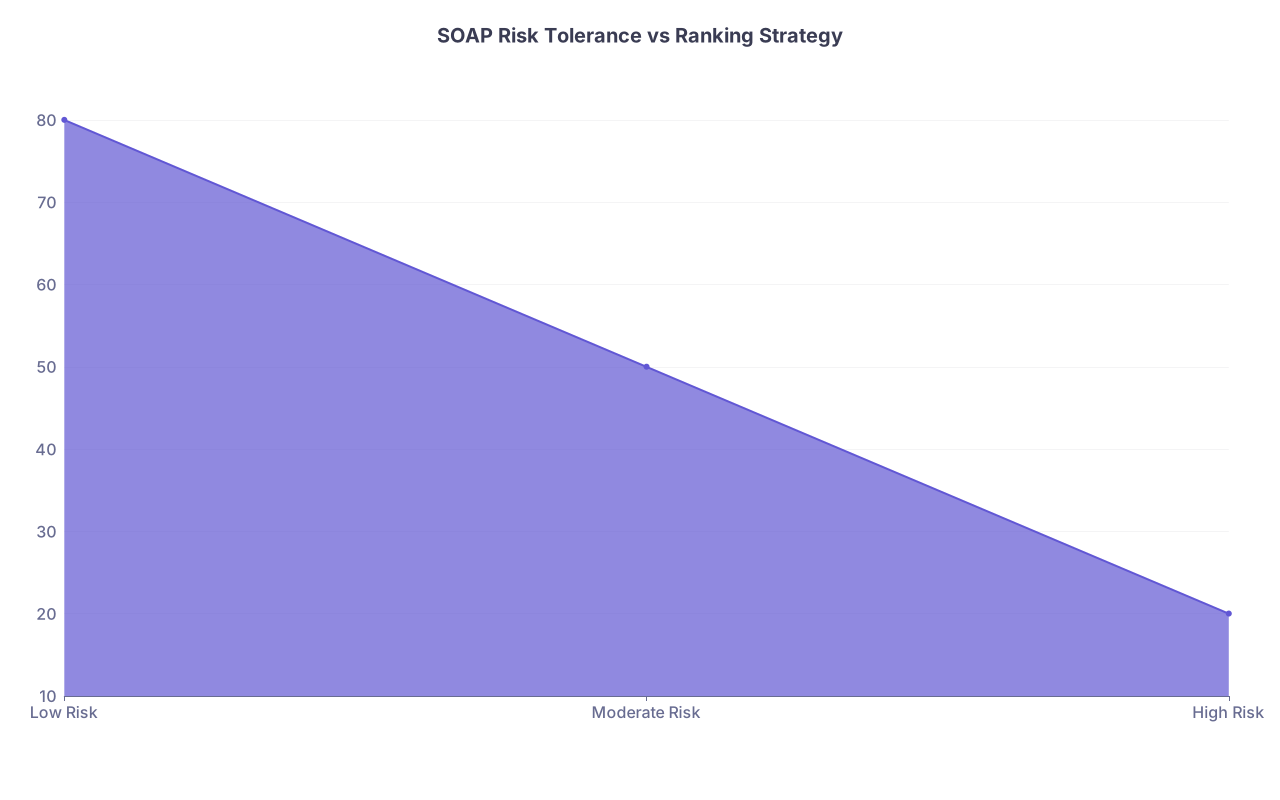
Quick Reality Check: Your Risk Profile vs Rank Strategy
SOAP is fast. Having a mental framework for risk vs reward helps.
| Category | Value |
|---|---|
| Low Risk | 80 |
| Moderate Risk | 50 |
| High Risk | 20 |
Rough guide:
Low risk tolerance (should be most people):
- Prioritize: stability, board pass rates, reasonable workload
- Rank: SOAP-friendly, less glamorous but safe programs higher
Moderate risk tolerance:
- Mix in: a few “reach” academic programs, but not at the expense of realistic, safe options
High risk tolerance:
- Going for absolute dream at the top, accepting possibility of no match
- Honestly, SOAP is not the best time to be a gambler
If you are already in SOAP, you have already taken some risk in the main match. Over-correcting now is how people go from “unmatched” to “derailed.”
Do Not Repeat These 5 Predictable SOAP Rank List Disasters
These are the ones I see over and over:

The Prestige Trap
- Ranking brand-name programs unrealistically high
- Dropping solid but unglamorous programs too low
- Ending unmatched despite being rankable elsewhere
The Location Prison
- Hard-limiting to 1–2 major cities
- Ignoring strong training options in less popular regions
- Paying for that choice with another cycle and more uncertainty
The Last-Minute Panic Re-Rank
- Destroying a rational list in the last hour
- Letting fear or peer opinions override your earlier, clearer thinking
The Toxic Program Gamble
- Ranking a malignant or unstable program high because “at least it is a spot”
- Ending up in probation, non-renewal, or burned out beyond recognition
The Lone Wolf Approach
- Not looping in advisors who know program reputations
- Relying on classmates and Reddit for life-altering decisions
Avoid those, and you are already ahead of a depressingly large fraction of SOAP applicants.
FAQ (Exactly 3 Questions)
1. Should I ever rank a program I really do not want “just in case”?
No. If you would seriously consider not going or quitting if matched there, do not rank it. A bad fit can be worse than taking a year to re-strategize and apply again. Rank only programs where you would actually show up and complete the year in good faith.
2. How many “reach” programs is reasonable to put at the top in SOAP?
A few, not a list. For most SOAP candidates, I would cap true reaches at the top 2–3 spots, then pivot quickly to realistic options. If your top 8–10 are all long shots, you are using a lottery ticket strategy in a process that punishes that mindset.
3. What if my advisor’s advice conflicts with what I want?
Listen very carefully when advisors talk about risk and realism, but you still own your preferences. If you choose against their advice, do it consciously:
- Acknowledge the risks they pointed out
- Decide whether you are truly willing to accept those risks
- Then commit to your choice, without pretending you were “unlucky” if the predictable downside hits
Key takeaways:
- Treat SOAP rank lists as binding career decisions, not temporary damage control.
- Ruthlessly prioritize realistic, stable programs over prestige and location fantasies.
- Do not build or change your list in isolation—use expert input, not group-chat panic.