Mastering Time Management in Medical School: Practical Strategies to Thrive, Not Just Survive
Entering medical school often feels like stepping into a fast‑moving, high‑stakes world where every hour matters. The volume of material, the pace of exams, clinical duties, research, extracurriculars, and personal responsibilities can quickly become overwhelming.
The students who thrive are rarely the ones who simply “work the hardest.” They’re the ones who manage their time intentionally, protect their energy, and design systems that support sustainable Student Success, high performance, and real Work-Life Balance.
This guide reframes Time Management in Medical School as a learnable, flexible skill—one that evolves with you from pre‑clinical lectures to clinical rotations and board prep. You’ll find concrete tools, examples, and strategies you can start using this week.
Why Time Management Is a Core Clinical Skill in Medical School
Time management isn’t just about getting more done; it’s about aligning your daily actions with your long‑term goals in medicine, while protecting your mental and physical health.
How Effective Time Management Impacts Your Medical School Life
1. Reduces stress and burnout risk
A clear plan for your days and weeks lowers background anxiety. Instead of constantly thinking, “I should be studying,” you know what you’re doing, when, and why. This structure helps prevent last‑minute cramming, missed assignments, and chronic stress that can lead to burnout.
2. Improves academic performance and exam scores
Deliberate Study Strategies—like spaced repetition and active recall—require consistent, planned time. Good time management makes it possible to revisit material multiple times before exams, which is crucial for board-style retention.
3. Supports true Work-Life Balance
Without a plan, leisure and self‑care slip to the bottom of the list. When you deliberately schedule rest, hobbies, and time with family and friends, you create a sustainable rhythm that keeps you motivated and grounded.
4. Builds professionalism and clinical readiness
As a future physician, you’ll be responsible for managing clinic schedules, call shifts, documentation, and emergencies. Learning to prioritize tasks, meet deadlines, and protect patient‑facing time begins now. Residency programs notice students who manage time well during rotations.
5. Increases confidence and sense of control
Medical school can easily feel like it’s happening to you. Effective time management shifts that narrative—you move from reactive to proactive, making intentional choices that reflect your values and goals.
Core Components of Effective Time Management for Medical Students
Time management is more than a calendar or to‑do list. It’s a system that integrates goals, priorities, planning, execution, and reflection. Below are the foundational components tailored to the realities of Medical School Life.
1. Setting Clear, Purposeful Goals
Vague intentions like “I need to study more” or “I want to honor this rotation” are hard to act on. Clear goals turn intentions into executable plans.
Use SMART Goals for Medical School Success
The SMART framework keeps your goals concrete and trackable:
- Specific – What exactly will you do?
- Measurable – How will you know you’ve achieved it?
- Achievable – Is it realistic with your current schedule and demands?
- Relevant – Does it support your long‑term path (e.g., Step exams, specialty choice)?
- Time-bound – By when will you complete it?
Examples adapted for different phases of medical school:
Pre‑clinical block:
“I will complete 80 Anki flashcards and 40 practice questions daily for the next 10 days to prepare for the cardiovascular block exam, aiming for ≥85% on the exam.”Board preparation:
“From January to March, I will review one UWorld block (40 questions) per day, plus 200 Anki cards, and finish one full pass of First Aid by the end of March.”Clinical rotations:
“During my internal medicine clerkship, I will pre‑round on my patients by 6:30 am, write all progress notes before noon, and read at least 30 minutes nightly on one diagnosis I encountered that day.”
Strong goals help you decide what not to do. If an opportunity, event, or commitment doesn’t align with your stated priorities, it becomes easier to say no.
2. Prioritizing Tasks in a High-Demand Environment
You will never run out of things you could be doing. The real skill is deciding what matters most right now.
The Eisenhower Matrix for Medical Students
The Eisenhower Matrix helps you classify tasks by urgency and importance:
Urgent and Important – Do first
- Tomorrow’s exam
- Clerkship notes due today
- Residency application deadlines
Important but Not Urgent – Schedule it
- Long‑term board prep
- Research projects
- Meeting with a mentor
- Wellness practices (exercise, sleep routines)
Urgent but Not Important – Delegate or limit
- Non-critical club emails
- Administrative tasks that others can handle
- Replying instantly to every message
Neither Urgent nor Important – Eliminate or minimize
- Endless social media scrolling
- Non‑academic YouTube rabbit holes
- Excessive gaming during peak focus hours
Example:
If you have an exam in three days, a research abstract due in three weeks, and a social event tonight:
- Exam prep → Urgent and Important
- Research abstract → Important but Not Urgent (schedule a 60‑minute block tomorrow)
- Social event → Depends on your wellness needs; could be “important but not urgent” if it restores you, or “neither urgent nor important” if it increases stress.
Prioritization ensures your limited time is invested where it yields the highest academic and personal impact.
3. Creating a Realistic Schedule That Actually Works
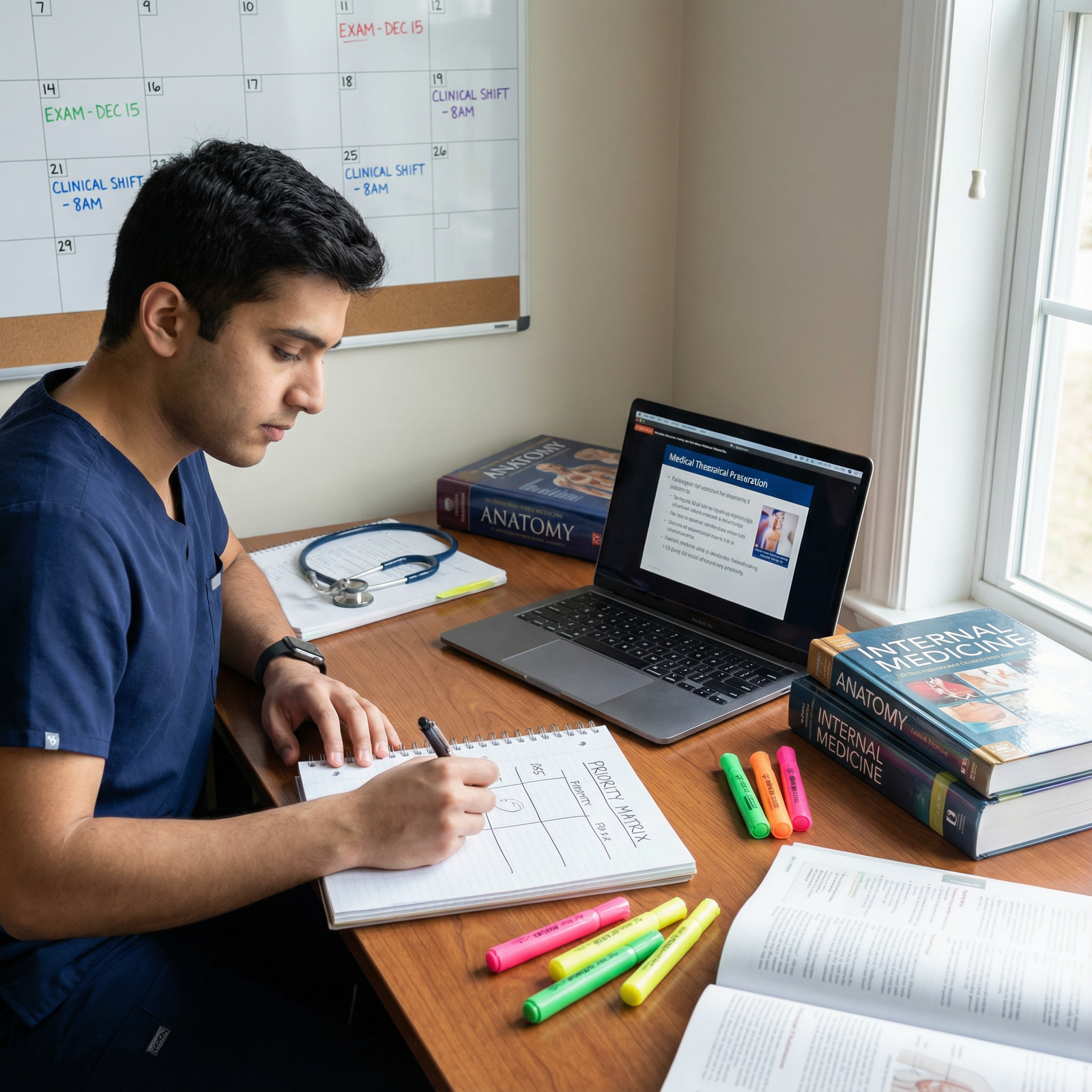
A schedule only helps if it reflects reality: your energy levels, existing commitments, and how long tasks actually take. Overloading your calendar leads to guilt and abandonment of the system.
Time Blocking for Medical School
Time blocking means assigning specific chunks of time to specific tasks or categories, rather than trying to fit things in “whenever.”
Weekly planning steps:
Start with fixed commitments
- Lectures and labs
- Clinical shifts/rounds
- Mandatory sessions, small groups, OSCEs
Add high-value study blocks
- Focused, distraction-free time for:
- New content learning
- Spaced repetition (e.g., Anki)
- Question banks (UWorld, NBME-style)
- Protect these blocks like appointments with yourself.
- Focused, distraction-free time for:
Schedule personal essentials
- Sleep (aim for 7–9 hours)
- Meals
- Commute
- Exercise and stress management
Include buffer time
- Transitions between tasks
- Catch‑up time for unexpected events or longer‑than‑expected tasks
Sample weekday schedule (pre‑clinical block):
| Time | Activity |
|---|---|
| 6:30 – 7:00 AM | Wake up, short stretch, light breakfast |
| 7:00 – 8:00 AM | Anki/spaced repetition review |
| 8:00 – 12:00 PM | Lectures + quick annotations |
| 12:00 – 12:30 PM | Lunch |
| 12:30 – 2:30 PM | Focused study: today’s lecture content |
| 2:30 – 3:00 PM | Break / short walk |
| 3:00 – 5:00 PM | Question bank (40 questions + review) |
| 5:00 – 6:00 PM | Exercise / decompress |
| 6:00 – 7:00 PM | Dinner, personal time |
| 7:00 – 9:00 PM | Review weak topics / group study |
| 9:00 – 10:00 PM | Wind-down, light review, sleep prep |
Your exact schedule will differ, but the principle holds: intentionally assign your time rather than letting tasks expand to fill the entire day.
Digital Tools for Time Management in Medical School
Consider using:
- Google Calendar / Outlook – For class schedules, exam dates, clinical shifts, and recurring events
- Todoist, Notion, or Microsoft To Do – For task management and prioritization
- Trello or Asana – For longer projects (research, QI projects, leadership roles)
- Scheduling apps (e.g., Reclaim, Motion) – To automatically block time for tasks
Pick one or two tools and master them rather than constantly switching platforms.
High-Yield Study Strategies to Maximize Learning in Less Time
Good Time Management is only half the equation. If your Study Strategies are inefficient, you’ll still feel behind no matter how structured your schedule is.
4. Use Active Learning Instead of Passive Review
Passive strategies (re-reading notes, highlighting, watching lectures at normal speed without pause) feel comfortable but are low‑yield.
Evidence-Based Active Learning Methods
1. Practice questions
- Use question banks early, not just right before exams.
- Treat each question as a learning opportunity: review both correct and incorrect options, and capture key concepts in notes or flashcards.
2. Flashcards and spaced repetition
- Anki or similar SRS (spaced repetition systems) are powerful for long‑term retention, especially for pharmacology, microbiology, and pathology.
- Set a daily review target (e.g., 200 cards) and treat it as non‑negotiable like brushing your teeth.
3. Teach-back method
- Explain a concept aloud as if teaching a patient or classmate.
- If you get stuck, you’ve identified a knowledge gap that needs focused review.
4. Concept mapping
- Draw connections between diseases, mechanisms, labs, and treatments.
- This fosters clinical reasoning and helps integrate systems-based learning.
5. Structure Your Focus With the Pomodoro Technique
The Pomodoro Technique can make long study days manageable:
- Set a timer for 25 minutes of focused work on a single task (no multitasking).
- Take a 5-minute break (stand up, stretch, hydrate).
- Repeat this cycle 4 times.
- After 4 cycles, take a 15–30-minute break.
You can adjust interval lengths (e.g., 50 minutes on, 10 minutes off) depending on your attention span and the task’s difficulty. The point is to protect focus and prevent mental fatigue, not to rigidly follow a clock.
Protecting Your Focus: Limiting Distractions in a Hyperconnected World
Even the best study plan fails if distractions are constantly derailing your attention.
6. Design a High-Quality Study Environment
Physical environment tips:
- Choose a consistent, dedicated study space: library, quiet café, or home desk.
- Ensure good lighting, comfortable seating, and minimal noise.
- Keep necessary tools nearby: water, pens, highlighters, notepad, chargers.
Mental environment tips:
- Start each study block by writing 1–3 specific tasks you will complete in that block.
- Use a simple mantra: “For the next 25 minutes, my only job is [task].”
7. Digital Distraction Management
Your phone and laptop can be essential tools or your biggest obstacles.
Practical strategies:
- Turn off non-essential notifications during study and sleep hours.
- Use website blockers like Freedom, Cold Turkey, StayFocusd, or Forest to limit access to social media or entertainment sites during focus blocks.
- Keep your phone in another room or on “Do Not Disturb” during deep work.
If you find yourself constantly checking messages or apps, treat this like any other habit: identify triggers, replace the behavior (e.g., with a short walk), and set clear rules for when and how often you’ll check your phone.
Self-Care as a Time Management Strategy: Protecting the Person Behind the Student
Time management is not just about squeezing more work into your day; it’s also about protecting the human being doing the work.
8. Physical Wellness: Fueling Your Performance
Sleep:
- Aim for 7–9 hours per night. Chronic sleep deprivation reduces memory, attention, mood, and exam performance.
- Keep a consistent sleep schedule when possible, even during rotations.
- Build a 20–30 minute wind‑down routine: no heavy studying, minimal screen time, relaxing activities (reading, stretching, music).
Exercise:
- Even 20–30 minutes, 3–5 times per week, improves focus, resilience, and mood.
- Choose forms that fit your life: a quick run, yoga video, resistance bands, or walking with a friend.
Nutrition:
- Plan simple, balanced meals: protein + complex carbs + healthy fats.
- Avoid relying on excess caffeine and sugary snacks; they cause energy crashes that derail your schedule.
9. Emotional Well-Being and Mindset
Medical school is emotionally demanding: constant evaluation, comparison, and exposure to suffering in clinical years.
Helpful practices:
- Mindfulness or meditation – Apps like Headspace, Calm, or free YouTube videos can guide 5–10 minute sessions to reduce stress.
- Journaling – Reflect on:
- What went well today?
- What challenged me?
- What am I grateful for?
- Boundaries – Learn to say no to commitments that consistently drain you without aligning with your goals or values.
If you’re noticing persistent sadness, anxiety, sleep disturbances, or loss of motivation, reach out early to student health services, counseling, or trusted faculty. Seeking help is a sign of professionalism and self-awareness, not weakness.
Reflection, Adjustment, and Support: Keeping Your System Flexible
No time management system works perfectly from day one. You’re running a series of experiments on yourself—refining what works and abandoning what doesn’t.
10. Weekly Review: The Engine of Continuous Improvement
Set aside 20–30 minutes once a week (e.g., Sunday evening) to review:
- What did I accomplish?
- Where did my plan fall apart, and why?
- What patterns am I seeing? (e.g., always losing focus after 9 pm, underestimating time for question review)
- What one or two changes will I test next week?
Adjust your schedule based on real data about your life, not what you wish your life were like.
11. Seeking Support: You Don’t Have to Do This Alone
High-functioning medical students often feel pressure to appear like they have everything under control. In reality, those who excel long‑term ask for help early and often.
Sources of support:
- Peers and study partners – Share resources, explain difficult concepts, divide and conquer complex topics.
- Upperclassmen – They’ve survived what you’re going through; ask how they studied for specific courses, exams, or rotations.
- Faculty advisors or mentors – Seek guidance on specialty interests, research, and long‑term planning.
- Academic support centers – Many schools offer learning specialists who can help refine your study and time management strategies.
- Mental health professionals – For managing anxiety, depression, imposter syndrome, or trauma exposure.
You are learning to balance intense academic demands with personal sustainability—a skill that will serve you throughout residency and your career.

Frequently Asked Questions About Time Management in Medical School
1. How many hours per day should I study in medical school?
There’s no universal number, because demands vary by school, block, and phase (pre‑clinical vs. clinical). Many students average 4–6 hours of focused study on top of scheduled classes during pre‑clinical years, and 1–3 hours on most clinical days.
More important than raw hours is quality and consistency:
- Use active learning (questions, flashcards, teaching back).
- Protect daily time for spaced repetition.
- Adjust your schedule based on upcoming exams or heavy rotations.
If you’re consistently studying long hours but not seeing results, it’s a sign to reevaluate your Study Strategies, not just increase the time.
2. What is the best time management app for medical students?
The “best” app is the one you will actually use daily. Common combinations:
- Google Calendar or Outlook – For schedules and deadlines
- Todoist / Notion / Microsoft To Do – For task lists and priorities
- Trello / Asana – For managing research, QI projects, or leadership roles
- Forest / Freedom / Cold Turkey – For reducing digital distractions
Try one system for at least two weeks before deciding if it works. Simplicity and consistency usually beat complexity.
3. How can I prevent burnout while trying to keep up with everything?
Burnout prevention is closely tied to both Time Management and Work-Life Balance:
- Schedule non‑negotiable time for sleep, meals, and movement.
- Include small daily joys (coffee with a friend, 15 minutes of a hobby, a walk outside).
- Be realistic about how much you can take on—avoid over‑committing to leadership, research, and extracurriculars all at once.
- Notice early warning signs (emotional exhaustion, cynicism, decreased performance) and seek support early from peers, mentors, or mental health services.
Remember: preserving your well‑being is part of your professional responsibility to future patients.
4. Is it better to study alone or in a group?
Both can be effective, and many students use a hybrid approach:
Study alone for:
- Learning new material
- Doing practice questions
- Working through Anki or detailed note review
Study in groups for:
- Explaining difficult concepts to each other
- High‑yield review sessions before exams
- Practicing oral presentations and clinical reasoning in clerkships
- Sharing mnemonics, frameworks, and key resources
The key is structure. Enter group study with specific goals (e.g., “We’ll review these 3 topics and quiz each other”) rather than letting it become social time in disguise.
5. What should I do if my time management system keeps failing?
If your system keeps breaking down, treat it like a clinical problem:
Diagnose the issue:
- Are you overestimating what you can do in a day?
- Are distractions derailing you?
- Are you using low‑yield study strategies?
Adjust the plan:
- Schedule less per block, but protect those blocks more fiercely.
- Simplify your tools—maybe one calendar and one to‑do app is enough.
- Switch to more active learning methods.
Ask for help:
- Talk to classmates, mentors, or academic support staff about what’s realistic and what has worked for them.
Improvement comes from small, consistent changes, not from building a “perfect” system overnight.
Effective Time Management in Medical School is not about doing everything; it’s about doing the right things, at the right time, in a sustainable way. By setting clear goals, prioritizing intelligently, building a realistic schedule, investing in high‑yield Study Strategies, and protecting your well‑being, you’ll put yourself on a path not just to pass—but to thrive academically, professionally, and personally throughout your medical training.