Introduction: The Funny Side of a Very Serious Journey
Life as a medical student is legendary for its intensity: 4 a.m. alarms, 2 a.m. study sessions, clinical rotations that blur into one another, and exams that feel like endurance sports. Medical school is demanding, high stakes, and often deeply stressful.
But that’s only half the story.
Behind the grim jokes about burnout and boards lies a surprisingly rich culture of humor in medicine. Student life is filled with inside jokes, absurd situations, and shared laughter that make the grind survivable—and often unforgettable. The same environment that creates stress also generates some of the funniest, most human moments you’ll ever experience.
This expanded guide dives into those hilarious struggles and small triumphs that define medical school and early clinical training. Along the way, we’ll highlight how humor helps you cope, connect, and grow into the kind of physician patients actually want to see.
Whether you’re just considering medical school, in the middle of your preclinical years, or trudging through clinical rotations, you’ll recognize yourself in these stories—and hopefully pick up a few tips for keeping your sanity intact.
The Endless Cycle of Studying: Comedy in Cramming
Medical education can feel like you’re trying to drink from a firehose while running a marathon. The material is vast, the pace is relentless, and your brain is constantly negotiating how much information it can reasonably absorb before it mutinies.
And yet, in the chaos of study marathons, some of the best medical school humor emerges.
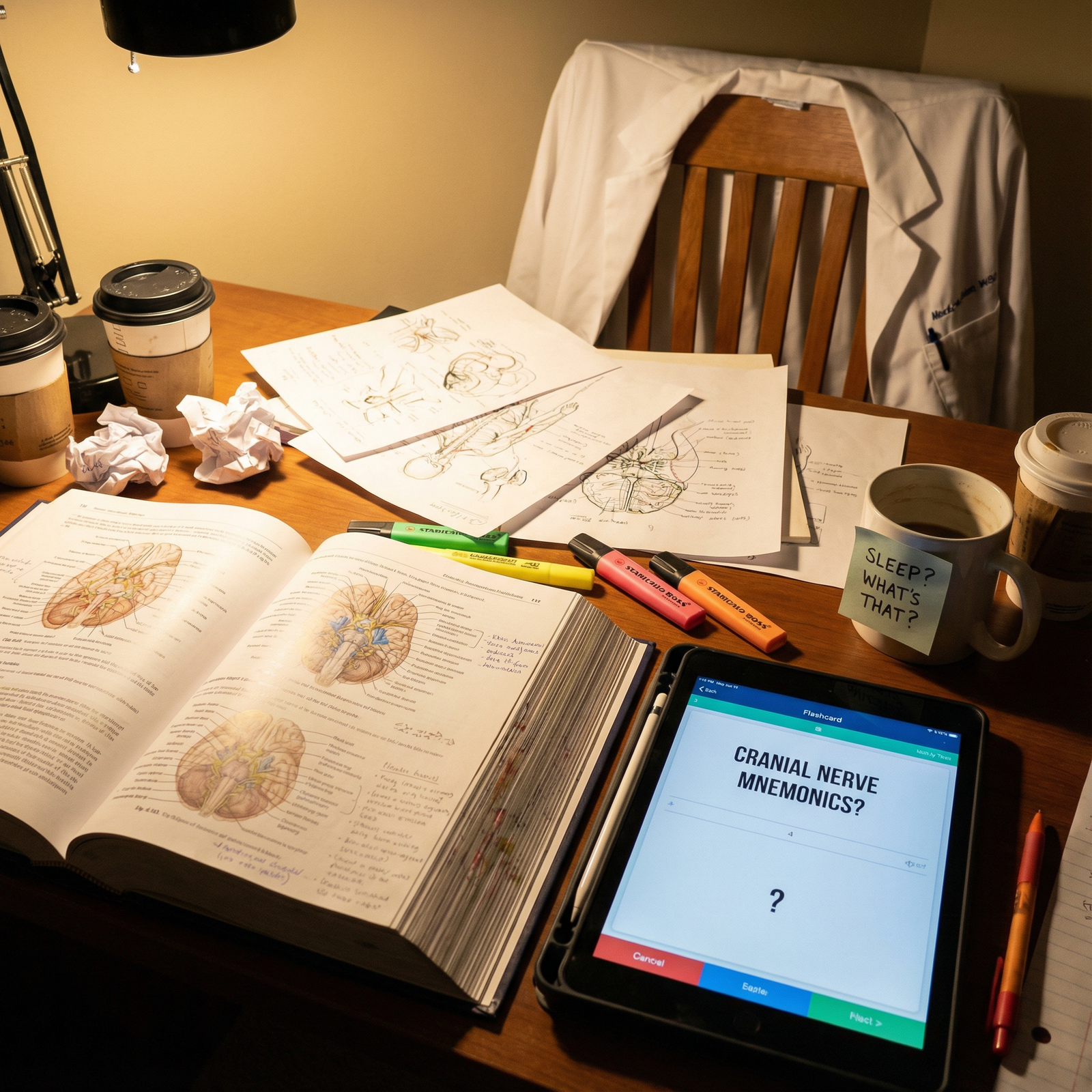
Textbooks, Apps, and the Art of “Efficient Confusion”
In the old stereotype, medical students lug around textbooks thicker than a brick. These days those bricks often live inside tablets and laptops—but the emotional weight feels the same.
You’ll watch classmates experiment with every possible “high-yield” strategy:
- Color-coded highlighting that looks like an art project gone wrong
- Flashcards that multiply overnight like bacteria on agar plates
- Mnemonics so bizarre you could never explain them to a non-medical friend
One student swore that highlighting every other line somehow made the text “more digestible.” By exam week, their book looked like a neon rainbow. When they sat for their anatomy exam, they realized they could recall the colors of the highlighted paragraphs better than the actual content. “Apparently, I was testing my color memory, not my knowledge of the brachial plexus,” they joked afterward.
Actionable Tip:
Lean into what actually works for you rather than what looks impressive. Evidence-based strategies that consistently help students include:
- Spaced repetition (e.g., Anki)
- Practice questions early and often
- Teaching concepts to classmates (“If I can explain it without reading, I actually know it.”)
Humor becomes crucial when you catch yourself reading the same paragraph for the fifth time at 2 a.m. Being able to laugh at your own “study fails” helps you reset instead of spiraling.
The Med Student Dress Code: Controlled Dishevelment
Student life in medical school has a dress code best described as “functional chaos.” In the preclinical years, fashion is often the first casualty of exam block season.
Standard uniform:
- Sweatpants or scrubs that have seen better days
- Oversized hoodies with your school logo (or a rival school’s, acquired at a conference)
- A rotation of T-shirts from anatomy lab and free pharma pens
One student showed up to a school social event in a semi-formal outfit…with one cartoon sock and one striped sock. When a friend pointed it out, they shrugged: “Every decision I make is life-or-death right now…except socks. The socks are free.”
Actionable Tip:
You don’t have to abandon all self-care. Simple, realistic habits help:
- Keep one clean “go-to” outfit for presentations and OSCEs
- Pack a spare pair of socks in your bag (you’d be surprised how often this helps in long days)
- Schedule one “non-medical” day per month where you wear something that makes you feel like yourself, not just “a med student”
Looking disheveled becomes almost a badge of honor—but laughing about it with classmates reminds you that you’re all in this together.
Clinical Rotations: Awkwardness in Scrubs and Learning on the Fly
Clinical rotations are where medical school stops being theoretical and starts feeling very real. You trade lecture halls for patient rooms, backpacks for stethoscopes, and sleep for call shifts.
They’re also where some of the funniest—and most humbling—moments in medical education occur.
“Scrub Life”: When Comfort Meets Comedy
There’s a special joy in getting your first official hospital ID and set of scrubs. They symbolize your transition into real-world medicine. They’re comfortable, minimal-effort, and weirdly empowering.
Until you see yourself in the mirror.
One student lamented, “Why does my attending look like they’re starring in a medical drama, and I look like I just crawled out of the laundry basket?” Same color, same hospital logo—completely different effect.
Then there are the scrub mishaps:
- Wearing pediatric cartoon scrubs on adult surgery because you misread the locker pile
- Realizing mid-rounds that your scrub top is on backwards
- Discovering a rogue sticker (“HELLO, MY NAME IS…”) still attached to your pant leg
An overenthusiastic student once chose scrubs covered in dancing pills, thinking they’d brighten up the ward. In the elevator, their attending raised an eyebrow and asked, “Is this your way of explaining polypharmacy?” The student, mortified, muttered, “I just wanted the patients to smile…”
Actionable Tip:
Keep a backup set of plain scrubs in your locker or car. Reserve the “fun scrubs” for pediatrics, holiday shifts, or when your team has explicitly said it’s okay.
Communication Fails and the Steep Learning Curve
Clinical rotations expose you to the complexity of real patient interactions, where miscommunications can be cringeworthy and hilarious (once the dust settles).
A student once confidently explained to a patient how lifestyle changes could help with their “chronic gymnastics” instead of chronic gastritis. When the puzzled patient asked if they needed a referral to a gym, the team had to gently translate: “We’re treating your stomach, not your cartwheels.”
Other classic blunders:
- Mixing up “benign” and “malignant” in front of a very anxious patient (quickly corrected by the attending)
- Asking, “What brings you in today?” to a patient clearly in a full leg cast
- Accidentally saying “I’ll be your doctor today” instead of “I’m one of the medical students working with your team today”
Actionable Tip:
Use humor carefully and always check in with the patient’s emotional temperature first. When you do make a harmless mistake, owning it with gentle self-deprecating humor (“This is why they still call us students”) can defuse tension and show humility.
Internships and the Unseen Challenges: When Coffee Becomes a Coping Strategy
The transition from student to intern ramps up everything—responsibility, hours, intensity, and, yes, the amount of caffeine consumed. You’re suddenly the one writing orders, answering pages, and doing “adult medicine” with less supervision than you’re used to.
The humor shifts too: from silly classroom stories to the darkly funny, “Can you believe that just happened?” moments shared on call.
Coffee: The Official Intern Co-Resident
During internship, coffee is no longer a beverage; it’s a survival strategy and a running joke.
Common phrases you’ll hear:
- “My blood type is now Arabica.”
- “I’ve had more coffee than water today; is that…bad?”
- “I can’t tell if I’m tachycardic from the espresso or the pager.”
One intern became known as the “Caffeine Connoisseur” after confidently ordering a “quad shot, half-caf, extra hot latte” during a night shift—and then accidentally sipping someone’s decaf. The look of dawning horror was legendary: “This must be what betrayal feels like.”
Actionable Tip:
Use humor to bond over shared exhaustion, but set some real limits:
- Try not to replace all meals with coffee and vending machine snacks
- Keep a water bottle with you and make a “drink rule” (e.g., water with every cup of coffee)
- Build micro-break routines: a 90-second walk, a quick stretch, or a text to a friend between tasks
The Pager, the Pen, and the Illegible Note
Internship also introduces you to some of medicine’s most mysterious objects—most notably, the pager and the handwriting of your seniors.
Decoding a senior resident’s admission note can feel like interpreting ancient hieroglyphs. One intern joked, “I can read MRI reports and EKGs, but this handwriting? That’s where I draw the line.”
There are also classic first-pager moments:
- Walking rapidly in the wrong direction because you’re too embarrassed to ask where Room 14B is
- Returning a page and forgetting which patient it was about halfway through the callback
- Getting paged while in the bathroom and contemplating your life choices
Actionable Tip:
Turn these awkward moments into learning opportunities:
- Create your own clear, structured templates for notes to avoid passing on illegible chaos
- Ask seniors early on how they triage pages and prioritize tasks—many have excellent systems
- Share the funny (de-identified) mishaps in safe spaces; it normalizes the learning curve
The Journey of Real-Life Patient Care: Humor at the Bedside
As you gain experience, you start to see how humor—when used thoughtfully—can be a powerful clinical tool. Patients are often scared, overwhelmed, or in pain. A moment of lightness can make them feel human again, not just like a “case.”
When Patients Surprise You
Patients bring their own humor to the table, often in ways that completely disarm you.
A medical student walked into a room, introduced themselves, and was met with:
“So, are you the clown from my last appointment or a new one?”
Taking the cue, the student replied, “New clown, same circus—but I didn’t bring balloon animals today.”
These exchanges create memorable bonds and remind you that patient care isn’t only about lab values and imaging results; it’s deeply human.
You’ll also meet patients who:
- Give nicknames to their IV poles
- Name their casts or surgical scars
- Ask if they can keep their gallstones “as a souvenir”
When you’re able to respond with respectful humor, you validate their coping strategies and build trust.
Humor as a Healing Tool (With Boundaries)
Many attendings will remind you: “You bring your stethoscope, your brain, and your sense of humor to every encounter—but you also bring judgment.”
A senior physician once told a nervous intern, “If you can make a patient genuinely smile even once during their hospitalization, you’ve done something important.”
A student had a particularly anxious patient who hated needles. Right before giving a vaccine, the student asked, “Can I take a shot at making you laugh first?” They cracked a simple, cheesy joke about flavors of ice cream and bravery badges. The patient laughed, relaxed, and the moment transformed from pure fear to something manageable.
Actionable Tip:
Use humor in patient care thoughtfully:
- Start after you’ve shown seriousness and respect for their concerns
- Avoid sarcasm, dark jokes, or anything that could be misinterpreted
- Let the patient lead—if they joke, you can gently meet them there; if they’re serious, follow their tone
- Always prioritize safety and professionalism over being “funny”
Triumphs, Milestones, and the Joy Hidden in the Chaos
For all its stress and absurdity, medical school is full of poignant, joyful milestones that often arrive wrapped in awkwardness and laughter.
First Procedures: Terrifying, Hilarious, and Unforgettable
Few moments stay with you like your first successful procedure—your first IV, your first sutures, your first time leading a family discussion with supervision.
One student, riddled with nerves while suturing a simple laceration, realized afterward that the stitches made a slight curve. Their attending joked, “You’ve created the world’s first smiley-face suture line.” Terrified they’d done something catastrophically wrong, the student apologized profusely, but the patient grinned: “Honestly, I kinda love it. It’s like a tattoo with a story.”
You’ll also remember things like:
- Your first time getting through a full OSCE without blanking on the physical exam sequence
- Your first attending who said, “Nice job, doctor,” and you realized they meant you
- Your first thank-you card or note from a patient
These moments matter. They’re the antidote to imposter syndrome and the fuel that keeps you going through the next exam block or night shift.
Graduation Day: Laughing at the Finish Line
By the time graduation arrives, your class has collected enough jokes, memes, and shared stories to fill a small book. The ceremony itself is a mix of formality and inside humor:
- Friends whispering, “Remember when we thought first-year anatomy was hard?”
- Jokes about finally deleting that Step study app
- Comments like, “We survived medical school, but can we survive prior authorizations?”
The laughter at graduation hits differently—it’s layered with exhaustion, pride, grief, and excitement. You’re closing a chapter that tested you in every possible way and stepping into a new phase as residents and future attendings.
Amid the pomp and gowns, someone will inevitably say, “We did it. We actually did it.” And yes, you did—one ridiculous, sleep-deprived, hilarious day at a time.

Conclusion: Why Humor Belongs in Medicine
Medical school is a roller coaster: rigorous, emotionally intense, and often overwhelming. But woven through the demanding curriculum and long clinical rotations is a steady thread of humor—small moments of absurdity, camaraderie, and shared struggle that keep you grounded.
Humor in medicine is not about making light of suffering. It’s about:
- Surviving the relentless pace of medical education
- Building genuine connections with classmates, residents, and attendings
- Humanizing yourself in a role that often demands self-sacrifice
- Bridging the gap between fear and trust in patient care
If you’re on this path, protect that sense of humor. It will help you:
- Bounce back from inevitable mistakes
- Maintain perspective during exam seasons and overnight calls
- Build strong, supportive relationships within your team
- Show up as a more present, compassionate, and relatable clinician
You’ll graduate not just with knowledge of pathophysiology and pharmacology, but with a collection of stories—some heartbreaking, some inspiring, and many genuinely funny—that shape you into the doctor you’re becoming.
FAQ: Humor, Student Life, and Surviving Medical School
1. What are some common struggles medical students face, and how does humor help?
Common struggles include:
- Long study hours and information overload
- Sleep deprivation, especially during exam blocks and clinical rotations
- Balancing personal life, relationships, and self-care
- High-stakes exams (USMLE/COMLEX, OSCEs, shelf exams)
- Imposter syndrome and constant comparison with peers
Humor doesn’t erase these challenges, but it changes how you experience them. Laughing with classmates about shared failures (like mispronouncing a rare disease in front of an attending) makes the journey feel less isolating. It transforms “I’m the only one struggling” into “We’re all figuring this out together.”
2. Is it appropriate to use humor with patients during clinical rotations?
Yes—when used thoughtfully. Appropriate humor can:
- Reduce anxiety and build rapport
- Make difficult conversations slightly easier to navigate
- Help patients feel seen as people, not just diagnoses
Guidelines for using humor with patients:
- Always read the room: some patients are in no mood for jokes
- Let the patient lead—if they use humor, you can gently mirror it
- Avoid jokes about their condition, appearance, or deeply personal topics
- Never prioritize being funny over being respectful and clear
When in doubt, err on the side of professionalism. You can always bring warmth and kindness even without overt humor.
3. How can I maintain my mental health in medical school while dealing with stress?
A few practical strategies:
- Community: Build a small circle of classmates you can be honest with and laugh with
- Boundaries: Protect some non-medical time each week (hobbies, family, exercise)
- Micro-breaks: Take short, scheduled breaks during study sessions to reset
- Support services: Use campus mental health resources, peer support groups, or counseling early—not just in crisis
- Perspective: Remind yourself regularly why you chose medicine and celebrate small wins
Integrating humor into these strategies—like turning group study into a meme-sharing break or joking about small mishaps—can make coping feel more natural.
4. Is it common to form close friendships in medical school?
Very common. Medical school forces you into intense shared experiences: anatomy lab, late-night study sessions, early-morning rounds, and the emotional weight of caring for real patients. These experiences often accelerate bonding.
You’ll likely:
- Form a core group who becomes your “second family”
- Develop inside jokes that only make sense to other med students
- Maintain some of these friendships well into residency and beyond
These relationships, built on both shared struggle and shared humor, become one of the most valuable outcomes of medical school.
5. What are some memorable, “funny in hindsight” moments many med students experience?
Across schools and countries, you’ll hear similar stories:
- Calling your attending “mom” or “dad” by accident after a 24-hour call
- Practicing your presentation out loud in an empty stairwell and getting caught
- Answering a pimping question with an overly detailed tangent because you panicked
- Realizing halfway through the day that your stethoscope has been hanging around your neck backwards
In the moment, these can feel mortifying. With time, they become cherished stories you tell future students to reassure them: “You’re not alone. We all go through this.”
Medical school will challenge you in ways you can’t fully anticipate. Let humor be one of your core survival tools. It doesn’t just make the journey bearable—it makes it meaningful.