

The real decisions about your medical startup are made after you leave the room.
That boardroom pitch you obsessed over? It is just the opening move. The politics, the horse-trading, the quiet assassinations of your proposal—those all happen when the door closes behind you and the senior people look at each other and finally say what they really think.
I’m going to walk you through that room after you’re gone. What gets said. Who kills deals. Who secretly saves them. And why that “We’ll be in touch soon” email often has nothing to do with the quality of your product.
What Actually Happens The Second You Leave
Here’s the part nobody tells you: within 60 seconds of you walking out, your fate is usually 80% decided.
They are not going to “go home and think about it.” They are not “waiting to see more demos.” The critical judgment happens in the immediate debrief. I’ve sat in on these debriefs: academic medical centers, big community systems, payors, pharma innovation arms. The pattern is the same.
The door closes. There’s usually a short silence. Then one of three people speaks first:
- The senior clinician everyone defers to
- The CFO-type (finance/operations)
- The shadow power in the room (often the COO, CMO, or service line chief)
Who speaks first matters more than your entire pitch deck.
If the first sentence is: “I like this, but…” you still have a shot.
If it’s: “I don’t see how this fits,” you’re basically dead, and everyone else will slowly align to that position to avoid risk.
No one wants to be the only person championing a risky idea if it later blows up. That’s the quiet truth.
The Real Criteria They Use (That You Were Never Told About)
You thought they were judging your:
- Clinical evidence
- ROI
- Regulatory status
- Traction and pilots
All that matters, but it’s not decisive by itself. The real filters are more primitive and political. Let me spell out the ones I keep watching play out.
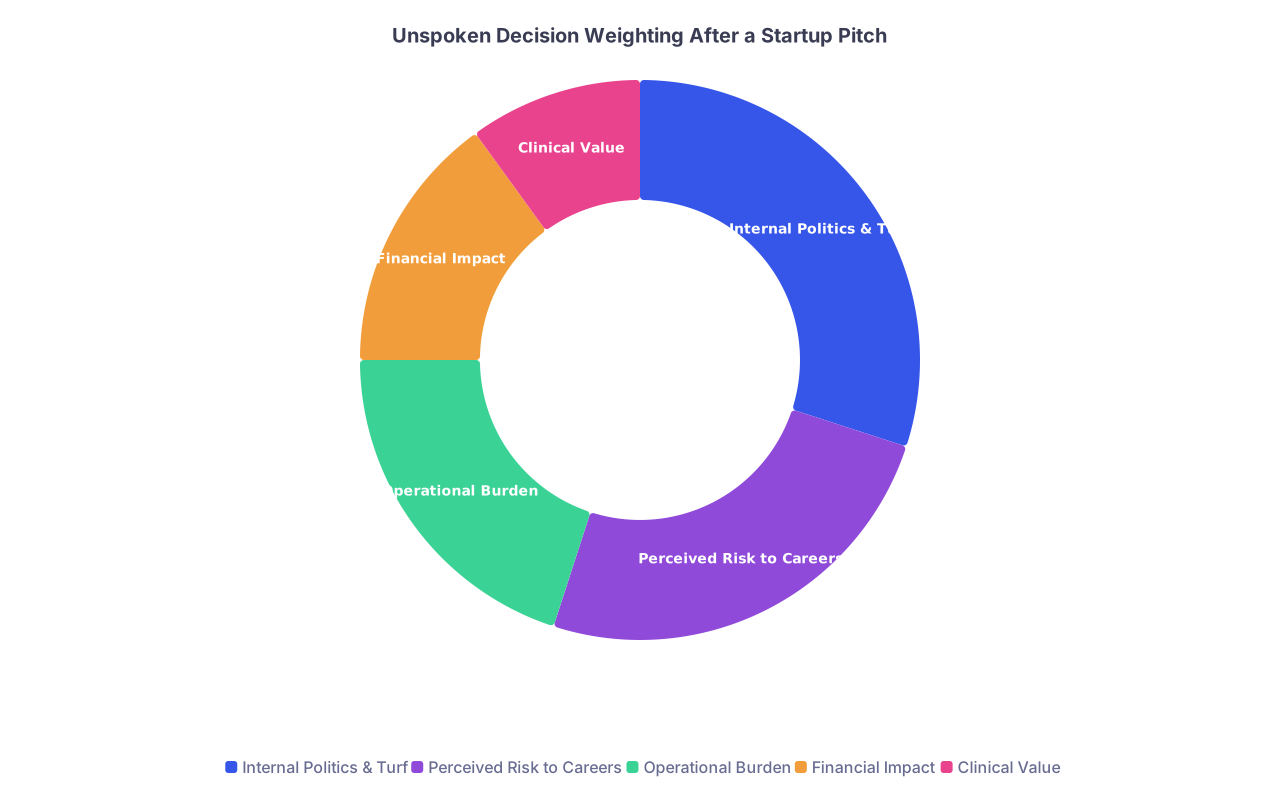
| Category | Value |
|---|---|
| Internal Politics & Turf | 30 |
| Perceived Risk to Careers | 25 |
| Operational Burden | 20 |
| Financial Impact | 15 |
| Clinical Value | 10 |
1. “Whose turf is this stepping on?”
This is the first subconscious check. If you built a platform that boosts outpatient follow-up, whose domain does that touch?
- Population health team
- CMIO / IT
- Chief of a specific service line
- Care management / nursing leadership
If any one of those groups feels blindsided, you’re in trouble. I’ve seen deals die not because the tech was bad, but because someone realized, “Wait, why were they in the room and we weren’t?”
You think they’re thinking about outcomes. They’re often thinking about budget lines, reporting structures, and who gets credit.
2. “If this fails, who gets blamed?”
Executives do not get fired for saying no to a startup. They get fired for saying yes to the wrong one.
So the internal monologue sounds like:
- “If this explodes and clinicians hate it, whose head is on the block?”
- “Is this going to be remembered as my initiative or just ‘some IT thing’?”
- “If there’s a data breach, does this land on me or legal or IT?”
That’s why they probe ownership so hard: “Who maintains this? Which department does it live under?” They’re not just asking about process. They’re mapping blame and credit.
3. “Will this create more work for my people?”
This is where physician and nurse leaders quietly kill you.
They are deeply suspicious of anything that adds clicks, logins, or “another inbox.” If they suspect your solution will generate messages, flags, or extra tasks that land on their already burned-out staff, you will face intense resistance.
They won’t phrase it as “this adds work.” They’ll say:
- “Workflow integration seems unclear.”
- “I’m not sure adoption will be high.”
- “I can see alert fatigue becoming an issue.”
All of those are code for: “My people are already drowning, and I’m not throwing them an anchor.”
4. “Does this line up with what we already decided last year?”
Hospitals and health systems run on multi‑year strategic plans: digital front door, value-based care, service line expansion, etc. If your startup directly advances a stated initiative, you get free tailwind.
If you’re orthogonal to their current agenda—or worse, competing with something they’ve already bought—you’re asking them to admit they made a bad prior decision. They rarely do that.
I’ve literally heard:
“We already told the board we were going with Vendor X. We can’t turn around and change course for this.”
No amount of “but we’re better” fixes that.
The Power Players In The Closed-Door Debrief
Let me show you who’s actually steering this conversation behind your back. It’s not always the person who smiled at you the most.

| Role | Visible Power in Room | Actual Post-Meeting Influence |
|---|---|---|
| CEO / President | High | Medium-High (rarely in details) |
| CFO / COO | Medium-High | Very High |
| CMIO / CIO | Medium | High if IT integration heavy |
| Service Line Chief | Medium | Very High on niche products |
| Nursing Leadership | Low-Medium | High when workflow changes |
| Innovation Director | High on paper | Low-Medium without allies |
The CFO / COO
These people often sound neutral during your pitch. Minimal questions. Polite nods. You think that’s good. It usually isn’t.
They’re running a mental model:
- Integration cost
- Hidden staffing cost
- Vendor risk
- Contract restrictions
When you leave, they’re the ones who say:
“I need to understand what we’re not going to fund if we do this.”
That’s where your pilot suddenly “needs more analysis” and gets delayed six months, which in hospital time is code for: “not happening unless something dramatic changes.”
The CMIO / CIO
If your startup touches the EHR, data, or workflows, these people are kingmakers.
They’re juggling dozens of vendors, internal projects, patchwork systems. The last thing they want is another point solution that will blow up their change management calendar.
In private, they’ll say things like:
- “We can do 80% of this in Epic with a build.”
- “I’d rather expand our existing vendor’s module than add a new one.”
- “Security and integration will be painful.”
Translation: “Even if this is good, I don’t have political capital to force this through IT.”
If the CMIO or CIO is lukewarm, your deal is on life support.
The Clinician Champion (If You Have One)
Here’s the one shot you have of surviving that room: a respected clinician who is willing to stick their neck out for you.
When you leave, if that person says:
“I will own this. I’ll pilot it with my group. I think this could solve a real problem for us.”
everything changes. Suddenly it’s no longer an abstract startup. It’s Dr. X’s project. People respect that, especially if Dr. X is known for getting things done.
But if your “champion” is junior, unknown, or perceived as a troublemaker? Their support is almost worse than neutral. I’ve heard:
“If Dr. Y is leading this, I’m out. Their last two projects were a disaster.”
You rarely know which kind of champion you have. That’s the scary part.
The Unspoken Scorecard: How They Really Rate You
They’re not filling out actual scorecards. They’re doing fast pattern recognition. After dozens of these meetings, the pattern is predictable.
| Dimension | What You Think It Means | What They Actually Ask Themselves |
|---|---|---|
| Clinical Evidence | RCTs, publications | Will my clinicians *believe* this data? |
| ROI | Savings, revenue projections | Will finance trust these numbers? |
| Founder Background | MD, PhD, ex‑big tech | Will this person disappear in 18 months? |
| Implementation Plan | Gantt chart, milestones | Who on *my* side is going to do all this work? |
| Risk / Compliance | HIPAA, SOC 2, FDA | Can I defend this if something goes wrong? |
| Strategic Fit | Market size, trends | Does this help *my* KPIs this fiscal year? |
Path 1: The Slow Death
This is the one you know too well:
- “We’re still very interested, just working through internal priorities.”
- “Legal is reviewing the BAA; it’s taking longer than expected.”
- “We’d like to revisit this after our EHR upgrade.”
Inside the room, what happened was simple: no one was willing to spend political capital to push your project ahead of everything else.
They did not say “no.” They said, “Let’s park this for now.” That phrase is lethal. It signals to everyone: you’re not worth a fight.
Then, real life takes over:
- Budget cycle changes
- Leadership turnover
- A major safety event or regulatory issue
- New strategic priority from the board
Your little project gets buried under “mission critical” issues.
By the time you send your third “just checking in” email, no one remembers the details of your solution. They just remember: “Another startup with a lot of integration needs.”
Path 2: The Quiet Yes
You almost never get a triumphant email like, “Everyone loved it and we’re in!” The yes is usually conditional, cautious, and underwhelming:
- “We’re open to a small pilot in one clinic.”
- “Let’s try this with a narrow patient group first.”
- “We can do a proof of concept if you take on most of the implementation work.”
Backstage, here’s what made this happen:
- A respected clinician or service line chief said, “I want this.”
- IT did not veto the idea. That alone is a win.
- Finance found a way to frame it as low risk—innovation budget, grant money, vendor discount, etc.
- No major leader felt their turf was threatened.
So you get your pilot. That’s good. But understand: you’re still not safe. Now you enter the internal narrative phase.
How They Talk About You During the Pilot
Once you’re in, a different kind of politics starts. The story people tell about your startup inside the organization matters as much as the metrics.
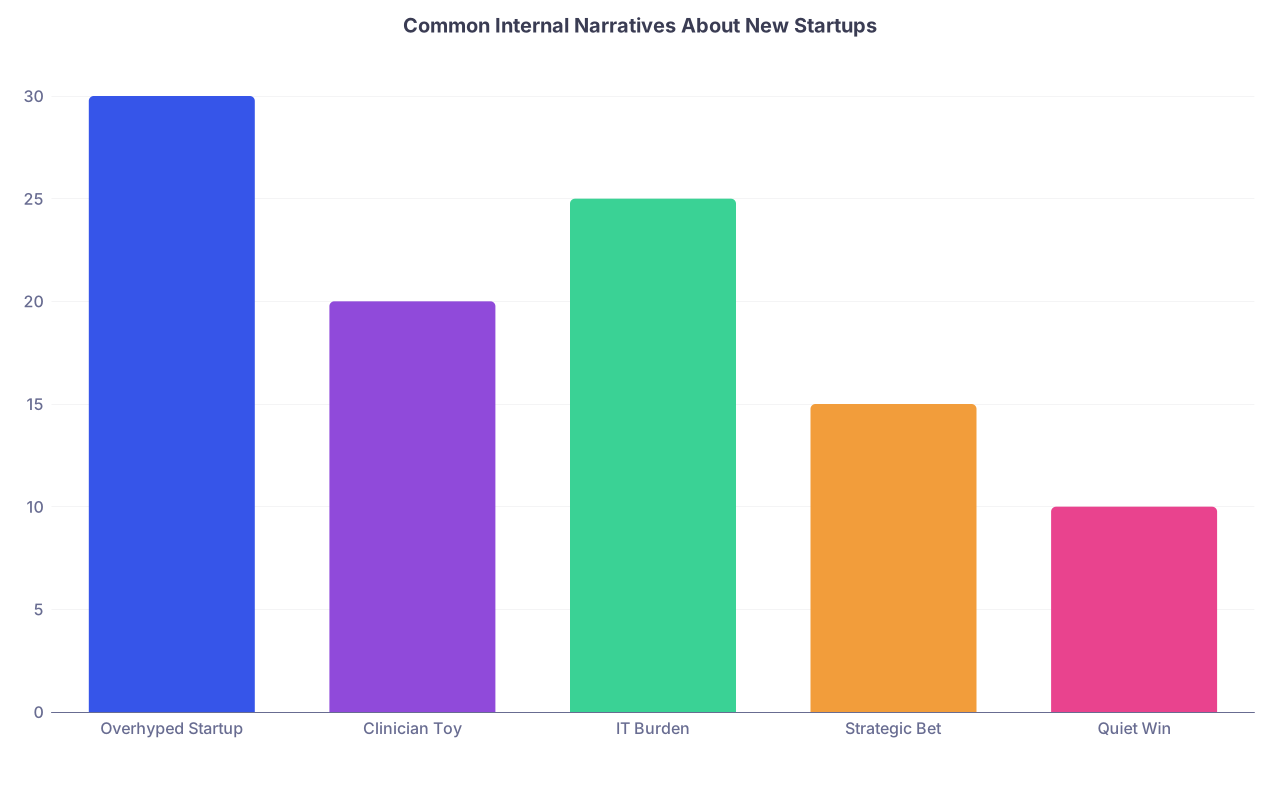
| Category | Value |
|---|---|
| Overhyped Startup | 30 |
| Clinician Toy | 20 |
| IT Burden | 25 |
| Strategic Bet | 15 |
| Quiet Win | 10 |
I’ve heard all of these labels used:
- “This is Dr. X’s pet project.”
- “Another shiny tech toy from the innovation group.”
- “An IT headache that doesn’t move core metrics.”
- “Something the CMO is excited about.”
- “A small pilot that quietly worked.”
You want to be in that last category. But you do not control the label. Internal champions, detractors, and neutral middle managers do.
That’s why your job after the pitch is not just product and data. It’s managing internal narrative. Who feels heard. Who feels threatened. Who gets credit when things go well.
How To Actually Influence The Room You’re Not In
You’ll never be in that closed-door debrief. But you can shape it long before you step into the boardroom.
Here’s what founders who consistently win these rooms do differently.
1. They pre‑wire the room
The real pros never meet the full committee cold.
They’ve already:
- Met 1:1 with the CMIO or CIO.
- Had coffee with the likely clinician champion.
- Talked with someone from finance about how this would be budgeted.
- Understood who lost out from a prior vendor decision.
So when the debrief starts, it’s not, “What do we think?” It’s, “As we discussed last week, this fits under the readmission reduction initiative; Dr. X is willing to pilot it in cardiology; IT said integration is manageable.”
That’s not an accident. That’s pre‑wiring.
2. They define ownership inside the org
During the pitch, weak founders say: “We’ll handle implementation end‑to‑end.” That sounds good to a startup. It sounds like a problem to a hospital.
Strong founders say something like:
“We see this living under your population health team, with Dr. X as clinical lead, reporting metrics monthly to Y committee. Our team will provide the project manager and training, but this will be your program.”
You’re handing them a structure they can argue for in the debrief. You’re also signaling you understand they need internal anchors, not just external vendors.
3. They address turf battles explicitly
I’ve watched a founder rescue a dying conversation by saying, in the room:
“I want to be clear: this doesn’t replace what your care managers or nurses do. It gives them earlier, cleaner data. If at any point this feels like it undermines their role, we’ll adjust.”
That line did two things:
- Defused the nursing director’s unspoken fear.
- Gave the CMO language to use later: “They’re augmenting, not replacing.”
You do not win by pretending politics do not exist. You win by showing you understand them.
Common Myths About What Happens After The Pitch
Let me kill a few illusions I see over and over from founders, especially physicians leaving residency or fellowship and entering the startup world.
Myth 1: “If my data is strong enough, they’ll have to say yes.”
I’ve seen randomized trials sitting on shelves while hospitals buy inferior tools from better‑connected vendors. Clinical data is table stakes. It gets you in the room. It does not close the deal.
Myth 2: “The innovation office will push this through.”
Innovation teams are often politically weak. Great people, minimal budget, little authority. They can sponsor you, host you, give you airtime. But when CFO, CIO, and service line chiefs say no, “innovation” loses almost every time.
Myth 3: “If they say no now, I’ll re‑pitch in a year with better results.”
If you got a real no, maybe. But most of the time you didn’t get a no. You got deprioritized. The context, leadership, and budget environment will be different in a year. You won’t be revisiting the same decision; you’ll be starting over.
Myth 4: “Landing one pilot means we’ve basically won the system.”
No. You’ve won one small political battle with one subset of people. Every new site, department, or hospital in the system is another political environment. Sometimes friendlier. Often worse.
Myth 5: “If I just explain it better next time…”
The problem usually isn’t explanation. It’s misalignment of incentives and risk. You can’t talk someone into spending political capital they don’t have or don’t want to use.
FAQ: The Questions Founders Quietly Ask
1. How do I know if my pitch actually went well, beyond polite smiles?
Watch for specifics. If they’re asking about exact pilot sites, internal owners, and timelines, that’s interest. If questions stay high‑level—“Tell me more about your vision”—they’re filling time. The strongest sign is when they argue with each other in front of you about how to use your product. That means they’ve mentally accepted it as real.
2. Should I ever ask directly, “Who would own this internally?”
Yes. It’s one of the best questions you can ask. Phrase it like: “If this moved forward, which department or leader would be the natural home for it?” Then shut up and listen. Their discomfort will tell you where the landmines are. Their clarity will tell you how close you are to a real deal.
3. What if IT or security is the main blocker after the pitch?
That’s common. Engage them as collaborators, not obstacles. Offer to fund or support a limited technical assessment. Show how you’ve handled similar environments. And crucially—get a senior clinical or operational leader to say, “This matters. Please help us find a way.” IT rarely moves for vendors. They move for their own leadership.
4. How aggressive should I be with follow‑ups if things go quiet?
Two or three thoughtful, spaced follow‑ups over 4–6 weeks is fine. Past that, you’re just confirming you have no internal champion. When responses become vaguer and timelines keep slipping, assume you’ve been deprioritized and invest your energy elsewhere. Obsessing over a stalled deal is how startups die.
5. Is it better to start with smaller community hospitals instead of big academic centers?
Often yes. Community systems can have fewer layers, faster decisions, and more pragmatic leaders who care less about prestige and more about “Does this fix a real problem this quarter?” You won’t get the same marketing shine as landing a brand‑name AMC, but you might actually get revenue and a cleaner case study faster.
You’ve learned what really happens when the boardroom door shuts: the turf wars, the risk calculations, the quiet moments where someone decides you’re worth betting on—or not.
Your next move is to stop treating the pitch as the event and start seeing it as one chapter in a much longer political story. The more time you spend shaping the conversations before and after that meeting, the more you’ll find doors quietly opening instead of quietly closing.
And once you’ve survived your first implementation and the internal narrative starts to flip in your favor—that’s when you stop being “a startup they’re trying” and start becoming “the way we do things here.” But that, as you’ll discover soon enough, is a different kind of battle.


