
You are two years out of residency. You have a full clinical load, a half-built digital tool that residents keep asking for, and an email from your hospital’s tech transfer office asking for a “disclosure meeting.” At the same time, a former co-fellow just DM’d: “Hey, didn’t you tell me about that app idea in 2021? Because Company X just launched something that sounds identical.”
Here is what you are up against: IP risk from every side. Employers, co-founders, vendors, investors, and your own past self putting ideas in emails and slide decks.
Let me walk you through how to lock this down — practically — as a physician innovator in the post-residency, early-career job market.
1. Know What You Actually Own (And What You Probably Do Not)
Most physicians guess wrong here. They either assume:
- “I am the inventor, I own it,” or
- “My hospital owns everything, so I have nothing.”
Both are usually wrong.
The three IP buckets you must understand
- Employment-related IP
- Independent / moonlighting IP
- Pre-employment or prior work
Start here before you write a single line of code or sign anything.
A. Pull and dissect your current contracts
You need to find, read, and mark:
- Your employment agreement (current job)
- Any fellowship / residency training agreements still in effect (yes, some linger)
- Any consulting agreements you have signed (speaker, advisory boards, side gigs)
Look for clauses titled:
- “Intellectual Property”
- “Inventions and Discoveries”
- “Work for Hire”
- “Assignment of Rights”
- “Moonlighting” or “Outside Activities”
- “Non-Compete / Restrictive Covenants”
What you are hunting for:
Scope of assignment
Phrases like:
- “All inventions conceived, developed, or reduced to practice during employment…”
- “…whether or not during work hours and whether or not using Employer resources…”
That kind of language means they will argue they own essentially everything you invent while on payroll, unless carved out.
Field of use
- Does it say “relating to Employer’s business”?
- Or “relating to healthcare, life sciences, or digital health”?
Narrow scope: easier to keep things.
Broad scope: assume they will claim almost any medical startup you build.Duty to disclose
- Any clause requiring you to “promptly disclose” inventions to the institution?
- Any reference to a “technology transfer office” or “innovation office”?
If yes, understand that hiding an invention can be breach-of-contract territory.
B. Rough rule of thumb (not a legal opinion, but reality)
Your employer is more likely to claim ownership if:
- You developed it:
- On their time clock
- Using their data, devices, engineers, or resources
- Directly tied to your clinical work or funded research
You are more likely to have leverage if:
- You built it:
- On your own time
- On your own equipment
- With your own money
- In a clearly distinct business area
But “more likely” is not “guaranteed.” This is where negotiation and documentation matter.
2. Decide What You Are Actually Protecting
You cannot protect “a cool idea.” You protect specific forms of intellectual property.

The main IP tools for physician innovators
- Patents – protect inventions and functional features
- Copyright – protects code, written content, training materials
- Trademarks – protect brand names, logos, product names
- Trade secrets – protect “how” you do something (algorithms, processes, datasets)
| Innovation Type | Primary IP Tool | Backup / Secondary |
|---|---|---|
| Medical device | Patent | Trade secret |
| Clinical decision support app | Patent + Copyright | Trade secret |
| Patient education platform | Copyright | Trademark |
| AI risk prediction algorithm | Trade secret + Patent | Copyright |
| New clinic model / workflow | Trade secret | Trademark (brand) |
Quick litmus test
- If your innovation solves a technical problem in a new way → patent might be in play.
- If you wrote a lot of original text, code, or visuals → copyright automatically exists.
- If you care about being “the named brand” in this space → trademark.
- If the “secret sauce” is a method or dataset you do not want public → trade secret.
You almost never use just one. Good strategies combine 2–3 of these intelligently.
3. The “First 90 Days” Protection Protocol
Assume you are at the “post-residency, have a job, and an idea is taking shape” phase.
Here is what to do in the next 90 days if you are serious.
Step 1: Lock down your documentation
Create a private, dated record of:
- How and when you came up with the idea
- Who you discussed it with
- What you built, and with what tools/resources
Use:
- A bound paper notebook with dates and signatures; or
- A version-controlled repo (GitHub/GitLab, private) with timestamped commits; plus
- A secure cloud folder (Not Google Drive shared with hospital account…)
Why: If there is ever a dispute about inventorship or timing, contemporaneous records matter.
Step 2: Stop over-sharing immediately
Do not:
- Pitch the full details in conferences, grand rounds, or on LinkedIn before protection.
- Give full access to code or documentation to “a friend who can help” without agreements.
- Email spec documents to your hospital IT department without thinking.
Instead:
- Use high-level descriptions with outsiders: problem, outcomes, not exact methods.
- For any serious discussion, push for an NDA before you share specifics.
Step 3: Put basic contracts in place before collaboration
Bare minimum:
NDA (Non-Disclosure Agreement):
Anyone you share substantive details with — developers, data scientists, potential co-founders, small dev shops.IP Assignment / Contribution Agreement:
If someone touches your code, design, algorithm, or prototype, they must agree in writing that:- The IP goes to your entity (or to you, if you are still pre-entity)
- They are not reusing proprietary code from elsewhere
- They have no independent ownership claim
Skip this, and you will eventually have an “ex-colleague” or contract developer arguing they co-own your core IP.
4. Patents: When a Physician Should Actually Consider Filing
Most physicians either chase patents too early or ignore them until it is too late.
When a patent strategy is smart
- Your innovation is:
- Technically novel, not just “a telehealth app but nicer”
- Tied to a device, diagnostic, algorithm, or unique workflow that can be clearly described
- You foresee:
- Licensing to device companies, pharma, or health tech players
- Future investors asking, “What stops Epic or Apple from doing this?”
Also: if you are in medical devices or diagnostics, patents are not optional. They are standard.
The minimum patent playbook
Do not publicly disclose before at least a provisional filing.
- Public disclosure includes:
- Conference posters with enough detail
- Preprints, articles, or social media posts
- Detailed slide decks shared beyond a small NDA-protected group
In the U.S., you technically have a 1-year grace period after your own disclosure, but international rights can vanish instantly. Do not rely on rescue provisions; plan ahead.
- Public disclosure includes:
File a provisional patent, not a napkin sketch.
A “good enough” provisional, for a resource-constrained physician:
- Drafted with a patent attorney or agent who actually understands life sciences.
- Includes:
- Clear description of the problem
- Multiple variations of your solution
- Diagrams / flowcharts of your system or method
- Example use cases
Cheap, thin provisionals lead to weak rights later. You are better served by one robust provisional than three flimsy ones.
Coordinate with your employer’s tech transfer office (if they have a claim).
Best play if the hospital might own or co-own:
- Disclose the invention formally.
- Have an explicit discussion about:
- Ownership percentages
- Licensing options to your startup
- Revenue share structures
Do this before outside investors start diligence. They will ask. If the tech transfer office surprises them, your deal may die.
5. Trade Secrets and Algorithms: The Reality for Digital Health and AI
If you are building:
- A risk prediction model
- Triage or workflow algorithms
- A unique data pipeline blending EHR data and other sources
Patents help, but the real moat is often trade secrets.
What qualifies as a trade secret?
- Something not generally known or easily discoverable
- That gives you economic advantage
- That you actively protect
That last part is where most physician startups fail.
Minimum protection steps
Access control
- Restrict codebase and key documentation to “need-to-know” only.
- Separate “research sandbox” data from production data.
- Disable casual Google Drive sharing; use a serious system (Git repos, private cloud with roles).
Contractual protection
- NDAs with all external collaborators.
- IP/Confidentiality clauses in employment or contractor agreements.
- Clear language that trade secrets must be returned or destroyed upon exit.
Process discipline
- Document what you consider trade secret (algorithms, specific parameter sets, unique datasets, process workflows).
- Periodically review access logs and who has what.
If you ever need to enforce trade secret rights, you must show you treated the information like a secret, not like clinic handouts on a hallway table.
6. Building with Others: Co-Founders, Developers, and “That Resident Who Helped”
This is where things get messy fast.
Co-founders: Set the rules before you build
Have a written Founders Agreement or early-stage operating agreement that covers:
- Equity split (not “we’ll figure it out later”)
- Roles and responsibilities
- IP ownership – all founders assign IP related to the venture to the company
- Vesting – equity earned over time, with cliffs, so someone who quits in 6 months does not own 33% forever
- Decision-making – who can sign deals, who controls the IP
If someone already contributed (e.g., your co-fellow built an early model during fellowship), you must decide:
- Are they a co-founder with vesting equity?
- Or are they a compensated consultant with a clearly defined assignment of rights?
Verbal understandings are how lawsuits start.
Developers and vendors: The two clauses that matter
When you hire a dev shop or freelancer, insist on:
“Work for hire” plus assignment of all IP to you / your entity
If the contract says they retain ownership and “license” to you, walk away or renegotiate.
Warranty of non-infringement
They should state that:
- Their code is original or appropriately licensed
- They are not inserting code they do not have rights to
You do not want DMCA takedown notices landing after your product gains traction.
7. Handling Employer Relationships Without Blowing Up Your Career
You are on staff. You have an idea. You want to build something real. How do you do that without becoming “problem physician” in HR’s inbox?
Step 1: Decide your path — inside or outside the institution
You have three strategic options:
Institution-owned innovation
- You disclose, they own, they patent, they maybe license back to you later.
- Pros: resources, legal help, credibility.
- Cons: slower, less control, future licensing friction.
Jointly developed / licensed innovation
- You negotiate that you retain or share ownership and license to the institution.
- Pros: shared upside, some independence.
- Cons: negotiation complexity early.
Completely external venture
- You build outside, on your own time and resources, with explicit clearance it is allowed.
- Pros: control, speed.
- Cons: risk of perceived conflict, need to stay very clean about resource use and scope.

| Step | Description |
|---|---|
| Step 1 | Idea During Employment |
| Step 2 | Disclose to Tech Transfer |
| Step 3 | Institution Owned or Joint |
| Step 4 | Negotiate Side Venture Terms |
| Step 5 | Build External Venture |
| Step 6 | Uses Employer Resources |
| Step 7 | Overlaps Employer Business |
Step 2: Put your boundaries in writing
If you choose an external venture, ask for:
- A written sign-off from compliance or legal that:
- The outside activity is permitted
- There is no current conflict with your assigned duties
- Your independent entity owns the IP you develop outside work
If they refuse to sign anything, that is a signal. At least document:
- Your understanding of their position
- That you are building on your own time and equipment
- That you will avoid using their data, patients, or colleagues without formal agreements
Send a short, clear email summarizing any verbal conversation. Keep that email.
8. Trademarks, Branding, and Online Footprint
This is the easy part to neglect and later regret.
Basic moves
Name search early
- Before you fall in love with “CardioMind” or “NeuroGuide,” do:
- USPTO TESS search (trademark database)
- Basic Google search
- Domain availability check
- Before you fall in love with “CardioMind” or “NeuroGuide,” do:
File a basic word mark once you commit
- If you have:
- A product name you are using in commerce, or will soon
- A clear class (software as a medical tool, educational services, etc.)
File a word mark (text only) first. Logos later. A word mark is more flexible and easier to defend.
- If you have:
Lock down domains and key handles
- Get the .com if you can.
- Lock Twitter/X, LinkedIn, and major healthcare-relevant platforms.
You do not want to rebrand a clinical product 18 months in because someone else registered your name properly.
9. What To Do If You Already Screwed Up
You presented the full idea at a conference. Or built your MVP on a hospital laptop. Or a co-founder left in anger. You are not the first.
Here is a triage protocol.
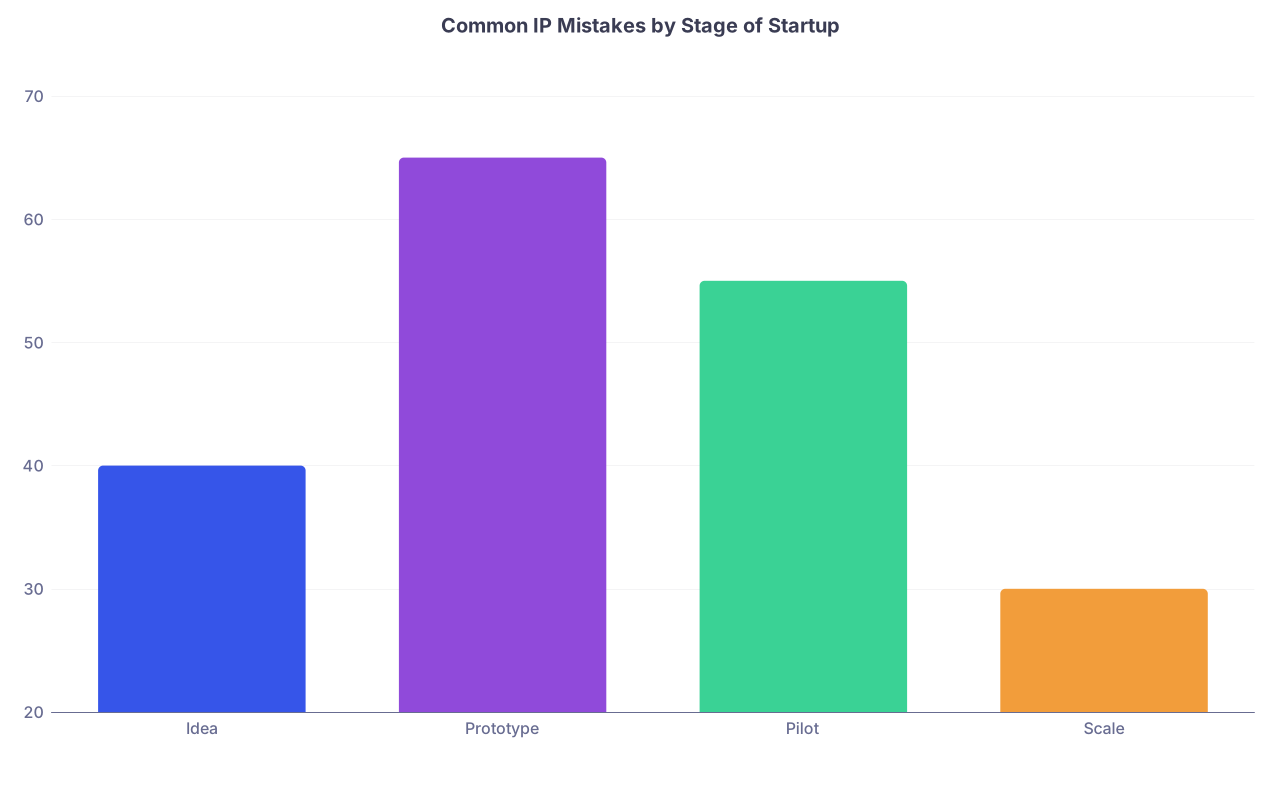
| Category | Value |
|---|---|
| Idea | 40 |
| Prototype | 65 |
| Pilot | 55 |
| Scale | 30 |
Scenario 1: You disclosed before filing
If it was only under NDA: you are fine, largely. File as soon as possible.
If it was a public talk or paper:
- Talk to a patent attorney promptly.
- U.S.: possibly still eligible within 1 year (grace period).
- Many other countries: rights may be gone already for that version of the invention.
Lesson: it may still be salvageable, but timing is now critical.
Scenario 2: You used employer resources
Did you:
- Train models on hospital EHR data informally?
- Have internal IT build a prototype widget?
- Use a hospital developer “as a favor”?
Then assume the institution may claim ownership or co-ownership.
Your options:
Bring it to tech transfer voluntarily and negotiate:
- Clarity on IP
- A license to your startup
- Maybe a revenue split
Or bury it and rebuild from scratch on clean, external resources. Not ideal, often impossible for data-driven projects.
Scenario 3: A co-founder or collaborator is now hostile
You must:
- Gather all written agreements, emails, and version history.
- Map out exactly what they contributed and when.
- Offer a structured exit: buyout, vesting freeze, or limited royalty.
Sometimes you involve a neutral third-party mediator or attorney. Letting it fester is how companies die before Series A.
10. Minimal, Realistic IP Action Plan for the Next 6–12 Months
If you remember nothing else, use this as your checklist.
In the next 30 days
- Pull and mark all employment and consulting contracts for IP clauses.
- Start a dated, secure documentation system for your innovation work.
- Stop casual sharing of detailed methods without NDAs.
- Draft and sign NDAs + IP assignment with any current collaborators.
In the next 90 days
- Decide whether your path is:
- Institution-owned, joint, or external venture.
- If external: get written approval (or at least email documentation) of your outside activity.
- Meet with a patent attorney for a 60–90 minute strategy session:
- Decide whether to file a provisional, or rely on trade secrets.
- Clean up your dev environment: no hospital laptops, no ambiguous shared drives.
In the next 6–12 months
- If appropriate, file at least one solid provisional patent that covers your core invention and variants.
- Form a legal entity (LLC or corporation) and assign the IP to it, instead of leaving it as “personal” IP.
- File a trademark for your core brand name once you validate the concept.
- Formalize co-founder roles, equity, vesting, and IP assignment in written agreements.
FAQ (Exactly 4 Questions)
1. Do I really need a lawyer, or can I just use templates and online filings?
For very early basic NDAs and equity splits among trusted colleagues, solid templates can be a decent start. But for anything involving patents, employer conflicts, or serious outside capital, not using a lawyer is false economy. The money you “save” now is almost always dwarfed by the cost of fixing bad IP structure later. At minimum, pay for a few focused hours with a patent attorney and a startup-savvy business attorney.
2. Can my hospital stop me from working on my startup outside work hours?
They can try, using broad IP ownership or non-compete clauses, especially if your startup overlaps heavily with their services. But many institutions are reasonable if you approach them early, define clear boundaries (no use of their data, staff, or time), and offer a path for them to benefit if relevant. The worst scenario is springing a nearly-finished product on them without prior conversation.
3. Is it better to patent my algorithm or keep it as a trade secret?
If the algorithm is easily reverse-engineered from the product or will be obvious in published literature, patents may be useful. If the value lies in complex internal methods, proprietary data, or constantly-updated models, trade secret protection is usually better. Many AI health startups do a hybrid: patent the high-level methods or unique system structure, guard the exact implementation and data as trade secrets.
4. What if my idea came during residency but I am now at a new job? Who owns it?
It depends on when and how you developed it. If you built key parts using your residency institution’s resources, or under funded research, they may claim ownership. If it was more of an early concept then and you substantially developed it after leaving, you have more leverage. The clean approach is to review your old training contract, talk to their tech transfer office if there is a genuine overlap, and consider a simple agreement clarifying rights before you raise money or go public.
Key points to walk away with:
- You protect specific IP (patents, trade secrets, copyrights, trademarks), not vague “ideas,” and you need to pick the right tools.
- Your employment contracts and early documentation habits quietly determine who will own your future startup’s core assets.
- Getting basic agreements and boundaries in place early — with employers, co-founders, and developers — is far cheaper and safer than trying to fix IP chaos after your product starts to succeed.