

Most physician startup ideas die in clinic hallways and hospital parking lots. Not because the ideas are bad, but because the owner never turns them into a working prototype.
You can fix that. In a structured way. Without quitting your job or “going all‑in on entrepreneurship.”
This is a 10-step, execution-focused plan for post‑residency physicians who are working full-time and want to take a real shot at building a medical startup—starting with a functional prototype, not a fantasy deck.
Step 1: Define the Problem So Clearly It Feels Boring
If you cannot state your problem in one painful, specific sentence, you are not ready to build anything.
You are probably starting from something fuzzy like:
- “Prior authorizations are a nightmare”
- “Discharge planning is broken”
- “Patients do not understand their meds”
That is not enough. You need surgical precision.
Your job in Step 1: Write a one-sentence problem statement with:
- A specific user
- A specific context
- A measurable pain
Examples:
- “Hospitalists at community hospitals waste 45–60 minutes per shift manually reconciling meds across fragmented EHRs during admissions.”
- “Primary care physicians lose 3–5 consult slots per week because inbound referrals arrive incomplete or with missing imaging/labs.”
- “Type 2 diabetics in the first year after diagnosis miss 25–40% of follow-up visits due to confusing scheduling processes and fragmented reminders.”
Now pressure-test it quickly:
Gut check (your own experience):
- Have you personally felt this pain at least 50 times?
- Can you recall specific shifts or patients where this problem derailed your day?
Quick peer validation (no surveys yet):
- Ask 3–5 colleagues in your specialty:
- “On a 0–10 scale, how annoying is this problem?”
- “How much time or money do you think this costs you per week?”
- If nobody is at 7 or higher, your problem is weak or misframed.
- Ask 3–5 colleagues in your specialty:
Constraint check:
- Can this problem be impacted by software or a workflow tool (not just by changing policy or staffing)?
- If the only “solution” is “hospital hires more people” or “payers change rules,” you do not have a startup problem; you have a policy problem.
Your deliverable for Step 1:
One brutal, specific sentence describing the problem, plus 3–5 quotes from colleagues that show it is real and painful.
Step 2: Box In the Scope Ruthlessly
Busy physicians fail here: they try to fix the entire care pathway in version 1.
Your goal is not “solve prior auth” or “fix discharge planning.” Your goal is “build a tiny, sharp tool that solves one narrow part of that problem so well that someone would miss it if it disappeared.”
Define your Minimum Viable Problem Slice (MVPS).
Ask:
- If I could only solve one micro‑piece of this problem, what would it be?
- What is the 15-minute daily pain I can remove that will be obviously noticeable?
Examples of MVPS framing:
- Instead of “fix prior auth”:
→ “Auto-generate draft prior auth letters for the 5 most common high-cost meds in my specialty, pulling data from a PDF chart export.” - Instead of “improve discharge planning”:
→ “Standardize, auto-populate, and e‑fax a discharge summary and follow-up instructions for patients going to SNFs, using templates tuned for 3 local facilities.” - Instead of “help diabetics adhere to care plans”:
→ “Send patients 3 simple, text-based check-ins during the first week after a medication change, and flag non-responders for the MA.”
This is where scope creep dies.
Your deliverable for Step 2:
- A one-sentence description of the smallest slice of the problem you will attack first.
- A list of 3–5 “won’t-do” items you explicitly leave for later versions.
Step 3: Turn Workflow Into a Simple Diagram
Before you fantasize about AI, blockchain, or FHIR, you need a brutally simple map of current and future workflows.
You are building a tool for people operating inside real systems with real constraints (EHRs, billing, call schedules). If you ignore workflows, you will build something clever and useless.
Create two flows:
- Current workflow (how it happens now)
- Ideal workflow with your tool involved
Use this simple structure:

| Step | Description |
|---|---|
| Step 1 | Trigger event |
| Step 2 | Current first step |
| Step 3 | Manual tasks and handoffs |
| Step 4 | Current pain points |
| Step 5 | Outcome today |
| Step 6 | Prototype step |
| Step 7 | Automated or simplified tasks |
| Step 8 | Reduced pain |
| Step 9 | Improved outcome |
Do it in 20–30 minutes using:
- A sheet of paper
- Or a whiteboard photo
- Or a quick digital diagram tool (Miro, Whimsical, draw.io)
Questions to answer:
- Where exactly does your tool touch the workflow?
- What comes immediately before and after your solution?
- Who interacts with it (nurse, MA, physician, front desk, patient)?
Your deliverable for Step 3:
- One “before” workflow.
- One “after” workflow with clear entry and exit points for your prototype.
Step 4: Lock In Your User and Your Setting
“Healthcare” is not your market. “Doctors” is not your user.
Pick one primary user and one primary environment for version 1. Yes, it feels limiting. Good. That is how you actually ship.
Use constraints like:
| User Type | Setting | Example Niche MVP User |
|---|---|---|
| Hospitalist | 250–400 bed community | No in-house informatics, Cerner |
| PCP | Independent 3–5 doc group | Athenahealth EHR |
| Oncologist | Academic outpatient clinic | Epic with home-grown tools |
| ED Physician | Community ED | Meditech, high volume |
| RN Care Manager | ACO-affiliated clinic | Mixed EHR environment |
Then answer:
- Who feels the pain most acutely?
- Who has enough control to adopt something new?
- In what setting do you have direct access for testing? (Your job, your friend’s practice, your old residency program.)
Your deliverable for Step 4:
- A single-sentence target:
“Version 1 is for [role] working at [type of practice/hospital] using [EHR/stack], dealing with [problem].”
If you hear yourself saying “and also,” you are already diluting your chances.
Step 5: Commit to a Lean Time Budget and Protect It
You are a post‑residency physician. You do not have 40 hours a week to tinker. You probably have 4–8.
Instead of vague aspiration, build a fixed 4–12 week execution window with a non-negotiable weekly time block.
For example:
- Duration: 10 weeks
- Weekly commitment: 2 evenings (2 hours each) + 1 block on weekends (3 hours)
- Total: ~7 hours/week → ~70 focused hours
Then translate that into a stepwise timeline:
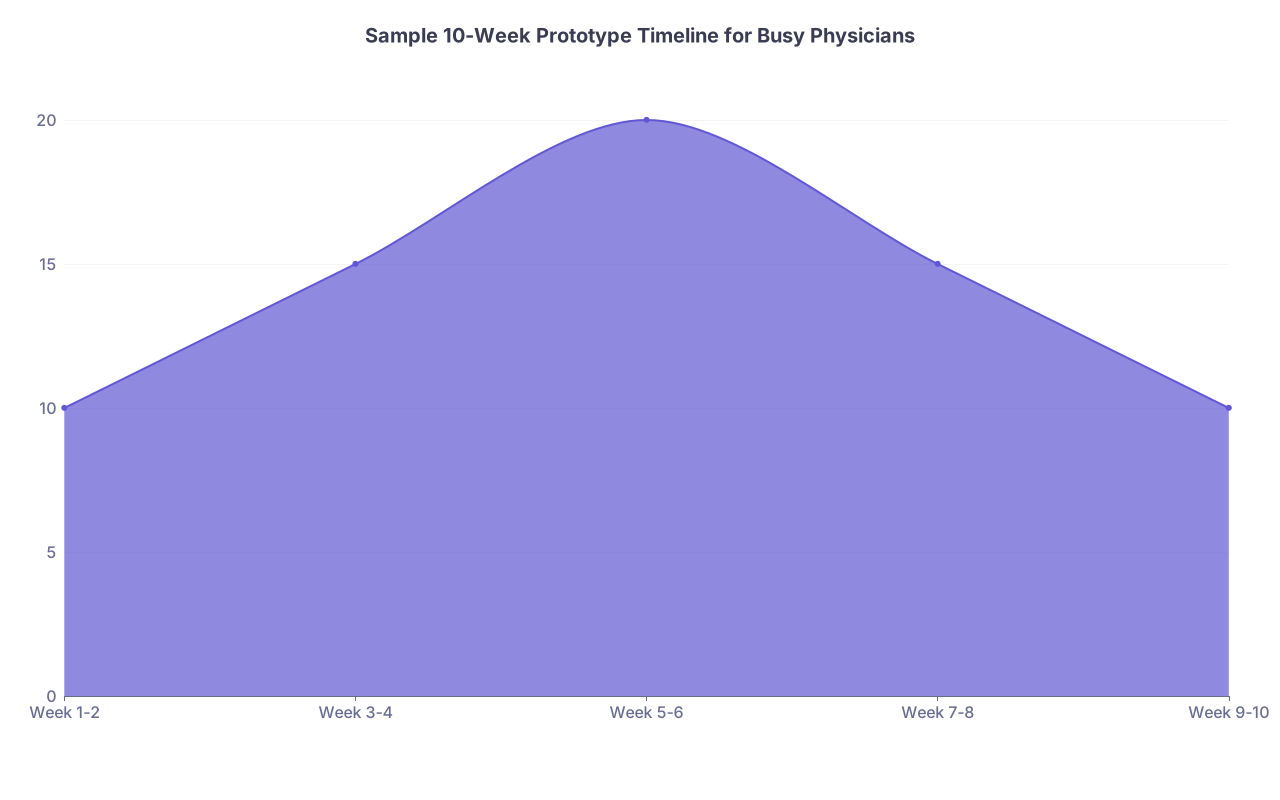
| Category | Value |
|---|---|
| Week 1-2 | 10 |
| Week 3-4 | 15 |
| Week 5-6 | 20 |
| Week 7-8 | 15 |
| Week 9-10 | 10 |
Rough breakdown:
- Weeks 1–2: Problem validation, workflow mapping, scope decisions
- Weeks 3–4: Low-fidelity sketches and user feedback
- Weeks 5–6: Build “ugly but working” prototype
- Weeks 7–8: Real-world tests with 3–5 users
- Weeks 9–10: Iterate and define next version or kill it
Make it real:
- Put recurring calendar blocks for the whole 10 weeks.
- Tell 1–2 trusted colleagues:
“I am building a prototype by [date]. I need you to try it for 10 minutes when it is ready.” - Decide in advance:
- No adding extra projects during these 10 weeks.
- If you miss more than 2 weeks, you either restart the clock or intentionally pause.
Your deliverable for Step 5:
- A dated, written commitment: “By [specific date], I will have a working prototype that can be used by [target user] to [do X].”
Step 6: Build the Prototype on the Simplest Possible Stack
Most physician-entrepreneurs waste months obsessing about tech stacks instead of proving anyone wants their tool.
You do not need:
- Custom iOS and Android apps
- A fully integrated FHIR-based Epic plugin
- A “scalable microservice architecture”
You need something that:
- A real user can touch
- Solves a small slice of the problem
- Can be modified quickly without a full engineering team
Pick the lowest-code option that can credibly support your MVPS.
Good first-iteration options
Depending on what you are building:
Workflow / admin / internal tools
- No-code/low-code platforms:
- Bubble, Glide, Retool, AppSheet, Softr
- Simple web front-end + spreadsheet backend (Google Sheets or Airtable)
- No-code/low-code platforms:
Patient-facing tools
- SMS-based: Twilio + a simple backend (or no-code SMS tools)
- Web app optimized for mobile (no need for native app yet)
Data capture / forms
- Typeform, Jotform, Tally, or Google Forms + automation (Zapier/Make) to push data where you want.
-
- Browser extension or sidecar web app where clinicians copy-paste minimal data.
- Basic “helper” apps that generate notes/text the clinician then pastes into the EHR.
Your goal:
From zero to “clickable prototype” in 2–3 weeks, not 6–9 months.

Your deliverable for Step 6:
- A functioning prototype with:
- A simple login or unique link (if needed)
- A minimal interface that walks the user through one key workflow
- Basic data persistence (even if it is just a spreadsheet)
It is allowed—encouraged even—to be ugly.
Step 7: Script the First 10 User Sessions
Let me be blunt: if you just “send people a link” and hope for feedback, you will get silence or useless opinions.
You must facilitate the first 10 uses like a mini usability study.
Plan:
- 5–10 users from your target group (colleagues, people you know through residency, old co-fellows)
- 20–30 minutes each, on Zoom or in person
Structure each session:
5 minutes – Context
- “Describe the last time this problem made your day worse.”
- “What are you currently doing to deal with it?”
10–15 minutes – Live use
- Share your screen or let them share theirs.
- Give a simple task:
- “Pretend you just admitted a patient with [scenario]. Use this tool to handle [task].”
- Say almost nothing. Watch where they hesitate, get confused, or click the wrong things.
5–10 minutes – Debrief
- Ask:
- “On a 0–10 scale, how helpful would this be if it worked flawlessly and was available every shift?”
- “What part felt most valuable?”
- “What part felt annoying or unnecessary?”
- “If I removed one step, which would you remove?”
- Ask:
Capture:
- Screenshots of confusion points
- Exact quotes:
- “I would only use this if it was integrated into Epic.”
- “This is faster than what I do now.”
- “I would have my MA do this, not me.”
Your deliverable for Step 7:
- A short document with:
- 10 ratings (0–10)
- Top 5 recurring compliments
- Top 5 recurring complaints or friction points
Step 8: Reduce, Don’t Add
Your instinct after collecting feedback will be to add features. Resist it.
Your prototype is too big already. Almost all early prototypes are. The path to something physicians actually use is subtraction and shortening.
Use a two-pass cleanup:
Kill list (mandatory)
- Identify:
- Fields nobody used or cared about
- Steps where everyone hesitated or asked “Why is this needed?”
- Data that is “nice to have” but not essential to the immediate problem
- Remove them for the next version. Do not “grey them out.” Delete.
- Identify:
Speed pass
- Ask yourself:
- “Can the user complete the main task in under 60 seconds?”
- If not, shave:
- Pre-filled fields instead of manual entry
- Default values
- Smart templates rather than free text
- Ask yourself:
This is where prototypes start feeling “magic” rather than “another screen to click through.”
Your deliverable for Step 8:
- A leaner version of the prototype whose main workflow:
- Has fewer screens
- Asks for less data
- Can be explained in one short sentence:
“This tool does X in under a minute.”
Step 9: Prove a Tiny, Concrete Win in the Real World
A prototype that demos well is worthless. A prototype that demonstrably saves 5–10 minutes or prevents a missed step in real workflows is gold.
You now run a single, small, real-world pilot with clear metrics.
Define:
- Setting: One clinic, one hospitalist service, one call group.
- Duration: 2–4 weeks.
- Scope: A narrow set of use cases (e.g., “admissions of CHF and COPD patients during day shifts” or “SNF discharges on weekdays only”).
Pick 1–2 primary metrics, such as:
- Time saved per use
- Number of avoided phone calls
- Reduction in incomplete referrals
- Time to complete a specific doc
- Number of patients who successfully respond to follow-up prompts
Keep it simple:
| Metric | Baseline Estimate | Pilot Target |
|---|---|---|
| Time per task (minutes) | 8 | 4 or less |
| Incomplete referrals / wk | 5 | 2 or less |
| Manual phone calls / wk | 12 | 6 or less |
| Follow-up response rate % | 40 | 55 or higher |
| User satisfaction (0–10) | — | 7 or higher avg |
During the pilot:
- Track a few concrete examples, not just averages:
- “Dr. Smith used this for 10 discharges; average doc time dropped from 9 minutes to 4.5.”
- “MA used this for 15 prior auths; 11 were auto-approved without back-and-forth.”
Collect:
- Short user comments
- Before/after screenshots if relevant
- One or two mini case stories
Your deliverable for Step 9:
- A 1–2 page “mini report”:
- Context, duration, number of uses
- Basic metrics (even if approximate)
- 2–3 quotes, ideally one strongly positive, one skeptical
This is now evidence. You can use it to:
- Decide if the idea deserves more of your time.
- Convince a technical co-founder or developer to join.
- Get early conversations going with your institution or potential customers.
Step 10: Decide: Kill, Pause, or Double Down
Most physicians never make this decision explicit. They drift. They tinker indefinitely.
You are going to be more ruthless.
After your first real pilot, block one hour and answer:
Is the pain real enough?
- Did users spontaneously say some version of:
- “If this were integrated / smoothed out, I would use it daily.”
- Do you see people trying to “hack” your prototype into their workflow?
- Did users spontaneously say some version of:
Is the impact visible?
- Did you observe:
- Clear time saved?
- Fewer errors?
- Less rework?
- Or was it “interesting, but not life-changing”?
- Did you observe:
Is this where you want to spend nights and weekends for 6–12 months?
- Forget “market potential” for a second. Do you feel energized debugging this specific problem and talking to these specific users?
Then choose one of three paths:
Path A: Kill It (This Is a Success)
You decide:
- The pain is not strong enough.
- The impact is marginal.
- Or you hate working on this problem.
Good. You learned:
- How to go from idea to prototype.
- How to run a pilot.
- How to talk to users like a founder instead of just as a clinician.
Those skills transfer to the next idea.
Path B: Park It With a Clear “Resume If” Trigger
Maybe:
- The prototype shows promise but you lack time.
- You think you need a willing institutional partner.
- Or the tech/barrier is just a bit too high right now.
Create:
- A short summary doc (problem, prototype, pilot results, what is missing).
- A “resume if” line, such as:
- “I will revisit this if I find a technical co-founder with EHR integration experience.”
- “I will pick this up if my group agrees to be a design partner.”
Then close the loop mentally. Do not half-work on it forever.
Path C: Double Down
The metrics look good. Users complain when they cannot use it. You still care.
Then your next 3–6 months shift from “idea to prototype” to “prototype to product”, which usually means:
- Hardening the tech stack (more robust backend, security, HIPAA compliance if applicable)
- Deepening integration into workflows (possibly light-weight EHR integration or better workarounds)
- Formalizing your founding team and equity
- Understanding the business model (who pays, how much, why)
But notice something: now you are doing that with evidence in hand. Not with a dream and a slide deck.
Your deliverable for Step 10:
- A written decision (kill, park, or double down) and a 2–3 line rationale.
How to Make This Work While Still Practicing
You are not a full-time founder yet. That is fine. Many strong healthcare startups started exactly where you are: post-residency, in the trenches, annoyed enough to build something better.
A few operational rules to make this plan realistic:
Pick one idea. Only one.
You will have 5 more ideas this month. Write them down. Do not touch them until you finish the 10-step cycle for the current one.Stay inside your circle of competence.
Build in domains where:- You understand the regulatory landmines.
- You speak the language of the users.
- You have easy access to test sites.
Treat your time like a scarce clinical resource.
- Block it.
- Protect it.
- Say no to “fun but unrelated” projects while you are in a build cycle.
Avoid structural perfectionism early.
You do not need:- A Delaware C‑Corp before a prototype exists.
- Fancy branding.
- A 20-page business plan.
Those matter later. Right now you need proof that anyone cares enough about this problem to use your ugly, early tool.
Talk to more users than investors.
In this phase:- 10 deep user conversations are far more valuable than 10 coffee chats with VCs.
- Investors will be more interested once you show real usage and impact anyway.
Your Next Action Today
Do not “bookmark this for later.” That is where physician ideas go to die.
Right now, before you move on:
Write a single, brutally specific problem sentence.
One user. One setting. One painful, measurable problem.
Type it out. Then send it to one colleague and ask:
“0–10, how much does this problem hurt you in your practice?”
That is Step 1. Start there. Everything else—prototype, pilot, startup—builds on that one clear sentence.


