
The fantasy that “a great MVP will sell itself” is killing medical startups.
If you are post‑residency, have a working product, a couple of pilots, maybe a glowing testimonial or two—and still no paying enterprise client—you are not unlucky. You are missing a very specific set of steps.
Let me walk you through them.
You are not in the “build” phase anymore. You are in the “sell to a bureaucratic, risk‑averse machine” phase. That requires a different playbook than hustling for pilot sites during nights and weekends on call.
Below is that playbook, built for medical founders who understand hospitals, not sales funnels.
1. Accept the Brutal Reality of Enterprise Healthcare Sales
You will not “close” a hospital the way you closed a pilot with your old attending.
Enterprise healthcare buying is:
- Slow (6–18 months is normal).
- Political (titles matter, but power often does not match titles).
- Conservative (status quo bias is insane).
- Compliance‑heavy (HIPAA, BAA, InfoSec, legal, procurement—the full circus).
That is not a bug. That is the game.
Your job now is not to shout “we improve outcomes” louder. Your job is to:
- Map the buying process.
- De‑risk the decision for the buyer.
- Give each stakeholder exactly what they need to say “yes” or at least “not no.”
To do that, you need a structured pipeline.
2. Define One Tight, Enterprise‑Grade Use Case
Most MVPs are “platforms” that can theoretically help everyone. That is exactly why no one buys them.
Enterprises buy specific solutions to clearly defined problems that show up on:
- Their budget line items.
- Their regulatory risk list.
- Their quality dashboard.
Pick one use case. Not four. One.
How to pick the right first enterprise use case
Use this filter:
Tied to an existing budget
Someone is already paying for this problem. Or paying a penalty for not solving it.- Example: Readmission penalties, overtime nursing costs, denial management, length of stay.
Quantifiable and time‑bound
You can show numbers in under 3–6 months:- % reduction in no‑shows.
- Minutes saved per nurse per shift.
- Decrease in denials per 100 encounters.
Operational, not just “clinical cool”
If the ROI is mostly “better care” with vague financial impact, you will stall. You need:- Revenue up, costs down, risk reduced.
- Not just “clinicians like it.”
Aligned with current industry pressures
Right now (post‑2020s reality), this is what keeps executives awake:- Workforce shortages / burnout.
- Throughput and access (ED boarding, OR efficiency, outpatient capacity).
- Value‑based contracts and readmissions.
- Prior auth, denials, revenue integrity.
If your MVP can do 20 things, carve out the one that hits those four points. Package that as “Version 1.0 – [Specific Use Case]”.
Then build everything in your sales motion around that one use case.
3. Build a Minimal but Real Enterprise Sales Asset Stack
You do not need a 50‑page deck and 20 white papers. You do need a small set of professional, consistent assets.
Here is the stack I tell medical founders to build before chasing serious enterprise deals:
| Asset Type | Purpose |
|---|---|
| 1-page Problem/ROI | Executive summary and business case |
| 10–12 slide deck | Standard sales and stakeholder pitch |
| 2-page case study | Credibility + outcomes proof |
| Security/Compliance sheet | Answer IT & compliance quickly |
| Implementation checklist | Calm ops and clinical leaders |
1. The 1‑Page Problem/ROI Sheet
Audience: CFO, VP Ops, Service line leader.
One page. No fluff. Include:
The problem in their language.
Example: “ED boarding and delayed inpatient admissions increase LOS and cost.”The current cost. Use conservative numbers.
- Pull from CMS, Vizient, HFMA, or major consulting reports.
- If you shorten LOS by 0.25 days, what is that worth per bed per year?
Your outcome metric.
“In a 3‑month pilot at a 350‑bed community hospital, we reduced X by Y%.”The simple ROI math.
“For a typical 300–500 bed hospital, this translates to estimated annual benefit of $X–$Y vs subscription cost of $Z.”
If you cannot fit it clearly on one page, your value prop is not ready.
2. The 10–12 Slide Deck
Structure it like this:
- Problem (their words, their metrics).
- Who this problem hurts (patients, staff, margins).
- Why current approaches fail (honest, specific).
- Your solution (very simple walkthrough).
- Evidence (pilot results, data).
- Implementation (timeline, who does what).
- Workflow impact (before/after screenshots).
- ROI and cost (clear pricing model).
- Risk mitigation (contract terms, reversibility).
- Call to action (proposal for a limited rollout).
Do not lead with your technology architecture or AI model. Executives care first about: “What bleeding do you stop and how fast?”
3. Evidence: At Least One Hard Case Study
Even if it is a small pilot at a single clinic, format it like a real enterprise case study:
- Client profile: “200‑bed community hospital, Midwest, Epic shop.”
- Problem baseline numbers.
- Intervention details (who used it, how often).
- Results with real numbers over a period (pre‑post, or comparison).
- Direct quote from a credible user (Service line chief, nurse manager, CMIO).
4. Map the Enterprise Buying Center and Power Lines
If you do not understand who actually approves what in a hospital or large medical group, you will waste 6–12 months with people who “love it” and cannot buy it.
Here is the rough reality for most clinical/ops SaaS in hospitals:
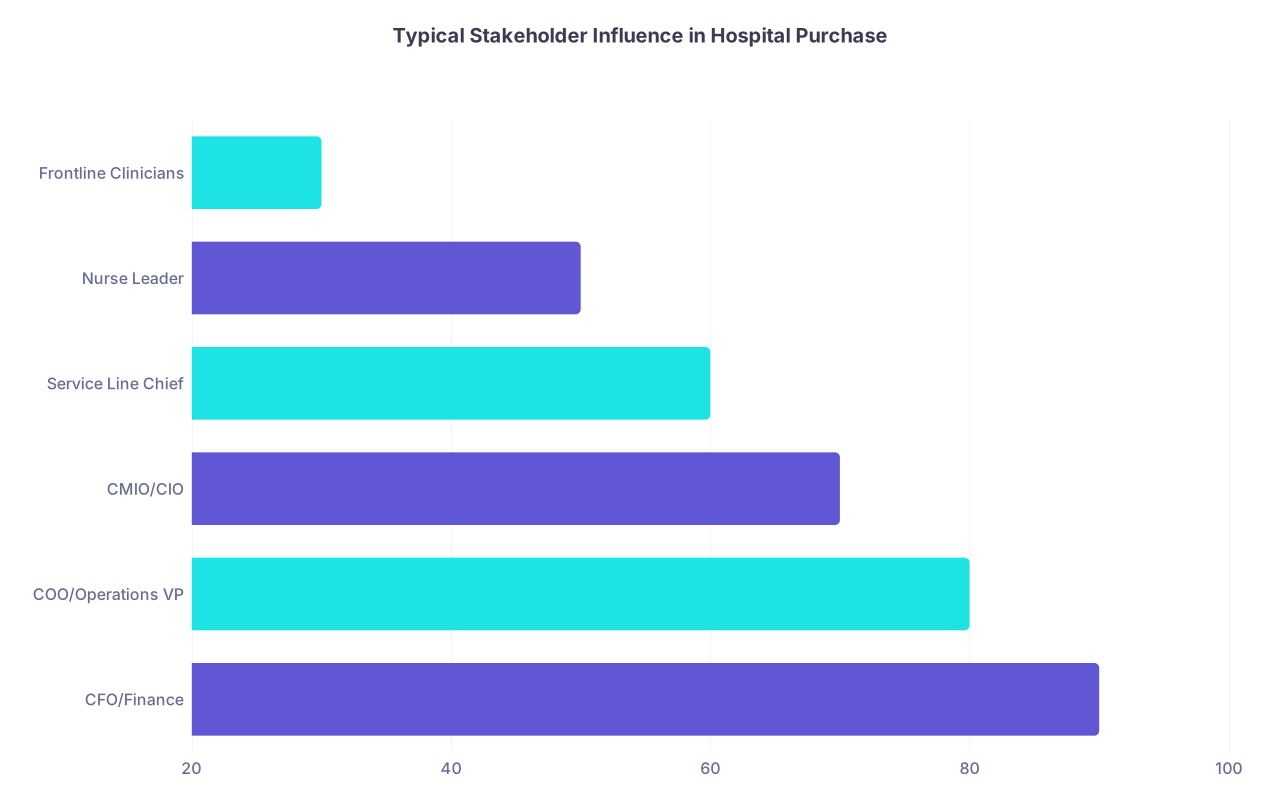
| Category | Value |
|---|---|
| CFO/Finance | 90 |
| COO/Operations VP | 80 |
| CMIO/CIO | 70 |
| Service Line Chief | 60 |
| Nurse Leader | 50 |
| Frontline Clinicians | 30 |
“Influence” here means their ability to drive a purchasing decision for a new solution.
Build a stakeholder map for each target organization
For each hospital/system you target, literally write this down:
- Who owns the budget for the problem you solve? (e.g., VP Perioperative Services, VP Revenue Cycle, CNO.)
- Who feels the pain daily? (ED director, clinic manager.)
- Who will be your internal champion? (The person who calls meetings and forwards your deck.)
- Who will kill this if you surprise them late? (CIO, CMIO, privacy officer, union rep.)
You want to meet at least one person from each of:
- Economic buyer – writes the check / controls the budget.
- Technical buyer – IT, security, integration, data.
- User buyer – service line director, nurse manager.
- Champion – the one who actually pushes your email up the chain.
Build a simple “account map” document for each target hospital and update it as you learn.
5. Stop Doing Product Demos; Start Doing Business Discovery
Most founder‑led demos are 80% feature tour, 20% questions. That is backwards.
For your first enterprise win, discovery is your weapon.
A simple 5‑step discovery script
In your first serious call with a potential enterprise client, aim for 70% them talking, 30% you. Use something like:
- “Walk me through how you handle [problem] today—who is involved and what systems do you touch?”
- “What are the top 1–2 metrics leadership is watching related to this?”
- “When this breaks or gets worse, what actually happens? Who gets the angry emails?”
- “If you had a magic wand and could change one part of this process overnight, what would it be?”
- “If you did fix this, who would care the most at the VP/C‑suite level?”
You adapt your pitch after hearing their reality. Not before.
Then, in the same or next meeting, do a diagnostic‑style demo:
- Start from their current workflow.
- Show just the 2–3 pieces of your product that touch that workflow.
- Translate each feature into an outcome they mentioned:
- “You said your nurses waste 30–40 minutes per shift tracking X. Here is where we cut that step.”
6. Design a “No‑Brainer” First Enterprise Offer
Hospitals hate irreversible commitments. They love structured pilots, especially when:
- Risk is limited.
- Scope is extremely clear.
- Success criteria are defined up front.
So stop selling full rollouts out of the gate. Sell a paid, time‑bound, narrow pilot that is framed as a decision tool for them.
Structure of a strong first enterprise deal
Make it look like this:
Scope
- One service line (e.g., ED, Cardiology clinic, ORs).
- One or two sites, not the whole system.
- Fixed number of users or departments.
Duration
- 3–6 months max. Less than 3 is rarely enough to measure outcomes.
- Clear start and end dates.
Pricing
- Pilot fee that shows skin in the game (not free), but meaningfully discounted from full enterprise list.
- Example: 25–40% of what full year / broader rollout would cost.
Success metrics (jointly defined)
- Pick 2–3 metrics they already track.
- Example: No‑show rate, average discharge time, denials per 100 claims, calls per patient episode.
Decision framework
- At the start, document: “At month 4, we will review these metrics and decide to: (a) expand, (b) continue at this scope, or (c) stop.”
- Get that in writing. Even if informal in an email recap.
This is not “trialware.” This is a structured, executive‑sponsored test with a clear decision point.
7. Prepare for the Four Guaranteed Roadblocks
Every enterprise client will throw basically the same four blockers at you. The details differ. The pattern does not.
1. Security and Compliance Review
If you do not have this ready, you look amateur.
You need:
- Signed BAA template.
- Summary of data flows: what you store, where, how long, how encrypted.
- SOC2 / penetration testing status (if you do not have SOC2 yet, be honest but show roadmap and compensating controls).
- Role‑based access controls basics.
Create a 2–3 page “Security and Privacy Overview” document. It will save you dozens of emails.
2. Integration with EHR and Existing Systems
You will hear: “We cannot add another system” or “We need it in Epic.”
Your answer cannot be hand‑waving.
Have:
- A simple diagram of your integration options: FHIR APIs, HL7, flat‑file batch, SSO via SAML, etc.
- A good‑enough story for Phase 1 that does not require a yearlong Epic project.
- Example: Start with SSO + nightly batch data loads, then move to real‑time FHIR when results proven.
The goal: make Phase 1 integration such a small, well‑defined project that IT can say “yes” without a full committee.
3. Procurement and Legal
This is where many first deals die from exhaustion.
You reduce friction by:
Keeping your first contract incredibly simple:
- MSA + SOW, or just an enterprise‑friendly SaaS agreement with 3–5 key sections:
- Scope, term, data handling, liability caps, termination clauses.
- MSA + SOW, or just an enterprise‑friendly SaaS agreement with 3–5 key sections:
Being flexible on:
- Termination for convenience (they need an escape hatch).
- Data ownership language (they own their data, you can aggregate/ de‑identify).
- Indemnity tied to your negligence, not every possible mishap.
Set an internal rule: “We will not drag negotiations over vanity terms in our first three enterprise logos.” You need wins more than perfect paper.
4. Internal Politics and Competing Priorities
You will get ghosted not because they hate you, but because:
- Budget cycle hit.
- Leadership changed.
- EHR project sucked up all IT bandwidth.
You counter that by:
- Always having a clear next step on the calendar (not “we’ll get back to you”).
- Maintaining multiple champions in the same organization.
- Aligning your project to an existing top‑3 initiative:
- “This supports your throughput initiative” is better than “this is a separate innovation.”
8. Turn Your Medical Background into a Sales Advantage (Without Being a Martyr)
You have something non‑founder‑MBAs do not: you speak clinician and admin both. Use that. But be smart about how.
Here is what works:
Lead early conversations with your clinical credibility:
- “I practiced as a hospitalist at [X]. I built this because I was tired of [specific problem].”
Translate front‑line pain into executive language:
- “When your ICU nurses are staying late to document this manually, that translates to [X] hours of overtime per month and increased turnover risk.”
Offer to speak directly to skeptical clinicians:
- “Let us set up 30 minutes with your nurse manager / ED director. I want them to tell us what will not work. We will adjust.”
Here is what does not work:
Playing the martyr:
- “Doctors are exhausted; just give us a shot.” No CFO will write a check based on vibes.
Over‑indexing on “better care” while ignoring budget:
- You must connect care improvement to financial, risk, or operational outcomes.
Your MD or clinical background gets you in the door. Your ability to speak CFO and COO will close it.
9. Build a Simple, Relentless Pipeline Process
Enterprise deals are too slow and too random to treat as “we will see what happens.” You need a process—even if you are the only salesperson for now.
At minimum, track:
- Number of target accounts.
- Stage of each account.
- Champion identified (yes/no).
- Economic buyer identified (yes/no).
- Next scheduled meeting.
- Biggest current blocker.
Use a basic CRM (HubSpot, Pipedrive, even a well‑structured Airtable). Or if you must, a spreadsheet with discipline.
A simple 5‑stage pipeline works:
- Targeted – You have reason to believe they have the problem you solve.
- Engaged – At least one meeting with a real stakeholder.
- Qualified – Problem confirmed, budget owner known, timeline discussed.
- Pilot proposal – Specific pilot scope, pricing, metrics on the table.
- Pilot signed / lost – Decision made.

| Step | Description |
|---|---|
| Step 1 | Targeted |
| Step 2 | Engaged |
| Step 3 | Qualified |
| Step 4 | Pilot Proposal |
| Step 5 | Pilot Signed |
| Step 6 | Lost |
Once per week, go through every account and ask one question: “What is the single next action that moves this one step forward?”
If there is none, you are not in a real deal. You are in “innovation theater”.
10. Use Your First Enterprise Client as a Growth Engine, Not a Trophy
Winning that first enterprise is not the finish line. It is the starting gun.
If you treat them like any other customer, you are wasting your most valuable asset.
Here is how to turn that first client into 3–5 more:
Design for referenceability from day one
- Ask at the start: “If this works and meets these metrics, are you open to being a reference site or sharing a case study?”
- Put that sentence in your SOW.
Stand up a formal quarterly review
- Every 90 days: review metrics, workflow, and qualitative feedback.
- Build a 3‑slide internal deck that your champion can send up the chain.
Document the story in their language
- They say “denials” not “claims friction.” Use their terms in your case study.
- Package their story so a similar hospital can see themselves instantly.
Ask your champion for 1–2 intros
- “Who are 1–2 peers at other systems that would find these results interesting?”
- Make the ask specific and easy: forwardable email template, short intro call.
If you execute well, your first enterprise client becomes your unofficial sales rep.
11. Concrete 30‑Day Execution Plan
You wanted concrete. Here is how I would structure your next 30 days.
Week 1: Focus and Assets
- Decide on your one primary use case.
- Draft:
- 1‑page Problem/ROI sheet.
- Skeleton of your 10–12 slide deck.
- List of 10–20 target organizations that fit that use case best.
Week 2: Evidence and Stakeholder Mapping
- Turn your best pilot into a tight 2‑page case study.
- For each target organization, build a rough stakeholder map:
- Who is likely the service line lead?
- Who is the CNO/CMO/COO/CFO?
- Any existing connections from residency, fellowship, prior hospitals?
Week 3: Outreach and Discovery
- Reach out to warm connections first (former attendings, program directors, colleagues now in leadership).
- Goal: 5–10 discovery calls.
- Run proper discovery, refine your pitch as you hear patterns.
Week 4: Pilot Offers and Process
- For any engaged org with clear pain and interest:
- Propose a specific 3–6 month paid pilot with scope, metrics, pricing.
- Build your simple pipeline tracker.
- Schedule internal weekly pipeline review (even if it is just you and a co‑founder on Zoom).
Then repeat. Ferociously.