
The biggest mistake physicians make when jumping into digital health sales is thinking “I will just explain the clinical value and they will buy.” They will not. You need scripts, structure, and a sales process the same way you once needed order sets and protocols.
You are not starting from zero. You already know:
- How to build rapport in 30 seconds
- How to take a history
- How to make a recommendation and get buy‑in
That is 70% of sales. The other 30% is language, sequencing, and knowing what to say when things get uncomfortable.
This playbook gives you that 30% in the form of concrete scripts and frameworks you can start using tomorrow.
1. Understand the Game You Are Walking Into
You are not “selling a cool app.” You are trying to change workflows, budgets, and risk perception in highly political organizations. That means:
- Multiple decision makers
- Long sales cycles (3–18 months)
- Constant risk of “looks great, maybe next year”
Your MD is an asset, but only if you use it correctly. Waving your credentials around without understanding budget, authority, need, and timeline (BANT) will just make you sound like an arrogant founder who never carried a sales quota.
Let me be blunt: in digital health, the people who hit quota are the ones who:
- Run a disciplined process
- Use tight, tested language
- Stay uncomfortably direct about money and decision making
Your new job is to become one of those people.
2. Translate Your Clinical Skills into Sales Skills
You already know the pattern:
- Chief complaint
- History of present illness
- Past history / meds / allergies
- Assessment
- Plan
Sales is the same pattern with different labels:
- Business pain (chief complaint)
- Impact and context (HPI)
- Current tools / budget / politics (PMH/meds)
- Fit / no‑fit (assessment)
- Next step with date and time (plan)
Here is the direct mapping:
| Clinical Skill | Sales Equivalent |
|---|---|
| Taking a history | Discovery call |
| Giving bad news | Handling objections |
| Presenting a plan | Product demo / proposal |
| Informed consent | Closing and next steps |
| Progress notes | CRM notes and follow-up |
You already have the emotional muscle. You just need new words.
3. Your Core Identity Script (How You Introduce Yourself)
You need a tight 15–20 second intro that:
- Signals you are a peer, not a random salesperson
- Positions you around outcomes, not technology
- Invites conversation instead of a monologue
Use this as a base and tweak for your product.
Cold outreach identity script (email or call):
“Hi Dr. Smith, I am Alex, I practiced internal medicine for 7 years before moving into digital health. I now work with hospitalist groups using [Product] to cut average length of stay by about 0.3 days without increasing readmissions. I am not calling to sell you software on the spot. I want to see if the problems we solve match anything on your plate this quarter. Does that sound worth a 15‑minute conversation?”
Key points:
- You name your clinical background once. Then stop.
- You anchor to a specific business outcome (length of stay, readmissions, no‑show rate, etc).
- You give them an easy “yes” to a short next step, not “demo our platform.”
In‑person conference intro (hallway or booth):
“I am Alex, I used to be a hospitalist at [Institution]. I now help CMOs and service line chiefs who are wrestling with [specific problem your product tackles: readmissions, RPM overload, poor portal engagement]. I am curious—what is the one operational headache you wish would disappear this year?”
You are not pitching. You are triaging.
4. Discovery Call Script: Your “History and Physical”
Stop winging it. A sloppy discovery call kills deals that should have closed.
Your job on discovery:
- Decide if there is a real problem
- Quantify it
- Map the buying process
- Decide if you walk away or go deeper
Think of it like a structured H&P.
4.1 Discovery Call Flow
Use this 30–40 minute structure:
- Brief framing and agenda (3–4 min)
- Problem and current state (10–15 min)
- Impact and priorities (10–15 min)
- Timing, budget, decision process (5–7 min)
- Close with clear next step (3–5 min)

| Step | Description |
|---|---|
| Step 1 | Intro and agenda |
| Step 2 | Explore current state |
| Step 3 | Quantify impact |
| Step 4 | Confirm priorities |
| Step 5 | Discuss budget and timing |
| Step 6 | Map decision process |
| Step 7 | Agree on next step |
4.2 Word‑for‑word Discovery Script
1. Opening and agenda
“Thanks for taking the time. To make this useful, I suggest we do this: I will ask a few questions to understand how you are handling [problem] today, share where we have been useful to groups like yours, and if there is a clear fit we can schedule a working session with your broader team to go deeper. If it is not a fit, we will say that and give you back time. Does that work for you?”
You are signaling: I am not here to pitch blindly. I am qualified. I will walk away if this is not real.
2. Problem and current state
Then go into open questions. Steal these:
- “Walk me through how you handle [clinical workflow your product touches] today.”
- “Where do things break most often?”
- “Who feels the pain the most—clinicians, admin, patients, finance?”
- “What have you already tried to fix this?”
Aim to talk 20–30% of the time and listen 70–80%. If you are doing 80% of the talking, you are not selling, you are lecturing.
3. Impact and priorities
You need numbers. Without numbers there is no business case.
- “Roughly how many [patients/visits/episodes] are affected per month?”
- “What does that translate to in terms of lost revenue, penalties, or extra FTEs?”
- “If nothing changed in 12 months, what breaks? Or who gets yelled at?”
- “Out of your top 5 initiatives this year, where does this sit?”
Then mirror back:
“So if I am hearing you correctly, the main issue is [X], it affects about [Y] patients per month, and it is generating [Z impact—cost, staff burnout, penalties]. And this is in your top 2–3 priorities for this year. Is that accurate or am I missing something?”
This is the sales version of your assessment.
4. Budget, timing, decision
Do not dance around this. You are not respecting anyone by avoiding the money questions.
- “Have you carved out budget for a solution in this area this year?”
- “Who will need to sign off, besides you, for this kind of project?”
- “What other initiatives are competing for the same dollars?”
- “Realistically, when would you want a solution live if you decided to move forward?”
Sample direct language:
“In other organizations, a project of this type falls into the [XX–YY] budget range annually. Is that in the realm of what your team would consider, or is that a non‑starter?”
5. Close the discovery call
Always book the next step on the call itself:
“Based on what you have shared, I see a clear overlap between your goals and where we have been effective. The logical next step is a working session where we show you exactly how we would tackle [their top 1–2 pains], and we get your [IT/finance/clinical champion] in the room. Are you open to setting that up now while we are here?”
If they say yes, schedule it before you hang up. If they hesitate, you just surfaced a hidden blocker.
5. Running a Clinical‑Credible Demo (Without Boring Them to Death)
Demos are where doctors switching into sales go off the rails. They start doing a CME lecture instead of running a decision‑focused conversation. The goal of a demo is not to show features. It is to prove three specific things:
- We understand your exact workflow.
- We can reliably achieve the outcomes we promised.
- We are safe—clinically, technically, and politically.
5.1 Demo Structure
Aim for 30–45 minutes, structured like this:
- Re‑anchor to their problems (5 min)
- Show only the 3–4 workflows that address those problems (20–25 min)
- Show evidence and outcomes (5–10 min)
- Discuss implementation and risk (5–10 min)
5.2 Demo Script Skeleton
Re‑anchoring:
“Last time we spoke, you highlighted three main problems: [A, B, C]. I will focus the demo only on how we address those areas. If something feels off or irrelevant, interrupt me and say so. Fair?”
Workflow 1 (e.g., remote monitoring alert triage):
“Let us start with how your nurses triage RPM alerts today. You described [their current workflow]. Here is the same scenario in our system.”
- Show the exact scenario they described in discovery.
- Use realistic, even slightly ugly, clinical data.
- Narrate like you are presenting a case, not a TED talk.
“This is the 72‑year‑old heart failure patient who triggers a weight and BP alert at 7 am. Your nurse sees this alert in the unified queue instead of in three different systems. She can quickly see trend, last contact, and medication changes. Here is how she decides whether to escalate or send a message.”
You are showing: reduced noise, speed, safety, and less chaos. Speak in operational outcomes:
- “2 minutes instead of 10”
- “One screen instead of four systems”
- “Clear documentation for billing and medico‑legal protection”
Evidence section:
Now you use your MD properly.
“Let me show you how this translated in similar organizations. At [Site A, 300‑bed community hospital], they cut unnecessary escalations by 27% and freed up roughly 0.8 FTE nursing time per day, while their 30‑day readmissions for CHF dropped from 22% to 18% over 9 months.”
Bring a simple chart if you have one.
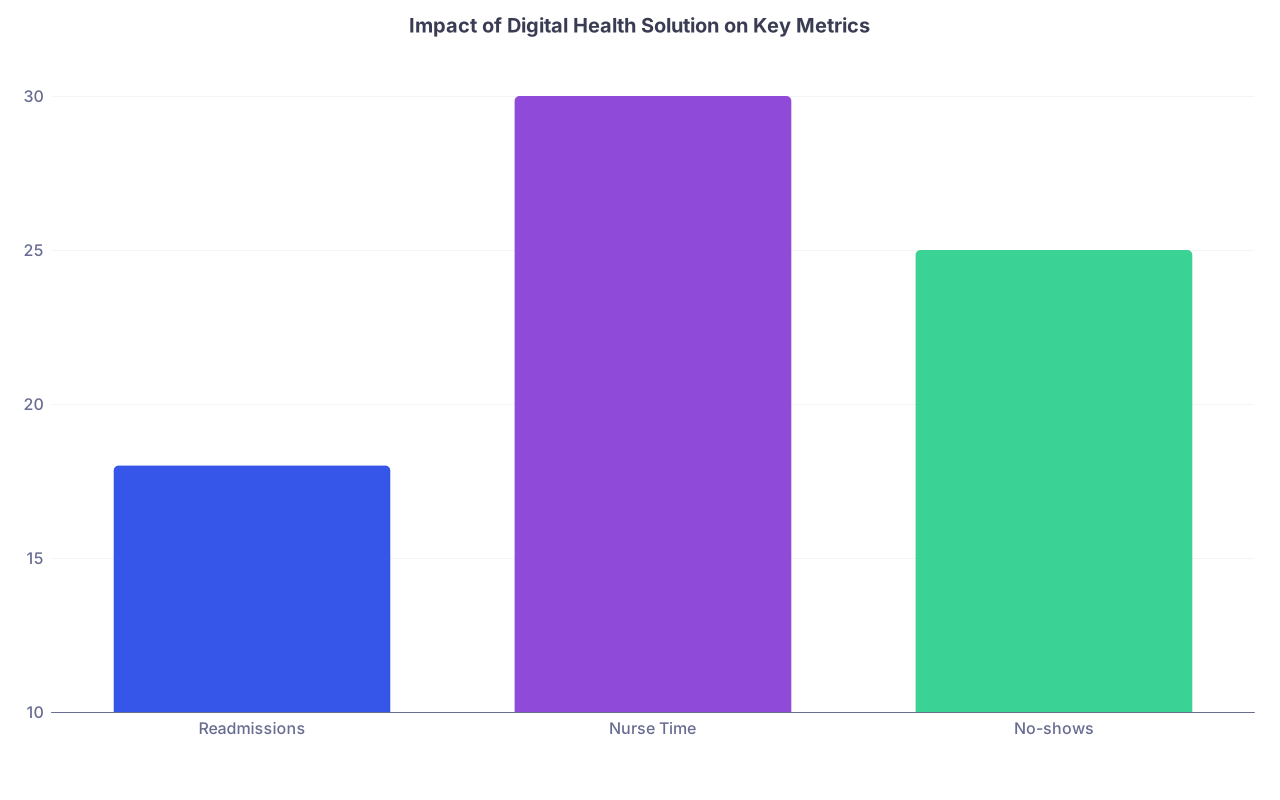
| Category | Value |
|---|---|
| Readmissions | 18 |
| Nurse Time | 30 |
| No-shows | 25 |
Then stop talking. Let them react.
Use your hospital experience.
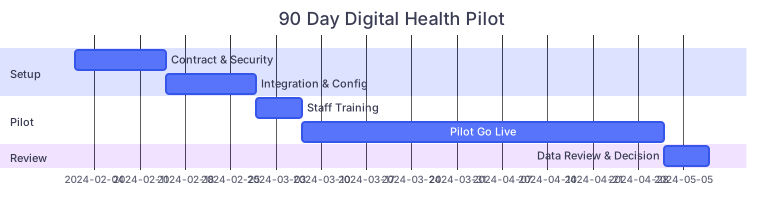
“I have seen tech projects die because they dumped everything on IT and one overworked nurse lead. We handle integration with [EHRs you support], provide a playbook for clinician training, and run a 90‑day pilot with very tight metrics before anyone commits to a full rollout. Here is what that looks like week by week.”
Outline a simple phased plan:
- Weeks 1–2: IT + security review
- Weeks 3–4: Workflow design with 2–3 clinical champions
- Weeks 5–12: Pilot with explicit success metrics
Use a visual if possible.
| Task | Details |
|---|---|
| Setup: Contract & Security | a1, 2024-02-01, 14d |
| Setup: Integration & Config | a2, after a1, 14d |
| Pilot: Staff Training | b1, after a2, 7d |
| Pilot: Pilot Go Live | b2, after b1, 56d |
| Review: Data Review & Decision | c1, after b2, 7d |
Then move to next steps.
6. Handling Common Objections Like a Clinician, Not a Vendor
You have heard everything from “I do not have time” to “we tried that and it did not work” from patients. Same game here.
6.1 The Objection Formula
- Acknowledge
- Align
- Reframe with evidence or question
- Confirm
Objection: “We do not have budget this year.”
“Totally fair. Most systems I work with are under intense financial pressure this year. Can I ask—when a problem like [X] is serious enough, where does the money usually come from? Is it operating budget, quality initiatives, or a specific service line?”
Then:
“I ask because teams similar to yours justified this from [avoidance of penalties / recovered revenue / reduced agency staffing], not from a ‘new tech’ line item. If we could quantify a realistic range of financial impact, would that be worth a separate discussion with finance, or is that door closed for this year?”
You are probing if it is a real budget problem or a polite brush‑off.
Objection: “Clinicians will not adopt another system.”
“You are right to be skeptical. I remember when we got [insert hated system—new EHR, CPOE, etc]. Everyone promised it would save time. It did not. Two points here. First, our adoption data: at [Site B] we reached 78% active use among hospitalists within 60 days. Second, we designed this to reduce click steps compared to current workflows, not add another place to document. Let me show you the before‑and‑after from a clinician’s perspective.”
Then show a 60‑second comparison:
- Today: 9 steps, 4 screens
- With you: 4 steps, 2 screens
Finish with:
“If we can show your frontline champions this delta and give them veto power on any workflow change, would they at least be willing to evaluate a pilot?”
Objection: “IT is overloaded. Integration will take a year.”
“Understood. Every CIO I speak with says the same thing. This is why we scope integrations very tightly for pilots. For example, at [Site C], we started with read‑only data feed from [EHR] and basic SSO, which took their team 40 hours total over 6 weeks. Full bidirectional integration came later, once we had proven value. Would your IT team be open to a scoped conversation like that, or do they insist on full integration out of the gate?”
You are not arguing. You are proposing a smaller, safer first step.
7. The Close: Getting a Real Decision, Not Endless “Follow‑ups”
You hate vague plans in medicine. “We will see what happens” is not a plan. Same in sales.
Closing is not aggression. It is clinical clarity: either we treat, or we do not.
7.1 Pilot Close Script
If you have done good discovery and demo work, your close sounds like this:
“From what we have seen so far, I believe we can realistically [achieve key outcomes: reduce readmissions by X, cut no‑shows by Y, free Z hours of nurse time per week] within a 90‑day pilot. The next step I recommend is a scoped pilot on [1–2 units / 1 clinic / 1 region] with clear success metrics.
If we design a pilot where success is defined as [3–4 measurable metrics], and if we hit those numbers, are you comfortable in advance that you would move toward a broader deployment? And if we do not hit them, we part ways. Is that a fair way to frame this?”
Then stay quiet.
If they say “yes, in principle,” you immediately lock in process:
“Great. To make this real, we need three things: your IT lead, a clinical champion, and someone from finance or operations. Who are the right people for that, and when can we get all four of you for 45 minutes?”
Again, you schedule before leaving the room.
8. Breaking Into the Role: How to Actually Land a Digital Health Sales Job
Now to your real question: how do you get your first AE or clinical sales role when your CV screams “doctor,” not “quota‑carrying rep”?
Here is the playbook that actually works for physicians.
8.1 Pick Your Target Product Type
Do not just spray applications. Target where your clinical background is an obvious asset.
Typical buckets:
- B2B SaaS for hospitals / health systems (EHR add‑ons, care coordination tools, RPM)
- Virtual care platforms
- Population health / analytics
- Patient engagement or adherence platforms
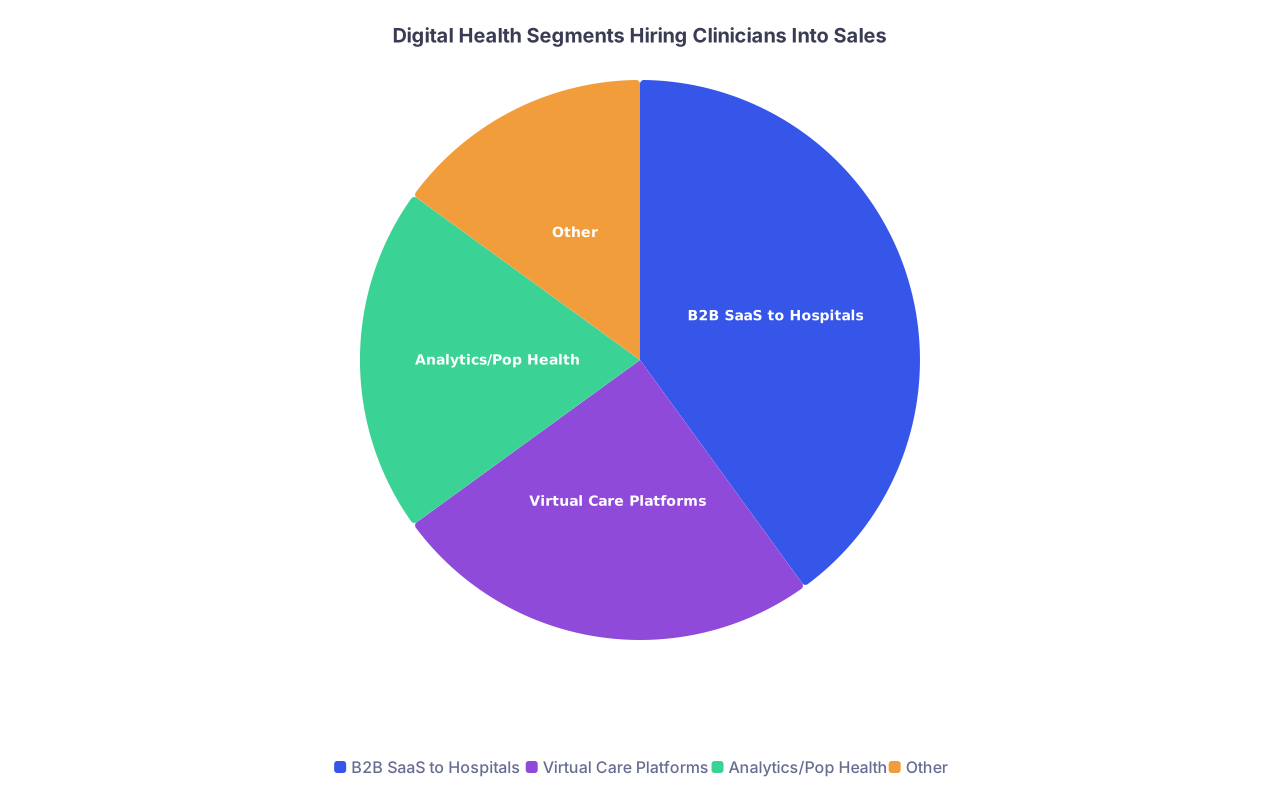
| Category | Value |
|---|---|
| B2B SaaS to Hospitals | 40 |
| Virtual Care Platforms | 25 |
| Analytics/Pop Health | 20 |
| Other | 15 |
Look at:
- Companies that already employ “clinical solutions consultants,” “clinical sales,” or “physician executive” roles
- Seed to Series C startups where they are still figuring out how to sell to clinicians
8.2 Rewrite Your CV into a Sales‑Ready Story
Stop leading with publications and committees. Lead with measurable outcomes and influence.
Examples:
- “Led redesign of discharge process, reducing 30‑day readmissions for CHF from 23% to 19% over 12 months.”
- “Implemented new telehealth workflow in clinic, increasing tele-visit volume from 5% to 35% of total visits.”
- “Trained 40+ residents in use of [EHR module], improving documentation completeness by 18%.”
Those are sales bullets. You changed behavior, moved metrics, and influenced stakeholders.
8.3 Your “Why Sales, Why Now?” Answer
You will be asked this. Have a clean, no‑nonsense answer:
“I enjoyed clinical care, but I am most energized when I am improving systems rather than individual encounters. Over the last few years I led projects around [X and Y]. I realized that the people who most directly drive adoption of high‑impact tools are often in sales roles. I want to use my clinical background to have leverage at scale by helping organizations choose and implement the right digital solutions—and I am willing to be measured on concrete outcomes and revenue to do that.”
Notice:
- You are not “burned out and running away.”
- You want to be measured on results (big green flag for hiring managers).
8.4 Get Actual Sales Reps to Vouch for You
You will almost never get into sales at a good startup by cold‑applying online.
Do this instead:
- Identify 10–15 companies you like.
- On LinkedIn, find their top performing sales reps (usually “Senior AE,” “Enterprise AE”).
- Message them something like:
“Hi [Name], I am a [specialty] physician who led several digital implementation projects at [Hospital]. I am transitioning into digital health sales and I am specifically interested in companies selling to [their customer type]. I am not asking you for a job. I would value 15 minutes to ask how you actually sell into [hospitals / payers / clinics] and what makes someone effective on your team. If it is helpful, I can share a few clinical shortcuts I have seen work when presenting to medical leadership.”
Some will ignore you. A few will talk. Those few can forward your CV directly to their VP of Sales with a note like, “This doc actually gets it.” That is your ticket.
9. Daily Practice: How to Build the Sales Muscle Fast
You learned procedures by doing, not by reading UpToDate. Same here.
Here is a 4‑week self‑training plan while you are interviewing or ramping in a new role.
| Week | Focus Area | Daily Practice (30–45 min) |
|---|---|---|
| 1 | Discovery questions | Roleplay 2 discovery calls |
| 2 | Demo storytelling | Record 1 short product walkthrough |
| 3 | Objection handling | Drill 3–4 common objections |
| 4 | Closing and next steps | Practice 3 pilot close variations |
Practice rules:
- Use your phone to record yourself. Cringe, then fix.
- Ask a non‑medical friend to be the “CFO” and see if they would buy.
- Once a week, send your recordings to someone in real sales (LinkedIn or a mentor) and ask for brutal feedback. Not “nice job.”
Over 4–8 weeks, you will feel the same shift you felt going from intern to senior resident. Less guessing. More pattern recognition.
10. Quick Scripts You Can Steal and Adapt
Here is a mini playbook you can literally copy into a doc and rehearse.
Cold email opener (to clinical leadership):
Subject: Quick question about [specific metric: readmissions, LOS, no‑shows]
Dr. Smith,
I am Alex, an internist turned digital health lead at [Company]. We recently helped [Comparable Institution] reduce [metric] by [X%] over [Y months] using a very focused workflow change and light tech.I am not assuming this is a priority for you. If it is, would you be open to a 15‑minute call to see if their approach is relevant for your service line this year? If not, I would appreciate a quick “not a fit” so we do not bother you.
Best,
Alex
Follow‑up after ignored email:
“Dr. Smith,
Following up once in case my earlier note got buried. If [metric/problem] is on your plate for this year, I can share what [Comparable Institution] did and you can decide in 10 minutes whether it is worth exploring. If it is not even in your top 5 priorities, reply “N” and I will close the loop on my end.
—Alex”
Post‑demo recap email:
“Thanks again for walking through your current process around [problem]. Here is my understanding of your goals:
• [Goal 1 with metric]
• [Goal 2 with metric]
• [Goal 3]Based on that, we proposed a 90‑day pilot on [scope] with success defined as:
• [Metric A]
• [Metric B]
• [Metric C]Next step: 45‑minute pilot design session with you, [IT lead], and [clinical champion] on [proposed dates]. Once we land on final scope, we can get legal/security started.
Please reply with which time works best or suggest alternatives.
—Alex”
These details are what separate “interesting conversation” from “signed pilot.”

11. Mindset Shift: From “Expert” to “Guide with a Quota”
One last thing. In clinical practice, you were The Authority. In sales, you are a guide with a clear commercial goal and limited control.
That means:
- You will get ignored and ghosted. Often.
- You will be told “no” more in one month than in a year of clinic.
- You will need to ask awkward questions about money and politics.
If you can accept that, here is the upside:
- You work on system‑level change, not just individual encounters.
- Your income can actually scale with impact.
- You can leverage your MD in rooms where few people have real clinical credibility.
And yes, you can be proud of doing sales. Selling a tool that prevents readmissions or frees nurses from pointless clicking is not “dirty.” It is applied medicine at scale.
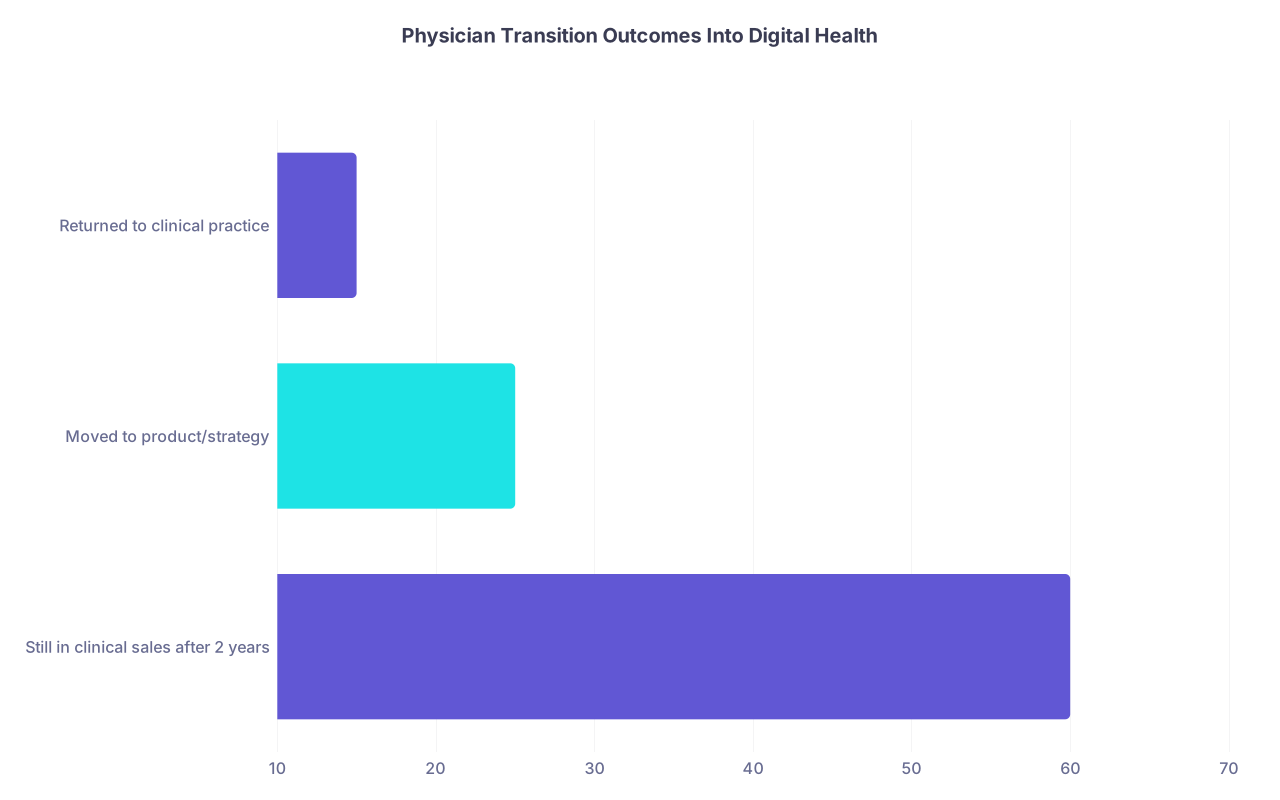
| Category | Value |
|---|---|
| Still in clinical sales after 2 years | 60 |
| Moved to product/strategy | 25 |
| Returned to clinical practice | 15 |