
Most medical side projects die not because the idea is bad, but because the operations stay amateur while the stakes become professional.
You are a physician coming out of residency or fellowship with a “side project” that suddenly has traction: paid pilots, active users, maybe even early revenue. Now investors are circling. Or at least, you want them to.
Here is the blunt truth: no serious fund will back you if your startup runs like a hobby. They do not just fund ideas. They fund systems.
This guide is the operational upgrade plan that bridges that gap—how to evolve from “smart doctor with a cool tool” to “venture‑backed company with disciplined operations.”
1. Define What “Venture‑Backable” Actually Means
Before we fix anything, clarify the bar you are trying to hit. Most founders get this wrong.
A side project is:
- Founder‑driven
- Relationship‑based
- Light documentation, heavy improvisation
- Dependent on your nights and weekends
A venture‑backed company is:
- System‑driven (people can change, systems persist)
- Process documented
- Financially legible
- Legally clean
- Measurably growing
If investors feel that:
- The business breaks without you personally,
- The numbers are unclear, or
- The regulatory risk is opaque,
they pass.
So your job in this phase is not “scale like crazy.” Your job is to:
- De‑risk the business operationally.
- Make it understandable in one deck, one data room, and one due diligence call.
- Prove repeatability—that what is working now can be reproduced 10x and 100x.
The rest of this article gives you the concrete upgrades to get there.
2. Get Your Corporate and Legal House in Order
If this section is a mess, nothing else matters. I have watched term sheets evaporate over cap table nonsense and sloppy healthcare compliance.
2.1 Incorporation and Equity: Clean the Cap Table
If you have:
- A random LLC formed on LegalZoom
- Co‑founders with vague handshake equity promises
- Advisors “sort of” promised 5% each
…you need to fix that now.
Upgrade protocol:
1. Incorporate (or convert) as a Delaware C‑Corp.
Healthcare VCs want C‑Corps. Do not argue this. Just do it.
Clarify founder equity.
- Put all founders on a written founders’ agreement.
- Implement 4‑year vesting with 1‑year cliff for everyone, including yourself.
Yes, including you. Investors view unvested founder equity as alignment, not risk.
Standardize advisor equity.
- Use small, vesting grants (0.1–1.0%, 2‑year vesting) rather than random big chunks.
- Put them on proper advisor agreements with clear scope.
Create a basic option pool (10–15%).
- Board‑approved, documented.
- You will need this for early hires and it shows you understand hiring dynamics.
| Role | Common Range |
|---|---|
| CEO (founder) | 30–60% total |
| Technical cofounder | 10–30% |
| Non-technical cofounder | 5–20% |
| Advisor | 0.1–1.0% |
| Initial option pool | 10–15% |
If any co‑founder is already drifting away, fix that now—restructure their equity to be partially vested, partially subject to milestones, or bought back.
2.2 Contracts and IP: Make Ownership Unambiguous
Investors will ask one simple question:
Does the company own everything it needs to operate and scale?
That includes code, clinical content, documentation, branding.
Upgrade protocol:
- IP Assignment Agreements:
Every founder, contractor, and early employee signs:
Proprietary Information and Inventions Assignment (PIIA)
Confidentiality / NDA clauses
Code and Content Ownership:
- If an external dev shop built your MVP, get:
- A written assignment of all IP to the company
- Source code access and documentation
- If you reused hospital materials or protocols, scrub protected content and create your own clinically sound equivalents.
- If an external dev shop built your MVP, get:
Name and Branding:
- Check for obvious trademark conflicts.
- At minimum, register domain, secure key social handles, and consider a basic trademark check with an IP attorney.
2.3 Healthcare Compliance: Remove Red Flags
This is where many physician‑founders get dangerously casual.
You must answer “yes” to:
- Are we clear on whether we are a healthcare provider, software vendor, or both?
- Do we have a HIPAA‑appropriate posture for what we actually handle?
- Are our BAAs (Business Associate Agreements) and DPAs (Data Processing Agreements) in place where necessary?
Upgrade protocol (minimum viable compliance):
Classify the product:
- Pure workflow tool with no PHI?
Lighter burden, but still need privacy policies done correctly. - Stores or processes PHI on behalf of providers?
You are a Business Associate. Need BAAs, security policies, and documented safeguards. - Direct‑to‑patient care (telehealth, remote monitoring)?
You are a Covered Entity or part of one. Regulatory bar is higher: licensure, malpractice, clinical protocols.
- Pure workflow tool with no PHI?
Implement basic security hygiene:
- Encrypted data at rest and in transit (your tech team knows how; make them certify it).
- Role‑based access within systems.
- Offboarding process for anyone leaving (immediate account deactivation, access audit).
- Centralized password management (1Password / LastPass, not “shared spreadsheet”).
Document the baseline: Create a simple but real Security and Privacy Overview (5–10 pages) that covers:
- Data classification
- Access controls
- Incident response plan
- Vendor management (e.g., how you vet your cloud provider)
For early investors, this does not need to be SOC2‑level perfection. It just cannot be hand‑wavy.
3. Level Up Your Financial Operations
If your “financial system” is a mix of Stripe emails, Excel tabs, and gut feeling, you are not ready to raise.
3.1 Get Real Books
Step one: hire a startup‑savvy bookkeeper or fractional CFO with SaaS or healthtech experience. Not your cousin’s tax guy.
Upgrade protocol:
Use QuickBooks Online or Xero.
Connect:- Bank accounts
- Credit cards
- Payment processors (Stripe, Square, etc.)
Set monthly close:
- All transactions categorized
- Bank accounts reconciled
- Simple P&L and cash flow statement produced
Track founder loans and previous personal spending:
- Document any personal funds you put in as either:
- Founder loans, or
- Paid‑in capital
- Document any personal funds you put in as either:
Do this for at least 3–6 months before you actively raise. Investors like patterns, not single snapshots.
3.2 Build a Simple Metrics Dashboard
You are post‑residency, not a full‑time FP&A analyst. So keep it simple but sharp.
For a typical medical startup (software, workflow, telehealth, or device‑adjacent), your core metrics usually include:
- Monthly Recurring Revenue (MRR)
- Number of active customers:
- Clinics / health systems / employers
- Or providers / patients, depending on your model
- Churn:
- Customer churn (% of customers lost per month/quarter)
- Gross margin:
- Revenue minus variable costs (e.g., clinician time, device costs, SMS usage)
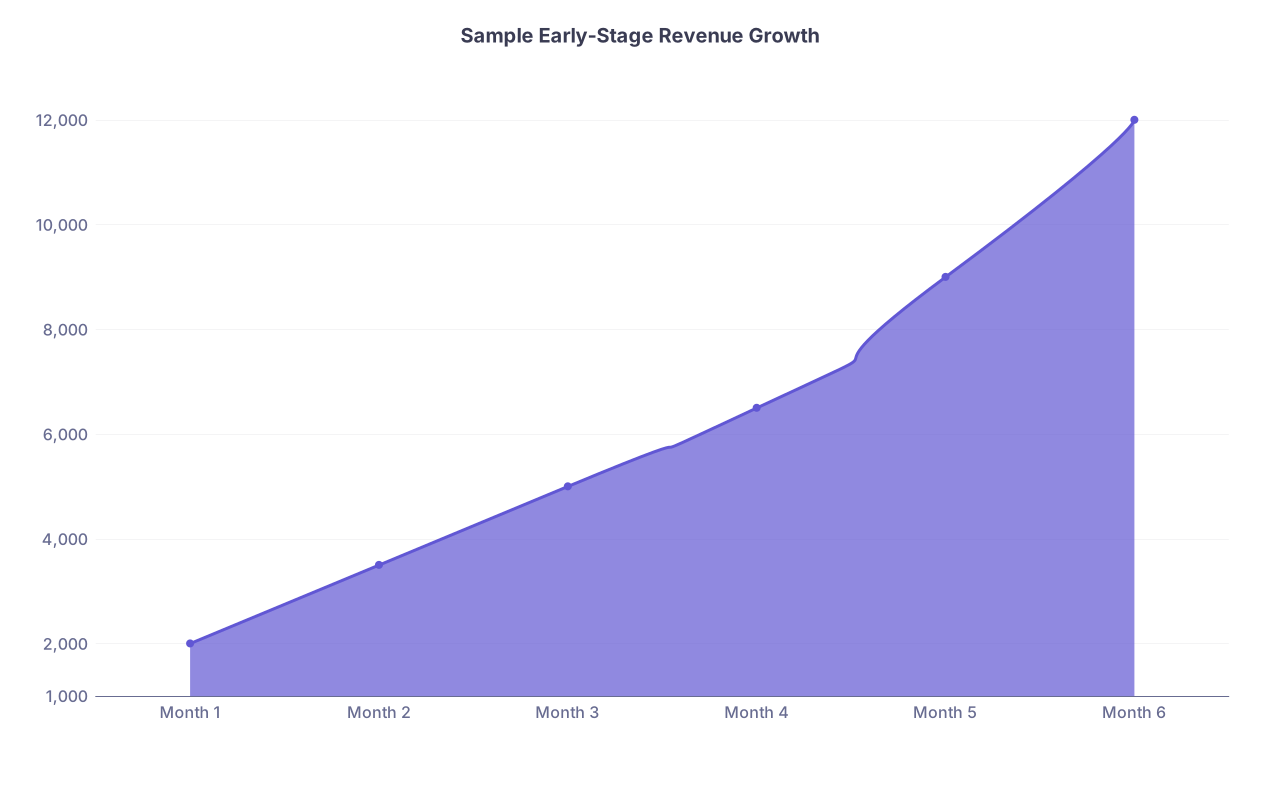
| Category | Value |
|---|---|
| Month 1 | 2000 |
| Month 2 | 3500 |
| Month 3 | 5000 |
| Month 4 | 6500 |
| Month 5 | 9000 |
| Month 6 | 12000 |
Once you have a few paying accounts, add:
- LTV/CAC (lifetime value / customer acquisition cost) rough estimates
- Sales cycle length (first touch to signed contract)
You do not need McKinsey‑grade precision. You do need consistency.
3.3 Budget and Runway: Decide How Aggressive You Can Be
You just got out of residency. You probably still have loans. You cannot play fantasy startup.
Create a 12–18 month budget that answers:
How much does it cost per month to:
- Keep the product running?
- Pay a small core team (even part‑time)?
- Cover your own minimum salary once you go full‑time?
How many months of runway do you currently have?
If you raise $1–2M, how does that extend your runway and change your hiring plan?
| Category | Monthly ($) | 12-Month Total ($) |
|---|---|---|
| Founder salary | 6,000 | 72,000 |
| Developer | 10,000 | 120,000 |
| Operations | 4,000 | 48,000 |
| Cloud/tools | 2,000 | 24,000 |
| Legal/compliance | 1,500 | 18,000 |
You want investors to feel you can:
- Spend money deliberately.
- Extend runway during bad months.
- Make cuts without killing the core product.
4. Turn Ad‑Hoc Work Into Repeatable Processes
Side projects depend on heroic effort. Venture‑backable companies run on boring, repeatable processes.
4.1 Map Your Critical Workflows
Start with 3–5 critical workflows that drive value or risk:
- New customer onboarding
- Support / issue resolution
- Clinical escalation (if applicable)
- Release of new features / product changes
- Handling data access or deletion requests
Use something visual. A whiteboard is fine; better is a simple digital map.

| Step | Description |
|---|---|
| Step 1 | Clinic signs up |
| Step 2 | Send implementation checklist |
| Step 3 | Configure clinic settings |
| Step 4 | Train staff |
| Step 5 | First patient enrolled |
| Step 6 | Monitor usage and feedback |
Once mapped, convert these into:
- Simple written SOPs (standard operating procedures)
- Shared checklists in tools like Notion, Asana, or ClickUp
Example: Clinic Onboarding SOP might include:
- Kickoff call scheduled within 3 business days of signature.
- Technical setup completed within 7 days.
- Staff training delivered (live or recorded) within 10 days.
- First patient onboarded within 14 days.
- Follow‑up usage review at 30 days.
This is the kind of operational clarity investors notice.
4.2 Implement Lightweight Tooling
You do not need enterprise software. You do need structure.
Minimum stack I would expect for a post‑residency founder going venture:
- Project management: Asana, Trello, or ClickUp
- Track features, bugs, onboarding, and internal projects. - CRM / Sales tracking: HubSpot (free tier), Pipedrive, or Close
- Track outreach, demos, pipeline by stage.
- Documentation / SOPs: Notion, Confluence, or Google Drive with a strict folder structure.
- Support: Shared inbox (Front, HelpScout, or at least a dedicated support@ email with clear routing).
Your rule of thumb:
If something happens more than 3 times per month, it gets:
- A clear owner
- A simple process
- A documented location
4.3 Remove Founder as Single Point of Failure
This is the harsh test:
Could someone else, with 1–2 weeks of shadowing, run your core operations for a month without burning it down?
If not, you are not ready for venture.
Identify:
- Tasks only you can do right now (e.g., nuanced sales conversations with CMOs, advanced clinical decisions).
- Tasks that should not require you (e.g., sending onboarding emails, basic support, scheduling demos).
Then, over 3–6 months:
- Write micro‑SOPs for the latter.
- Hand them to a part‑time ops hire or VA.
- Watch and refine.
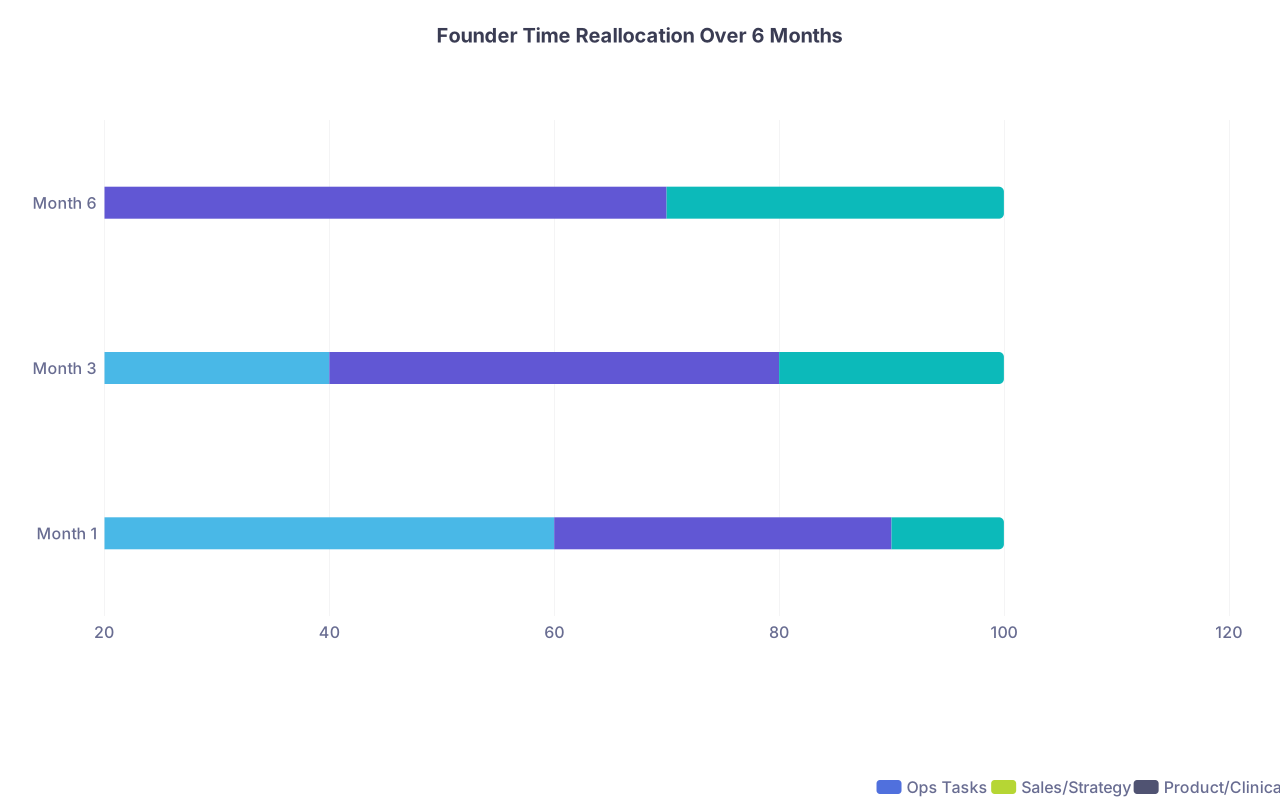
| Category | Ops Tasks | Sales/Strategy | Product/Clinical |
|---|---|---|---|
| Month 1 | 60 | 30 | 10 |
| Month 3 | 40 | 40 | 20 |
| Month 6 | 20 | 50 | 30 |
Your goal is to move from “I do everything” to:
- Founder focus: sales, strategy, key relationships, clinical oversight.
- Team/contractors: repeatable, well‑defined work.
5. Professionalize Sales and Customer Success
This is where post‑residency founders often underbuild. They assume “if the product is good, adoption will spread.” That is not how hospitals or payers work.
5.1 Build a Real Sales Motion
Even if you are the only “salesperson,” act like a real sales team.
Define:
Ideal customer profiles (ICP):
- Example A: Independent cardiology groups, 5–20 physicians, already using cloud‑based EHR, frustrated with readmission penalties.
- Example B: Regional health systems with >200 beds, launching a new heart failure clinic.
Entry points: - Who actually signs the check?
- Who blocks deals?
Standard sales stages:
- Lead → Qualified → Demo → Pilot Proposal → Pilot → Contract Negotiation → Closed Won/Lost

Track all of this in a CRM. Not in your head.
5.2 Turn Pilots into Playbooks, Not One‑Offs
Side projects live on bespoke pilots. Venture‑backed companies live on repeatable pilot designs.
For each pilot, define in writing:
- Duration (e.g., 3 months)
- Scope:
- Number of patients / providers / clinics
- Success metrics:
- Clinical (e.g., reduced no‑show rate by X%, improved adherence)
- Operational (e.g., staff time saved)
- Financial (e.g., increased billables, reduced penalties)
- Required inputs from the client:
- Time from clinical champion
- IT approvals
- Staff training sessions
Then, build a “Pilot Kit”:
- Pilot proposal template
- Standard slide deck
- Baseline data collection form
- End‑of‑pilot outcomes report template
This kit is gold during fundraising. You can show:
- X pilots run
- Y converted to paying contracts
- Z pattern in outcomes
5.3 Support and Retention: Make It a System
Hospitals and clinics hate being ignored after go‑live. They also hate being smothered with chaotic attention.
Define a basic Customer Success cadence for every paying account:
First 30 days:
- Weekly check‑in (email or call)
- Monitor usage
- Quick response to friction
After 30–90 days:
- Monthly exec summary (1‑pager)
- Highlight wins, issues, and upcoming changes
Annually:
- Business review
- Discuss renewal, expansion, new features
Use that to drive NPS (Net Promoter Score) and referenceability. VCs look for customers who say:
“Yes, I would absolutely take a call from your potential investor and tell them why we like this.”
6. Decide Your Founder Time Model: Clinical vs Full‑Time
Post‑residency you face a brutal question:
Do you go full‑time on the startup, or split time with clinical work?
There is no universal right answer. There is a wrong answer: pretending you can do both at 100% indefinitely.
6.1 Be Honest About the Tradeoffs
If you stay part‑time clinical:
Pros:
- Income stability.
- Maintained skills and licensure.
- Credibility with clinicians.
Cons:
- Slower decision cycles.
- Harder to hire and lead full‑time team.
- Some VCs will question your commitment.
If you go full‑time founder:
Pros:
- Faster learning and iteration.
- Easier narrative for investors.
- Better team cohesion.
Cons:
- Financial risk.
- Need to plan for skill decay and CME differently.
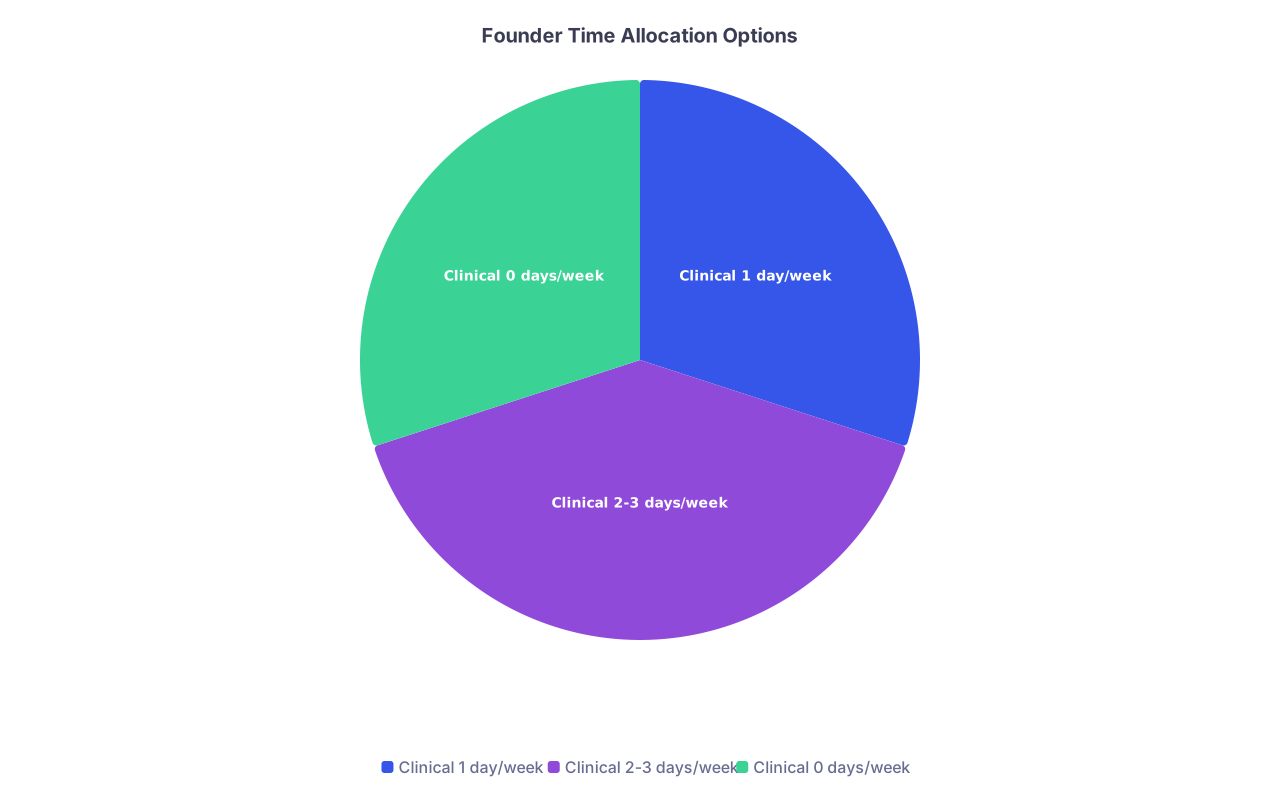
| Category | Value |
|---|---|
| Clinical 1 day/week | 30 |
| Clinical 2-3 days/week | 40 |
| Clinical 0 days/week | 30 |
Here is the practical bar:
By the time you raise a serious seed/Series A, most investors expect you full‑time, with at most 0.5–1 day per week clinical.
6.2 Communicate Your Plan Clearly
Whatever you choose, make it explicit in your pitch and planning:
- Your current clinical schedule.
- Your transition plan:
- Example: “I am currently 0.6 FTE in cardiology. Once we close a $1.5M seed, I will step down to 0.1 FTE tele‑only and dedicate 90–95% of my time to the company.”
Investors are not allergic to physicians staying somewhat clinical. They are allergic to vague answers.
7. Build a Minimal but Real Team
You do not need a 15‑person org chart. You do need people other than “me and a random freelancer I pay on Upwork sometimes.”
7.1 Cover the Four Critical Functions
At this stage, your company must competently handle:
- Product / Tech
- Clinical (if applicable)
- Operations
- Sales / BD
You can absolutely double‑hat roles, especially early on. A realistic early configuration:
- You: CEO + Clinical + early Sales
- Technical co‑founder or strong lead developer: Product / Tech
- Part‑time or full‑time Ops person:
- Coordinates pilots, handles support tickets, manages calendars, maintains SOPs.
- Contractor support:
- Designer, marketing, legal, bookkeeping.
| Function | Who Owns It |
|---|---|
| CEO/Clinical | Physician founder |
| Tech/Product | Technical cofounder or lead dev |
| Operations | Full-time ops generalist |
| Sales/BD | Founder + contractor help |
7.2 Hire for Versatility, Not Titles
Your first ops hire is not “VP of Operations.” It is someone who can:
- Run clinic onboarding
- Manage your calendar and email
- Track pilot metrics in a spreadsheet
- Update SOPs
- Keep customers from falling through cracks
Job titles can inflate later. Skills and bias toward action matter now.
7.3 Document Roles Before You Hire
Write 1‑page Role Scorecards:
- Mission of the role
- Key outcomes for the first 90 days
- 5–7 responsibilities
- Required skills (specific, not fluff)
This does two things:
- Keeps you honest about what you actually need.
- Impresses investors that you do not hire reflexively.
8. Prepare Like an Adult for Venture Due Diligence
When investors move beyond a first call, they ask for a data room. If yours looks like a trash heap of random PDFs, they lose confidence.
8.1 Build a Simple, Organized Data Room
Use Google Drive or Dropbox. Structure it cleanly:
- 0 – Pitch & Overview
- Pitch deck (latest)
- 1–2 page company overview
- 1 – Corporate
- Charter, bylaws
- Cap table
- Board consents
- 2 – Financial
- Last 12–24 months P&L
- Current balance sheet
- 12–18 month projections
- 3 – Product
- Product overview / screenshots
- Tech architecture summary
- 4 – Commercial
- Customer list
- Sample contracts (redacted if needed)
- Metrics summary
- 5 – Legal & Compliance
- IP assignments
- Key contracts
- Security & privacy overview
- 6 – Team
- Bios
- Org chart (present and 12‑month target)

Do this before you chase serious investors. It will save you weeks of chaos later.
8.2 Practice the Operational Story
Your pitch cannot be just “huge market, exciting tech.” You must talk like a future operator of a 50‑person company.
Be ready to answer, with specifics:
- What are your top 3 operational risks and how are you managing them?
- What is your implementation timeline from signed contract to go‑live?
- What KPIs do you look at weekly?
- What is the next key hire and why?
If your current answer to most operational questions is “I handle it,” fix that. Investors want to hear about systems, not heroics.
FAQs
1. How “finished” do my operations need to be before I raise a seed round?
They do not need to be perfect. They do need to be real. That means:
- Clean C‑Corp structure and cap table.
- Basic books with at least 3–6 months of consistent metrics.
- Documented core workflows (onboarding, support, pilots).
- A minimal team or clear hiring plan that shows you are not trying to do everything yourself.
If every answer in diligence starts with “we plan to…,” you are too early for serious institutional seed capital.
2. I am the only technical and clinical person right now. What should I prioritize first?
Prioritize removing yourself from low‑leverage operational tasks. Hire or contract:
- An ops generalist to handle onboarding, support, scheduling.
- A bookkeeper to handle finances.
- Maybe a part‑time project manager if pilots are complex.
Your time should go to:
- High‑value product/clinical decisions.
- Sales and key relationships.
- Fundraising and strategy.
Once those are running, your next big decision is whether to bring in a technical co‑founder/lead or a commercial lead. In most cases, for medical startups with real traction, getting a strong technical partner in place early pays off more.
3. Do I need a full HIPAA compliance program before talking to investors?
You need a credible, documented risk posture, not a full enterprise compliance stack. That means:
- Correctly classifying your role (Business Associate vs Covered Entity vs neither).
- Implementing reasonable safeguards for how you actually use data.
- Having BAAs where appropriate.
- A short written security and privacy overview.
For later rounds, investors may expect SOC2 or more formal frameworks. For a side project stepping into venture‑backed territory, the goal is to show you understand the rules, have taken concrete steps, and have a roadmap for maturing compliance as you scale.
Core takeaways:
- Venture money flows to companies with systems, not founders doing heroics. Clean up corporate, legal, and financial basics first.
- Turn everything that happens more than 3 times a month into a documented, delegated process—onboarding, support, pilots, and sales.
- Decide on your founder time model and team plan early, then communicate it clearly; investors bet on your ability to run a real operation, not just your ability to practice good medicine.