
The worst clinic workflows make the best startups—if you stop complaining and start dissecting.
You are sitting on problems investors will happily fund. You see them every shift: clunky EMRs, referral black holes, prior auth purgatory, inbox chaos. The difference between “annoying headache” and “fundable company” is a disciplined process, not genius.
Let me walk you through that process.
1. Stop Whining, Start Capturing: Build Your Problem Bank
Your brain is currently a leaky bucket. You notice workflow pain every day, then forget it by the weekend. That is how billion‑dollar ideas die.
You need a problem bank. Today.
Step 1: Set up a simple capture system
Use whatever you actually open daily:
- A private Notion page
- A Google Doc titled “Clinic Problems – Raw”
- Apple Notes folder
- Or even a physical notebook you keep in your bag
Template to use for each entry (keep it brutally simple):
- Date / Setting: “2025‑01‑05, hospitalist night shift, community hospital”
- Role: Your role at the time (attending IM, locums EM, urgent care, etc.)
- Problem (1–2 sentences): What happened, in plain language
- Who felt pain: MD / RN / MA / front desk / patient / billing / admin
- Frequency: Daily / Weekly / Rare but catastrophic
- Impact: Time wasted, revenue lost, risk, burnout, patient safety, etc.
- Workaround used: What you or the team actually did to survive
Example entry:
2025‑01‑03, outpatient cards clinic.
Role: Attending cardiologist.
Problem: Referrals from PCPs arrive by fax, get scanned into EMR, then “disappear” because our staff has no standardized triage and patients think we lost them.
Who: Front desk, MAs, cardiologists, patients, referring PCPs.
Frequency: Several times per week.
Impact: Angry patients, delayed visits, lost referrals (lost RVUs), PCP frustration, unsafe delays.
Workaround: Staff keeps an unofficial Excel sheet + sticky notes. Everyone hates it. No one owns it.
You do not need to be clever yet. Just honest and specific.
Step 2: Force a weekly review
Pick one time slot when you are routinely brain‑alive but not on shift. Sunday morning. Friday afternoon. Whatever.
In that slot, run through the week’s entries and tag them:
Tag by domain:
- Documentation / EMR
- Scheduling / access
- Referrals / coordination
- Billing / prior auth
- Communication / messaging
- Patient education / follow‑up
- Data / quality / reporting
Tag by stakeholder:
- Physician
- Nurse / MA
- Front desk
- Admin / leadership
- Payer
- Patient
You are building a dataset of pain. This is your raw material.
2. Turn Annoyances into Real Problems Worth Funding
Most “ideas” physicians pitch are too soft: “Make communication better,” “Improve burnout,” “Fix EMR usability.” VCs hear that 20 times a week.
You need to translate frustration into quantifiable business pain.
Use the PFS framework
Every fundable startup idea in clinics usually hits at least one of these four:
- P – Profit: Drives new revenue or better capture of existing revenue
- F – Flow: Increases throughput or capacity (more patients, same resources)
- S – Safety / Compliance: Reduces risk, liability, or regulatory burden
(Yes, I skipped an “E” on purpose. Remember 3 things, not 4.)
For each problem in your bank, ask:
Can someone show me a line item or metric this affects?
- Revenue, denied claims, days in A/R
- No‑show rate, length of stay, time‑to‑visit
- Readmissions, serious safety events, compliance audits
Is this problem expensive enough that someone would pay to fix it?
- Rule of thumb: If solving it cannot move numbers by at least tens of thousands per year per clinic / department, it is probably a feature, not a company.
Is there a person who owns that pain?
- “Everyone” does not own it.
- Example owners: clinic manager, CFO, CMO, director of ambulatory ops, director of revenue cycle.
Take your raw entry and rewrite it in PFS language.
Example transformation:
Raw complaint: “Our inbox is insane and I answer portal messages for hours every night.”
PFS version:
- Flow: Physicians spend 1–2 hours per day on portal messages, reducing clinic availability and pushing them toward part‑time or locums.
- Profit: If each physician reclaimed 1 hour/day, that is 1–2 extra visits, ~$300–$600/day, $75k–$150k per physician per year.
- Safety: Message overload causes missed critical results and delayed responses, increasing malpractice exposure.
Now we are talking. That smells like a buyer’s problem, not just a therapist’s topic.
3. Find Problems Big Enough to Build a Business Around
You now have a list of structured pain points. You want the outliers:
- Broadly shared across clinics / systems
- Painful enough that leadership already tries to fix them
- Chronic, not episodic
- Poorly addressed by current tools
Use a simple scoring system. Literally a 1–5 scale on each dimension.
| Dimension | 1 (Low) | 5 (High) |
|---|---|---|
| Frequency | Rare | Daily / continuous |
| Financial impact | Negligible | \$100k+ per site / year |
| Workflow pain | Annoyance | Major burnout driver |
| Existing tools | Many / adequate | None or universally hated |
| Buyer clarity | Fuzzy | Clear role & budget |
Anything scoring 18–25 across these five is a candidate startup problem. Under 15 is probably a niche feature. Not worth quitting your job.
Now you narrow down to 1–3 problems that:
- You feel legitimately annoyed by
- You understand deeply from the inside
- Show consistent patterns in your notes
Circle those. You now have your short list.
4. Map the Workflow: Where Exactly Does Reality Break?
Here is where most clinicians go wrong. They jump to “I need an app that…” before they understand the actual workflow.
Do not write a single “solution” sentence yet. Draw the ugly truth first.
Build a workflow map for your top problem
Pick one scenario. Example: specialty referral from PCP to cardiology.
Grab pen and paper or a whiteboard. Then:
Start from the triggering event
- PCP decides to refer patient to cardiology.
List each step, each actor, each tool used
- PCP clicks “referral” in EMR → populates form
- Front desk or MA prints/faxes or sends electronically
- Receiving clinic front desk processes inbound referral
- MA or nurse triages urgency
- Scheduler contacts patient
- Patient confirms or no‑shows
- Referring PCP gets (or never gets) feedback
Mark failure points with a red X
- Referral never leaves clinic (EMR bug, fax fails)
- Receiving clinic receives but misroutes
- Referral queue has no owner
- Scheduling backlog, patients fall through
- PCP never gets confirmation or cardiology note
Annotate each failure with concrete costs
- Lost patients / RVUs
- Delayed care / safety events
- Duplicated tests
- Reputation damage with referring PCPs
You can formalize it later. For now, your messy diagram is gold.
Here’s a simple way to think of these maps:

| Step | Description |
|---|---|
| Step 1 | PCP decides to refer |
| Step 2 | Enter referral in EMR |
| Step 3 | Transmit referral |
| Step 4 | Receiving clinic intake |
| Step 5 | Triage urgency |
| Step 6 | Schedule patient |
| Step 7 | Visit completed |
| Step 8 | Note and feedback to PCP |
| Step 9 | Referral lost |
| Step 10 | Stuck in queue |
| Step 11 | Patient never seen |
| Step 12 | PCP uninformed |
You are not looking for a place to bolt on a new app yet. You are looking for:
- Missing owners
- Repeated manual work
- Data that exists but is not visible
- Places where people “track things” with side spreadsheets, sticky notes, or personal notebooks
Those are your leverage points.
5. Validate the Pain Outside Your Own Bubble
Your experience alone is not enough. It is the spark, not the evidence.
Now you go out and interview. This is where most physician founders get lazy and then wonder why investors pass.
Who to talk to
For each candidate problem, talk to:
- 5–10 people in your same role (other attendings in your specialty)
- 5–10 adjacent roles (MAs, nurses, front desk, clinic managers)
- 3–5 from different institutions (other health systems, private practice, FQHCs)
You are not selling yet. You are listening for patterns.
Use a simple discovery script
Skip the PowerPoint. Call, Zoom, or meet in person. Ask:
- “Walk me through how you handle [referrals / prior auth / inbox] in a typical week.”
- “Where do things break, and what happens when they do?”
- “What do you do to work around those issues?”
- “Have you tried any tools or fixes? What worked, what failed, why?”
- “If you could wave a magic wand and fix one part of this, what would it be?”
- “If someone offered a solution that actually fixed this, who would have to approve paying for it?”
You are mining for:
- Shared pain language (“our inbox is a dumpster fire,” “referrals vanish into the void”)
- Workarounds that repeat across sites
- Actual budget owners (“the ambulatory ops director,” “our practice manager controls that”)
- Attempts at existing tools that failed (so you know how not to repeat them)
If you do not hear intense emotion at least a few times (“This drives me insane,” “I stay late three nights a week because of this”), your problem probably is not fundable. Move on.
6. Translate Workflow Pain into a Startup Concept
Once the pain is validated and the workflow is mapped, now you earn the right to sketch a solution.
Do not think “app.” Think system change with a software core.
Use this discipline:
Define your core value proposition in one sentence
Template:
“We help [who] reduce [painful metric] by [specific improvement] using [unique approach].”
Examples:
- “We help cardiology clinics reduce lost referrals by 80% and gain an extra $300k+ per year in captured visits, using a referral tracking and triage layer that sits on top of existing EMRs.”
- “We help hospitalist groups cut night‑time result chasing in half by automatically prioritizing and routing critical results with clear ownership and escalation inside their current EMR.”
If your sentence sounds like:
- “We improve communication in healthcare” → too vague
- “We are like Slack for doctors” → lazy analogy, not a value proposition
- “We reduce burnout with better workflows” → investor eye‑roll
Tighten until you can name:
- A specific customer (not “health systems,” but “hospitalist groups in 200–500 bed community hospitals”)
- A specific metric (lost referrals, time‑to‑treatment, no‑show rate, days in A/R)
- A specific relative change (50% reduction, 2x faster, etc.)
7. Design a Minimum Viable Prototype That Works in the Real World
You are not building a full product yet. You are building a prototype that proves people will use it and pay for it.
Here is the trap: overbuilding. Physicians love bells and whistles. Investors do not.
Use the clinic‑ready MVP rule:
Your first version should be so simple you are slightly embarrassed to demo it, but it must complete one critical workflow end‑to‑end.
For a referral‑tracking startup, that might be:
- One simple web interface for tracking referrals
- Basic integration via secure email / fax inbox rather than full EMR integration
- Manual data entry by front desk + basic status updates
- Automated daily summary emails to clinic manager and referring PCPs
Yes, it is crude. But if:
- Front desk actually uses it
- Referrals stop disappearing
- PCPs feel safer and more informed
- Manager can see a dashboard of “referrals received / scheduled / lost”
You have real traction.
Visualizing how “MVP → real product” grows helps:
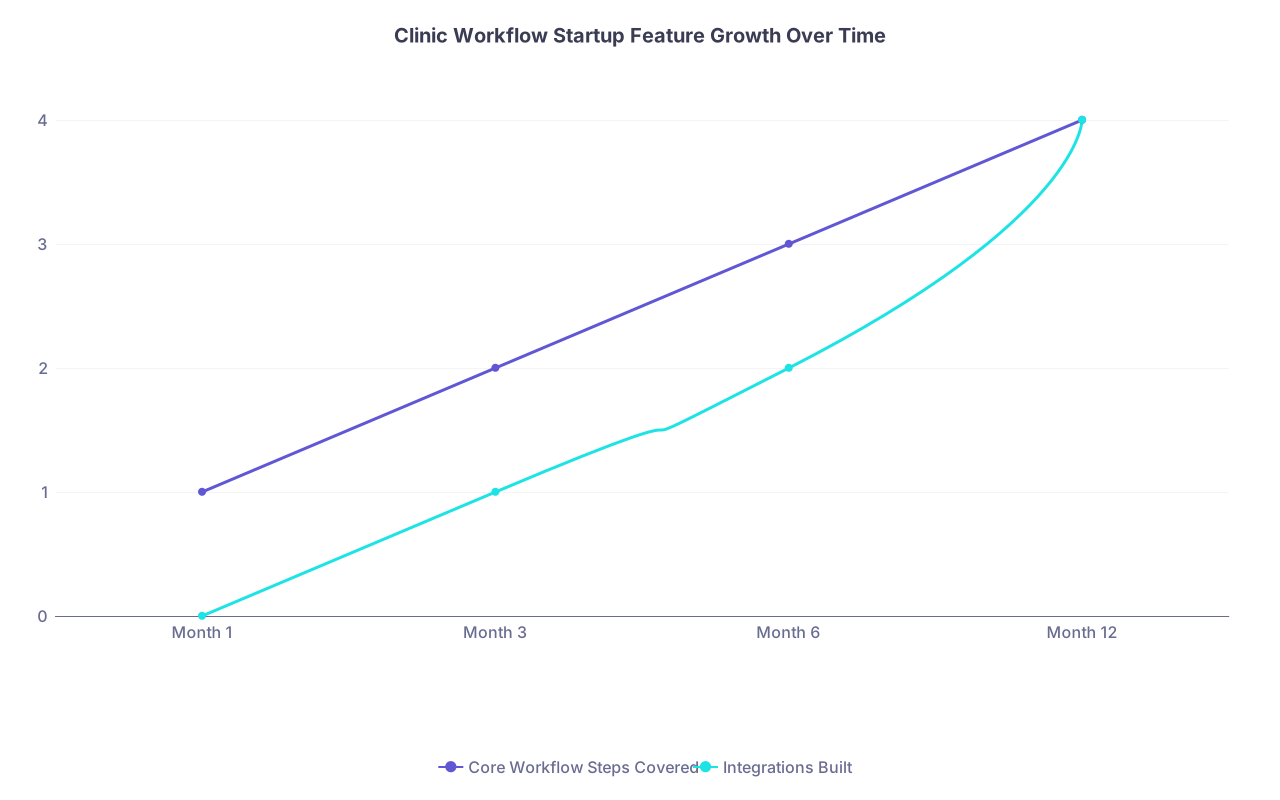
| Category | Core Workflow Steps Covered | Integrations Built |
|---|---|---|
| Month 1 | 1 | 0 |
| Month 3 | 2 | 1 |
| Month 6 | 3 | 2 |
| Month 12 | 4 | 4 |
Notice: It does not start at 10.
You will be tempted to “wait until it is integrated with Epic / Cerner.” Resist that. You can test demand using:
- Standalone web tools + exports
- Email‑based summaries
- Basic HL7 or FHIR integration only after you confirm people care enough
8. Prove That Clinics Will Pay: Your Early Go‑to‑Market Strategy
Fundable ≠ “people like it.” Fundable = “people pay for it and stay.”
You are post‑residency; you have credibility others would pay for. Use it strategically.
Start with 2–3 design partners, not 50 pilot sites
You want a few deep relationships where:
- You can text the clinic manager or medical director
- They will let you iterate in real time
- You have access to before/after metrics
Offer them a design partner deal:
- Discounted early pricing (or limited free period)
- In exchange for:
- Regular feedback calls
- Permission to use de‑identified metrics in your deck
- A testimonial if it works
Track a brutally simple metrics set
For each site, start with 3–5 metrics:
- 1–2 operational metrics (e.g., referral leakage, time from referral to scheduled visit)
- 1 financial metric (e.g., incremental visits / revenue per month)
- 1 adoption metric (e.g., % of staff using tool daily)
- 1 satisfaction metric (simple NPS or “How likely are you to be upset if we removed this tool?”)
Summarize like this:
| Metric | Before | After 6 Months |
|---|---|---|
| Lost referrals per month | 18 | 3 |
| Avg days from referral to appt | 21 | 9 |
| Additional visits / month | 35 | 70 |
| Staff daily active use | 0% | 85% |
That table will matter more to investors than any UI screenshot.
9. Translate Clinical Success into an Investor‑Ready Story
Once you have:
- A clear high‑pain problem
- A workflow‑true solution
- 2–3 design partners using it
- Early impact metrics
You can finally talk about funding with a straight face.
What early‑stage health investors want to see
They do not care that you are “fixing healthcare” in the abstract. They look for:
- Problem clarity: You can explain the workflow and the pain more crisply than anyone they have seen.
- Beachhead market: A specific starting segment (e.g., “cardiology and GI clinics with 5–20 providers, on Epic, in the US”).
- Revenue path: Clear buyer, clear pricing model, clear sales motion.
- Regulatory sanity: You understand HIPAA, BAAs, and whether your tool is or is not a medical device.
- Real adoption: People using it in live clinics, not just in a sandbox.
How you frame revenue matters. Pick something normal for clinics:
- Per‑provider / per‑seat monthly SaaS pricing
- Per‑clinic / per‑site fee for small practices
- Or, for pure revenue‑capture tools, a percentage of incremental revenue (if you can prove you generated it)
Illustrate the revenue potential with a simple chart:
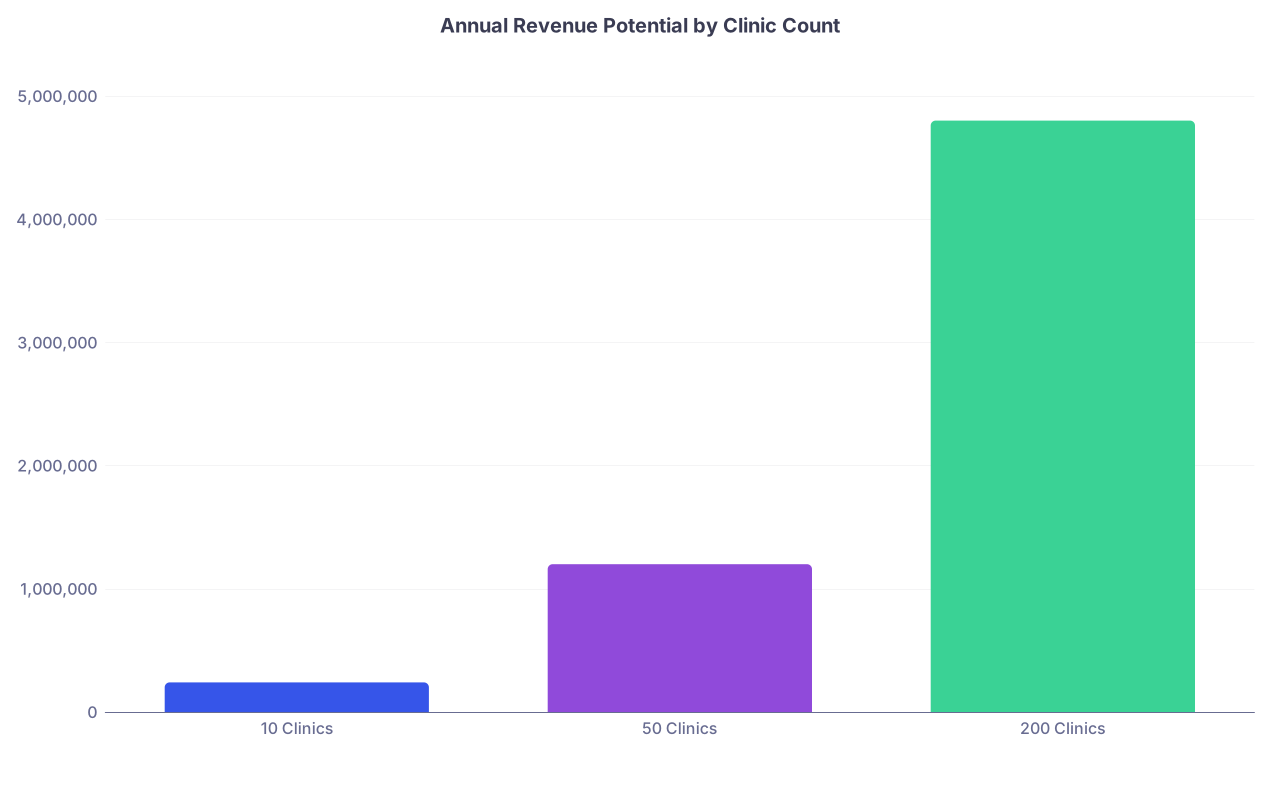
| Category | Value |
|---|---|
| 10 Clinics | 240000 |
| 50 Clinics | 1200000 |
| 200 Clinics | 4800000 |
(Assuming $2,000 per clinic per month. Adjust to reality, obviously.)
10. Protect Your Time and Sanity While You Build
You are not a 23‑year‑old hacker with no responsibilities. You have loans, maybe a family, and a job.
You do not “go all‑in” on day one. You stage it.
Stage 1: Nights and weekends + tiny prototype
- 5–10 hours/week
- No employees
- A freelance developer or no‑code tool to build simple prototypes
- Focus: Validate the problem, land 1–2 design partners
Stage 2: Reduce clinical time once you see pull
You know it is time when:
- Users are asking for more features faster than you can build
- Clinics are offering to pay or renew a pilot
- You can point to hard metrics you improved
Then:
- Drop to 0.6–0.8 FTE clinically
- Formalize the company entity (LLC or C‑corp, usually Delaware C‑corp if you aim for VC)
- Seek small pre‑seed / angel round, or fund yourself if you can
Stage 3: Full‑time only when there is clear traction
Only quit your main gig when you have at least one of:
- $10k+ MRR (monthly recurring revenue) and growing
- Strong investor interest with term sheets
- A clear path to 10–20 paying clinics in the next 12 months
Until then, your clinical work is not a distraction. It is your unfair advantage:
- Deep domain knowledge
- Ongoing exposure to evolving problems
- Instant user access for testing
Use it.
Visual Roadmap: From Headache to Startup
Sometimes it helps to see the whole flow laid out.
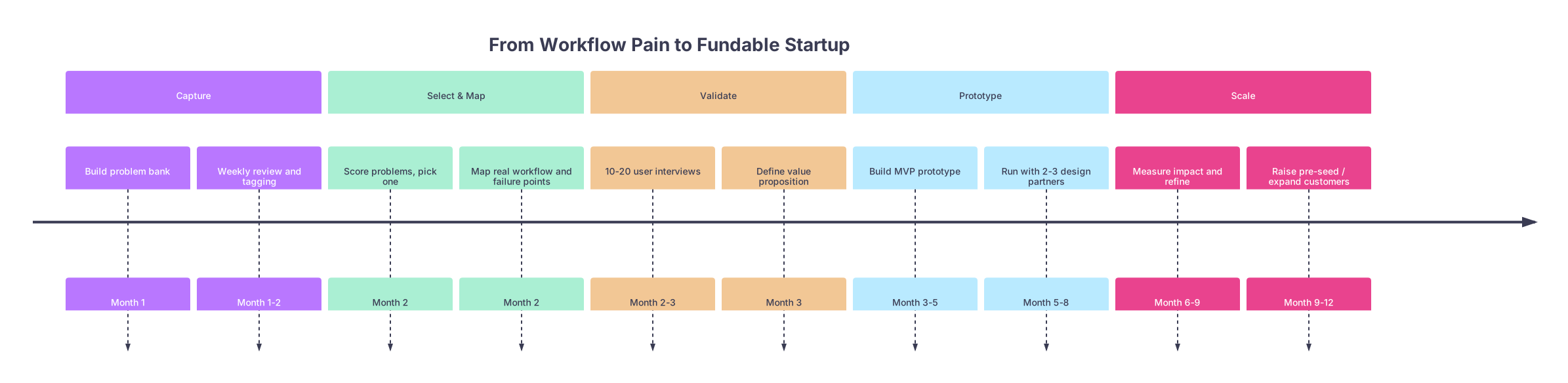
| Period | Event |
|---|---|
| Capture - Build problem bank | Month 1 |
| Capture - Weekly review and tagging | Month 1-2 |
| Select & Map - Score problems, pick one | Month 2 |
| Select & Map - Map real workflow and failure points | Month 2 |
| Validate - 10-20 user interviews | Month 2-3 |
| Validate - Define value proposition | Month 3 |
| Prototype - Build MVP prototype | Month 3-5 |
| Prototype - Run with 2-3 design partners | Month 5-8 |
| Scale - Measure impact and refine | Month 6-9 |
| Scale - Raise pre-seed / expand customers | Month 9-12 |
This is realistic. Not overnight. But absolutely doable while you are post‑residency and working.
Quick Reality Checks (Harsh but Necessary)
Let me be blunt about a few common traps I have seen:
- “We will fix all of healthcare” → Unfundable. Focus on one tight workflow.
- “We just need Epic integration and then…” → Excuse. Start manual, prove value, then integrate.
- “Doctors will use this because it is better” → False. If it does not save obvious time or protect revenue, they will not.
- “If only patients did X” → Weak. Build systems that succeed even when patients behave like humans, not robots.
- “Pilots are free, we will figure out pricing later” → Dumb. Test willingness to pay early, even if you discount heavily.
If reading that stings a little, good. It means you are still early enough to course‑correct.
FAQs
1. Do I really need a technical co‑founder, or can I start alone as a physician?
You can absolutely start alone. I have watched multiple physician‑led startups reach real revenue with:
- A freelance developer
- A no‑code platform (Bubble, Retool, Glide)
- Off‑the‑shelf tools (Airtable, Zapier, Twilio) glued together
Where a technical co‑founder becomes critical is:
- When you have validated demand and need to scale product reliability, performance, and integrations
- When the core value of your company is advanced tech (AI models, complex optimization, deep integrations), not just workflow design
Action path:
- Prove there is a problem worth solving and that clinics will use a basic version.
- Then use that traction to attract a technical co‑founder who respects that you did the hard part: defining the problem and winning early users.
2. How do I avoid getting crushed by EMR vendors or hospital IT?
You avoid getting crushed by avoiding direct competition with the core EMR and by sitting in the gaps:
- Focus on cross‑system workflows (referrals across orgs, coordinating unaffiliated clinics, patient‑facing processes) where the EMR is weak.
- Build your product as a “workflow layer” that can integrate loosely (via FHIR, HL7, SSO) but still provides value in a lightweight or standalone mode.
- Stay modular so clinics can adopt one piece without a massive IT project.
You also win allies in IT by:
- Reducing ticket volume (not adding to it)
- Being clear about security, BAAs, and data handling
- Coming with a clinic champion who is pushing for your tool, not you begging IT cold
3. What if I have multiple good problems and I cannot pick just one?
That is normal. The solution is not a brainstorm. It is a test.
- For each top‑3 problem, run 10 quick interviews.
- Score each on:
- Emotional intensity of complaints
- Willingness to try a new tool
- Clarity of buyer and budget
- Build the smallest possible prototype for the most promising one and get it into a clinic within 60–90 days.
If two ideas are still tied after that, pick the one where:
- You have stronger insider credibility (your specialty, your network)
- The sales cycle looks faster (clinic‑level decision vs. system‑wide RFP)
Indecision kills more physician startups than “wrong idea” does. Commit to one, test it aggressively, and let reality give you feedback.
Key points: Your daily clinic headaches are not random annoyances; they are potential companies. Treat them like data, not destiny. Map the real workflow, validate the pain with others, and design the smallest possible system that fixes one measurable problem. Then prove clinics will pay for it before you worry about pitch decks and VC.