
What if my hospital suddenly says they own my startup idea and can shut me down?
You’re post‑residency, finally making a real salary, and you finally have that one idea that could actually fix something broken in healthcare. You mock up a prototype on nights and weekends, maybe get a friend to code an MVP, and then HR/legal drops a bomb:
“Under your employment agreement, we own all inventions you create.”
Heart rate: 140. Worst‑case scenarios exploding in your brain.
Let’s walk through this like someone who’s actually sat in those miserable meetings with hospital counsel and anxious physician‑founders — because that’s exactly the vibe here.
First: Could they actually own your medical startup idea?
Short answer: yes, it’s possible. But it’s not automatic, and it’s not always as bad as it sounds.
Most big health systems, academic centers, and some private groups bake “inventions assignment” clauses into their contracts. You probably skimmed it when you signed because you were just trying to secure a job and pay your loans.
Common language looks like:
- “Employee hereby assigns to Employer all right, title, and interest in and to any inventions, discoveries, developments, or improvements conceived or reduced to practice during employment that relate to Employer’s business or actual or anticipated research.”
- Or even worse: “whether or not developed during working hours or using Employer resources.”
So yeah, on paper, it can look terrifying.
But three key questions actually matter:
- When did you come up with the idea?
Before you started work there? During? After? - Does the idea clearly relate to your job duties or employer’s business?
Example: you’re a hospitalist building an inpatient rounding tool vs. building a fitness app for dog walkers. - Did you use their stuff?
Hospital data, EMR access, your clinic computer, staff, residents, internal dev team, grant funding, etc.
Courts and institutional legal teams care a lot about these three axes: time, relationship to your job, and use of employer resources.
If your idea is deeply tied to your clinical work or uses hospital data or systems, they absolutely might have a colorable claim. Especially in academic medicine.
If it’s more like a generic consumer health app you hacked together at Starbucks on your own laptop with no institutional connection, you’ve got more leverage than you think.
The scary clause in your contract: what it actually means
Let me guess: you’re thinking, “I signed something. I’m totally screwed.”
Not necessarily.
Here’s what’s usually going on under the hood.
| Scenario | Employer Leverage | Your Risk Level |
|---|---|---|
| Idea pre‑employment, no employer resources | Low | Low |
| Idea during employment, unrelated to job | Medium | Medium |
| Idea during employment, clearly related to job, no resources | Medium‑High | High |
| Idea during employment, related + hospital data/resources used | Very High | Very High |
| Idea through formal institutional program (innovation center, grant) | Max | Max |
Most contracts overreach by default. They’re written to give the employer as much control as possible so they can push if something looks commercially valuable.
But here’s what’s usually true in practice:
- They don’t want to litigate against one attending or post‑res doc unless there’s real money on the line.
- They may actually prefer to negotiate ownership or a revenue‑sharing / equity agreement rather than kill the project.
- Their bark (scary legal language) is often stronger than their bite — until you raise outside money or sell.
The trigger point that wakes everyone up? Fundraising and publicity. The moment your face is in a press release or your startup pops up in a TechCrunch blurb with “raised $2M,” that’s when institutional legal suddenly “discovers” your contract.
So yeah. This isn’t theoretical.
Signs your employer might seriously come after your startup
The worst‑case scenario in your head is: they sue you personally, shut everything down, report you to the board, blacklist you from jobs, and your career dies.
Reality is usually more boring, but there are red flags.
Watch for:
- You’re using their:
- EHR integration or API access
- Protected health information (PHI) or de‑identified hospital data
- Staff/trainees to “test” your product
- You’ve informally pitched this idea to:
- Your department chair
- The innovation office / tech transfer office
- The CMO or CIO
and they turned you down or ghosted you
- Your employer has:
- A big, loud innovation program
- A tech transfer office that files patents regularly
- Internal incubators / accelerators
- You’re working on something that:
- Sounds like “clinical decision support,” “care coordination,” “population health,” “EHR integration,” or “workflow optimization”
i.e., exactly what your hospital already cares about and invests in
- Sounds like “clinical decision support,” “care coordination,” “population health,” “EHR integration,” or “workflow optimization”
- You get an email from legal, compliance, or the tech transfer office asking:
- “Can we schedule time to learn more about your project?”
- “Can you send us your pitch deck?”
Those are not casual questions. That’s the reconnaissance stage.
If they’re interested enough to poke, they’re interested enough to claim.
How do you tell if your specific idea is at risk?
You’re probably looping: “Is this dumb to worry about? Or am I one VC pitch away from a cease‑and‑desist?”
There’s a semi‑rational way to assess this.
Ask yourself, brutally honestly:
Does my startup clearly fall within ‘what my employer does’?
- Hospital / academic center + you’re building:
- inpatient tools
- scheduling or throughput tools
- readmission reduction stuff
- telemedicine infrastructure
They can probably argue it’s in their business scope.
- But if you’re building:
- a mindfulness app for med students
- consumer weight‑loss coaching without institutional data
Their claim is weaker.
- Hospital / academic center + you’re building:
Did I use ANYTHING from work?
Examples that people forget:- You pulled anonymized patient data to “test” your algorithm.
- You asked the EMR analysts to generate a “just for my project” report.
- You used your clinic hours to interview patients about your product.
- You built the prototype on your hospital laptop or GitHub account authenticated via hospital SSO.
These sound minor, but they’re the breadcrumbs legal teams love.
When did I conceive the core idea?
If you can show early:- notes
- email to yourself
- a sketch
dated before your start date, that helps. It’s not everything, but it’s something.
Is there any paper trail tying this to the institution?
- A grand rounds talk you gave where you mentioned the project
- Slides with the hospital logo on prototypes
- Internal emails where you pitched it as “our hospital’s tool”
All of that strengthens their story that this is “theirs.”
If you’re feeling your stomach drop reading this, that’s a sign to stop winging it and get help. As in: actual IP/employment counsel that works for you, not them.
What happens if they do claim ownership?
Let’s imagine the actual horror story:
You raise a seed round. Your LinkedIn blows up. Maybe you get featured in some “doctors turned founders” article. A few days/weeks later:
- “We’d like to discuss your external business activities.”
- “Our review of your employment agreement suggests the institution may have rights to your IP.”
- Or, even nastier: a formal letter from counsel claiming ownership.
What can happen next (and what I’ve seen):
They demand you assign the IP to them.
They want to own the patents/code and maybe license it back to your company (if they even allow that). This can scare investors off fast.They push you into a university/hospital spinout structure.
Translation: they want:- equity
- rights to royalties
- heavy approval on licensing and deals
You’re no longer a clean, independent startup. You’re an institutional asset.
They insist you shut it down or step away.
Sometimes they’ll say:- you can’t serve as CEO
- you can’t work on it during employment
- you must choose: job or startup
They threaten, explicitly or implicitly, disciplinary action.
Especially if:- you used PHI without proper approvals
- you violated conflict‑of‑interest policy
- you misrepresented affiliation
That’s where things feel very, very personal.
All of this is why investors obsess over “IP clean‑up” and founder employment contracts during due diligence. They hate surprise institutional claims.
What you can do before things blow up
If your idea is still relatively quiet, you have way more options than you think. You’re not powerless here, even if it feels like it.
Some concrete moves:
Stop using any employer resources. Completely. Now.
- No employer laptop or email
- No hospital data, even de‑identified
- No staff time, residents, or nurses as “testers” during work
- No screenshots of the hospital EMR in your deck
Document your timeline.
Right now, open a doc and write:- When you first had the idea
- When you made first sketches
- When you started development
- What devices/accounts you used (personal vs employer)
Save any old evidence: texts, emails, notebook photos.
Read your employment agreement like a paranoid lawyer.
Look for:- “Inventions assignment” clause
- “Outside activities” or “moonlighting” section
- “Conflict of interest” policy references
- Any language about “prior inventions” or carve‑outs
Check if your state has “employee invention” laws.
Some states (like California) limit employers from owning inventions developed entirely on your own time without their resources that don’t relate to their business. This can be huge. A health‑tech lawyer in your state will know this cold.Quietly talk to an attorney who routinely handles physician + startup IP issues.
Not your friend’s divorce lawyer. Not your cousin who “does contracts.”
Someone who lives in:- IP
- employment
- healthcare / tech transfer
You will feel 10x calmer once someone who actually knows the case law looks at your contract and your story.
If your employer is already sniffing around
If they’ve already asked to “discuss your project,” this is where you really have to stop trying to DIY.
You want to:
- Avoid:
- casually admitting you used hospital data or devices
- emailing them your full deck before you’ve gotten legal advice
- signing anything “just to move things along”
- Get:
- a clear understanding (with your own counsel) of your leverage
- a strategy: do you want independence at all costs, or is a structured institutional partnership acceptable?
Sometimes, weirdly, the smart move is to negotiate a formal arrangement:
- They acknowledge:
- your role as founder
- your equity stake
- You acknowledge:
- some royalty to the institution
- their rights to use internally
It’s not pure. Investors might roll their eyes. But it’s survivable — and way better than a lawsuit or being forced out of your own company.
What about just not telling them and hoping for the best?
This is the fantasy: stay quiet, build on nights and weekends, then one day quit and reveal yourself as the brilliant founder.
Here’s the risk profile:
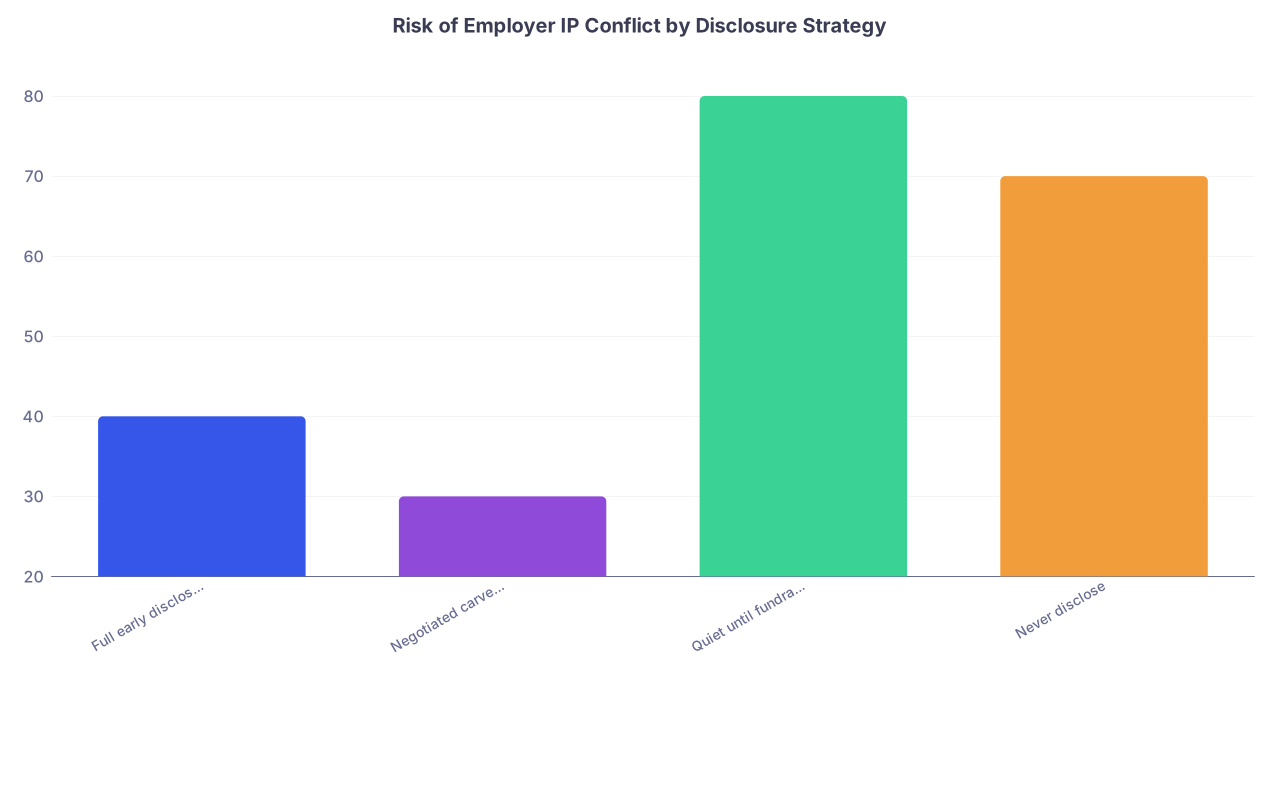
| Category | Value |
|---|---|
| Full early disclosure | 40 |
| Negotiated carve-out | 30 |
| Quiet until fundraising | 80 |
| Never disclose | 70 |
Quiet can work if:
- Your product is clearly outside their domain
- You’ve used zero employer resources
- Your contract + state law give you some protection
But staying totally quiet when:
- you’re using their brand (“Dr. X from Y Hospital launches…”), or
- you’re pitching to people in the same city/market
is playing with fire. The more public you get, the more likely someone forwards your press to your CMO “just FYI.”
You’re not paranoid. That literally happens.
How to think about your long‑term options
You’re not just trying to avoid a lawsuit. You’re trying to protect:
- Your startup
- Your ability to keep practicing (if you want to)
- Your reputation in a very small, very gossipy medical world
Realistic paths:
Stay employed and keep the startup small/quiet for now.
Buy time, validate the idea, avoid heavy PR, maybe don’t raise institutional VC yet. Cleaner later exit from your job.Negotiate a carve‑out or letter acknowledging your personal ownership.
This is gold if you can get it. Sometimes framed as:- “Employer acknowledges that the following project is not subject to the inventions assignment clause…”
You need a lawyer to draft/approve this. But if you get it signed? Massive de‑risk.
- “Employer acknowledges that the following project is not subject to the inventions assignment clause…”
Join forces with the institution (spinout / joint venture).
You sacrifice some control. Gain access to:- data
- internal champions
- pilot sites
Not my favorite for pure startups, but sometimes the only path with RCTs and heavy clinical integration.
4. Quit, then build — once you’ve assessed the landmines.
Risky but clean. Especially powerful if you:
- move to a non‑competing employer
- or go fully independent
- and your attorney believes their claim is weak
But walking away from a stable attending salary with loans hanging over you? That’s a whole different panic spiral.
You’re not crazy for being scared
You’re not “overthinking it” when you imagine:
- Your dream startup getting taken away
- Your own employer using your idea against you
- Being labeled “difficult” or “unprofessional” for trying to protect yourself
That fear is rational. Hospitals and large medical groups are perfectly capable of being territorial and heavy‑handed about IP.
But here’s the part you’re underestimating:
You have far more ability to shape this than you think — if you stop treating it like a side hobby and start treating it like what it is: a potentially valuable asset that deserves actual protection.

| Step | Description |
|---|---|
| Step 1 | Employer claims ownership |
| Step 2 | High risk - get lawyer now |
| Step 3 | Medium risk - review contract and state law |
| Step 4 | Consider negotiation or spinout |
| Step 5 | Consider carve out or leaving job |
| Step 6 | Structure equity and rights |
| Step 7 | Have you used employer resources |
FAQ: What if my employer claims ownership of my startup idea?
1. Can my hospital actually sue me personally over my startup?
Yes, they can. Will they? Usually only if there’s real money or clear misuse of data/resources. More common than a full lawsuit is a threatening letter, internal pressure, or forcing you into a structured deal. That said, don’t gamble on “they probably won’t bother” once you’re doing anything public or raising capital. Assume that once numbers hit seven figures, they’ll care.
2. What if I had the idea during residency at Hospital A but I’m now an attending at Hospital B?
Messy, but not hopeless. Hospital A might claim rights if you: conceived, developed, or tested the idea using their systems or support. Hospital B might also have broad inventions language going forward. You need someone to map your timeline against both contracts and state law. Document exactly what happened where and when before you talk to either institution.
3. Should I tell my chair or keep my startup quiet?
If you’re deep in clinical‑adjacent tech that obviously touches hospital operations, telling your chair without legal prep is risky. They may feel obligated to loop in legal/innovation, and you lose control of the narrative. The safer sequence is: talk to your own lawyer first, get a clear strategy, then decide how and how much to disclose — or whether to delay disclosure until you’ve secured carve‑outs or changed jobs.
4. Do I need to quit medicine to seriously build my startup and avoid IP issues?
Not automatically. Plenty of physician‑founders keep a small clinical role while running a startup. The key is separating: no employer data, no employer time, no employer branding, and ideally a clean arrangement in writing. But if your current job’s IP language is aggressive and directly overlaps with your startup, eventually you may have to choose between that job and full‑throttle building. Better to plan that thoughtfully than get forced into it mid‑crisis.
5. What’s the very first step I should take if I’m worried they might own my idea?
Today — as in right now — do this: grab your employment contract, highlight the inventions/IP sections, and start a one‑page timeline of when and how your idea developed, including what devices, accounts, and data you used. That gives a competent lawyer something concrete to work with. Then, schedule a consult with a healthcare‑savvy IP/employment attorney. Don’t wait for legal to email you first.
Open the folder where you keep your job documents. Find your employment agreement. Read every line that mentions “inventions,” “intellectual property,” or “outside activities,” and highlight them. That’s your starting map — and you should have it in front of you before you build one more line of code.