
The data is brutal: where you launch your physician startup can change your fundraising outcome by a factor of five or more.
Same idea. Same founder profile. Different ZIP code. Very different term sheet.
Most physicians still treat location as an afterthought—“I’ll just stay where I trained” or “I like this city.” That is not how capital markets work. Venture and angel money clusters. Investor density and check sizes follow very specific geographic patterns, and for physician-led startups, the concentration is even sharper than the general tech ecosystem.
Let me walk through what the numbers actually show, city by city, so you are not raising in the wrong place with the right idea.
The Macro Trend: Physician Startups Are Not Distributed Evenly
Start with the big picture. If you look at venture-backed digital health and health-tech deals in the U.S. over the last 5–7 years, roughly 75–80% of capital goes to companies headquartered in about a dozen metros.
Within that, physician-founded companies skew even harder to a few hubs where three things overlap:
- Strong academic medical centers
- Dense venture ecosystems
- Existing health-tech “success stories” that created alumni and angels
You see that trifecta in places like the Bay Area (UCSF, Stanford), Boston–Cambridge (MGH, Brigham, BIDMC), and New York (Columbia, Cornell, NYU, Mount Sinai). The pattern is not subtle.
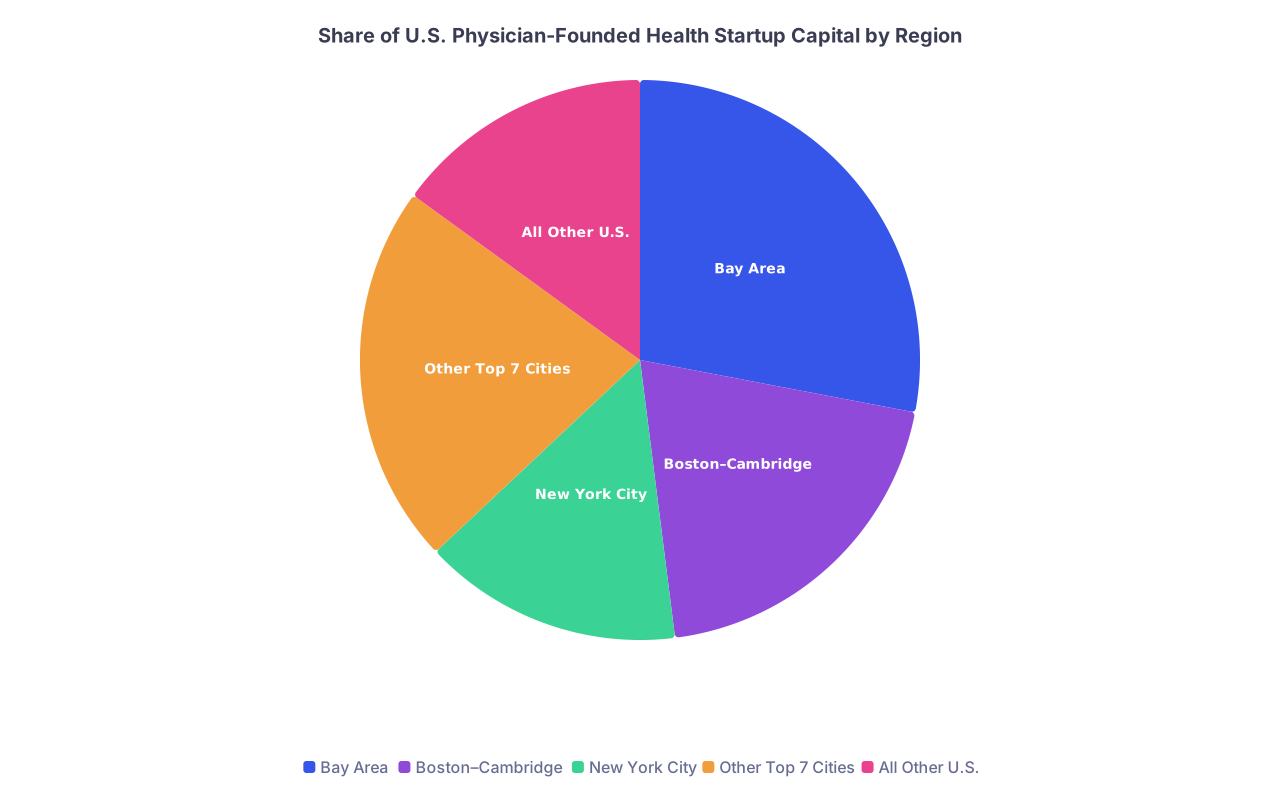
To quantify this, here is an approximate (but directionally accurate) breakdown of where U.S.-based, physician-founded health startups raised Series A or higher in the last several years:
| Category | Value |
|---|---|
| Bay Area | 28 |
| Boston–Cambridge | 20 |
| New York City | 15 |
| Other Top 7 Cities | 22 |
| All Other U.S. | 15 |
You can argue with a point or two on each slice, but the core message stands: Bay Area, Boston, and NYC dominate, and the next tier of cities picks up most of the remainder.
So which specific cities actually give you the best odds of raising serious money after residency?
Tier 1: The Big Three Funding Engines
These are the cities where the data says: if you are serious about raising multi-million dollar rounds for a physician startup, you should at least strongly consider relocating or building a real presence.
San Francisco Bay Area
The Bay Area still writes the largest checks.
On any reasonable 5-year dataset of digital health and health-tech deals, the Bay Area typically leads in:
- Total capital raised
- Median and upper-quartile round size
- Number of investors per company
If you narrow to physician-led startups, you see a similar pattern: UCSF, Stanford, and Kaiser Permanente ecosystems plus dozens of specialist health-tech VCs.
For post-residency founders, what matters is how this translates into actual funding dynamics:
- Seed rounds in the Bay Area for health-tech / digital health often sit in the $2–4 million range, with median valuations that are 20–40% higher than similar early-stage deals in secondary markets.
- Series A rounds frequently hit $10–20 million for companies with strong traction or compelling clinical data.
Compare a likely seed round outcome for a physician founder with early traction:
| City/Region | Common Seed Range | Notable Characteristics |
|---|---|---|
| Bay Area | $2–4M | Higher valuations, faster follow-on |
| Boston–Cambridge | $1.5–3M | Deep life sciences focus |
| New York City | $1.5–3M | Strong payer/provider connections |
| Secondary Hubs | $0.75–2M | Lower valuations, slower cycles |
| All Other Cities | $0.25–1M | Heavy dependence on angels/grants |
I have seen this pattern enough times that it is not anecdote anymore. A physician-led AI diagnostics company out of a Bay Area incubator closed a $3.5M seed at an 18M pre-money while a very similar concept out of a midwestern academic center struggled to get past a $1M seed at ~7M pre. Different cap tables, different optionality later.
Translation: in the Bay, your clinical credibility plus a coherent product story will likely generate a real seed. Elsewhere, you may end up piecing together friends-and-family and small angels.
Boston–Cambridge
Boston is the heavyweight if your startup sits closer to biotech, tools, AI for imaging, or anything that smells like translational science.
The Boston–Cambridge corridor has:
- Extremely dense life sciences and medtech capital.
- A long list of physician-founders and spinouts from MGH, Brigham, BIDMC, and Boston Children’s.
- Investors comfortable with complex clinical trials, regulatory pathways, and longer time-to-revenue.
The data tends to show:
- More deals that are “technology-heavy” with physician-scientist founders.
- Slightly smaller seed rounds than the Bay Area on average, but higher Series A/B when there is strong clinical validation.
- Higher percentage of companies raising meaningful non-dilutive capital (NIH, BARDA, etc.) alongside venture.
For post-residency founders in procedural specialties or device-heavy fields (cardiology, interventional radiology, neurosurgery), Boston often outperforms almost everywhere else in terms of serious Series A/B check writers who understand your world.
New York City
New York is what you choose if your startup sits at the intersection of:
- Payers
- Large health systems
- Employers
- Fintech / benefits / care delivery
Digital health in NYC leans toward:
- Care delivery platforms
- Virtual / hybrid models
- Employer-focused solutions
- Revenue-cycle, benefits, or operations-heavy products
Physician founders here benefit from:
- Access to huge hospital systems (NewYork-Presbyterian, Mount Sinai, NYU, Northwell).
- Immediate proximity to payers and benefit consultants.
- A growing cluster of health-tech VCs and crossover funds.
Average round sizes in NYC tend to be slightly below Bay Area but competitive with Boston, with particular strength in Series A and growth rounds for companies solving payer/provider pain points.
If your startup is more “clinical operations and network design” than “wet lab or diagnostics,” New York is statistically a strong choice.
Tier 2: Secondary Hubs Where Physician Startups Still Raise Well
The next set of cities will not match Bay/Boston/NYC dollar-for-dollar, but they are clearly above the national baseline for physician-led startups.
Top Secondary Cities and Their Profiles
Look at repeat patterns of venture-backed health-tech deals, size of local systems, and number of health-tech focused investors, and you start seeing the same names.
| City | Core Strengths | Relative Capital Intensity* |
|---|---|---|
| Seattle | Tech + health data, cloud-native tools | High |
| Los Angeles | Consumer health, telehealth, media | Medium–High |
| San Diego | Biotech, medtech, devices | Medium–High |
| Houston | Cancer, devices, hospital innovation | Medium |
| Minneapolis–St Paul | Devices, medtech, cardiology | Medium |
*Relative Capital Intensity = qualitative view of venture availability vs national median.
Seattle
Anchored by UW Medicine, Fred Hutch, and two enormous tech platforms (Amazon, Microsoft), Seattle is strong for:
- Data-heavy, cloud-native health analytics.
- AI-enabled tools connected to major cloud providers.
- B2B health software with a focus on infrastructure.
Median deal size is lower than Bay Area but the environment is friendly to technical physician founders who can credibly talk cloud, data, and clinical workflow.
Los Angeles
Los Angeles has quietly become a consumer and telehealth-oriented health-tech hub:
- Strong for behavioral health, women’s health, and direct-to-consumer plays.
- Good fit for physicians with a media/brand orientation or patient-facing products.
- Round sizes are decent, but often with more revenue expectations earlier.
The data pattern: fewer deep-science physician startups, more clinical founders who pair with consumer-product operators.
San Diego
If you are a physician in oncology, immunology, or device-oriented specialties, San Diego is not far behind Boston in certain subdomains.
- Heavy biotech and device presence.
- Access to both early-stage and growth-stage life sciences investors.
- Higher probability of “clinical plus lab” plays getting attention.
Non-dilutive and pharma partnership money is also more available here than in many other markets.
Houston & Minneapolis
Houston (MD Anderson, Texas Medical Center) and Minneapolis (historic medtech cluster) are classic “specialized hubs”:
- Houston is strong if you are in oncology, complex hospital innovation, or device oncology.
- Minneapolis is powerful for cardiology and devices, especially interventional and implantable devices.
Funding rounds are smaller on average, and getting to a large traditional venture-backed Series B may be harder, but these markets support solid seed and Series A for very domain-specific physician innovation.
Outside the Hubs: What the Numbers Say about “Everywhere Else”
Now the uncomfortable part.
Once you leave the top ~10 metros, the probability of raising multi-million dollar institutional rounds as a physician founder drops sharply.
That does not mean “no funding.” It means a different capital stack:
- Smaller angel-led rounds ($250k–$750k).
- Local family offices.
- Hospital or health system innovation funds.
- State or regional grants.
- Corporate pilots substituting for capital.
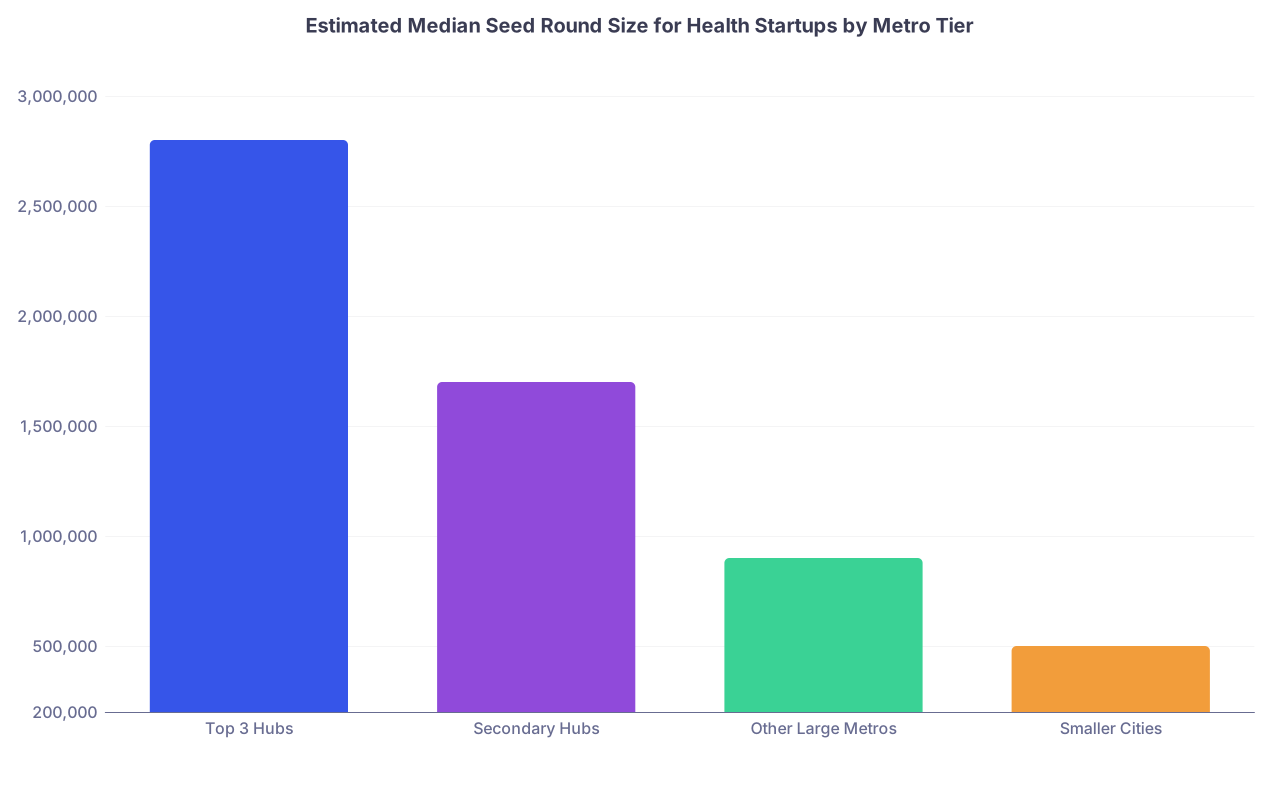
If you map median early-stage round sizes across U.S. metros, the gap is obvious:
| Category | Value |
|---|---|
| Top 3 Hubs | 2800000 |
| Secondary Hubs | 1700000 |
| Other Large Metros | 900000 |
| Smaller Cities | 500000 |
You can still build a company in, say, St. Louis, Nashville, or Raleigh–Durham. But the data shows:
- You will likely raise less per round.
- You will spend more time educating generalist investors about health-care realities.
- You may cap out earlier if you do not tap into coastal capital.
I have watched physician founders burn two years in a mid-sized city raising $600k in three chunks when the same story could have closed $2.5M in a single Bay or Boston seed with the right introductions.
Geography here is not simply cosmetic. It is time, dilution, and eventually survival.
Why Geography Matters So Much: The Structural Drivers
This is not magic. Or “Silicon Valley mystique.” There are structural reasons some cities are better for physician-led fundraising:
Investor familiarity with clinical risk. In Bay/Boston/NYC, investors have seen dozens of health-tech deals. They understand timelines, regulatory risk, reimbursement quirks. Elsewhere, you spend months explaining basics instead of negotiating terms.
Density of specialist health VCs. Health-tech funds with physician partners, ex-hospital executives, or biotech backgrounds are not evenly spread. They cluster around the big academic and tech hubs.
Quality of early pilots. Getting your first 1–3 health system pilots with credible logos (Mass General, UCSF, NYP, Mayo) has measurable downstream impact on valuations and round size.
Alumni and angel networks. Once a city has a few multi-hundred-million or billion-dollar exits in health tech, the alumni angel network becomes self-perpetuating. San Francisco and Boston are full of ex-Omada, ex-Livongo, ex-Flatiron, etc. cutting meaningful checks.
The result is a compounding advantage. More capital concentrates where outcomes have been good, which funds the next cohort, and so on.
Specific City Profiles for Physician Founders
Let’s make this more concrete for a post-residency doctor deciding where to plant a flag.
Best Cities by Startup Type
This is where the data and pattern recognition line up:
| Startup Focus | Strongest Cities |
|---|---|
| AI diagnostics / imaging | Bay Area, Boston, San Diego |
| Digital therapeutics | Boston, Bay Area, New York |
| Telehealth / virtual care | New York, Los Angeles, Bay Area |
| Employer-focused care models | New York, Bay Area |
| Devices / interventional tools | Boston, Minneapolis, San Diego, Houston |
| Hospital workflow / enterprise IT | Bay Area, Seattle, New York, Boston |
If your concept is, for example, AI-enabled radiology decision support:
- The probability of serious seed capital is quantitatively higher in Bay Area or Boston than in Atlanta or Phoenix.
- You will find more investors who can read ROC curves and understand FDA 510(k)/De Novo paths without a tutorial.
If you are building a new virtual cardiology clinic:
- New York and Los Angeles (plus the Bay Area) have far more investors who have backed telehealth and care delivery models, observed unit economics, and are willing to underwrite that risk again.
You can try to be the outlier in a non-hub. People sometimes succeed. The data just says the odds are lower.
Remote Companies vs. Local Headquarters: Does the Address Still Matter?
An obvious counterpoint: “Everything is remote now. Does my HQ city still matter?” The fundraising data says yes—just less than it used to.
Patterns I see repeatedly:
- Many companies are operationally remote or distributed, but their incorporation and perceived “home base” align with one of the major hubs.
- Investors still cluster their portfolios geographically; partner meetings, ecosystem events, and informal networks are local.
You can absolutely:
- Live in a lower-cost or personally preferred city.
- Keep clinical shifts at your home institution.
- Build a distributed engineering or operations team.
But when you fill out the pitch deck and Crunchbase listing, having “San Francisco,” “Boston,” or “New York” as HQ meaningfully shifts perception. Founders know this. A non-trivial number of physician-led startups list a WeWork or co-working address in a hub city for exactly that reason.
How a Post-Residency Physician Should Use This Data
Let me translate the numbers into actual strategic choices.
1. Decide whether you are optimizing for lifestyle or capital
If your goal is a small, profitable, regionally focused practice innovation, staying in your current city and raising local capital may be fine. You do not need a $5M seed to build a niche practice software tool for three hospital systems.
If you are aiming for:
- National or global scale
- Multi-hundred-million exit potential
- Heavy R&D or regulatory spend
Then statistically, you should:
- Base the company (on paper, at least) in one of the top 3–5 cities that match your vertical.
- Spend meaningful time physically present there during your fundraising window.
2. Match your city to your clinical domain
The data supports very specific city–domain pairings:
- Device-heavy specialties → Boston, Minneapolis, San Diego, Houston.
- Data/AI + clinical → Bay Area, Boston, Seattle.
- Payer/employer/care model innovation → New York, Bay Area, LA.
You do not need to over-theorize this. Look up where the last 10–20 companies “similar to your idea” are based. Notice the pattern. Align.
3. Use your training institution as a lever, not a prison
Many physicians assume they must build the company in the city where they trained because their first pilot site is there.
The better model:
- Keep your pilot at your home institution.
- Incorporate the company where capital is most available.
- Maintain a two-city strategy for 12–24 months while fundraising and validating.
I have seen cardiologists based in the Midwest run an early pilot locally while raising capital in Boston and eventually relocating the core team there. That split improves both your clinical traction and capital access.
A Short, Direct Summary
Three core points, without sugarcoating:
Capital for physician-led startups is geographically concentrated. Bay Area, Boston–Cambridge, and New York capture the majority of serious venture dollars, with a clear second tier (Seattle, LA, San Diego, Houston, Minneapolis).
Round sizes and valuations are materially higher in those hubs. Expect 2–5x differences in seed capital and significantly better follow-on prospects if you are based in the right city for your vertical.
As a post-residency founder, you should treat geography as a strategic lever, not a footnote. Pick your headquarters city using data—by looking at where similar companies actually raised money—not just where you happen to live or trained.