
The biggest mistake post‑residency founders make is not clinical. It is underestimating how the FDA clock will crush their startup clock.
You can practice medicine. But the data show the real survival curve for medical startups is defined by regulatory time, not by technical difficulty. If you do not decide early whether you are on an FDA track or a no‑FDA (or low‑FDA) track, you will build the wrong runway, hire the wrong team, and set the wrong expectations with investors.
Let’s quantify that.
1. The Two Clocks: Startup Survival vs Regulatory Time
Here is the blunt reality from the numbers side:
- Typical early‑stage health startup runway: 18–30 months per funding round
- Typical time to first regulated product clearance (FDA device): 2.5–7+ years, depending on pathway
- Time to “first revenue” without FDA (pure SaaS/service): 6–18 months if you execute well
The mismatch is obvious. If you are post‑residency, you probably do not have a decade to wait for a maybe. You want product in the market and data on patients, not endless protocol revisions.
The key decision: do you build something that is a “medical product” in the eyes of the FDA, or something that sits deliberately outside that definition and sells earlier?
The answer lives in timelines.
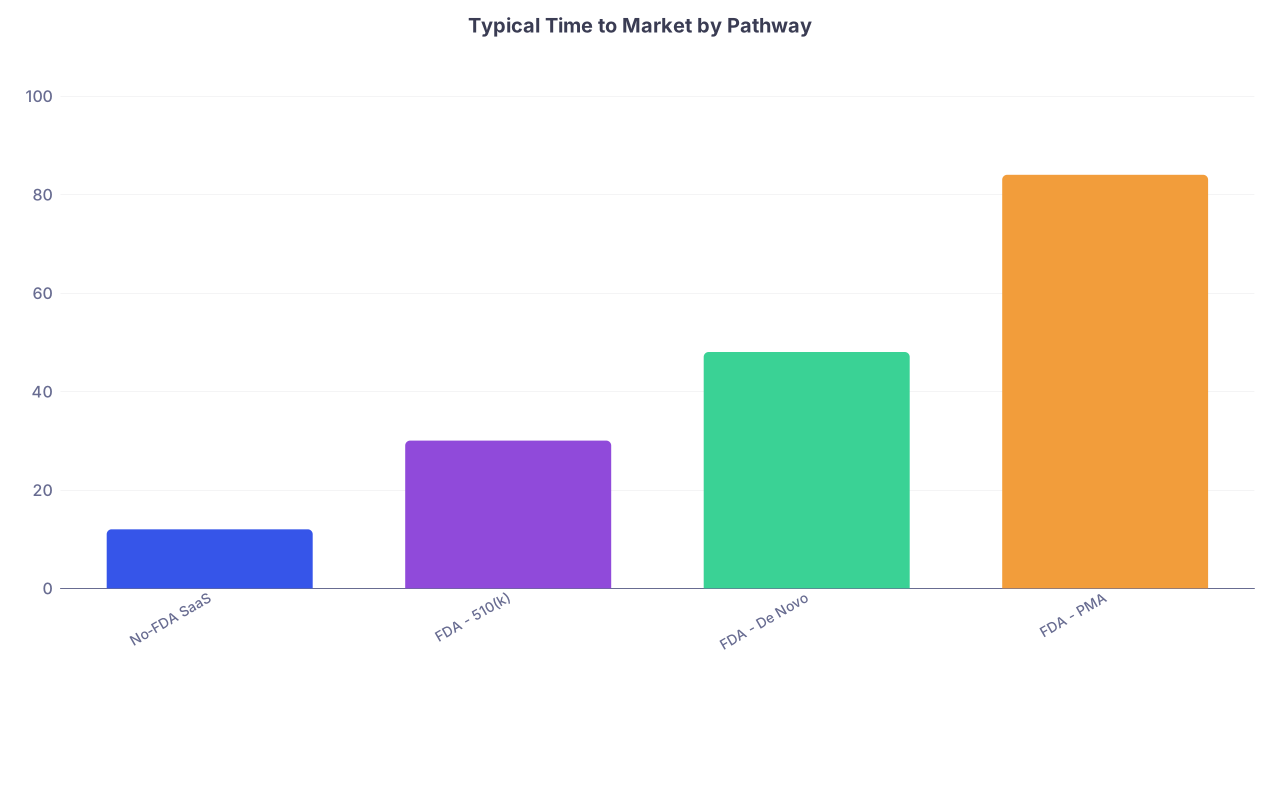
| Category | Value |
|---|---|
| No-FDA SaaS | 12 |
| FDA - 510(k) | 30 |
| FDA - De Novo | 48 |
| FDA - PMA | 84 |
Numbers are approximate median months to meaningful commercial launch for early‑stage startups that do not implode.
2. FDA Pathways and Realistic Timelines
Do not get lost in regulatory jargon. Look at time and cash.
2.1 Core FDA device pathways (for most med‑tech founders)
For a post‑residency founder, 90 percent of relevant paths fall into four buckets:
- Non‑device / not regulated as a device
- Device – 510(k)
- Device – De Novo
- Device – PMA (including some combo/drug‑device situations)
Let’s anchor them with realistic, not rosy, durations from concept to clearance, assuming focused execution and no major disasters.
| Pathway Type | Concept to Clearance | FDA Review Window | Total Capital Typically Needed* |
|---|---|---|---|
| No‑FDA (SaaS/Service) | 6–18 months | N/A | $0.3M–$2M |
| 510(k) | 24–42 months | ~6 months | $2M–$10M |
| De Novo | 36–60 months | 9–12 months | $5M–$20M |
| PMA | 60–120+ months | 12–18 months | $20M–$100M+ |
*Total capital needed includes product dev, trials, regulatory, and early commercialization for a serious U.S. launch. These are order‑of‑magnitude, but they match what I see repeatedly in early‑stage term sheets and post‑mortems.
2.1.1 510(k) – “Fast” in FDA land, slow in startup land
For class II “substantially equivalent” devices:
- Prototype & formative tests: 6–12 months
- Verification/validation, bench + limited clinical (if needed): 6–12 months
- Preparing 510(k) dossier: 3–6 months
- FDA review: 90 days on paper, 5–9 months in reality with questions
Optimistic but honest: 24 months if experienced; 30–36 months if this is your first rodeo and you are building a team as you go. That is 1–2 funding cycles for a lean startup.
Where founders get burned: they plan around the FDA review clock (≈6 months) and ignore the pre‑submission build/test/documentation phase (18–24 months).
2.1.2 De Novo – no predicate, more time, more uncertainty
With a novel moderate‑risk device:
- You lose the “predicate” shortcut
- You usually owe more extensive clinical evidence
- Interactions with the FDA become more bespoke and iterative
Data from public De Novo summaries suggests 3–5 years from start of serious development to grant of De Novo. Many teams underestimate:
- Time to first FDA feedback (pre‑sub meetings, Q‑subs)
- Time to design and enroll a meaningful clinical study
- Time lost if your first study design is not acceptable
If you are post‑residency and starting from scratch with minimal regulatory support, planning for less than 4 years to De Novo clearance is fantasy.
2.1.3 PMA – the cardiothoracic of regulatory: heroic, risky, long
PMA territory: implantables, life‑sustaining devices, high‑risk diagnostics, combination products.
Typical timeline:
- Preclinical + design controls: 1–3 years
- Pivotal trials (often multicenter, hundreds to thousands of patients): 3–7 years
- FDA review and advisory panel: 1–2 years
From first check in the company bank account to PMA approval: 7–10 years is not uncommon. Plenty of projects go longer or die.
If your goal is to leave your attending job in 18 months and live on startup salary, a PMA‑required product is structurally misaligned with your personal time horizon unless you join a much larger, well‑capitalized effort.
3. No‑FDA or Low‑FDA Routes: Where Time Shrinks
The other side of the matrix is anything that avoids being a “medical device” in the regulatory sense.
This is where a lot of smart post‑residency founders quietly make their money, then come back later to build a regulated product once they have revenue and investor leverage.
3.1 What “no‑FDA” really means
You are typically in one of these categories:
- Pure administrative / operational tool. Example: OR scheduling optimization, revenue cycle analytics, prior‑auth automation.
- General wellness / lifestyle. Example: patient engagement apps that do not diagnose or treat, step trackers, CBT‑style mental wellness tools that avoid specific claims.
- Clinical workflow but not decision‑making. Example: documentation automation, scribe tools, secure messaging platforms.
- Data aggregation / analytics products that support, but do not drive, clinical decisions and avoid explicit medical claims.
Here, your timeline looks like traditional SaaS:
- Discovery and prototyping: 3–6 months
- MVP in pilot clinics: 6–12 months
- Paid contracts starting: often 9–18 months
Your gating factors become:
- Sales cycle to hospitals or large groups (slow)
- Integrations (EHRs, billing, etc.)
- Data privacy and security (HIPAA, SOC 2, etc.)
Those are nasty, but they are under your control and do not require a 200‑page regulatory dossier.
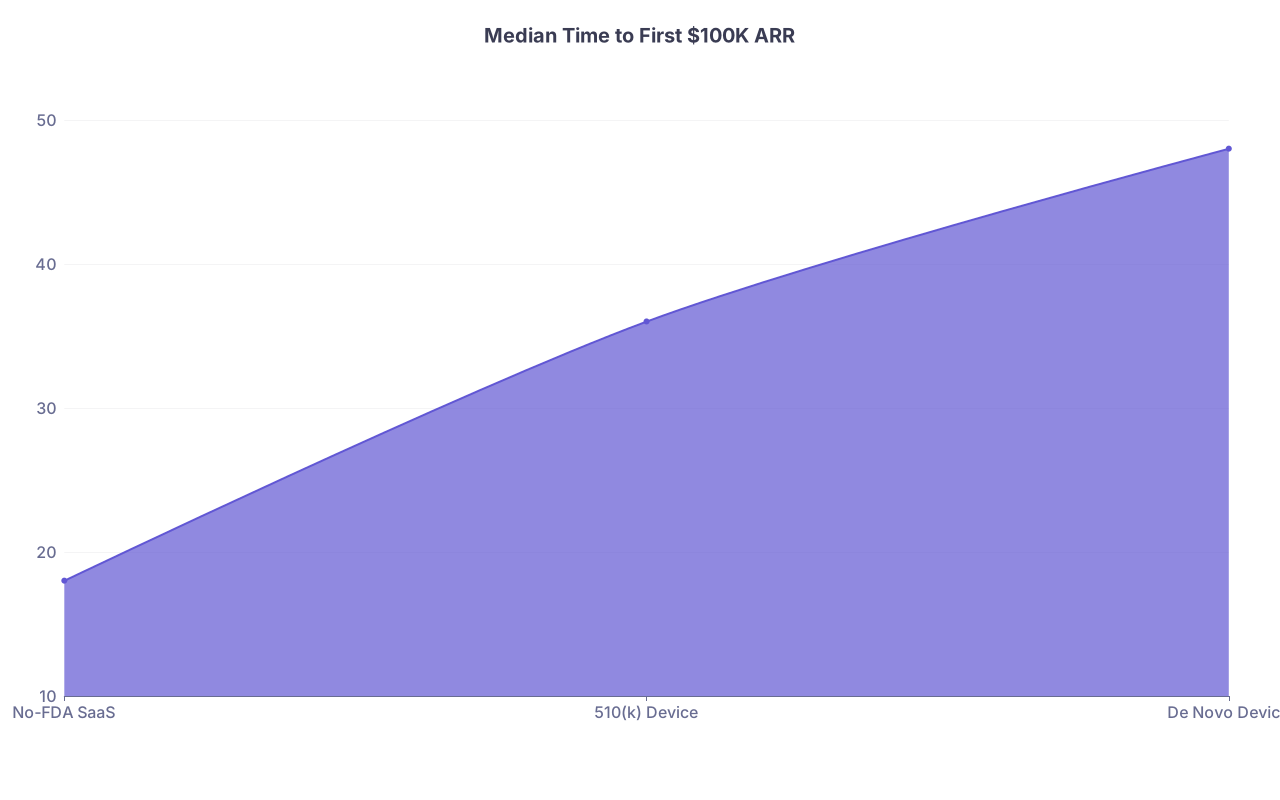
| Category | Value |
|---|---|
| No-FDA SaaS | 18 |
| 510(k) Device | 36 |
| De Novo Device | 48 |
18 months to $100K ARR for no‑FDA SaaS is aggressive but achievable if you are scrappy and sell into smaller practices or specific service lines. Hitting that as a device company before clearance is almost impossible, unless you monetize services around development or data.
3.2 “Low‑FDA” and borderline categories
There is a grey zone that founders love and regulators scrutinize:
- Clinical decision support (CDS) where the clinician can “independently review the basis” of the recommendation. Recent FDA guidance narrowed some of this, especially for ML/AI.
- Software that presents information from medical devices but does not interpret it.
- Wellness apps that push right up to, but do not cross, into diagnosis or treatment language.
These can cut your timeline dramatically vs a full device filing, but only if your claims stay tightly scoped. I have seen startups lose 12–18 months backing out overly aggressive claims retroactively because they triggered device classification.
4. Timeline Strategy for Post‑Residency Founders
Let me connect this to where you are: you are finishing training or early in your attending job, thinking about leaving full‑time clinical work. Your runway is not just money; it is credibility, energy, and family tolerance.
4.1 Map your personal runway vs regulatory runway
You need to quantify three personal timelines:
- Financial runway: how long you can live on reduced income or founder‑level salary
- Career runway: how long you are comfortable being “off track” in conventional medicine
- Startup runway: how many funding cycles you realistically want to suffer through before you see real patients using your product
Now align those with pathway data:
If you want a 2–3 year journey to “patients actually using it,” you probably need:
- No‑FDA product, or
- 510(k) with a very focused scope and experienced regulatory partners, or
- A staged approach: unregulated product first, regulated add‑on later
If you are willing to play a 7–10 year game and raise institutional capital, then:
- De Novo or PMA may be reasonable
- But you must build like a biotech, not a bootstrapped SaaS shop
| Personal Horizon to Real Use | Better‑Fit Pathways |
|---|---|
| 1–2 years | No‑FDA SaaS/service, pilotable tools |
| 2–4 years | No‑FDA + future add‑on, 510(k) |
| 4–7 years | De Novo, complex 510(k) |
| 7–10+ years | PMA, combination products |
4.2 Parallel tracks: build unregulated value while you prepare for FDA
The most effective play I see from clinician‑founders:
Phase 1 (Year 0–1.5):
- Build a non‑device tool that solves a painful workflow or analytics problem.
- Start small: single department, single health system, or even high‑volume private practice.
- Generate revenue and real‑world data.
Phase 2 (Year 1–3+):
- Use those users and data as the backbone for a regulated feature: diagnostic AI, personalized dosing, predictive risk scoring.
- Raise a round explicitly for regulatory and clinical validation, anchored on your existing footprint.
This splits your timelines:
- Time to revenue: 9–18 months
- Time to FDA‑cleared differentiator: 3–5 years
Instead of waiting 5 years for your “product moment,” you are adding a regulatory layer to a business that already exists.
5. Detailed Timeline Comparisons: Step‑By‑Step
To make this concrete, let’s walk through side‑by‑side approximate schedules for three archetypes:
- No‑FDA SaaS for clinic workflow
- FDA 510(k) device (software as a medical device, SaMD)
- FDA De Novo AI‑driven diagnostic tool
5.1 Gantt‑style comparison
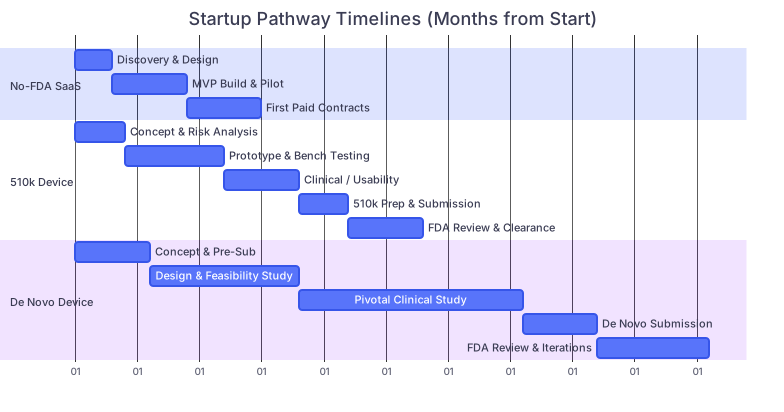
| Task | Details |
|---|---|
| No-FDA SaaS: Discovery & Design | a1, 2024-01, 3m |
| No-FDA SaaS: MVP Build & Pilot | a2, after a1, 6m |
| No-FDA SaaS: First Paid Contracts | a3, after a2, 6m |
| 510k Device: Concept & Risk Analysis | b1, 2024-01, 4m |
| 510k Device: Prototype & Bench Testing | b2, after b1, 8m |
| 510k Device: Clinical / Usability | b3, after b2, 6m |
| 510k Device: 510k Prep & Submission | b4, after b3, 4m |
| 510k Device: FDA Review & Clearance | b5, after b4, 6m |
| De Novo Device: Concept & Pre-Sub | c1, 2024-01, 6m |
| De Novo Device: Design & Feasibility Study | c2, after c1, 12m |
| De Novo Device: Pivotal Clinical Study | c3, after c2, 18m |
| De Novo Device: De Novo Submission | c4, after c3, 6m |
| De Novo Device: FDA Review & Iterations | c5, after c4, 9m |
Translating that into simple numbers from day zero:
No‑FDA SaaS:
- First pilot: month 3–6
- First paying customer: month 9–15
510(k) SaMD:
- First meaningful pilot under IRB: month 12–18
- Clearance: month 28–36
De Novo diagnostic:
- First feasibility study: month 12–18
- Clearance: month 42–51
Your personal savings and your spouse’s patience need to match one of those curves.
6. Investor Expectations by Pathway
You are not just planning timelines; you are choosing your investor universe. Each pathway carries different fundraising cadence and risk tolerance.
6.1 Capital intensity profiles
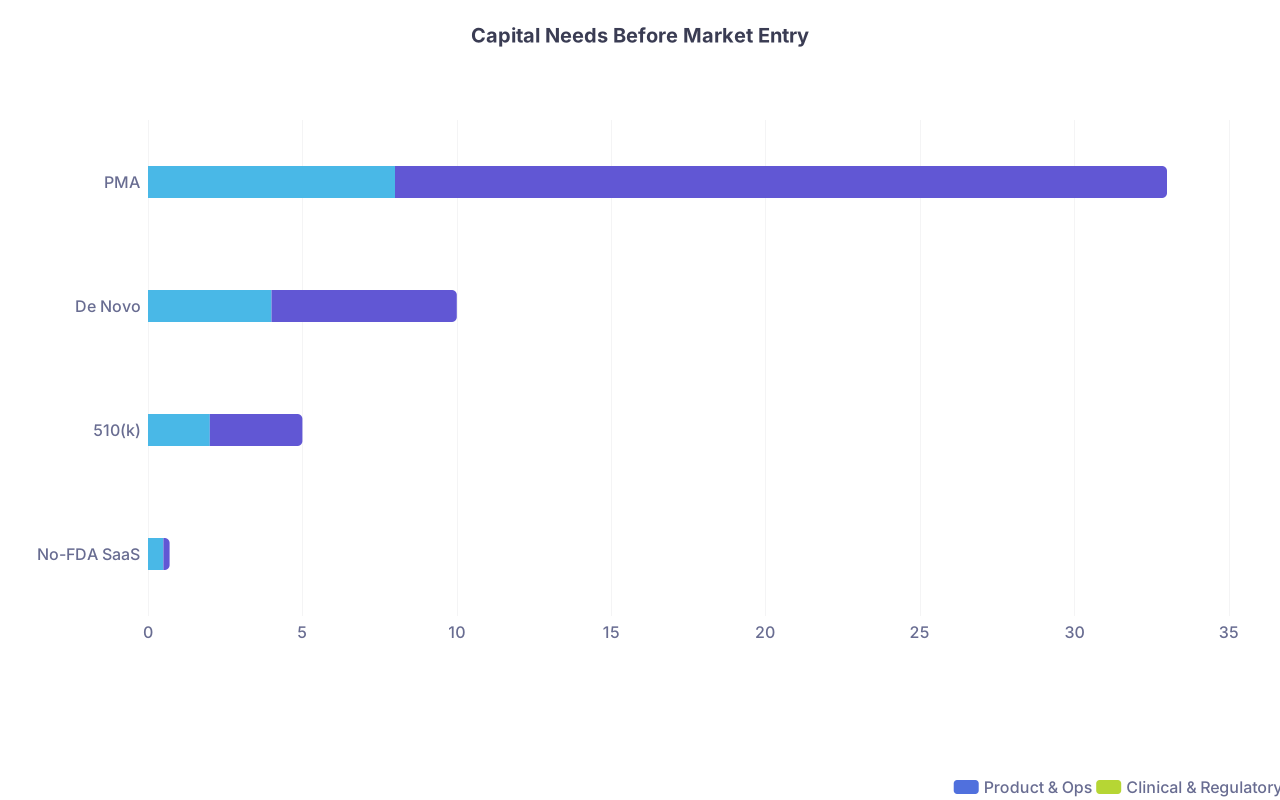
| Category | Product & Ops | Clinical & Regulatory |
|---|---|---|
| No-FDA SaaS | 0.5 | 0.2 |
| 510(k) | 2 | 3 |
| De Novo | 4 | 6 |
| PMA | 8 | 25 |
Values are rough millions of USD needed before true commercial scaling.
Interpretation:
No‑FDA SaaS founders can often:
- Raise $500K–$2M from angels and small funds
- Reach revenue without ever touching major venture
510(k) founders generally:
- Need institutional seed / Series A relatively early
- Must show a clear lead on predicate devices to justify risk
De Novo and PMA founders basically:
- Require venture firms comfortable with long biotech‑style curves
- Must present robust regulatory and clinical strategies from day one
So your pathway choice is also a choice about board meetings, dilution, and how much power you will actually have after three rounds.
7. Practical Planning Rules for Post‑Residency Founders
Let me condense this into operational rules you can actually use.
Decide your regulatory intent in the first 60–90 days. Not later.
- If there is any chance you will need FDA clearance, design documentation, validation plans, and data collection must be structured from the beginning. Retrofitting adds 12–24 months of pain.
If your target timeline to patient impact is under 3 years, default to:
- Non‑device SaaS/service, or
- A split model: non‑device product + long‑term plan for a regulated module.
Budget your personal runway against the longest realistic regulatory timeline, not the marketing brochure timeline.
- Assume:
- 510(k): 3 years
- De Novo: 4–5 years
- PMA: 8+ years
- Assume:
When in doubt, constrain your first product. Narrow indication, narrow user group, minimal claims.
- For FDA, narrower claims = simpler trials = shorter timelines.
- For no‑FDA, narrower scope = faster MVP and sales.
If you are already an attending, do not burn your clinical bridge too soon.
- Data from founder surveys shows the most stable med‑tech founders keep 0.2–0.5 FTE clinical work for several years, especially in the 510(k)/De Novo range. This buys both cash and credibility while you wait on the regulator.
FAQ (exactly 4 questions)
1. How do I know if my product actually needs FDA clearance?
The classification hinges on whether your software or device is intended to diagnose, cure, mitigate, treat, or prevent disease, or to affect the structure or function of the body. The formal path is: write down your intended use and claims in one paragraph, then map those against existing FDA guidance and similar cleared products. If your claims sound like “predicts risk of X,” “recommends treatment Y,” or “detects condition Z,” you are probably in device territory. Anything that adjusts therapy or interprets physiological signals usually triggers regulation. When founders show me a one‑pager, I can usually tell within 5–10 minutes which side of the line they are on by the verbs they use.
2. Can I launch first as no‑FDA and later convert to an FDA‑regulated product?
Yes, that is often the smartest sequencing. But you must plan for eventual FDA needs from the start. That means: collecting data in a structured way, maintaining design history, and avoiding early claims that will contradict future labeling. I see two common patterns: (1) analytics/operational product first, then add a diagnostic or predictive module; (2) clinician‑facing documentation tool first, then layer decision support that becomes SaMD. The transition cost is lowest when your architecture and data model were built with eventual validation in mind.
3. How much time does an FDA pre‑submission (Q‑sub) process add to my timeline?
On paper, a Q‑sub adds 3–6 months. In practice, it usually saves you 6–18 months of wasted work. The sequence: prepare briefing package (4–8 weeks), FDA schedules meeting (4–8 weeks), you digest feedback and adjust plans (4–8 weeks). So you invest perhaps half a year to avoid running the wrong study or picking the wrong predicate. In real projects, the teams that skip early FDA interaction typically end up doing at least one extra study phase, which can delay clearance by a full year or more.
4. As a post‑residency founder, is a PMA‑level device ever realistic for a first startup?
Statistically, it is a very high‑risk move as a solo or first‑time founder. PMA devices correlate with long timelines, high burn, and heavy institutional control. You are looking at 7–10 years and tens of millions in capital before full approval, with the very real possibility of clinical trial failure. The path that works better for most clinicians: start with either a no‑FDA or 510(k) product to learn the startup game, build a track record and network, and only then take on PMA‑class problems, ideally as part of a larger team with experienced regulatory and clinical operations leadership. The data show that founders who attempt PMA as their first venture have much higher rates of company failure and personal burnout.
Two critical points to leave you with:
- Your regulatory pathway is a time decision, not just a compliance decision.
- As a clinician‑founder, the only sustainable plan is the one where your personal runway and the FDA clock actually line up.