
It’s 7:32 a.m. You’re in a too-cold conference room on the executive floor. Your pilot just wrapped on two inpatient units. You’ve got a tidy slide deck with impressive-looking p‑values and a smiling nurse testimonial video queued up.
The COO walks in five minutes late, coffee in hand. The CIO is half on their phone. The CMO waves, says, “Sorry, I have to drop at the half-hour.” You feel your shot at a real contract shrinking by the second.
Here’s what nobody told you during med school, residency, or in your shiny accelerator program:
They are not evaluating your pilot the way you think they are.
What they say vs what actually matters
You’ve heard the script:
“Show us outcomes.”
“We’re very focused on patient experience.”
“We need innovation that supports our clinicians.”
That’s the public-facing story. The deck they show at conferences. The quotes in Becker’s.
Behind closed doors, when they evaluate your pilot, they’re running a completely different checklist in their head. It’s less “Is this good for patients?” and more:
- “Will this blow up in my face politically or financially?”
- “Does this make my most influential clinicians happy or pissed?”
- “Will this survive our budgeting and committee gauntlet without me spending political capital I need for other stuff?”
And then, the quiet killer:
- “Is this worth the operational pain of rolling out across the whole enterprise?”
Your bar chart about reducing 30‑day readmissions by 5% is not going to close the deal by itself. I’ve watched founders with beautiful data walk out with a “We’ll keep in touch” because they totally misunderstood what the decision was actually about.
Let me walk you through how the evaluation really works, from the C‑suite side.
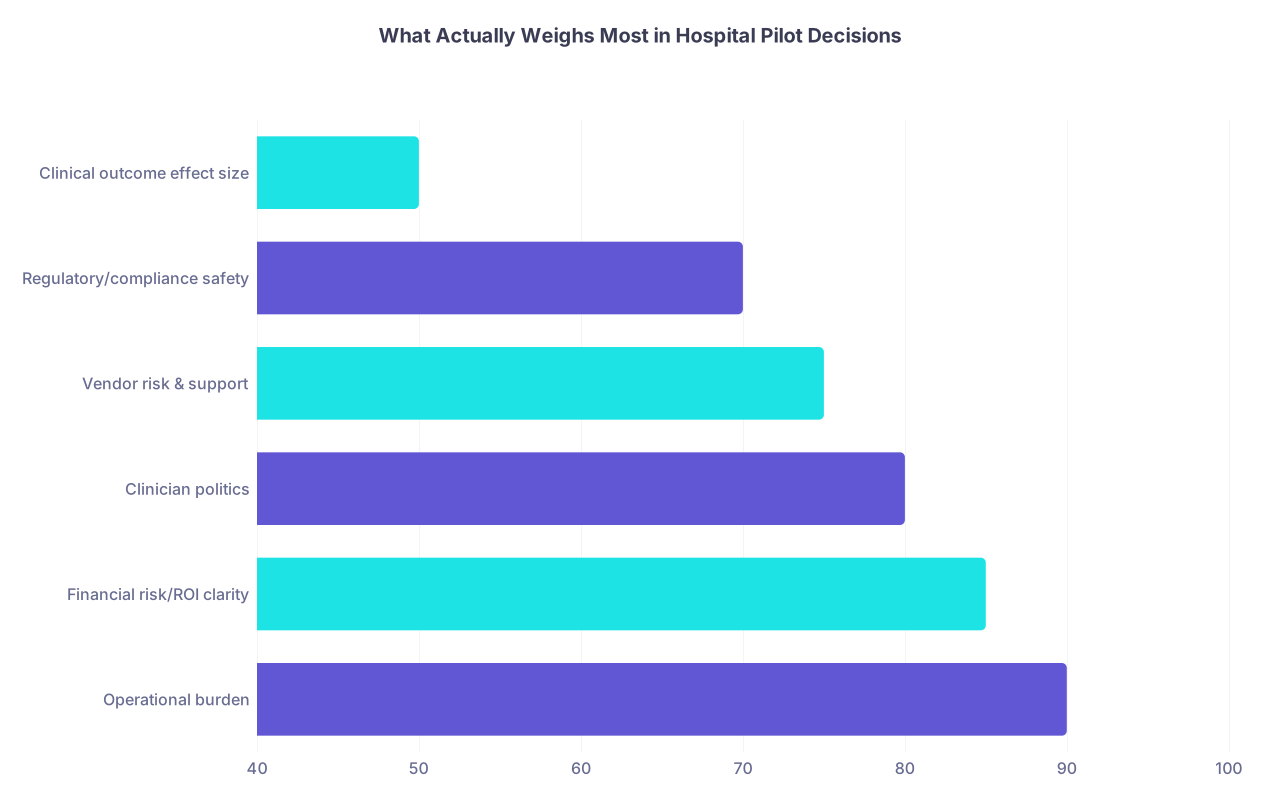
| Category | Value |
|---|---|
| Operational burden | 90 |
| Financial risk/ROI clarity | 85 |
| Clinician politics | 80 |
| Vendor risk & support | 75 |
| Regulatory/compliance safety | 70 |
| Clinical outcome effect size | 50 |
Step 1: Your champion’s political capital, not your outcomes, sets the ceiling
Every successful pilot has a champion. You know that part. What you probably haven’t internalized is this:
Your champion’s political capital is the upper limit of how far your pilot can go.
I’ve sat in steering committee rooms and heard some version of:
“I like what they’re doing, but this is Dr. Chen’s project, and she’s already spent a lot of chips on Epic optimization. We can’t give her another big win this year. Finance is already antsy.”
Blunt translation:
Your results could be fantastic. But if your champion is seen as “already getting too much” or “pushing too many changes,” your pilot will quietly die on the vine. Not because of your product. Because of your champion’s internal politics.
You need to understand who your champion really is:
- If your champion is a mid-level director without budget authority, your pilot was a science project, not a buying process.
- If your champion is a beloved department chair with a history of “playing ball” with admin, your pilot has a much longer runway.
- If your champion is known as a squeaky wheel or a tech hobbyist, the execs are already discounting whatever you present.
Founders almost never ask the direct question they should:
“Who else internally needs to put their name on this for it to move forward?”
The execs already know the answer. If your pilot doesn’t bring a second or third name with real clout—CMIO, service line chief, major revenue owner—you’re asking the C‑suite to stick their neck out solo. They won’t.
Step 2: How they really judge your “results”
You come in thinking they want statistical rigor. They don’t. They want narrative safety.
I’ve watched CFOs barely glance at the p‑values but spend ten minutes grilling a founder on, “So how would this show up in our budget? Which cost center?”
Here’s the quiet reality:
They’re not asking, “Is this clinically perfect?”
They’re asking, “Can I defend this to the board, to the medical staff, and to the press if it goes sideways?”
That shifts what matters.
What they quietly look for in your outcome data
They’re scanning for four things, fast:
Directionally obvious benefit
Not “We saw a trend with p = 0.06.” They want: “This obviously helped.” If your result is subtle, you better tie it to something strategically hot (workforce burnout, length of stay, throughput) and translate it into their language immediately.No glaring downside
The question in the room is, “Did anything get worse in a way that would embarrass us?” If your intervention improved one metric but worsened another that clinicians care about, that’s a problem even if the net calculus is positive.One or two simple executive-proof metrics
They need something they can repeat without sounding dumb: “We cut discharge delays by 18%” or “We reduced time to pain meds in the ED by 9 minutes.” If your story requires five caveats, they’ll mentally mark it “too complicated.”Evidence that YOU understand your own limitations
Ironically, the more aggressively you spin your small pilot as definitive, the less they trust you. The smartest founders I’ve watched win contracts say things like:“This is what we feel confident about from the pilot. This is what we’ll need to validate at scale. Here’s how we’d structure that.”
Execs aren’t statisticians. But they are very, very good at smelling bullshit. Especially optimistic founder bullshit.
Strike the balance: confident, but not evangelical.
Step 3: The operational pain test
This is the big one almost every health tech founder underestimates.
During your presentation, while you’re describing features and workflow tweaks, here’s what’s happening in the COO’s head:
- “How many departments need to touch this?”
- “How many policies does this break?”
- “Will I need IT to support this, and are they already at war with Epic this quarter?”
- “Which director is going to end up screaming at me about this at 11 p.m. on a Saturday?”
If the answer to any of those is “a lot” or “someone volatile,” your pilot will need to absolutely crush it on value to survive.
Here’s the kind of thing you’ll never hear publicly, but I’ve heard versions of in more than one C‑suite:
“Could it help? Sure. But this would be another change to nursing workflow. They’re already furious about the last documentation change. I’m not taking that hit for a 5% improvement.”
Your startup accelerator probably cheered you on for “transforming workflows.” The COO hears that as “more change fatigue and more people quitting.”
You win when you can credibly say:
“This shifts work away from your highest-burnout groups”
or
“This replaces three existing tools and one annoying manual workaround.”
If you can’t say something like that—and mean it—your operational burden score is probably too high.

Step 4: IT, security, and integration – the hidden veto
You know this intellectually, but let me translate it into how it actually lands in decisions:
If your pilot required “special handling” by IT, that’s already a black mark.
Executives will quietly ask their CIO or VP of Apps, “How painful was this company to work with?” They’re not asking about your FHIR adapter. They’re asking:
- Did your engineers show up prepared and competent?
- Did you respect their processes or try to pressure them into shortcuts?
- Did you dump work on their already-overloaded Epic team?
- Did you trigger any security drama?
I’ve seen promising pilots die instantly with a single side comment from IT:
“We really don’t want to support this long-term. They required lots of custom work and then kept changing scope.”
You will never be told that’s why you lost.
From the security side, they’re thinking much more bluntly than your SOC 2 report:
“Can this company be on the front page of the paper because of us?”
If your security review was messy, resistant, or slow, you’ve already lost some trust that no data slide can fix.
Step 5: Follow the money (their money, not your TAM slide)
Your slide says, “We’re a $5B TAM market.” No one in that room cares.
What they’re actually asking is:
- “Whose budget does this come from?”
- “Is this a capital expense, operating expense, or can we throw it into some grant/foundation/legal settlement fund?”
- “Which line on my P&L will look worse this year because of this deal?”
If your pilot was “free” or heavily discounted, they don’t yet take your economics claims seriously. They assume they haven’t seen the real price yet.
Here’s a pattern I’ve watched multiple times:
- Startup runs a “no-cost” pilot.
- Everyone is happy with the tool.
- Real pricing discussion happens.
- CFO goes, “So you want $750k per year, plus implementation. Show me exactly where that comes back, in our world, not as ‘industry averages’.”
This is where most founders fail. They keep talking in research-article language. Or they throw up a generic ROI model that doesn’t map to the hospital’s actual levers:
- Penalty avoidance (readmissions, quality metrics)
- OR/bed/ED throughput revenue
- Staffing costs (agency spend, overtime)
- Denial reduction / revenue capture
- Contractual quality incentives with payers
If your pilot never clearly linked to one of those buckets for that specific hospital, your “ROI” is abstract. Abstract does not get funded in a tight budget year.
| Exec Role | What They Care About Most |
|---|---|
| CFO | P&L line item impact within 12–24 months |
| COO | Staffing/throughput and operational friction |
| CMO | Safety, quality scores, medical staff politics |
| CIO | Support burden, integration risk |
| CEO | Strategic narrative and reputational risk/benefit |
If you can’t speak to at least three of those with concrete, hospital-specific numbers or scenarios, your pilot is a “nice innovation story,” not a funded initiative.
Step 6: Clinician politics and reputational risk
Hospitals are not tech companies. They’re political ecosystems with long memories.
In that executive room, someone is thinking:
- “What does the nurses’ union think about this?”
- “Will the ED docs see this as more clicks or actual help?”
- “Will this be used as a pawn in the ongoing passive-aggressive war between surgery and anesthesia?”
I’m not exaggerating. I’ve watched a promising periop tool die because the anesthesia group felt it was built “for surgery” and not them, and the CMO didn’t want to pour gasoline on that fire.
Another one: a digital rounding tool that genuinely improved throughput stalled because the hospitalists read it as “admin trying to track our every move.” The CMO’s quiet comment in the exec review:
“Look, this is solid. But I am not picking a fight with the hospitalists over perceived surveillance for a few percentage points of efficiency.”
You probably collected some “user satisfaction” surveys during your pilot. Execs don’t care about global averages. They care whether:
- Any powerful group is visibly opposed.
- Any respected “informal leaders” (that grumpy senior intensivist everyone secretly follows) are clearly supportive.
The most effective founders engineer this on purpose during the pilot:
- They identify 3–5 skeptics early.
- They give them ownership of something small.
- They make sure those skeptics have a chance to say, in their own words, “Look, I was against this, but it actually fixed X problem we’ve had for years.”
That clip—literally one quote from a previously negative stakeholder—is worth more than your entire Net Promoter Score slide.

| Step | Description |
|---|---|
| Step 1 | End of Pilot |
| Step 2 | Champion Summary |
| Step 3 | Soft Kill - Defer or Stall |
| Step 4 | Ops and IT Feedback |
| Step 5 | Financial Review |
| Step 6 | Executive Narrative |
| Step 7 | Scale and Contract Discussion |
| Step 8 | Any major political landmines? |
| Step 9 | Operational burden acceptable? |
| Step 10 | Clear budget source and ROI? |
| Step 11 | Strategic story fits? |
Notice where your pilot data truly lives in that flow: it’s part of the champion summary and a footnote to the financial review. Everything else is politics, operations, and narrative.
Step 7: Vendor risk – are you a future headline?
This one they will not say to your face, but they absolutely discuss without you:
“Are these people going to still exist in three years?”
They’ve all been burned. Shuttered startups. Acquisitions that killed products. Promises that turned into zombie implementations.
So they evaluate you like this:
- Do you look like a “features company” or a real business?
- Did your team show up for the pilot like pros or grad students?
- Did you handle problems transparently or defensively?
- Do you have 2–3 credible other logos they respect?
They are not just buying your product. They’re buying the risk profile of your company.
I’ve watched a hospital choose a clearly inferior solution because it came from a boring, stable vendor that “we know will still be here in 5–10 years and knows how to handle a joint commission visit.”
Harsh, but that’s the bar.
If your pilot required heroics from your team to keep it running, and the hospital saw that, they’re extrapolating: “This will not survive scaling to 15 sites, night shifts, and our worst-performing units.”
You’d better show that you learned from every failure of the pilot and turned it into process. Not just code.
How to present when you finally get “the room”
Let me lay it out plain: the moment you present your pilot to the C‑suite, you are no longer pitching a product. You’re pitching a decision that affects internal power, money, and risk.
The founders who win those rooms do a few things differently:
They don’t open with a product demo. They open with a story that uses the hospital’s own language:
“Six months ago, you told us ED boarding and nurse burnout on 5 West were top priorities. We designed this pilot specifically to hit those two pain points. Here’s what happened.”
They don’t show abstract metrics. They show before/after screenshots of real unit workflows and real pain removed.
They don’t over-index on statistical significance. They emphasize “fit to your strategy” and “no nasty surprises.”
They always, always show they understand the implementation burden:
“Here’s exactly what it took to run this pilot. Here’s what we’d change to reduce friction at scale. Here’s how we’d keep the impact while taking pressure off your nursing and IT teams.”
And they preempt the quiet questions by speaking them out loud:
“You’re probably wondering where this lives in your budget. Based on your current structure, this most naturally sits in X cost center and should show up as Y on your P&L. Here is how CFO Smith and I have already mapped that out at a high level.”
That single sentence tells the room: “We did the political homework. We aren’t throwing work over the wall.”
FAQs
1. What if my pilot results weren’t amazing, but users really liked the product?
Then you sell the trajectory, not the snapshot. I’ve seen hospitals move forward when results were modest but the trend was clearly improving, the pain point was strategically important, and the implementation friction was low. You say: “Here’s what we saw in 90 days. Here’s exactly what we’d change in the next 90 to double that impact.” Tie it to their high-priority problems and show that the organization wants to keep working with you. But if clinicians love it and IT hates supporting it, you’re still dead. Fix that first.
2. How big does a pilot need to be for execs to take it seriously?
Not as big as you think—if it’s in the right place. A well-run pilot on a flagship unit or service line with politically influential leaders beats a huge deployment in a marginal clinic. A single ICU or ED with real operational pain, clear metrics, and strong champions is often enough. What matters more is whether the site looks like a credible microcosm of where you want to scale: same EHR, similar workflows, similar staff mix.
3. Who should actually be in the room for the final pilot presentation?
At minimum: your internal champion, someone with financial authority (CFO or VP of Finance), someone who owns the affected operations (COO, CNO, service line VP), and someone from IT/IS who can vouch for you. If you walk into a room of only “innovation” or “digital strategy” people, you’re still in toy land. You want at least one person who signs budgets, one who controls staff and workflows, and one clinical leader who can say, “Our people will use this.” If your champion cannot get those people there, your deal is already in trouble.
Two things to walk away with:
- Your pilot is not being judged on clinical results alone. It’s being judged as a political, operational, and financial decision inside a stressed system.
- You win not by screaming “we improved X%,” but by making the lowest-risk, most defensible story for an exec who has to live with that decision long after you pack up your slide deck and fly home.