
Most physician-founders don’t need a tech cofounder. They need control, clarity, and the right kind of technical help at the right time.
Let’s cut through the noise. Everyone in tech parrots the same line: “You must have a technical cofounder.” For a physician building a healthcare startup, that advice is often lazy, sometimes wrong, and occasionally disastrous.
Here’s the real answer:
You do not automatically need a tech cofounder.
You also should not automatically hire an agency.
You need to match your choice to:
- Your product type
- Your goals (lifestyle business vs venture-scale)
- Your skills and risk tolerance
- Your timeline and budget
So let’s walk through it like an attending walking you through a consult: what you’re actually deciding, the real trade-offs, and a simple way to choose between “find a CTO” and “hire a dev shop.”
Step 1: Be Honest About What You’re Building
Before you worry about cofounders or agencies, you need to know what game you’re playing.
There are four broad buckets most physician-led tech ventures fall into:
| Startup Type | Tech Complexity | Typical Goal |
|---|---|---|
| Simple tool / MVP | Low | Test idea, side income |
| Workflow SaaS for clinics | Medium | Grow to meaningful revenue |
| Patient-facing platform/app | Medium-High | Scale regionally/nationally |
| Deep-tech / AI / data-heavy | High | Venture-scale, partnerships |
If you’re building:
- A simple scheduling tool, calculator, or niche practice workflow tool → tech is a means to an end.
- A SaaS for clinics with standard CRUD features (users, data entry, reports) → tech is important, but not novel.
- A patient app with engagement, messaging, triage, or remote monitoring → tech quality and security matter a lot.
- A deep-tech product (diagnostic AI, complex analytics, novel algorithms, heavy integration with EMRs, custom devices) → tech is your core IP.
Here’s the rule of thumb:
- If tech is core IP and differentiator, you probably need a technical cofounder or in-house team.
- If tech is delivery vehicle for your clinical insight, you can often start with an agency, contractor, or low-code.
Step 2: What a Tech Cofounder Actually Does (When It’s Done Right)
A real technical cofounder is not “someone who can code.” They’re your clinical mirror image on the tech side.
They typically:
- Own technical architecture and decisions
- Build the first versions themselves (or with a small team)
- Recruit and manage future engineers
- Translate messy product ideas into realistic technical plans
- Guide decisions on security, scalability, integrations, and data
- Sit across from hospitals, payers, or investors and credibly answer, “Is this safe and scalable?”
And in return, they:
- Get meaningful equity (often 20–40% if early and core)
- Share long-term risk and reward
- Are expected to stay for years, not months
You bring:
- Domain expertise
- Clinical credibility
- Access to users, pilots, and test sites
- Regulatory and reimbursement insight
- Sales narrative and trust
Done well, it’s a powerful partnership. Done poorly, it’s a slow-motion divorce.
Step 3: What Agencies Actually Do (When They’re Not Just Burning Your Cash)
A good dev agency (or product studio) is not your CTO. They’re a paid team delivering:
- Discovery and scoping
- UX/UI design
- Engineering (web, mobile, backend)
- QA/testing
- Sometimes DevOps and light product management
You pay them. They ship software. Then they bill you again when you want changes.
The upside:
- Fast start, no hiring headaches
- Clear-ish budget and timeline (if scoped well)
- No equity given up
- Easier to “fire” than a cofounder
The downside:
- They don’t think like owners unless heavily pushed
- Incentive to do more billable work, not less
- Can vanish after launch, leaving you with a codebase no one else understands
- You’re still on the hook to make smart product decisions
And here’s the hardest truth:
If you don’t know what good looks like technically, it’s easy to get overcharged, overbuilt, and under-served.
Step 4: How to Decide – A Simple Decision Framework
Here’s the stripped-down triage framework I use with physician-founders.
Question 1: Is your value prop mostly clinical/process, or mostly technical?
Ask yourself:
- If someone cloned my workflows in a spreadsheet or basic web app, would 80% of the value still be there?
- If yes → your value is mostly clinical/process.
- If no, because it depends on advanced algorithms, real-time analytics, custom integrations, complex edge cases → your value is heavily technical.
If your value is mostly clinical/process:
- You do not need a technical cofounder on day one.
- You probably need:
- A decent product spec
- A modest MVP
- Possibly a good niche agency or a strong freelance lead dev.
If your value is heavily technical:
- Seriously consider a technical cofounder or at least a fractional CTO early.
- An agency alone is risky because they will:
- Build what you ask for, not what you actually need
- Walk away after launch
- Leave you with no internal technical leadership
Question 2: Do you want a venture-scale company or a profitable niche business?
- If you’re chasing VC money and want to be the “Epic for X” or “AI copilot for Y specialty,” investors will ask:
- “Who owns the tech?”
- “Who leads engineering?”
- “Is your CTO full-time and committed?”
In that world:
A serious technical leader on the founding team is a major credibility signal.
Agencies are fine for an MVP, but you’ll be expected to internalize tech quickly.
If you want a profitable, moderate-scale business:
- You can absolutely run it with you + agency/contractors for quite a while
- You can hire a first full-time engineer later, once revenue is real
Question 3: What’s your budget and risk tolerance for the first 12 months?
Here’s a rough, realistic range for getting a v1 off the ground (US or Western dev shops):
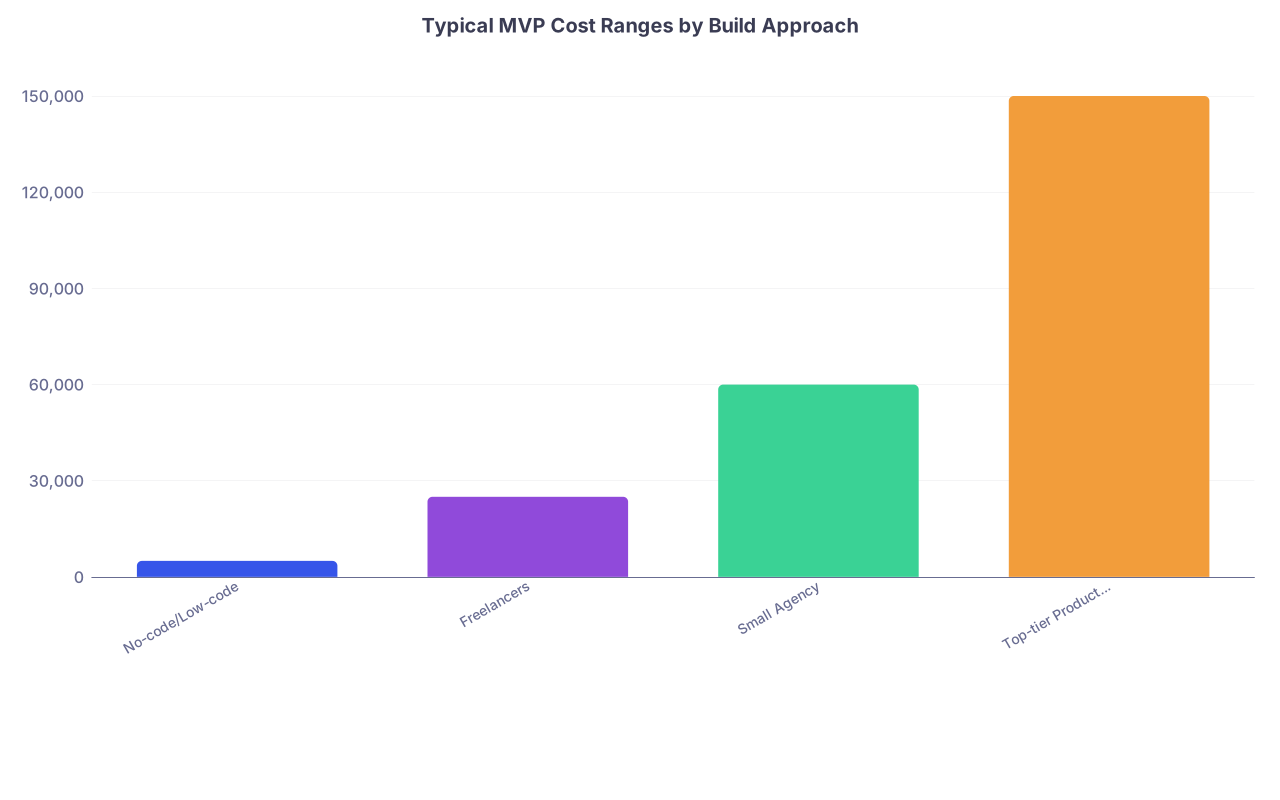
| Category | Value |
|---|---|
| No-code/Low-code | 5000 |
| Freelancers | 25000 |
| Small Agency | 60000 |
| Top-tier Product Studio | 150000 |
If:
- You have under $20k → forget big agencies.
- Use no-code/low-code + a good freelancer for polish.
- You have $20–80k → a small specialized healthcare agency can work if you’re disciplined.
- You have $80k+ and serious ambitions → you can do a meaningful MVP with a strong agency or studio, but still think about fractional CTO or early technical partner.
Step 5: Pros and Cons – Tech Cofounder vs Agency for Physicians
Let’s compare them brutally.
| Factor | Tech Cofounder | Agency |
|---|---|---|
| Upfront cash | Low | Medium–High |
| Equity cost | High | None (usually) |
| Long-term commitment | High | Low |
| Speed to first build | Medium | Often Fast |
| Technical ownership | Strong | Weak |
| Investor perception | Strong (if good) | Neutral/Weak |
| Flexibility to change direction | Medium | Low–Medium |
| Works well for | Deep-tech, VC-backed | MVPs, workflow tools |
Here’s my blunt take:
If you’re not sure the idea is real yet → Don’t hunt a cofounder. That’s like marrying someone before a first date.
- Use no-code + cheap dev help + manual workflows.
- Prove people will pay or use it.
If you’ve validated demand and need a real product quickly → A good agency plus a strong spec is fine.
- Layer in a fractional CTO (even 5–10 hours/month) to keep them honest.
If your product is hardcore technical and you want to raise real money → Start courting technical cofounders early.
- Agencies at that stage are band-aids, not a backbone.
Step 6: Hybrid Option – Fractional CTO + Agency (Often Best Early Move)
There’s a third path that’s underrated and works extremely well for physicians post-residency:
Fractional CTO + Agency/Freelancers
You:
- Own the vision, clinical workflows, and customer development
- Stay non-technical but intelligently involved
Fractional CTO (part-time, monthly retainer):
- Translates your concept into a sane technical spec
- Evaluates agencies, negotiates contracts
- Reviews architecture, security, HIPAA posture
- Performs code reviews and sanity checks
- Helps you decide when to:
- Bring work in-house
- Hire a first engineer
- Stop paying an agency
Agency:
- Builds according to a real technical plan
- Knows someone technical is watching
This setup gives you:
- No full-time tech partner commitment
- Way less risk of being overbuilt or locked in
- Real technical ownership and continuity
It’s also much easier to pitch to investors:
“Right now we work with X agency, overseen by our fractional CTO who used to be Y at Z health tech company. As we grow, we’ll internalize the team.”
Step 7: Specific Red Flags and Green Flags
You’re a physician. You know pattern recognition. Apply it here.
Red flags in a “tech cofounder”:
- They want cofounder equity but are only available nights/weekends forever
- They can’t show you products they’ve shipped before
- They talk in buzzwords but can’t explain trade-offs in plain language
- They expect you to defer to them on everything technical without transparency
- They disappear for weeks and say, “Trust me, it’s complicated”
Green flags in a tech cofounder:
- They’ve shipping history: “I built X that’s used by Y”
- They ask you annoying but smart questions about workflow, reimbursement, risk
- They’re comfortable saying “I don’t know yet, I’d test A vs B”
- They push back on gold-plating and prioritize learning over building
Red flags in an agency:
- They say “We can build anything” but can’t show healthcare projects
- Their proposal is 80% design fluff and 20% technical reality
- No mention of HIPAA, PHI, access controls, threat modeling
- They lock you into long retainers before you have a spec
- You don’t get repo access or documentation as part of the deal
Green flags in an agency:
- They’ve built healthcare products (even better: in your niche)
- They can show you example user stories, specs, test plans
- They’re clear: “Here’s what we do, here’s what you must own”
- They’re happy to work with a fractional CTO or external reviewer
- They insist on MVP scope and tell you not to build extras
Step 8: A Concrete Playbook for a Post-Residency Physician
You’re post-residency, maybe in your first attending job, thinking: “I’ve seen this workflow disaster for years, and I know the solution.” Here’s a sane path.
Clarify the problem and user
- One pager: who, what problem, how you fix it, what’s different than Excel/EMR.
- Talk to 10–20 clinicians or admins. Get hard feedback.
Sketch the product
- Paper, Figma, PowerPoint—doesn’t matter.
- Walk through: login → main actions → reports → how it fits into existing workflows.
Decide your tech intensity
- Simple workflow tool? → Lean towards agency/freelancer + maybe fractional CTO.
- AI-heavy / data-heavy / deep integration? → Start courting technical partners now.
Run a cheap validation test
- Could be:
- A clickable prototype
- A landing page collecting interest
- Manual service using Google Sheets + phone + email
- Could be:
Only then choose your build path
- If people are actually willing to pilot/pay:
- Budget under $20k → Freelancers + low-code.
- $20–80k → Small healthcare-focused agency + fractional CTO.
- Going for VC / deep-tech → Talk to potential technical cofounders in parallel with small build experiments.
- If people are actually willing to pilot/pay:
Plan for “after launch” before you start
- Who fixes bugs?
- Who manages hosting, PHI, BAA, log monitoring?
- How fast can you respond if a clinic breaks something mid-clinic day?
This is where having someone technical on your side (fractional, cofounder, senior advisor) pays for itself.
Visual: Choosing Your Tech Path
Here’s a simple flow of how most physician-founders should think about this.

| Step | Description |
|---|---|
| Step 1 | Idea and Problem Identified |
| Step 2 | Validate with 10 to 20 users |
| Step 3 | Build simple prototype |
| Step 4 | Start talking to technical partners |
| Step 5 | Use low code plus freelancer |
| Step 6 | Hire small healthcare agency |
| Step 7 | Add fractional CTO oversight |
| Step 8 | Launch MVP and test |
| Step 9 | Search for tech cofounder or senior engineer |
| Step 10 | Decide on hybrid - cofounder plus targeted agency |
| Step 11 | Gather feedback and iterate |
| Step 12 | Tech is core IP? |
| Step 13 | Budget under 20k? |
FAQs
1. Will investors take me seriously if I don’t have a technical cofounder?
If you’re aiming for venture-scale, deep-tech, most serious investors will eventually want a strong technical leader on the core team. But for a first MVP or early traction stage, many will accept:
- You (domain expert)
- A fractional CTO
- A credible agency or engineering partner
What they won’t tolerate long-term is: “We outsource everything and have no idea how it works.” So you can start without a tech cofounder, but you shouldn’t plan to scale that way indefinitely.
2. How much equity should I give a tech cofounder as a physician founder?
If they’re:
- Early, full-time, and owning all tech → often 20–40% is reasonable.
- Late joiner after product and revenue exist → more like 5–15%, depending on impact and risk.
If you’re giving someone less than 5% and calling them a “cofounder,” you’re not being honest. If someone writing a few scripts wants 40%, they’re not being realistic either.
3. How do I evaluate an agency if I’m not technical?
Use three filters:
- Healthcare experience – have they built HIPAA-aware products? Any EMR integrations?
- Client references – call 2–3 past clients and ask: “What broke? How did they handle it?”
- External review – pay a fractional CTO or senior engineer for a few hours to review their proposal, plan, and code (later). That third set of eyes will save you tens of thousands.
4. Should I learn to code as a physician founder?
You don’t need to become an engineer. You do need to become dangerous enough to ask the right questions:
- Understand basic terms: API, database, frontend/backend, cloud hosting, PHI.
- Learn how to read a simple architecture diagram.
- Get comfortable using tools like Jira/Trello, GitHub issues, Figma.
Learning some light scripting or no-code tools is a bonus, but your real job is product and problem clarity, not writing production code.
5. What’s the biggest mistake physicians make when hiring an agency?
They treat the agency like a brain, not a pair of hands plus experience. Agencies are excellent at execution when given:
- A clear problem
- Tight constraints
- Someone on your side who can say “no” to scope creep
The mistake is saying, “Here’s my vague idea, go build something amazing,” then being shocked when you get something shiny, expensive, and wrong. You must stay in the driver’s seat—or bring in a fractional CTO who will.
Three takeaways you should not forget:
- You don’t automatically need a tech cofounder; you need the right technical help for the stage and type of product you’re building.
- Agencies are powerful tools for MVPs and workflow products—but only if you pair them with clear direction and at least light technical oversight.
- If your product’s value is truly technical and you want to go big, start finding a real technical partner early; if it’s mostly clinical/process insight, you can absolutely start with hired help and keep your equity.