
The usual chatter about “healthcare exits” is dangerously imprecise. For a physician CEO, mixing up MedTech and digital health exit multiples is how you overpay for growth, mis-price equity, and mis-time a sale.
The core truth: MedTech and digital health live in different valuation universes
Let me be blunt. The market does not value a $20M-revenue 510(k) device company and a $20M-revenue SaaS remote-monitoring platform the same way. Not even close.
Across deals from roughly 2018–2024, the pattern is consistent:
- Pure-play MedTech (devices/diagnostics) typically exits in the 2–5x revenue range, sometimes higher with strong growth or unique IP.
- Scaled digital health SaaS and tech-enabled services have printed exits from 1–3x revenue for services-heavy models and 4–10x+ revenue for high-margin, high-retention SaaS platforms.
The spread is large because the underlying economics are different: gross margin profiles, regulatory risk, capital intensity, churn, and how “repeatable” the revenue is.
Let’s quantify that.
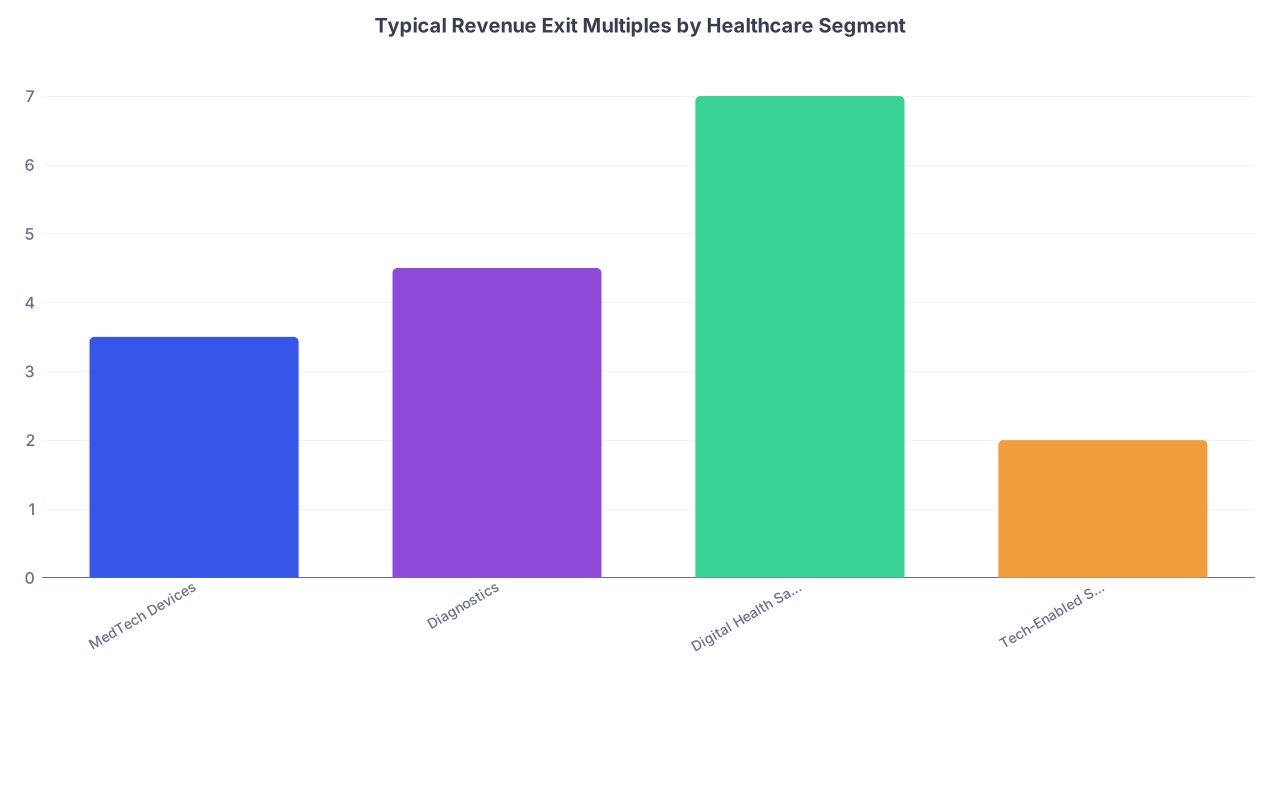
| Category | Value |
|---|---|
| MedTech Devices | 3.5 |
| Diagnostics | 4.5 |
| Digital Health SaaS | 7 |
| Tech-Enabled Services | 2 |
These are typical midpoints you see in private M&A and public-market take-privates, not the outlier froth from 2021 SPAC mania.
As a physician CEO, you need to internalize three things:
- What multiple range your category justifies.
- Which levers actually move that multiple.
- When the marginal dollar of ARR (or revenue) stops being worth delaying an exit.
Let’s break it down with numbers, not vibes.
1. How investors and acquirers actually compute MedTech multiples
MedTech is still, fundamentally, hardware plus procedures. The market values:
- Defensible IP and regulatory barriers.
- Procedure volume and ASP (average selling price).
- Installed base and disposables revenue (razor/razorblade).
Typical MedTech valuation logic
For a mid-market strategic buyer looking at a device company, you’ll see some version of this mental model:
- Baseline revenue multiple for solid but not spectacular device company: 2.5–3.5x revenue.
- Bump toward 4–5x+ if:
- Revenue growth >20–25% annually.
- Gross margins >70%.
- High recurring consumables (>40% of revenue).
- Strong clinical data and guideline inclusion.
Let’s put actual numbers on that.
Assume:
- $30M trailing twelve month (TTM) revenue.
- 68% gross margin.
- 23% year-over-year growth.
- 35% of revenue from recurring disposables.
A reasonable private M&A range: 3–4x revenue, so $90–120M enterprise value.
Same revenue, but:
- 50% gross margin,
- 10% growth,
- Low disposables mix,
and that range compresses to 1.5–2.5x, i.e., $45–75M.
That is the multiple mindset of MedTech acquirers. Not “how big can this be 10 years from now?” but “what margin and growth am I buying today, and how defensible is this in the OR or cath lab?”
Devices vs diagnostics: slightly different but same playbook
Diagnostics, especially recurring-lab-type businesses (e.g., central lab tests, genetic testing), often see higher multiples when:
- Reimbursement is locked-in.
- High test volume, sticky ordering behavior.
- Strong margins and low churn among ordering physicians.
You might see 3–6x revenue for well-positioned diagnostic platforms with solid reimbursement history. But the moment payers push back or volume growth slows, those multiples contract hard.
| Segment | Typical Revenue Multiple | Upper Range (Top Decile Deals) |
|---|---|---|
| MedTech Devices | 2–4x | 5–7x |
| Diagnostics (central) | 3–5x | 6–8x |
| Digital Health SaaS | 4–8x | 10–15x |
| Tech-Enabled Services | 1–3x | 3–4x |
Notice: the upper range for best-in-class digital health SaaS can rival or exceed most devices. But that is conditional on software economics, not just “we use an app.”
2. Digital health: why some platforms get 8–10x and others barely clear 2x
Digital health is a broad bucket. That vagueness kills physician founders, because you start benchmarking against the wrong cohort.
There are essentially three digital health archetypes from a multiple perspective:
- Software-first (true SaaS) – think care coordination platforms, RCM tooling, workflow software, remote monitoring dashboards sold per-seat or per-patient-per-month.
- Tech-enabled services – virtual clinics, staffing models, outsourced care management, where software is an enabler but not the primary product.
- Marketplace/network plays – B2B2C platforms matching patients, payers, and providers with network effects (these are rare and often overhyped).
The data from public comparables and disclosed M&A suggests:
- SaaS digital health with >80% gross margin, low churn, and 25–40% growth: 5–10x ARR (annual recurring revenue).
- Tech-enabled services with 30–50% gross margins and decent growth: 1–3x revenue.
- “We are a clinic with an app” models: almost always valued like services, not like tech.
The SaaS math
Here is how a professional buyer (growth equity or strategic) actually evaluates your digital health SaaS company:
They start with ARR:
- $10M ARR.
- 85% gross margin.
- 110% net revenue retention (NRR).
- 30% year-over-year growth.
Benchmarked against horizontal SaaS, this profile can justify 7–10x ARR. Healthcare-specific regulatory complexity and integration friction might shave 1–2x, but payer/sticky-provider contracts add durability.
So you might see:
- 7–8x ARR → $70–80M enterprise value.
Now, adjust just one metric: NRR.
Same $10M ARR, but 95% NRR (you lose 5% of ARR per year net of expansions):
- Suddenly the believable long-term growth curve flattens.
- Buyers model higher CAC (customer acquisition cost) to replace churn.
That often compresses multiples down to 4–6x ARR → $40–60M. Same top-line, different retention, very different check size.
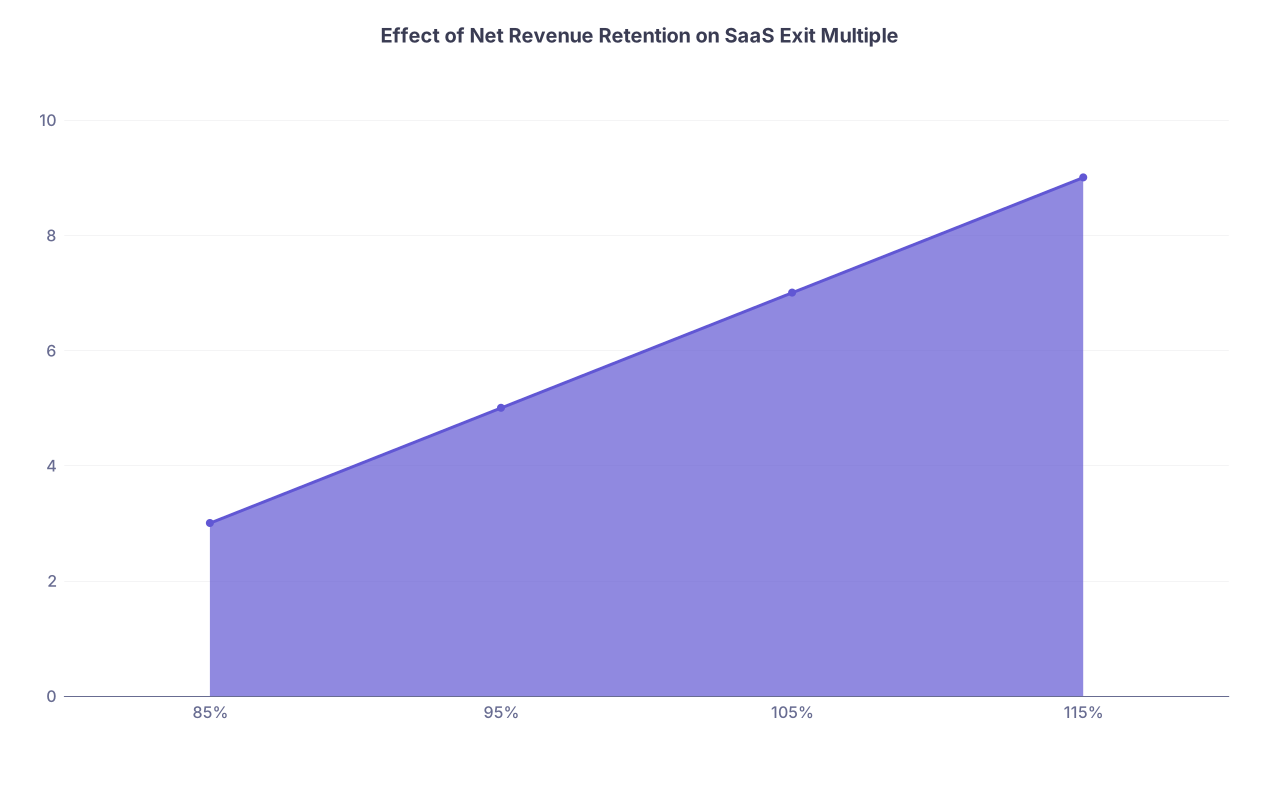
| Category | Value |
|---|---|
| 85% | 3 |
| 95% | 5 |
| 105% | 7 |
| 115% | 9 |
This is why obsessing over retention and expansion is not just “good operations.” It is literally a multiple lever.
Tech-enabled services: the trap most physician-led digital startups fall into
Every time I see a physician founder say, “We are building an AI-powered virtual clinic,” I already know the future conversation:
- They raise capital at a SaaS-style multiple on revenue because investors buy the story.
- The P&L, however, behaves like a services company: 35–55% gross margin, labor-heavy, complex operations.
- At exit, buyers pay a services multiple on revenue. The “software premium” disappears.
Let’s put math to it.
Company A:
- $25M revenue.
- 40% gross margin.
- 50% of operating costs are clinical labor.
- 30% revenue growth.
Investors at Series B may have paid 6–8x ARR when it was early and story-driven. Strategic buyers at exit, however, will look at comparative healthcare services deals, which typically cluster around 1–3x revenue.
If A sells for 2x revenue → $50M. If the company previously raised at a $120M post-money, that is not a win for common shareholders.
This gap between “fundraising valuation” and “exit multiple reality” is where a lot of physician CEOs get burned.
3. The capital intensity discount: MedTech vs digital health
Capital intensity changes everything. The data shows:
- MedTech often requires $30–100M+ total invested capital to get to scalable commercialization (regulatory, clinical trials, manufacturing, sales force).
- Digital health SaaS can get to meaningful ARR on $10–40M if well executed.
Buyers care about capital efficiency. They will not pay the same multiple for $30M revenue built on $150M of invested capital vs. $30M revenue built on $30M.
This shows up in payback:
- For MedTech, acquirers often do a kind of “payback period” check: “Can we earn back this purchase price in 5–7 years from cash flows and synergies?”
- For digital health SaaS, they think more about long-term growth optionality and platform value, not just cash payback.
Simple payback lens
Take two hypothetical exits, both priced at 4x revenue:
- Company D (Device): $50M revenue, 65% gross margin, 15% EBIT margin.
- Company S (SaaS): $50M ARR, 85% gross margin, near-breakeven but growing 30%.
D generates: $7.5M EBIT per year. At a $200M price tag, that is a 26.7x EBIT multiple, or roughly 3.7% “earnings yield” before growth and synergies. Buyer hopes they can expand margins and drive volume.
S currently does not generate material EBIT, but with NRR >110% and high gross margins, the buyer models future operating leverage and a much larger TAM. They justify the same 4x multiple on very different logic: forward growth, not current cash.
So while headline “4x revenue” looks identical, the underlying expectations differ sharply.
A capital-hungry MedTech that still needs $50M of post-acquisition capex to scale may see its multiple cut to reflect this.
4. What moves your multiple in each category
This is where you, as a physician CEO, actually have levers. You cannot change that you are a device vs software vs services company. But you can align your strategy to the metrics that matter for your category.
For MedTech CEOs
Three things move your exit multiple more than anything else:
Recurring revenue mix
If 50–70% of your revenue is consumables, service, or software tied to the device, you look less like one-time hardware and more like a platform. Buyers pay up.Clinical and guideline presence
Being in a Class I guideline, or having strong RCT data, increases perceived durability of procedure volume. This stabilizes forward projections and justifies a higher multiple.Sales efficiency
High revenue per rep and low churn among hospitals prove that expanding the commercial footprint has leverage. Acquirers see this and are willing to pay more than just “asset value.”
Quick example:
- Device Co X: $40M revenue, 30% disposables mix, 55% gross margin, 15% growth. Likely 2–3x revenue.
- Device Co Y: $40M revenue, 65% disposables+software, 72% gross margin, 28% growth, adoption in major academic centers. Likely 4–6x revenue.
Same top line. Different structure and trajectory. 2–3x difference in proceeds.
For digital health CEOs
If you claim “tech,” your numbers must behave like tech.
Here’s what the data says buyers reward:
Gross margin
75–80% = real SaaS.
40–60% = services. Expect a services multiple.Net revenue retention (NRR)
<90%: red flag.
90–105%: acceptable.
110–120%+: premium.Customer concentration
Top 5 payers or systems <40% of revenue is healthier. Heavy concentration tends to compress multiples by 1–2x, because one contract loss can crater revenue.Sales efficiency and payback
CAC payback <18–24 months supports higher multiples; 3+ years is a drag.
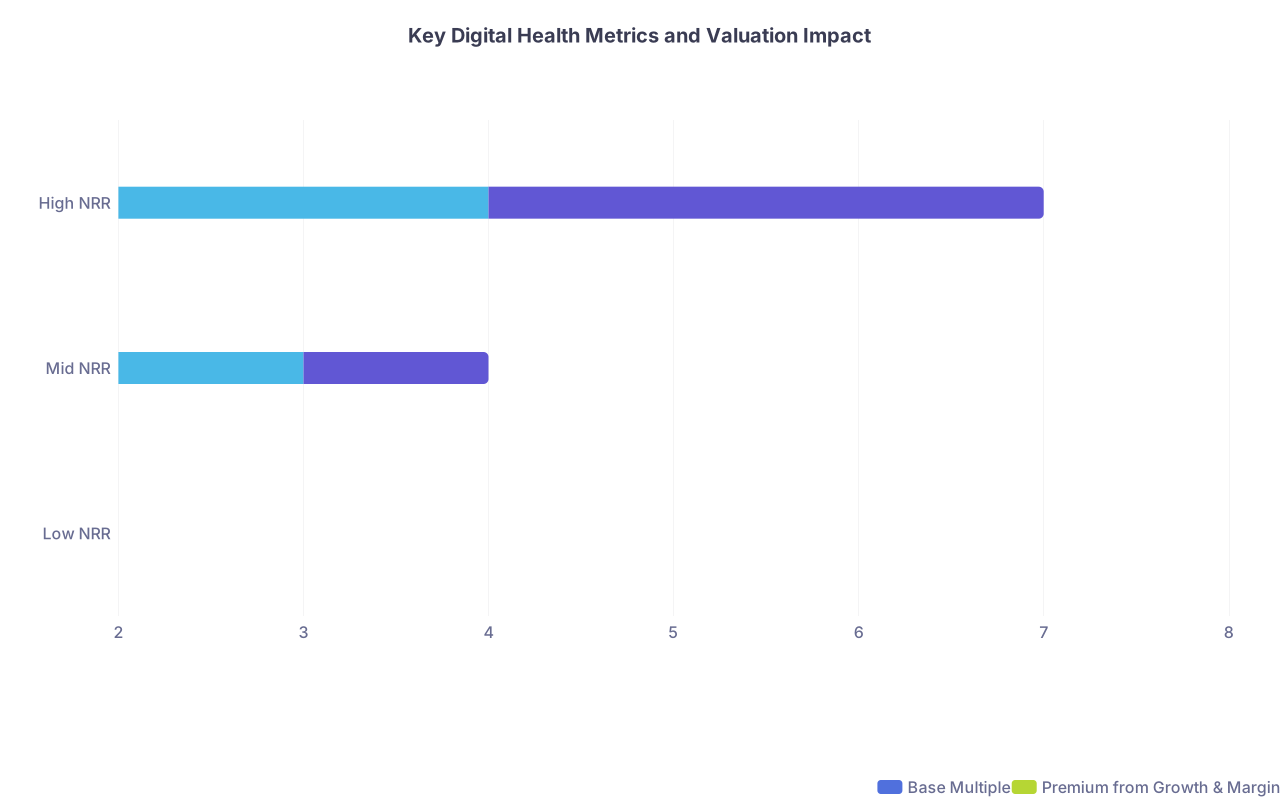
| Category | Base Multiple | Premium from Growth & Margins |
|---|---|---|
| Low NRR | 2 | 0 |
| Mid NRR | 3 | 1 |
| High NRR | 4 | 3 |
If you are running a hybrid model (software + services), decide explicitly:
- Either embrace being services-heavy and focus on profitability and durability (you will be valued 1–3x revenue).
- Or aggressively productize, automate, and migrate value into software so that your margin profile earns you a SaaS-like multiple.
Hoping a buyer will “see the tech” when 60% of your COGS is clinicians is fantasy.
5. Timing your exit: when the incremental multiple is not worth the delay
Founders obsess about revenue growth. What they usually neglect to model is the tradeoff between:
- Growing revenue.
- Yet potentially facing a lower multiple as the market cools, category matures, or growth decelerates.
You should be roughly modeling scenarios like this:
Example: digital health SaaS
Today:
- $10M ARR.
- Multiple environment: ~6–8x ARR.
Potential exit: $70M (midpoint 7x).
Two years later (plan):
- $25M ARR.
- Growth slows from 50% to 30% as you scale.
- Market multiples compress from 7x to 5x (macro, sector sentiment).
Exit value: 5x * $25M = $125M.
So you grew ARR 2.5x, but exit value only 1.8x. If you spent $25M more capital to get there and diluted yourself by another 25–30%, your personal share of the outcome might be flat or worse.
I have seen founder cap tables where the CEO would have personally made more money selling at $70M early than at $150M late.
Simple physician-friendly heuristic
You do not need a full DCF. Ask:
- “What multiple band is realistic for my category for the next 3–5 years?”
- “How much ARR (or revenue) can I realistically add before growth slows?”
- “How much dilution will that require?”
If the product of [future revenue] x [likely future multiple] x [your ownership %] is not materially higher than your current scenario, you are just working for your investors.
6. Positioning as a physician CEO: avoid category confusion
A recurring pattern: physician founders pitch MedTech companies with software components as if they were pure SaaS. Or they pitch services with some automation as if they were “AI platforms.”
Smart buyers have very clean buckets. If you want to land a higher multiple, your numbers and narrative must line up.
For MedTech founders dabbling in software
If you add software to a device:
- Track and highlight attach rates: what % of installed base is on paid software?
- Show software as a separate line with >80% gross margin and strong growth.
- Demonstrate that losing the software would materially reduce utility of the hardware.
If software is 10% of revenue, it is an add-on. You are not suddenly a SaaS company. But if, over time, software+services becomes 30–40% of revenue, your blended multiple can move.
For digital health founders with clinical services
Be honest: if >50% of COGS is clinician salaries, you will be valued closer to services. That is not bad, but it changes what a “good exit” looks like.
Your best play is usually to:
- Push standardization and automation aggressively.
- Package what you do into repeatable, licensable workflows.
- Transition as much revenue as possible to subscription-like structures (PMPM, per-member-per-month, or multi-year license) rather than pure encounter-based billing.
Then you can make a credible argument for a higher multiple within the services band.

7. Practical steps: how to use this as a physician CEO
Let’s make this concrete. You are post-residency, running or joining a startup, and you do not have years to become a valuation nerd. So you want a minimal, data-driven framework.
Step 1: Classify your business honestly
Ask three blunt questions:
What % of revenue is:
- One-off device/hardware sales?
- Recurring disposables/service?
- Recurring license/SaaS?
What is my actual gross margin?
If I stopped selling today, how much of next year’s revenue would recur automatically?
Your answers push you into one of three buckets: device, SaaS, or services. That determines your base multiple band.
Step 2: Grab 5–10 relevant comparables
You do not need a Bloomberg terminal. Look at:
- Public MedTech comps (Boston Scientific acquisitions, Stryker, Medtronic deals).
- Public digital health / health IT comps (Teladoc, Phreesia, Veeva’s life sciences lines, RCM vendors).
- Announced M&A where revenue and purchase price are disclosed.
You will see patterns: devices cluster around 2–4x, diagnostics a bit higher, health IT SaaS around 4–8x, and services near 1–3x.
Step 3: Map your metrics to multiple drivers
Make a simple grid:
- Growth rate now and 2–3 years ago.
- Gross margin trend.
- NRR (if SaaS).
- Recurring revenue mix (if MedTech).
- Customer concentration.
Then ask where you sit relative to top-quartile in your category. You will not see 10x multiples with bottom-quartile metrics.
Step 4: Align board expectations with category reality
Too many boards push for unrealistic “tech multiples” on services-heavy companies. As a physician CEO, you need to push back with data:
- “Our gross margin is 50%. Median tech-enabled care deals trade at 2–3x revenue. If we want a tech multiple, we must get this margin to >75% and reduce labor intensity.”
You are not just being conservative. You are preventing a valuation overhang that can kill an exit.

Step 5: Design your product roadmap with multiples in mind
This is where clinical intuition meets financial discipline:
- MedTech: prioritize features that increase utilization per procedure, drive disposables usage, or lock-in software subscriptions.
- Digital health SaaS: prioritize features that increase stickiness (NRR), cross-sell potential, and integration depth with EHRs and payers.
- Tech-enabled services: prioritize automation, protocols, and IP that make you less people-linear and more scalable.
You are not building features. You are engineering future exit multiples.

| Step | Description |
|---|---|
| Step 1 | Classify Business Type |
| Step 2 | Focus on Recurring Disposables |
| Step 3 | Focus on SaaS Metrics |
| Step 4 | Improve Margins and Automation |
| Step 5 | Increase Consumables Mix |
| Step 6 | Boost NRR and Gross Margin |
| Step 7 | Target 1-3x Revenue Exit |
| Step 8 | Target 3-5x Revenue Exit |
| Step 9 | Target 5-10x ARR Exit |
| Step 10 | Device or Software? |
Key takeaways for physician CEOs
Two or three points, very simply:
- MedTech, digital health SaaS, and tech-enabled services live in different multiple bands. Your actual margin and revenue structure, not your pitch deck label, determine which band you are in.
- In MedTech, recurring revenue mix and clinical defensibility move multiples. In digital health, gross margin and net retention do the heavy lifting.
- Timing and capital efficiency matter as much as growth. An earlier, smaller exit at a strong multiple can be personally better than a later, larger exit on a compressed multiple after heavy dilution.