
Most health startup founders underestimate how brutal investors are about revenue milestones. They talk “vision” and “impact”; investors look at one thing first: annual recurring revenue and its trajectory. The data is painfully consistent.
If you want institutional capital after residency, you need to think like a growth equity analyst, not a clinician with a side project.
This is a numbers article. We are going to anchor what “good” looks like, in revenue terms, for health startups at different stages — and what investors actually expect to see before they wire money.
1. The Investor Lens: Why ARR Rules Healthcare Startups
Healthcare has two structural features that make revenue benchmarks harsher, not softer:
- Sales cycles are long (3–18 months is common for enterprise health).
- Churn is lower once you land, especially with embedded workflow or regulated products.
So investors accept slower initial ramp… but they demand clear, objective ARR proof as compensation for that risk.
For most software‑enabled health businesses, three metrics dominate early investor conversations:
- ARR (Annual Recurring Revenue) – normalized, contracted revenue run rate
- Growth rate (month‑over‑month or year‑over‑year)
- Revenue quality – gross margin %, logo retention, net revenue retention (NRR)
You can be “post‑residency with a great team” all day. If you cannot answer the question “What’s the current ARR and what did it look like 6, 12, 18 months ago?” you are not fundable beyond friends and family.
Let’s quantify what investors actually want to see.
2. Core Revenue Benchmarks by Stage (Specific to Health Startups)
We will split health startups into three broad go‑to‑market models:
- B2B / B2B2C (selling to health systems, payers, employers, life sciences)
- B2C direct‑to‑patient (subscription or pay‑per‑use)
- Tech‑enabled clinical services (virtual clinic, hybrid models, specialized care)
Different models, different expectations. But they all get mapped back to ARR and growth.
| Stage | Typical Round | ARR Range | Growth Expectation |
|---|---|---|---|
| Pre-Seed | Angel/Pre-Seed | $0–$100K | Early pilots, first logos |
| Seed | Seed | $100K–$1M | 8–15% MoM or 2–3x YoY |
| Series A | A | $1M–$3M | 100%+ YoY |
| Series B | B | $3M–$10M | 70–100% YoY |
| Growth | C+ | $10M+ | 40–70% YoY |
Those are generic SaaS‑like benchmarks. In health, investors will often accept the low end of ARR at a given round if:
- ACV (annual contract value) is high (>$200K),
- Sales cycles are long but pipeline is strong and proven, and
- Retention / NRR is exceptional (NRR 120%+).
Now let’s break this down more surgically for each model.
3. B2B / B2B2C Health: ARR Milestones Investors Actually Use
Think: clinical workflow tools, RPM platforms, care coordination, quality / risk adjustment tools, employer health benefits platforms.
Here the standard venture model (pre‑seed → seed → A → B) maps reasonably well, but with slightly lower ARR at each stage vs traditional SaaS, offset by higher ACVs and stickier logos.
3.1 Pre‑Seed: Evidence of Willingness to Pay
At true pre‑seed, a lot of decks still show $0 ARR. That is tolerated, but rarely celebrated. Data from recent digital health rounds points to three credible pre‑seed patterns:
- 0–$25K ARR from paid pilots with 1–2 logos
- 25–$75K ARR from multiple pilots or early contracts
- $75–$100K+ ARR where you are actually underpricing but proving fast adoption
Investors at this stage want to see:
- 1–3 paying customers (even if pilot discounts)
- ACV clarity: “This contract is $40K/year; we renew+expand if we hit X KPI.”
- A path to $500K–$1M ARR in 18–24 months
3.2 Seed: The “$500K ARR and Growing Fast” Threshold
For B2B/B2B2C health, the practical seed benchmark most investors carry around is:
- $300K–$1M ARR, with a strong bias toward $500K+ at the time of the seed round.
The data from deals I have seen in the last 3 years:
- Sub‑$250K ARR seed raises happen, but rounds are smaller and more founder‑friendly.
- The most competitive seed rounds in health tech cluster around $500K–$1.2M ARR with 10–20% month‑over‑month growth in the preceding 6 months.
Growth matters as much as the static ARR number. If you are at $300K ARR but you were at $80K six months ago, a good investor will do the math:
- ~22% MoM growth over 6 months gets you from $80K → ~$260K.
- That is credible acceleration, not random noise.
At seed, benchmark expectations for B2B health:
- ARR: $300K–$1M
- MoM growth: 8–15% (or 2–3x YoY)
- ACV: $10K–$100K+ depending on whether you sell to clinics vs large systems
- Customers: 5–30 paying logos with concentration risk understood
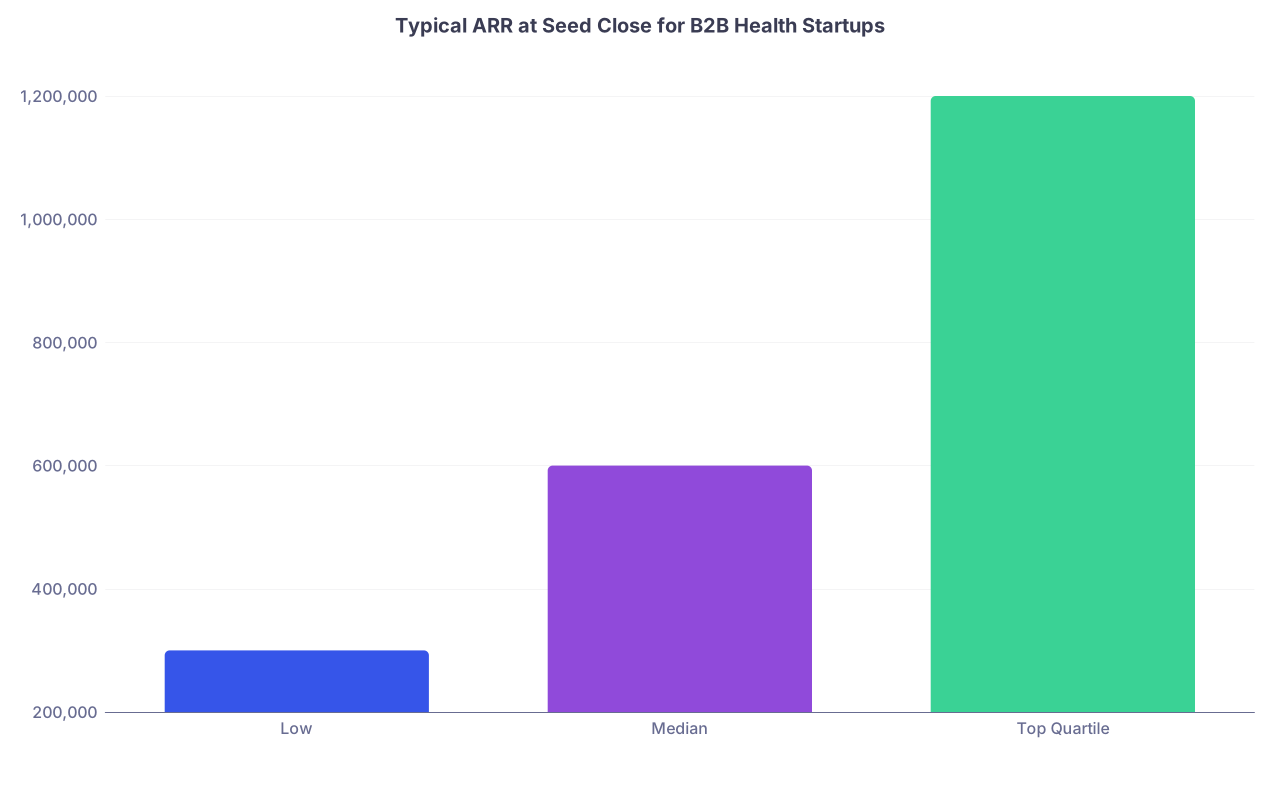
| Category | Value |
|---|---|
| Low | 300000 |
| Median | 600000 |
| Top Quartile | 1200000 |
3.3 Series A: The “$1–3M ARR with Repeatable Sales” Bar
Series A is where the bar jumps and investors get picky.
For B2B/B2B2C health, credible Series A rounds are usually at:
- $1M–$3M ARR, with:
- 100%+ year‑over‑year growth,
- 80%+ gross margin for pure software, or
- 50–70% for tech‑enabled workflows / services.
Patterns that increase your odds:
- Multiple 6‑figure ACV contracts (e.g., $200–$500K each) with major systems or payers.
- A sales cycle you can quantify: “From first meeting to signed contract: median 5.3 months.”
- Conversion rates in your funnel: demo → proposal → contract.
Investors want proof this is not founder‑hero selling anymore. They want:
- 2+ full‑time sales reps or AEs with quota
- Closed‑won deals not directly driven by the CEO’s personal network
- Early signs of upsell: net revenue retention >110%
3.4 Series B: Scaling With Predictable Unit Economics
Series B in healthcare is where many teams hit the wall. Sales cycles, integrations, and procurement drag kill scaling speed.
The Series B bar tends to be:
- $3M–$10M ARR, 70–100% YoY growth, and:
- Sales efficiency: $1 of new ARR for each $1–$1.5 in sales and marketing spend over a period.
- Mature retention: Gross revenue retention 90%+; NRR 120%+ is gold.
B2B health investors will also track:
- Pipeline coverage: 3–4x pipeline vs next 12 months’ new ARR target.
- Segment concentration: “50% of ARR from the top 5 customers” is risky. Under 30% is safer.
4. B2C Health: ARR Milestones With CAC and Retention Attached
Direct‑to‑consumer health is a different beast. You may not call it ARR (subscriptions mixed with one‑off consults), but investors will normalize your revenue to a recurring equivalent.
Think: digital therapeutics, coaching apps, men’s/women’s health clinics, mental health platforms.
4.1 Pre‑Seed and Seed: Proving That Units Work, Not Just Topline
For consumer health, ARR benchmarks at seed are often higher than B2B, but expectations on retention and CAC are stricter.
You commonly see:
- Seed rounds at $500K–$2M ARR with:
- Clear CAC (customer acquisition cost) data: e.g., $45 CAC via paid channels.
- LTV (lifetime value) / CAC ratio at least 3:1 on a cohort basis.
- 3–6 month retention data for early cohorts.
Investors ask questions like:
- “What is day‑30, day‑90, day‑180 retention for your first 1,000 paying users?”
- “What % of users churn in the first billing cycle?”
- “What is ARPU (average revenue per user) per month and per year?”
If you have $1M ARR but 70% of users churn inside 3 months, that revenue is low quality and heavily discounted in investor minds.
4.2 Series A: $3–5M+ ARR and Paid Growth That Scales
Top‑tier investors in direct‑to‑consumer health expect:
- $3–5M+ ARR at Series A for strong deals,
- 100%+ year‑over‑year growth,
- Reasonable paid acquisition: CAC that is not inflating quarter by quarter.
Strong Series A B2C health profiles:
- Paid CAC <$150 for a customer with $400+ 12‑month LTV.
- Month‑6 retention of 50%+ for subscriptions.
- Blended margin 60–80% depending on service intensity.
The bar is not only “revenue scale” but “revenue quality under performance marketing pressure.”
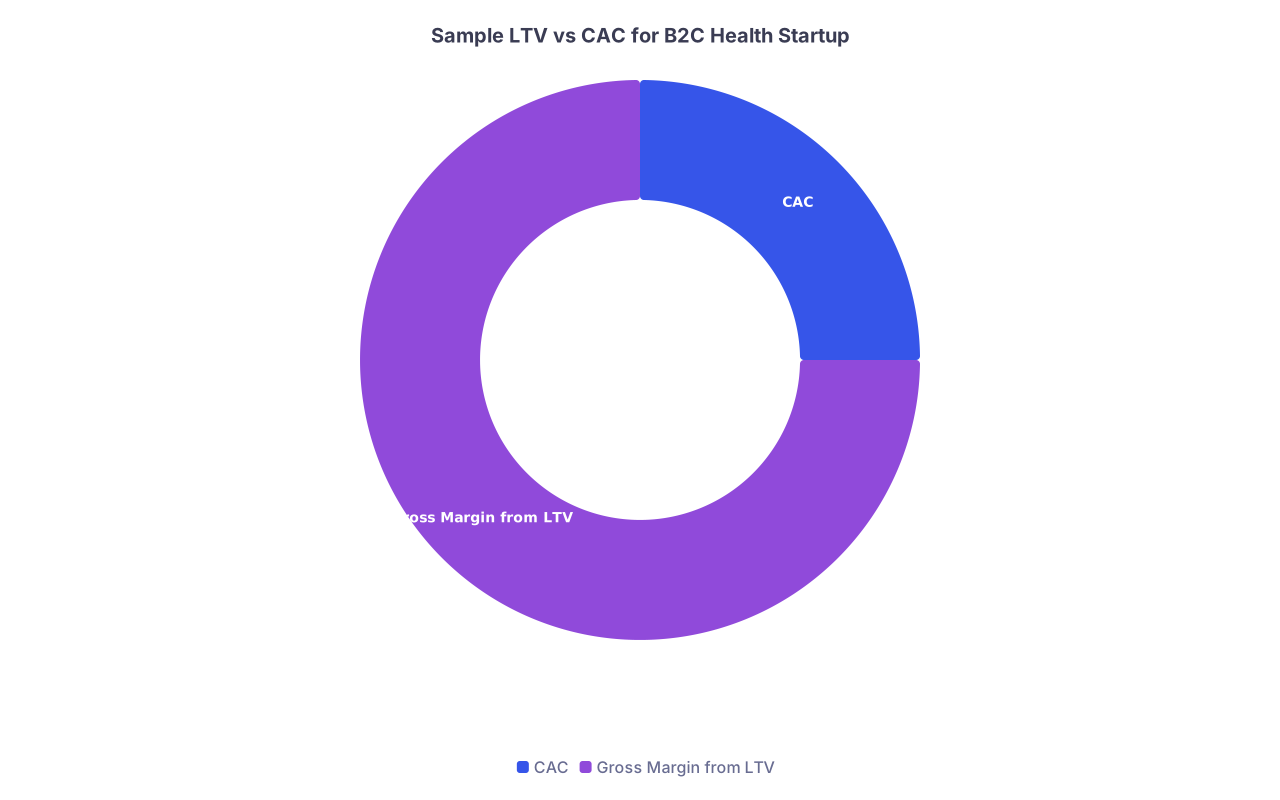
| Category | Value |
|---|---|
| CAC | 100 |
| Gross Margin from LTV | 300 |
If your Series A story is:
- $4M ARR,
- 120% YoY growth,
- LTV/CAC 3–4x,
you will get multiple term sheets. If you are at $2M ARR but have LTV/CAC of 1.3x and retention curves collapsing after 3 months, you are in trouble.
5. Tech‑Enabled Clinical Services: Blended Revenue Benchmarks
Post‑residency founders often start clinical‑heavy businesses: virtual specialty clinics, chronic care programs, remote diagnostics. These are not pure SaaS. Gross margins are lower, but revenue ramps faster because you are selling visits and programs, not just licenses.
Investors here think in terms of:
- Revenue run‑rate (can be ARR‑like if membership or episodic care with repeatability),
- Gross margin bands (40–70%, not 80–90% SaaS),
- Clinic economics: contribution margin per patient, provider utilization.
5.1 Seed Benchmarks: “Can You Get to $1M+ Run‑Rate Fast?”
Tech‑enabled clinical services that raise strong seed rounds often show:
- $500K–$2M annualized revenue run‑rate (even if technically not pure ARR),
- Clear path to repeat usage or membership (e.g., weight management, fertility, cardiometabolic),
- Cohort‑level margins trending upward as ops scale.
The implicit question: “If we pour $X into marketing and provider hiring, does this scale linearly or sublinearly?”
5.2 Series A and Beyond: Balancing Growth vs Margin
Series A investors in these models typically want:
- $3–$10M annualized revenue, 80–150% YoY growth,
- Steadily improving unit economics:
- Gross margin moving from 35–45% toward 50–60%+,
- Contribution margin positive on a per‑cohort basis.
Your “ARR milestone” story is less about some clean, contractually guaranteed subscription number and more about:
- Predictable per‑patient revenue over 6–12 months,
- High repeat visit rates,
- Payor or employer contracts that stabilize volume.
6. Trajectory Matters More Than the Snapshot
Investors almost never look at ARR as a point estimate. They look at the curve.
What matters:
- How steep was the growth in the last 6–12 months?
- Did growth accelerate or decelerate?
- Did you maintain or improve margins as you grew?
If your ARR moved like this in the last year:
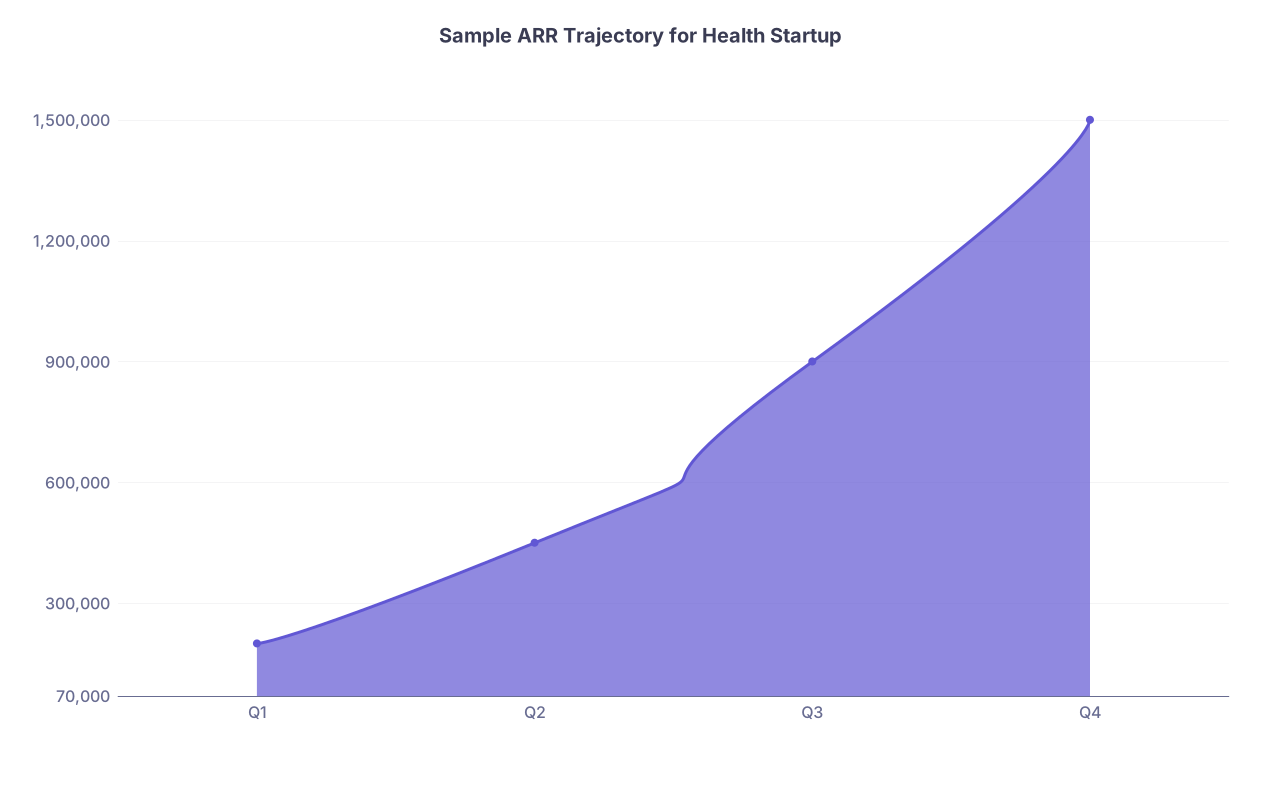
| Category | Value |
|---|---|
| Q1 | 200000 |
| Q2 | 450000 |
| Q3 | 900000 |
| Q4 | 1500000 |
An investor immediately sees:
- 125% QoQ growth from Q1 to Q2,
- 100% from Q2 to Q3,
- 67% from Q3 to Q4.
Yes, growth is slowing in relative terms, but the absolute dollar ARR added each quarter is increasing ($250K, $450K, $600K). That is a healthy signal.
Compare with a startup that goes from:
- $800K → $1M → $1.15M → $1.25M ARR over the same period.
Mathematically:
- Q1–Q2: +$200K
- Q2–Q3: +$150K
- Q3–Q4: +$100K
That is a decelerating business. Even though the final ARR is similar (~$1.25M vs $1.5M), the first curve is far more fundable.
Investors mentally pair the absolute $ ARR added per period with the percentage growth. That is where you either look like a rocket ship or a stalled engine.
7. Health‑Specific Nuances: Why Your $1M May Be Worth More (or Less)
Not all ARR is valued equally. In health, the variance is huge. A quick breakdown.
7.1 Payer vs Provider vs Employer Revenue
Revenue from:
- National payers or multi‑state health systems tends to be valued more per dollar than:
- Small clinics or one‑off pilots with no renewal history.
A $1M ARR profile with:
- 3 national payer contracts and 10 large IDNs is simply more defensible and scalable than:
- 200 small independent clinics with tiny ACVs and high admin overhead.
7.2 Reimbursement Risk
If your revenue depends heavily on:
- A single CPT/HCPCS code,
- A fragile temporary reimbursement policy,
- Or a narrow regulatory carve‑out,
investors will haircut your ARR. With reason. They have seen too many stories where one CMS memo cut revenue in half overnight.
On the other hand, multi‑payer coverage, long‑term value‑based care contracts, or direct employer spend are viewed as more stable bases for ARR.
7.3 Implementation and Integration Drag
A $300K ACV enterprise contract sounds impressive until you admit:
- The implementation took 12 months,
- The client is only using 20% of the product,
- Expansion probability is low.
Investors will weigh time‑to‑value and implementation complexity when they assess the real quality of your ARR.
The data pattern I have seen:
- Startups with 3–6 month time‑to‑value tend to grow 1.5–2x faster than those with 9–12+ month implementations, even at similar ACVs.
8. Mapping ARR Milestones to Your Capital Plan
Here is the cold, financial reality: your burn and your ARR milestones must line up. If they do not, you die or you accept bad terms.
A simplified, realistic progression for a post‑residency founder in health tech:
| Year | Target ARR at Year End | Likely Round | Capital Needed |
|---|---|---|---|
| 0–1 | $0–$100K | Pre-Seed | $500K–$1M |
| 1–2 | $300K–$800K | Seed | $2M–$4M |
| 2–3 | $1.5M–$3M | Series A | $6M–$15M |
| 3–4 | $4M–$8M | Series B | $15M–$30M |
You adjust this by model:
- B2B with high ACV may tolerate slightly lower ARR at each round.
- B2C may require higher ARR at the same round but with cleaner unit economics.
- Tech‑enabled clinics raise on revenue run‑rate and margins, not SaaS‑pure ARR.
But the structure holds: each funding event must credibly take you to the next ARR milestone in 18–24 months, with at least 9–12 months of cash buffer when you start the next raise.
This is where many founders from clinical backgrounds miscalculate. They think in “coverage” and “patient panels,” not in “runway to the next ARR bar.”
9. A Simple Framework: Are You Ready for the Next Round?
Strip away the noise. A pragmatic readiness checklist, based purely on the revenue lens:

| Step | Description |
|---|---|
| Step 1 | Current ARR |
| Step 2 | Focus on pilots and logo wins |
| Step 3 | Show 2-3x YoY growth |
| Step 4 | Prove repeatable sales engine |
| Step 5 | Scale with strong unit economics |
| Step 6 | Reassess burn and growth |
| Step 7 | Pre-Seed <100K? |
| Step 8 | Seed 100K-1M? |
| Step 9 | Series A 1-3M? |
| Step 10 | Series B 3-10M? |
The quantitative gates roughly align with:
- Pre‑Seed → Seed: crossing $100K–$300K ARR and evidence of repeatability.
- Seed → Series A: crossing $1M+ ARR with 2–3x YoY growth.
- Series A → Series B: crossing $3M+ ARR with 70–100% YoY growth and sane unit economics.
Overlay one more layer: time.
If:
- You are 24 months post‑seed and still under $500K ARR,
- Or 24 months post‑Series A and still under $2M ARR,
investors will not just ask “why.” They will quietly downgrade the trajectory of your company.
10. How to Talk About ARR to Investors (Without Sounding Naive)
The numbers matter. The narrative around those numbers matters almost as much. You want to sound like someone who lives inside the metrics, not someone who pulled ARR from their accountant yesterday.
Three practical rules:
- Always show a time series, not a single ARR number. Monthly or quarterly, with clear labels. 12–24 months back if available.
- Separate booked vs implemented vs live revenue clearly.
- Tie ARR explicitly to your GTM engine:
- “X% inbound from content or clinical channels.”
- “Y% outbound from sales reps.”
- “Z% expansion from existing accounts.”
When you walk an investor through your metrics, the subtext they are testing is simple:
- Does this founder understand what drives their own revenue?
- Do they have a credible, data‑driven plan to hit the next ARR milestone?
If the answer is yes, your post‑residency background becomes a strong asset: you know the domain cold, and you can now prove you know the business math too.
If the answer is no, your MD is just a credential. Not a reason to invest.
You are not building “an app for doctors.” You are building a revenue engine operating in one of the slowest, most regulated sectors on earth. Investors fund engines, not ideas.
Now that you know the ARR milestones they quietly use to judge you, your next move is straightforward: design your next 12–24 months around hitting one of those revenue benchmarks, not around accumulating vague “traction.” Once you can show the right curve on the chart, the conversation shifts. That is when investor capital stops feeling theoretical and starts becoming a term sheet. The mechanics of that fundraise — timing, process, and negotiation — are the next part of the journey.