
The biggest threat to your medical startup is not your competitor. It’s your compliance blind spots.
You spent a decade mastering medicine, not regulatory law. But regulators, payors, and plaintiff attorneys will not care. They’ll treat you like any other company that “should have known better.” And doctor-founders routinely walk straight into malpractice and enforcement traps that were completely avoidable.
Let me walk you through the mistakes I see again and again—and how to not be the next cautionary tale.
1. Thinking “I’m a Good Doctor, So I’m Safe”
This is the first and most dangerous lie doctor founders tell themselves.
You assume that because you practice evidence-based medicine, explain risks, and care about patients, your startup must be “low risk.” That is not how the law works.
Your clinical judgment and your company’s legal exposure are two different universes.
Common versions of this mistake:
- “We’re just providing education, not medical care.”
- “We don’t bill insurance, so HIPAA doesn’t really apply.”
- “It’s an app, not a clinic. So malpractice isn’t the same.”
- “We’re just helping patients find doctors, not treating them.”
Every one of those statements has been uttered—confidently—by founders who later ended up:
- Answering to a state medical board
- Responding to an OCR (Office for Civil Rights) investigation
- Burning six figures on retroactive legal cleanup
If your product influences diagnosis, treatment, triage, or patient decisions, you are in a zone of liability, whether you call yourself a “platform,” “tool,” “navigator,” or “community.”
The mindset you need instead:
- Assume someone will get harmed using your product at scale.
- Assume lawyers will read your marketing and UI more literally than you intended.
- Assume regulators will treat you like a care provider if you even smell like one.
If that makes you slightly uncomfortable, good. That discomfort is what keeps you out of the malpractice trap.
2. Sloppy Telemedicine = License and Malpractice Nightmare
Telehealth is where a lot of doctor-founders quietly blow themselves up.
They see big names doing 50-state telehealth and think, “We’ll just expand later; for now ‘we see patients nationwide’ is fine.” That sentence alone can trigger problems.
Common telemedicine mistakes:
- Treating patients in states where you are not licensed, but still documenting care under your NPI
- Using your personal DEA registration for a “startup side gig” prescribing across state lines
- Letting out-of-state patients book visits through your platform with no state-based filtering
- Assuming “asynchronous care” or “text-based advice” is not the practice of medicine
Here’s the harsh reality:
State medical boards are not impressed by your startup story. They care about:
- Are you licensed where the patient is located at the time of care?
- Are you prescribing controlled substances legally under the Ryan Haight Act and related state laws?
- Are you practicing within telemedicine rules for that state (audio-only vs. video, in-person exam requirements, follow-up, etc.)?

| Step | Description |
|---|---|
| Step 1 | Patient requests visit |
| Step 2 | State where you hold license |
| Step 3 | State where you are not licensed |
| Step 4 | High legal risk |
| Step 5 | Document and proceed |
| Step 6 | Block or refer |
| Step 7 | Where is patient located |
| Step 8 | Telehealth rules ok |
If your platform allows:
- Patients from any state to schedule with you
- Automated routing ignoring licensure
- Marketing like “24/7 doctors nationwide” when that’s not legally supported
You’re inviting board complaints and malpractice claims, even if your clinical care is excellent.
Fix this before you grow:
- Lock your scheduling and prescribing by state of patient location
- Have a clear telehealth policy per state you operate in
- Stop using your individual licenses as a patch for a poorly architected business model
Do not expand coverage faster than your legal structure can handle.
3. Underestimating HIPAA, PHI, and “But We Don’t Bill Insurance”
The second sentence I hear right after “we’re just providing education” is this:
“We’re not a covered entity because we don’t bill insurance, so HIPAA doesn’t really apply.”
Sometimes that’s technically true. Often it’s dangerously wrong or oversimplified.
Here’s the trap:
Even when HIPAA does not strictly apply, plaintiffs’ attorneys and regulators still expect HIPAA-level behavior around privacy and security. And you can still get hammered under:
- State privacy laws (California, Colorado, etc.)
- FTC enforcement (for deceptive promises about privacy)
- Breach notification laws
And if you are a covered entity or a business associate and you don’t have BAAs, or your security is a mess, you’ve just opened another flank.
The classic doctor-founder mistakes:
- Using consumer-grade tools (Gmail, Dropbox, generic cloud drives) for PHI
- Never signing Business Associate Agreements with vendors handling PHI
- Sharing screenshots of patient conversations in Slack, email, or pitch decks
- Letting product and marketing teams access identifiable data “for testing”
- Storing PHI in logs, analytics platforms, or customer support tools with no protections
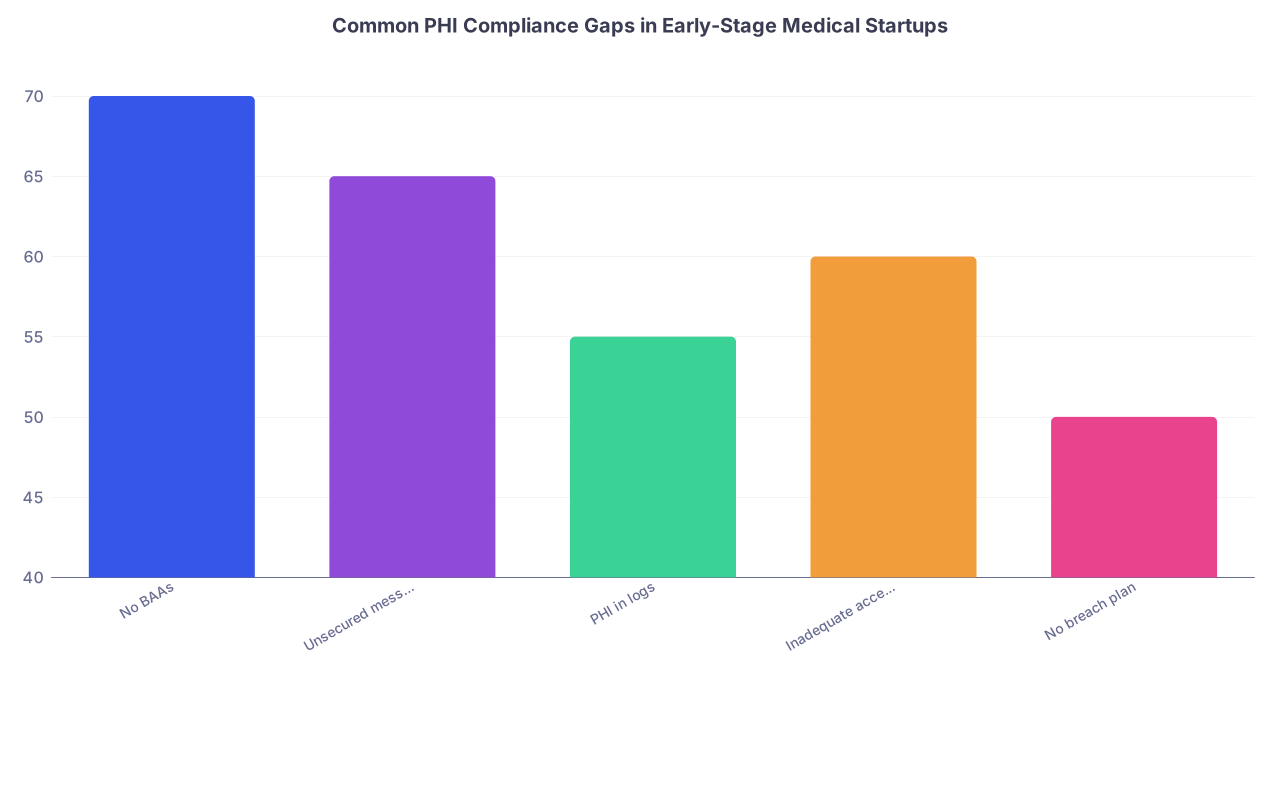
| Category | Value |
|---|---|
| No BAAs | 70 |
| Unsecured messaging | 65 |
| PHI in logs | 55 |
| Inadequate access control | 60 |
| No breach plan | 50 |
You need to treat PHI like a loaded gun:
- Only access when necessary
- Log every use
- Lock it away by default
If you’re building post-residency and cash is tight, the temptation is to “just use what’s easy” and clean it up later. That’s how people end up investigating data breaches in the middle of their Series A.
Non-negotiables:
- Identify whether you are a covered entity, business associate, or neither—but don’t stop there.
- Put access controls and audit logs in place early (engineering hates doing this retroactively).
- Sign BAAs or don’t use the vendor. There’s no halfway.
Also stop promising “military-grade encryption” on your website unless you can actually defend that sentence in front of an investigator.
4. “It’s Just Education” – When Content Becomes Medical Advice
A huge malpractice trap hides in your content and UX.
You call your product “educational” so you can feel better about not having a big physician panel. But you let the app:
- Generate personalized “care plans” based on symptoms
- Flag specific diseases with language like “You most likely have…”
- Suggest medication categories or dosage ranges
- Tell patients to skip seeing a doctor and “monitor at home”
That’s not neutral education. That’s care direction. Courts and regulators will treat it that way.
Typical places founders cross the line without realizing it:
- Symptom checkers that give disease labels, not risk ranges
- Chatbots that answer “Should I go to the ER?” with definitive yes/no answers
- Automated follow-up messages telling patients to adjust medications
- Community platforms where your company “moderators” give specific advice

Fix this before your product goes live at scale:
- Avoid disease labels; use risk language (“low/moderate/high risk of X, discuss with a clinician”)
- Avoid direct treatment recommendations unless under a licensed clinician relationship
- Build hard stops directing people to emergency care when red-flag symptoms appear
- Log every patient-facing recommendation from automated tools
And for the love of your future self, stop hiding behind a lazy “this is not medical advice” disclaimer in tiny font at the bottom of the screen. Courts look at what a reasonable user would think, not just your legal incantation.
5. Corporate Structure: Piercing Your Own Veil
Another quiet way doctor-founders blow their protection: mixing personal clinical work with startup care in a sloppy mess.
Here’s how the mistake plays out:
- You use your personal professional corporation (PC) or solo practice NPI to deliver care on behalf of the startup
- You document care in the startup’s system, but bill under your individual tax ID
- Your startup markets the service, but the legal entity providing care is…no one can explain it clearly
Result? When something goes wrong, the plaintiff’s lawyer has a field day arguing:
- You, personally, were the treating physician
- The startup was effectively practicing medicine without a proper structure
- The veil between you and the company is thin enough to pierce
You’ve combined clinical malpractice exposure with corporate liability. Congratulations, you’ve built a bomb.
In physician-founded startups, especially in states with corporate practice of medicine laws, you have to be crisp about:
- Which entity employs the clinicians
- Which entity owns the medical records
- How money flows between the “management company” and the professional entity
- Where your personal role stops and the company role begins
| Area | Clinical Role (Doctor) | Founder/Exec Role (Startup) |
|---|---|---|
| Medical decisions | Patient-specific, documented | Set protocols, not case decisions |
| Documentation system | EMR as clinician user | Approve vendor, policies |
| Billing | Under proper clinical entity | Oversee strategy, not coding |
| Liability | Malpractice insurer | Corporate/GL, cyber, D&O |
| Communications | Chart & secure messaging | Investor updates, ops channels |
If your Google Calendar, Stripe account, malpractice policy, and startup bank account are all tangled together, you’re doing it wrong.
Fix it now, while it’s small:
- Separate personal practice from startup care entity
- Get proper malpractice coverage that aligns with how care is being delivered
- Stop experimenting on live patients through an entity that doesn’t actually “exist” as a medical provider
6. Letting Business People Practice Medicine
You’ve seen this. A non-clinical cofounder starts deciding:
- Which meds the protocol will recommend
- How long visits “should” be
- When clinicians can override the algorithm
- That scripts should be renewed automatically to keep churn down
That’s the corporate practice of medicine problem, and it’s not theoretical. States like California, Texas, New York, and others take this seriously.
Risky behaviors include:
- Compensation structures that pay clinicians per prescription or per refill
- Giving product managers the final say on care protocols
- Allowing sales/marketing to dictate clinical eligibility to hit growth targets
- Letting customer support staff give “off-the-record” medical advice to appease users
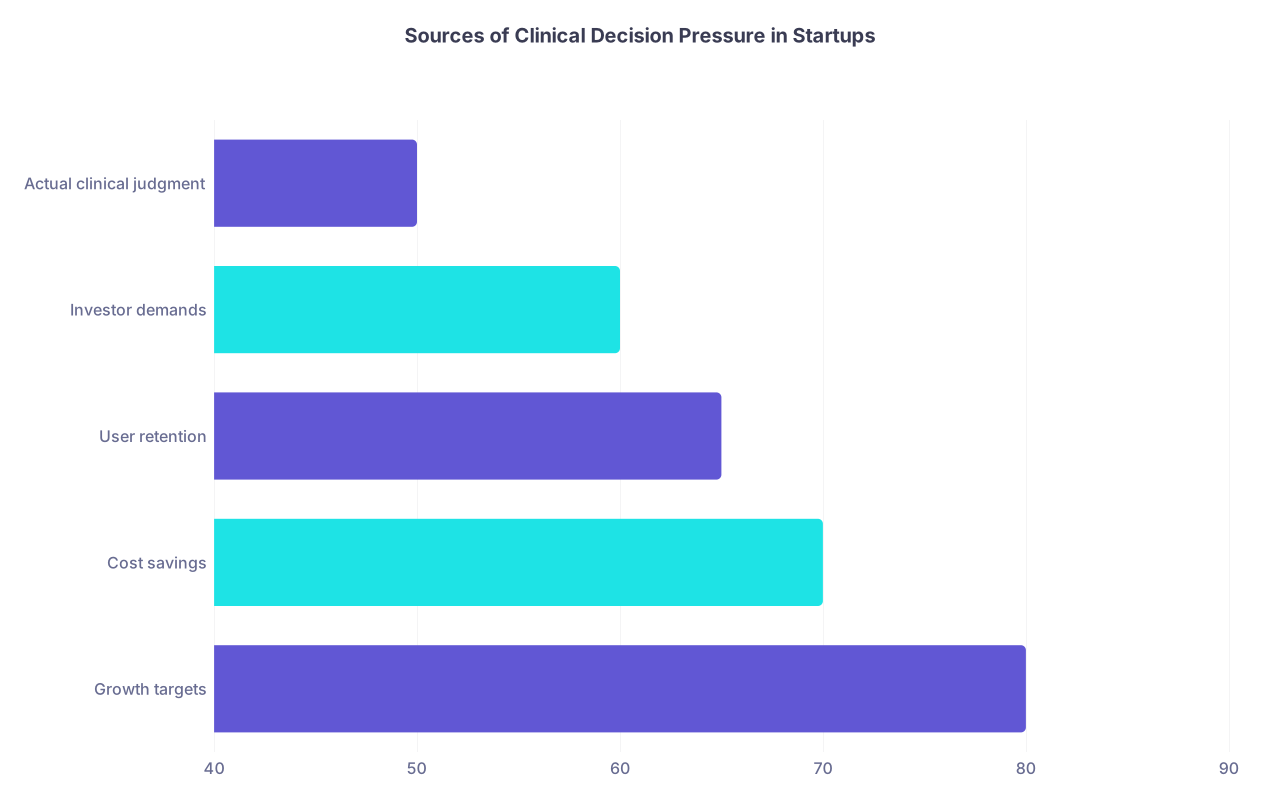
| Category | Value |
|---|---|
| Growth targets | 80 |
| Cost savings | 70 |
| User retention | 65 |
| Investor demands | 60 |
| Actual clinical judgment | 50 |
You think, “We’ll clean this up when we hire a CMO.” But by then, the patterns are established and your documentation will show non-clinicians effectively practicing medicine.
You need:
- A clearly defined clinical governance structure
- Documented clinical protocols owned and signed by licensed physicians
- A bright line: product and business teams can suggest, clinicians approve or reject
If a Slack thread shows your head of growth telling a doctor, “We can’t add that safety step, it’ll reduce conversions,” you’ve got a problem waiting to surface in discovery.
7. Ignoring Malpractice Tail Risk While You “Experiment”
Post-residency founders often treat their startup like a side hustle. They keep their old malpractice coverage and assume it covers whatever they’re doing as long as they’re “being careful.”
It usually does not.
Common mistakes:
- Assuming your hospital or group policy covers your startup work (it doesn’t)
- Practicing under an entity that has no malpractice policy at all
- Letting your individual policy lapse while old patients are still within the statute of limitations
- Making rapid changes to care models (visit length, modality, supervision) without updating underwriting

Malpractice carriers care a lot about:
- Practice setting (hospital vs telemedicine vs urgent care vs concierge)
- Patient volume
- Supervision structure (for NPs, PAs, residents if involved)
- Scope of practice (high-risk specialties, procedures, controlled substances)
If your actual risk profile looks nothing like what you told the insurer on the application, you’ve just given them ammo to deny coverage when you need it most.
Don’t make these two specific errors:
- Launching a telehealth or digital-first service under a policy written for traditional clinic work without telling your carrier.
- Shutting down or pivoting the startup without securing tail coverage for the period when you were seeing patients.
Get on the phone with your carrier and be uncomfortably honest about what you’re building. If they don’t understand it, find one that does.
8. Bad Documentation and Audit Trails in a Digital World
You’re a founder. You push your team to move fast. Documentation becomes an afterthought.
That’s how you die in both malpractice and regulatory investigations.
Digital care creates records in:
- Product databases
- Chat logs (in-app, SMS, WhatsApp, email)
- Call recordings
- Third-party platforms (Zendesk, Intercom, etc.)
- EHR/EMR systems
- Analytics tools
When something goes wrong, lawyers and regulators will mine all of that. And they will find inconsistencies if you weren’t intentional.
Common documentation pitfalls:
- Clinical advice happening in “non-medical” channels without being charted
- Different patients getting different advice from the same script or bot
- No documentation of informed consent for telehealth, data use, or experimental features
- Product changes that affect clinical decisions but have no version tracking tied to patient records
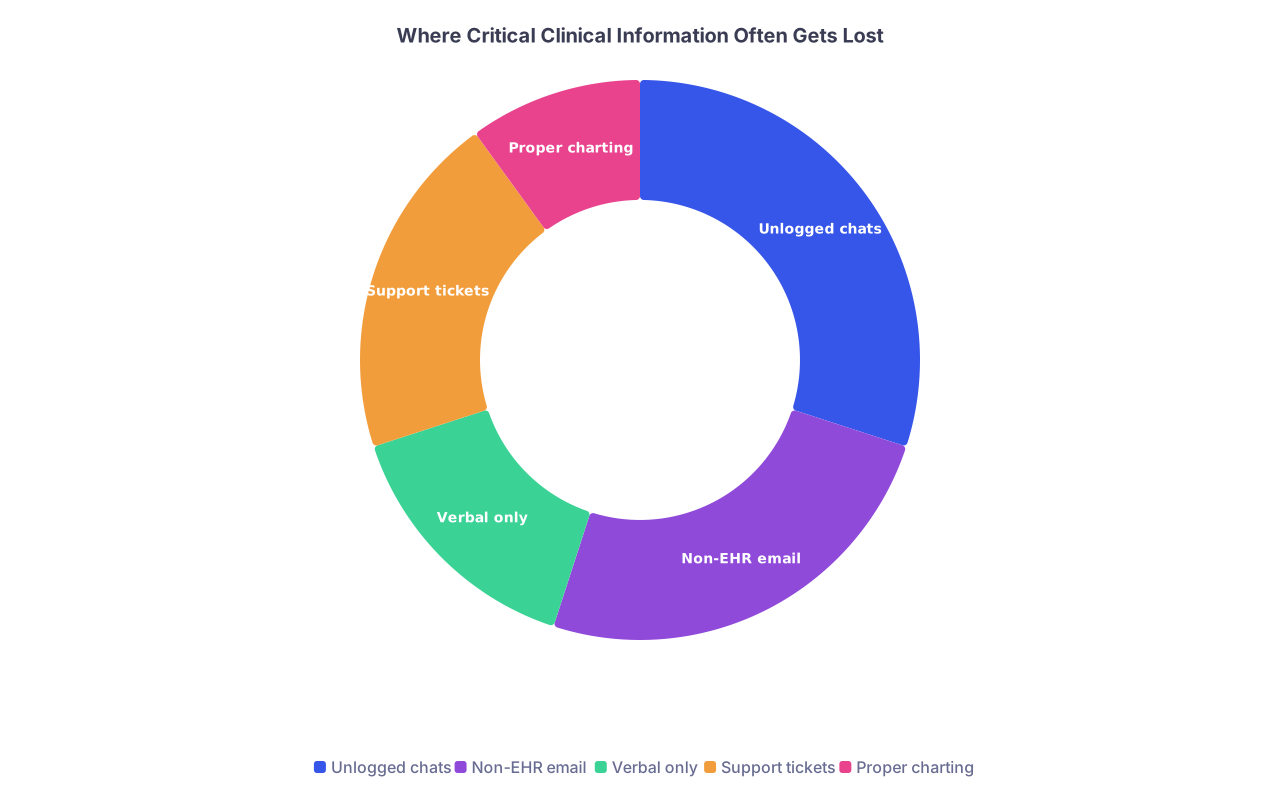
| Category | Value |
|---|---|
| Unlogged chats | 30 |
| Non-EHR email | 25 |
| Verbal only | 15 |
| Support tickets | 20 |
| Proper charting | 10 |
Fix it while you’re still small enough to change habits:
- Decide which communication channels are clinical and must be documented
- Push everything clinical into systems that can be audited and exported
- Tie product versions to date ranges so you can know what patients saw when
- Train everyone: “If it affects clinical care, it lives in the chart. Full stop.”
You will not be able to reconstruct missing documentation when you’re under subpoena. Do not rely on memory. Or worse, hope.
9. Moving Fast and Breaking… Laws
Startup culture glorifies “move fast and break things.” That’s charming for a photo-sharing app. In healthcare it’s an engraved invitation to a consent decree.
I’ve literally heard founders say:
- “We’ll do compliance later, after product-market fit.”
- “We just need to get something live to test the funnel.”
- “Let’s run it under my license for now and we’ll fix it post-Seed.”
That’s how you end up with:
- Thousands of patients treated under an unscalable, non-compliant model
- A cap table and investor base tied to a company now doing a compliance pivot
- Founders spending fundraising conversations explaining past regulatory exposures instead of future upside

| Step | Description |
|---|---|
| Step 1 | Launch MVP fast |
| Step 2 | Short term growth |
| Step 3 | Regulatory or malpractice event |
| Step 4 | Costly cleanup and rework |
| Step 5 | Slower launch |
| Step 6 | Stronger foundation |
| Step 7 | Sustainable scale |
| Step 8 | Compliance light |
Your competitive edge as a doctor-founder is supposed to be discipline about safety and ethics, not that you’re willing to cut more corners than the non-clinical bros.
Prioritize:
- Getting core compliance threads at least minimally right from day 1: licensing limits, PHI handling, malpractice coverage, corporate structure
- Explicitly budgeting time and money for legal review before scaling
You are not “too early” for compliance once a real patient is involved.
FAQ – 5 Questions Doctor Founders Actually Ask
1. Do I really need a separate legal entity to see patients through my startup?
Yes. Mixing your personal practice and the startup in a single, informal blob is a direct path to both personal and corporate exposure. You want a clear structure where a properly formed professional entity (PC/PLLC, depending on state) provides care, and a separate management or tech entity handles the business side. Anything else becomes very hard to defend when something goes wrong.
2. If I’m only offering second opinions or coaching, is that still practicing medicine?
It might be. If you’re interpreting clinical data, modifying treatment plans, advising on specific medications, or making recommendations that affect diagnosis or management, boards and courts can absolutely see that as practicing medicine. Calling it “coaching” doesn’t save you. If you influence clinical decisions, treat it like medicine from a risk standpoint.
3. Can I start with generic tools like Gmail and regular Zoom, then switch to HIPAA-compliant tools later?
That’s a classic and dangerous shortcut. If you’re handling PHI, you need vendors who will sign Business Associate Agreements and provide the right protections from the start. “We were just early” is not a defense when you have a breach or complaint. Clean migrations are also harder and riskier than doing it right at the beginning.
4. My hospital malpractice policy covers telehealth—so am I fine for my startup work?
Almost certainly not. Hospital or group policies are written for care you provide as part of that organization, under their protocols and systems. Startup work usually falls outside that scope, especially if it uses different platforms, billing, or practice models. You need explicit confirmation from the carrier or a separate policy that matches what you’re actually doing.
5. Are disclaimers like “this is not medical advice” enough to protect me if something goes wrong?
No. Courts and regulators look at the actual function and impact of your product, not just the labels and fine print. If a reasonable user would think they’re receiving medical guidance—and your product actually shapes their clinical decisions—the disclaimer won’t magically erase your duty of care. Disclaimers are a supplement to good design and compliance, not a shield for bad behavior.
Here’s what you should walk away with:
- Being a good clinician does not protect you from regulatory and malpractice exposure if your business model and product are sloppy.
- The biggest traps—telemedicine, PHI handling, “just education,” corporate structure, and documentation—are predictable and fixable if you respect them early.
- Your job as a doctor-founder is not just to innovate; it’s to ensure that when you scale care, you don’t also scale your liability into something that can end your career.