
You are post‑residency, sitting in a WeWork‑style office, wearing the same fleece you used on night float. Your seed round is soft‑circled. A mid‑size strategic investor just asked a “simple” question on the diligence call:
“Can you walk us through your HIPAA posture and how you manage data sharing with partners?”
Your stomach drops. Because you know the answer is basically, “We have a BAA template and a security policy in Google Docs.”
This is exactly the moment when otherwise promising medical startups lose investor confidence. Not because you lack vision. Because you look reckless with patient data.
Let me walk you through the mistakes that quietly kill deals, trigger walk‑aways in partner negotiations, and permanently brand your company as “the HIPAA risk” in an investor’s mental spreadsheet.
1. Treating HIPAA as Paperwork Instead of a Risk Model
Most clinicians turned founders make the same early mistake: viewing HIPAA as a formality, not as a risk architecture.
You know how attendings talk about “anchors” in differential diagnosis? This is the anchor investors use:
“If they are sloppy with PHI, they will be sloppy with everything.”
Red flag behaviors investors notice
- “We’ll figure out HIPAA after product–market fit.”
- “We’re a wellness product, so HIPAA does not apply” (without a real analysis).
- “Our EHR partner signed a BAA, so we are covered.”
- “We de‑identify everything” (but no one can explain how).
When an investor hears this, what they really hear is: no one here owns compliance; no one understands data risk.
The mistake that destroys confidence
You skip a structured analysis of:
- Are we a covered entity, business associate, or neither?
- Where does PHI actually flow in our system?
- Who touches it? Which vendors see it? Where is it logged?
- What is the minimum necessary data we truly need?
Instead, you copy your friend’s BAA, throw “HIPAA Compliant” on your pitch deck, and hope.
A serious investor will ask for:
- Role‑based access controls description.
- Data flow diagrams.
- Security risk assessment (even a basic one).
- Names of your cloud vendors and whether they sign BAAs.
If you cannot answer in detail, with diagrams or documents, you are flagged as dangerous. Even if they like you.
Do not make this mistake: treat HIPAA like a risk model first, paperwork second.
2. Confusing “De‑Identification” With “We Are Not Under HIPAA”
This one is lethal. And sadly, very common.
You tell investors:
“We only use de‑identified data, so we are outside HIPAA.”
Then, under even light questioning, it turns out:
- You keep dates of service.
- You store zip codes.
- You have patient IDs that can be mapped back by a partner.
- You combine multiple datasets from different sources.
That is not de‑identification. That is you misunderstanding the law.
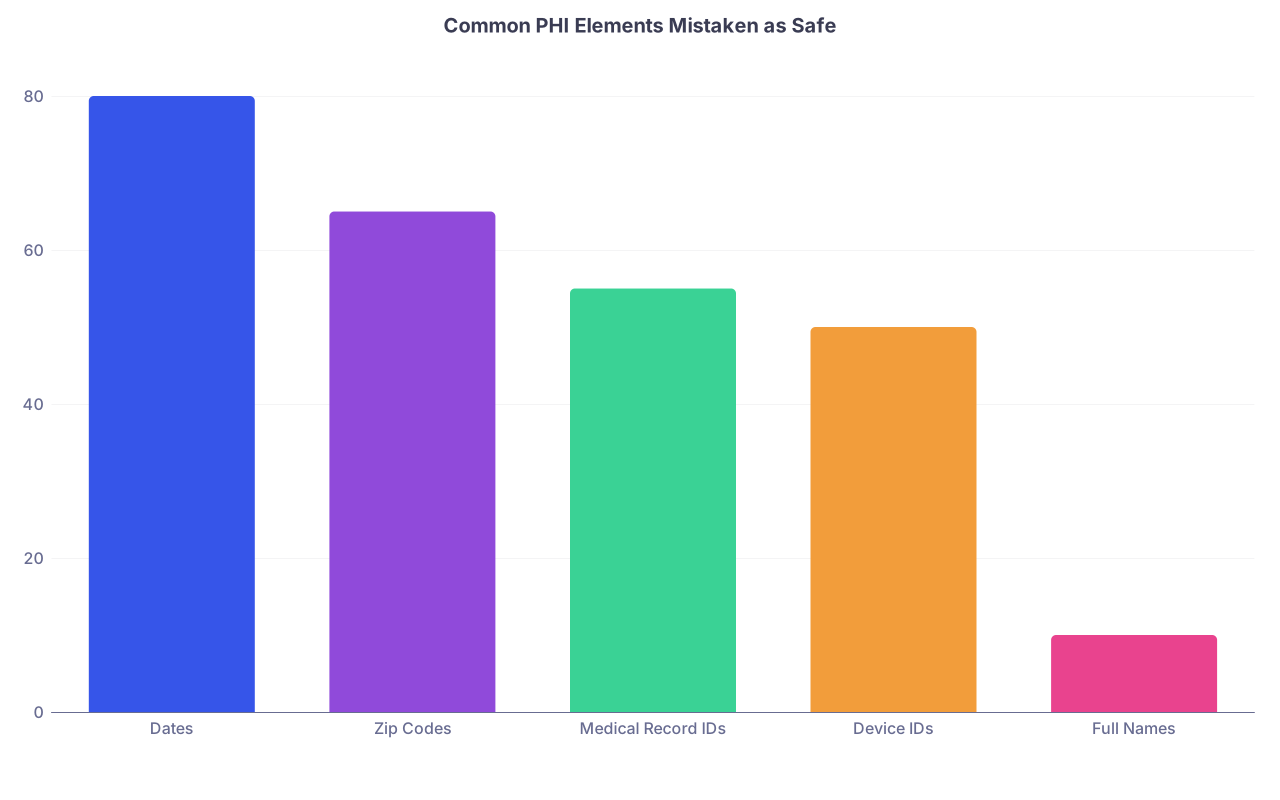
| Category | Value |
|---|---|
| Dates | 80 |
| Zip Codes | 65 |
| Medical Record IDs | 55 |
| Device IDs | 50 |
| Full Names | 10 |
The two big errors here
Thinking “removing names” = de‑identified.
HIPAA has 18 identifiers. Dates, small geography, phone numbers, emails, device IDs, biometric identifiers, and more. If you are not following the Safe Harbor standard or using a qualified expert in de‑identification, investors know you are winging it.Not understanding what “reasonably re‑identifiable” means.
If a recipient (e.g., payer, big health system, analytics vendor) can, in practice, re‑identify the data by linking multiple datasets, your “de‑identification” is fiction.
How this kills confidence
I have seen this exact sequence in a diligence meeting:
- Founder: “We are de‑identified.”
- Investor: “Who does the de‑identification?”
- Founder: “Our lead engineer wrote a script.”
- Investor: silent, then: “So you do not use a de‑identification expert, and you have not validated re‑identification risk?”
- The meeting ends. The term sheet never shows up.
If you are going to say “de‑identified,” do not improvise. Either:
- Follow HIPAA Safe Harbor rigorously and document it, or
- Use an experienced de‑identification expert and be able to show their methodology.
Anything else looks amateur.
3. Signing Sloppy BAAs (or Not Knowing When You Need One)
Founders love to wave BAAs like magic talismans. Investors are not impressed.
Here is the actual investor test:
“Do they know when a BAA is required, and do their agreements reflect real risk allocation?”
| Mistake | Why It Scares Investors |
|---|---|
| No BAA with cloud provider | Signals basic misunderstanding |
| BAA with mis-labeled roles | Legal ambiguity, liability risk |
| One-way indemnity against you | You bear all breach consequences |
| Conflicting language in MSA | Shows legal sloppiness |
| Verbal-only assurances | No enforceable protection |
Common destructive errors
Using SaaS tools with PHI and no BAA.
Gmail, Notion, Slack, analytics tools, error tracking, logging platforms. If any of them handle PHI and they do not sign BAAs, you are non‑compliant. Investors will find this quickly.Letting the counterparty define your role incorrectly.
A hospital labels you as the “data controller” in one agreement and “business associate” in another, while your own materials claim you are just a subcontractor. That inconsistency can explode later when there is a breach and everyone points at you.Signing BAAs with absurd indemnity and breach terms.
I saw one startup sign a BAA where:- Any breach involving their system, even if caused by the hospital’s staff misusing credentials, was fully their liability.
- They had to notify the hospital within 24 hours, regardless of when they actually discovered the breach. That company survived, but investors demanded a complete contract cleanup before a Series A. Months lost.
Do not let your first BAA be drafted by the other side’s lawyer while you nod along.
You do not need a fancy firm. But you do need:
- A clear template where your role is accurate.
- Internal rules about which vendor types must sign BAAs.
- A matrix of: “If PHI touches this, BAA required. If not, no PHI allowed, ever.”
When you present this cleanly, investors exhale. When you wave random BAAs around, they back away.
4. Leaking PHI Through “Invisible” Channels
This is where tech‑savvy investors catch you in 10 minutes.
You talk big about encryption, SOC 2, and zero trust. Then they ask:
“Where do logs go? What analytics and error tracking systems do you use?”
If your answer is:
- “Segment, Google Analytics, Sentry, and a couple others,”
- and you have not scrubbed PHI from those streams or secured BAAs,
you just told them you are leaking PHI into vendors that were never meant to touch it.
Typical leak paths
- Logging:
- Error logs with full request bodies.
- Stack traces containing patient names, MRNs, or full URLs with query parameters that include identifiers.
- Analytics:
- Page titles or event names with patient IDs.
- Passing email or phone as a user ID into third‑party analytics.
- Support tools:
- Screenshots with visible patient information sent through ticketing systems without BAAs.
- Copy‑pasted PHI into email threads with non‑compliant mail providers.
Once an investor realizes your “clean” system is actually spraying PHI into non‑covered tools, they have to assume:
- You do not understand your data surface.
- A real audit would uncover many more issues.
I have watched an investor syndicate call end with this single sentence:
“Their logging system has unredacted PHI going to a non‑compliant vendor. We are out.”
You need a hard rule early on:
- No PHI in logs.
- No PHI in analytics.
- No PHI in screenshots.
- No PHI in support tickets.
If you must, strictly limit and document it, and ensure BAAs are in place.
5. Over‑Promising “HIPAA Compliance” in Pitch Materials
You want to look grown‑up. So you put this slide in your deck:
“HIPAA Compliant, GDPR Compliant, SOC 2 Coming Soon”
To someone who actually knows this territory, that line often screams: marketing wrote this.
Where you lose credibility
- You use “HIPAA certified” (there is no such thing under the law).
- You list compliance frameworks with no independent audit, no policies, and no controls.
- You claim GDPR compliance while mixing consent-based and HIPAA-based data use with no real legal architecture.
- You show a SOC 2 slide, but when an investor asks, “Type I or Type II? Who did the audit? Can we see the report?” you have nothing.
Sophisticated investors do not expect a pre‑Series A startup to be perfect. They do expect honesty.
They will forgive:
- “We are partially implemented.”
- “We use a lightweight security program right now.”
- “Here is our roadmap to a formal audit.”
They will not forgive pretending you have a compliance posture you clearly do not.
Be precise:
- “We operate under HIPAA as a business associate. We have signed BAAs with X, Y, Z. We completed an internal risk assessment in Q2 and plan to start SOC 2 Type I in Q4.”
- “We do not yet support EU users; GDPR is not in scope yet.”
That sounds far more credible than “fully compliant” nonsense.
6. Misusing Patient Data for Product and Fundraising
This is where good intentions ruin companies.
You built something that actually helps patients. You want to show traction. Real outcomes. Real charts.
Then you:
- Use screenshots of real patient charts in your investor deck.
- Share non‑de‑identified datasets with a friendly AI vendor for “experimentation.”
- Let your data science contractor take sample data home in a Google Drive folder.
- Spin up a test environment with a clone of production PHI, and no one locks it down.
You would be stunned how often I hear: “We just use it for internal analytics, so it is fine.”
Why investors run from this
Because this is exactly how investigations start. Especially for:
- Unclear patient consent.
- Use of PHI for purposes beyond treatment, payment, and operations.
- Training models with PHI when your contracts explicitly forbid it.
- Sharing PHI with third parties who are clearly not covered by any BAA.
A single wrongly sent dataset to a vendor without a BAA can trigger:
- Contract breaches with your hospital or payer partners.
- Mandatory breach notifications.
- Regulatory scrutiny.
Investors know that. They also know plaintiffs’ attorneys read press releases.
So when they hear casual language around “we used this PHI to train our algorithm” and “we shared anonymized data with a partner,” they hear:
“There is potential litigation and reputational landmine here.”
If you want to maintain confidence:
- Never use real PHI in demo decks or sales materials.
- Clearly separate production PHI from de‑identified / synthetic test data.
- Lock down how and when PHI can be used for analytics and ML, and reflect it in your policies and contracts.
7. Having No Owner for Privacy and Security
Ultimately, this is the underlying problem in 80% of HIPAA and data‑sharing failures.
You have:
- A smart founding team.
- Solid clinical insight.
- A solid product thesis.
But no one is the clear owner of:
- Security architecture.
- HIPAA compliance.
- Vendor vetting.
- Data minimization.
You “share” it. Which means no one owns it.
Investors notice:
- No one on the team can confidently walk through your data flows.
- No formal risk assessment has ever been done.
- Policies exist only as a Google Doc copied from somewhere else.
- On security questions, you keep saying, “We’ll handle that later.”
Contrast this with a startup that has its act together:
- The CTO (or a fractional CISO/privacy counsel) can explain:
- Where data enters.
- Where it is stored.
- Who accesses it.
- How it is logged and monitored.
- They have a simple matrix of which vendors can see PHI and why.
- They have a breach response plan, even if lightweight.

| Step | Description |
|---|---|
| Step 1 | Data Ingest |
| Step 2 | Storage |
| Step 3 | Processing |
| Step 4 | Analytics |
| Step 5 | Exports to Partners |
| Step 6 | Owner - CTO |
I am not saying you need a $250k/year CISO at seed stage. But you do need:
- A clear internal owner.
- A relationship with an external expert (fractional CISO, privacy counsel).
- A basic but real documentation set: data flows, risk assessment, access controls.
When investors see that, confidence goes up. When they see HIPAA as “handled by our lawyer, somewhere,” confidence tanks.
8. Ignoring State Privacy Laws and “Only Thinking HIPAA”
The last landmine: thinking HIPAA is the only privacy regime that matters.
It is not 2006 anymore. Sophisticated investors know:
- State privacy laws (e.g., California, Colorado, others) can apply even when HIPAA does not.
- Non‑HIPAA health data, especially in consumer apps, can still trigger state law obligations.
- FTC enforcement actions against health apps for sharing sensitive data with ad networks are a growing trend.
If your pitch is:
“We avoid HIPAA by being a consumer wellness app.”
Investors now ask:
- “Do you collect data that looks like health data?”
- “Do you share it with ad or analytics vendors?”
- “How do you handle data subject requests in states with heightened privacy laws?”
If you stare blankly at those questions, you look naïve. Or worse, evasive.
You do not need to become a privacy scholar. You do need:
- A clear statement of:
- Whether you are under HIPAA.
- Whether and how state privacy laws might apply.
- A rationale for your marketing and analytics stack.
- Some plan for handling user access/deletion rights in high‑regulation states.
Investors care not because they enjoy legal nuance. They care because privacy landmines derail exits.
Quick Reality Check: How Bad Does This Look to Investors?
Here is how investors mentally score you on HIPAA and data‑sharing, even if they never say it out loud.
| Posture Level | What They See | Confidence Impact |
|---|---|---|
| Level 0 - Hand‑waving | Buzzwords, no specifics | Huge red flag |
| Level 1 - Basic Controls | Some policies, BAAs, owner identified | Acceptable at seed |
| Level 2 - Structured | Clear data flows, risk assessment, plan | Strong for Series A |
| Level 3 - Audited | SOC 2 / external review, real metrics | Major advantage |
You do not need Level 3 on day one. But if you are still at Level 0 while asking for millions, you are asking investors to finance your regulatory education. Many will decline.
FAQ (Exactly 3 Questions)
1. We are pre‑product and do not yet handle real PHI. How much should we worry about HIPAA right now?
Enough to avoid painting yourself into a corner. You do not need full audits at idea stage, but you should:
- Design your architecture assuming PHI will exist later (segregated services, strong auth, no PHI in logs).
- Choose vendors that can sign BAAs when needed.
- Avoid using personal health data sloppily in demos or “sample” datasets. If you build on a non‑compliant foundation, you will pay heavily to re‑architect right when you should be accelerating.
2. Do investors really walk away just over HIPAA issues if everything else looks good?
Yes. I have seen it multiple times. Not because HIPAA itself terrifies them, but because poor HIPAA and data‑sharing hygiene is a proxy for:
- Poor risk management.
- Weak operational discipline.
- Future legal and reputational headaches.
Plenty of companies have good tech and die on diligence. Investors with options pick teams that understand the stakes of handling patient data.
3. What is the minimum HIPAA posture that does not scare off serious investors at seed stage?
At minimum:
- Clear understanding of your role (business associate / covered entity / neither) and where PHI flows.
- No obvious PHI leaks into non‑compliant tools (email, analytics, logs).
- BAAs in place with any vendor that actually touches PHI.
- One internal owner for security and privacy, plus access to an external expert.
- A lightweight but real risk assessment and documented data flow diagram.
If you can calmly walk an investor through those points with specifics, you will be far ahead of the typical “we’re HIPAA compliant because we say so” crowd.
Key points to remember:
- Sloppy HIPAA and data‑sharing practices are not “small details”; they are loud signals of deeper risk.
- Investors do not expect perfection, but they expect honesty, ownership, and a coherent plan for handling PHI.