

You’ve just finished residency or fellowship. Your inbox has those “We’re excited to offer you…” emails from groups or hospitals. Your co-fellows are signing contracts, hunting for houses, comparing 401(k) matches.
And you’re… secretly sketching product screens on the margins of your offer letter.
You’ve got this idea. Maybe it’s a workflow tool that would’ve saved your sanity on nights. Maybe a patient engagement thing that’s actually usable. Maybe a niche AI tool only someone in your subspecialty would even understand. Whatever it is, it’s gotten far enough in your head that you’re asking the question that immediately triggers the anxiety spiral:
“Will starting a company hurt my reputation in my specialty?”
Like… will attendings think I’m a sellout? Will programs blacklist me for academic positions later? Will private groups assume I’m flaky or “half in, half out”? Will everyone assume I washed out clinically or couldn’t hack it?
Let me cut through the noise: starting a company can hurt your reputation. Or it can massively boost it. It depends a lot less on “startup vs no startup” and a lot more on how you do it and how honest you are about what you want.
But your anxiety is not crazy. The risks are real. Let’s walk through them without sugarcoating.
What People in Your Specialty Actually Think When You Say “Startup”
First, the unfiltered version of how different groups tend to react when they hear you’re starting something.
Old-school academic attendings:
Half of them think “That’s great, innovation is important,” out loud, and silently wonder if you’re about to vanish into LinkedIn vaporware and branded hoodies. Some will quietly assume your research career is over unless you tie the startup tightly to publishable work.
Private practice partners:
They’re thinking: “Is this person going to be in clinic when we need them?” and “Are they going to leave in 18 months?” Your “reputation” to them is: reliable, billable, not a legal risk. Anything that smells like distraction makes them hesitate.
Hospital admin / CMOs:
They mostly care about conflict of interest, optics, and whether you’re about to pitch your product to every committee you’re on. They don’t want to see their employee on the front page of a paywalled article about “Physician with Startup Uses Hospital Data Without Approval.”
Your co-fellows / peers:
Some are genuinely excited and a bit jealous. Some quietly hope you fail because it validates staying in the safe lane. A few will think you’ve “left the tribe” and aren’t a “real” clinician anymore.
Then there’s how you interpret all of this, which is usually the worst-case:
“If I do this and it doesn’t work, I’ll be the punchline at conferences. And if it does work, they’ll say I sold out.”
Here’s the truth: most people don’t think about you that much. The reputational hit (or boost) happens in a few specific scenarios, not in the abstract idea of “startup = bad.”
Where Starting a Company Actually Hurts Your Reputation
Let me be specific. These are the landmines.
1. Looking clinically weak or checked-out
Fastest way to trash your reputation: let your clinical work slip because of your startup.
I’ve seen it. The new attending who’s “really into digital health” starts missing notes, cutting corners on documentation, being weirdly unavailable for late consults because “a call ran over.” Nurses notice. Co-attendings notice. Word spreads fast.
People in medicine are surprisingly tolerant of side projects as long as:
Your patients are cared for. Your colleagues don’t have to cover your slack. Your quality is high.
They’re ruthless if they think patient care takes a back seat to your pitch deck.
So if you’re early-career and you want to protect your reputation, you over-deliver clinically. You’re on time. You’re prepared. You’re not the one always trading call or asking to leave early for “a meeting.” You let your work ethic counterbalance the “startup distraction” narrative.
2. Conflicts of interest and ethical gray zones
Where people get burned:
- Using institutional data without proper approvals
- Pitching their own product in clinic without disclosures
- Shoving patients into their app like test subjects
- Sitting on hospital committees and steering purchasing decisions to their company
Those stories travel. “Did you hear Dr. X is basically using our patients as beta testers?” That’s how reputations rot.
It doesn’t matter if “everyone in tech does it.” You’re not in “everyone in tech.” You’re in medicine, where ethics are weaponized when people already don’t like what you’re doing.
Be excruciatingly conservative with conflicts. You’d rather be the annoying person who over-discloses than the headline in a compliance PowerPoint.
3. Being all talk, no substance
The “founder” who’s constantly posting on LinkedIn, launching glossy websites, dropping buzzwords, but has nothing real behind it? People can smell that from a mile away.
In your specialty, that translates into: “They were okay as a fellow, now they’re calling themselves a CEO of a company with a landing page and no users?”
You want the order to be:
- Problem you actually lived
- Solution you quietly build/test
- People benefitting who are not your friends
- Then, maybe, some polished branding
If you flip that (branding first, substance later), your reputation will suffer even if you’re brilliant.
4. Trashing the system as if you were never part of it
The founder narrative of “medicine is broken; we’re here to fix it” plays well with VCs. It plays terribly with the colleagues whose lives you just reduced to a talking point.
If your public persona becomes, “Doctors are behind, docs don’t understand innovation, hospitals are the problem,” don’t be surprised when your specialty thinks you abandoned ship and started throwing rocks from the shore.
You can be critical of EMRs, prior auths, admin bloat. That’s fine. Just don’t erase the complexity or disrespect the people doing the hard work while you’re on Zoom with investors.
Where Starting a Company Helps Your Reputation
Now the part your anxious brain probably minimizes.
1. You become “the go-to person” for a problem that actually matters
If your product legitimately solves a pain point in your specialty—something that made your co-fellows miserable—you become the person people mention in rooms you’re not in:
“Oh, talk to her—she’s the one who built that consult-tracking tool.”
That’s reputation. Specific, grounded, tied to value.
In academic circles, this can actually strengthen your CV: implementation science, quality improvement, leadership, innovation grants. In community practice, you become the doc who “gets” workflows and tech, which is increasingly valuable.
2. You develop serious non-clinical skills your peers don’t have
Even if your company flames out (most do), you come away with:
- Contract negotiation experience
- Understanding of product/engineering timelines
- Basics of regulatory, privacy, billing, and sales
- Comfort with uncertainty that makes hospital politics feel tame
Down the line, that’s exactly the profile health systems want in a medical director, service line lead, or CMO. I’ve watched “failed founders” jump into really interesting leadership roles because they could talk about building, not just criticizing.
3. You signal courage and agency
There’s a quiet respect—sometimes grudging—for people who actually try things instead of just complaining.
Your peers might roll their eyes at first. But a few years later, they’re the ones texting you asking how you managed your schedule, or whether they should join a startup as a medical director, or how you approached IP with your institution.
Long term, “this person takes initiative and can create something from nothing” is a strong reputation to have in any specialty.
Academic vs Private Practice vs Industry: Reputation Plays Differently
Let’s make this more concrete.
| Career Path | Startup Reputation Risk | Startup Reputation Upside |
|---|---|---|
| Traditional Academic | Medium-High | High if aligned with research/innovation |
| Private Practice | High on reliability | Medium on local influence |
| Hospital Employed | Medium | Medium-High for leadership roles |
| Industry / Pharma | Low | High – makes you more attractive |
In academics, you’ll get side-eyed if your startup is random and unconnected to your scholarly work. But if it ties to your research, QI, or grants? It can amplify everything you’re doing. The trick is staying visible as a serious clinician/researcher, not vanishing into “mysterious startup land.”
In private practice, the main fear is you being unreliable or leaving fast. Reassuring them means clear expectations: “I’m 0.8 FTE, here these days, reachable these hours, and my startup doesn’t touch this group’s patients or contracts.” Then actually living up to that.
In hospital-employed roles, admin is terrified of PR headaches and legal issues. If you’re transparent, document everything, and involve compliance early, you look like a safe bet who still brings innovative energy.
If you eventually want industry, medtech, digital health roles—honestly, starting a company often helps you. It shows you understand more than just guidelines; you understand markets, teams, and failure.
The Fear of Failure and Being “That Person”
Let’s hit the ugliest fear directly:
“What if my startup fails and everyone in my field knows and judges me forever?”
Here’s what actually happens:
Year 0–1: A few people are curious. You get some “how’s the company going?” comments at conferences. You feel awkward if it’s not going well. You over-explain.
Year 2–3: Half of them forget you even started something. The other half just want to know what you learned because they are now considering consulting or an advisory role somewhere.
Year 5: No one cares. Unless you did something unethical or loudly obnoxious, your “failed startup” is either an interesting story or a line on your CV that makes you stand out slightly.
The only time it haunts you is if:
- You burned bridges leaving your job (“I’m too good for this place”)
- You were arrogant/condescending when you left (“I’m building the thing that will replace all of this”)
- You did sketchy stuff with data, conflicts, or patient care
Those things people remember. The simple fact that something didn’t “take off”? Everyone in medicine understands failure. They just don’t talk about theirs.
You’re not going to be a conference meme because your B2B SaaS for prior auth didn’t scale.
Concrete Ways to Protect Your Reputation While You Build
Let’s move from theory to the stuff you can actually control.
Be radically clear on your clinical identity
Decide what you are clinically for the next 2–3 years. Full-time? 0.6 FTE? Locums? Academic part-time?
Then make that identity boringly solid.
If you’re 0.7 FTE hospitalist, you’re 100% present on those days. Your colleagues don’t see you taking startup calls in the workroom. Your service chief doesn’t get weird scheduling requests every month. You become the “no drama” doc with an interesting side thing.
You want the story people tell about you to be:
“They’re involved in some startup stuff, but clinically they’re rock solid.”
Over-communicate boundaries and conflicts
Before problems arise, you sit with:
- Your group/hospital leadership
- Maybe legal/compliance if your product even remotely touches patients, data, or hospital systems
You say something like:
“I’m working on a company in [very short description]. It does not use any of this hospital’s data or infrastructure. I won’t pitch or promote it here without explicit permission. I’ll disclose any conflicts on committees. I want to be squeaky clean about this.”
Yes, it’s awkward. Yes, you’ll feel like you’re inviting scrutiny. But the worst reputational risk is someone discovering your company on LinkedIn and wondering what else you’ve hidden.
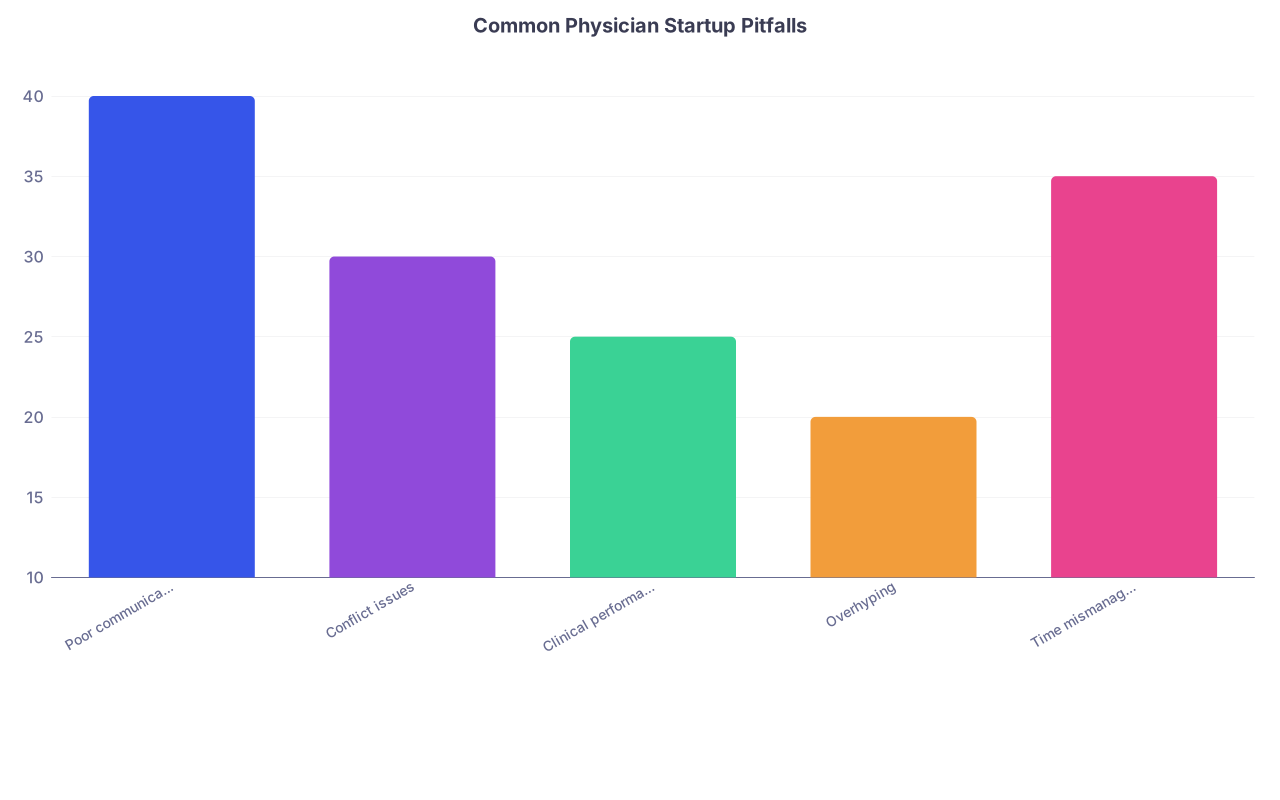
| Category | Value |
|---|---|
| Poor communication | 40 |
| Conflict issues | 30 |
| Clinical performance | 25 |
| Overhyping | 20 |
| Time mismanagement | 35 |
Choose your public persona intentionally
Do a quick scan of your online presence like you’re your crankiest attending:
- LinkedIn: Does it read like you quit medicine to be a “serial founder”? Or like you’re a physician who also builds things?
- Twitter/Threads: Are you constantly dunking on your specialty? Or sharing problems you’re trying to solve with some humility?
- Conference behavior: Are you “the salesy person” everyone avoids? Or the colleague experimenting with something interesting?
This stuff bleeds back into your specialty. People absolutely judge based on tone. You want to be ambitious but grounded, critical but not contemptuous.
A Few Very Real Career Paths This Opens Up
Here’s the part your anxiety doesn’t give enough airtime.
You might start a company, run it for a few years, and eventually:
- Take an innovation/strategy leadership role at a big health system
- Join a larger startup or medtech company in a senior clinical role
- Go back to academics with a focus on implementation and digital health
- Return to near-full-time clinical with a much more interesting side career in consulting/advisory work
This is not “step off the straight clinical path and you’re banished forever.” It’s more like: you’re adding an extra, messy, but high-upside branch to your career tree.

| Step | Description |
|---|---|
| Step 1 | Finish Residency or Fellowship |
| Step 2 | Full time clinical |
| Step 3 | Physician Founder |
| Step 4 | Scale founder role |
| Step 5 | Part time clinical + consulting |
| Step 6 | Return to clinical stronger |
| Step 7 | Leadership roles open |
| Step 8 | Health system or industry leadership |
| Step 9 | Start Company? |
| Step 10 | Outcome |
I’ve seen people follow all of these paths. The ones whose reputations suffered were usually the ones who were messy about ethics or unreliable clinically. Not the ones who simply “tried and it didn’t become a unicorn.”
The One Question You Actually Need to Answer
Strip everything else away and ask yourself this:
“If my company completely failed in 2–3 years, and all I had to show for it was experience and some minor scars, would I be okay going back to my specialty with my head up?”
If the answer is no—if your ego can’t handle that—then yes, your reputation fears are going to control you, and maybe this is the wrong time.
If the answer is yes—if you can picture yourself going back to your group or another job saying, “Yeah, I built something, it didn’t scale, here’s what I learned”—then you’re already halfway to protecting your reputation. Because that mindset makes you more honest, less bombastic, more ethical, more grounded.
People respect that.
Do This Today
Open a blank document and write three short paragraphs:
- How you’d introduce yourself at a conference if you stay purely clinical.
- How you’d introduce yourself if you build a startup and it fails.
- How you’d introduce yourself if it works reasonably well (not unicorn, just real).
Read them out loud.
If you can read version #2 without wanting to disappear into the floor, then starting a company probably won’t destroy your reputation in your specialty—as long as you keep your clinical work clean, your ethics boring, and your ego in check.
And if you can’t read it without cringing? That’s your real homework, not the pitch deck.


