
The VC world doesn’t judge physician-led startups the way they judge everyone else. The bar is different. Higher in some places, surprisingly lower in others. And if you do not understand that double standard, you will get politely “this is too early for us”–ed into oblivion.
Let me walk you through how investors actually evaluate you—the doctor-founder—behind closed doors. Not the sanitized Medium posts. The partner meeting conversations. The eye rolls. The “interesting, but…”
You’re post-residency. You’ve seen the system from the inside. You’ve got a real insight and maybe even a prototype. Now you’re stepping onto a playing field where most people assume physicians are naive about business, slow to move, and addicted to prestige.
Here’s how they really think—and how to weaponize it in your favor.
The First Filter: “Is this doctor actually crossing the line?”
The first 5 minutes of any VC interaction with a physician founder are not about your product. They’re about your identity.
They’re asking one core question:
Is this a doctor who dabbles, or a founder who used to doctor?
They do not articulate it that way. They feel it.
In partner meetings, I’ve heard variations of:
- “She’s clearly brilliant, but is she actually leaving practice?”
- “Is this a nights-and-weekends project?”
- “Is he still on faculty? Then he’s not all-in.”
You think your MD and your residency are huge credibility markers. And they are. But there’s a twist:
Your clinical pedigree is a strong signal of insight
Your ongoing clinical identity is a strong signal of divided focus
VCs love to tell limited partners they’ve backed “world-class domain experts.” They do not love founders who are unavailable on Monday because they’re on call.
So they use a few quiet heuristics:
| Signal They See | What They Assume About You |
|---|---|
| Full-time attending + startup | Not committed enough |
| 0.2–0.4 FTE clinical + startup | Transitioning, plausible founder |
| Fully left practice | All-in, serious about building a company |
| Still publishing heavily in academia | More professor than entrepreneur |
They will not say, “Quit your job or we won’t invest.” But if you’re still full-time clinical at Series A? You’ve basically answered their question for them.
If you’re early and need the income, fine. Just do not pretend you’re “all-in” when your schedule says otherwise. Make the path explicit:
- “I’m currently 0.4 FTE clinical; my employment agreement includes a clear step-down path to 0.0 FTE once we close a $X round, and my chair is fully on board.”
Say that out loud. Before they have to ask. Because if they have to ask, they already don’t trust the answer.
The Secret Rubric: What They Really Score You On
Forget the pitch deck templates. VCs listening to a physician-led pitch mentally score you across a few unspoken axes. They rarely admit this. But it’s shockingly consistent.
1. Clinical credibility vs. commercialization risk
They absolutely want you to be the person in the hospital who said, “This is insane, there’s a better way.” But they’ve also seen this movie before:
Brilliant clinician. Beautifully thought-out solution. Zero adoption. Zero revenue.
So they’re silently asking:
- Does this founder understand the buyer, not just the user?
- Can they talk payer, CFO, CMIO, value-based contracts—or only frontline pain?
When a physician talks only about “improving patient care” without mentioning CPT codes, DRGs, revenue cycle, throughput, or cost savings, they get mentally filed as:
“Great problem, wrong founder to commercialize it.”
Your MD gives you a free pass on problem selection. It does not give you a free pass on business mechanics.
2. Ego risk
This one is ugly but real.
A lot of VCs think physicians are uncoachable. Their word, not mine.
They’ve seen too many MDs walk in assuming their Stanford fellowship or Harvard appointment translates into product-market fit. It doesn’t. And investors are deeply allergic to people they’ll be stuck with for 7–10 years who do not listen.
So they test you.
They’ll ask:
- “What’s something you were wrong about in building this?”
- “What’s the biggest pushback you’re hearing from customers?”
- “If this doesn’t work, what will the postmortem say?”
If your answers are long monologues about how others just “don’t get it,” you’re done.
What wins them over is confident humility:
- “Originally we thought X, but after 14 sales conversations we killed that feature and doubled down on Y. Our clinical intuition was off there.”
That sentence alone flips the ego-risk flag from red to green.
3. Founder–market–timing fit
For physician founders, “founder–market fit” is not enough. They look for a very specific variant:
“Is this the right doctor, with the right scars, at the right moment in this market?”
A cardiologist building AI for derm images? Odd. A hospitalist building prior auth automation, after 3 years battling fax machines and payer portals? Makes immediate sense.
They look for:
- Tight alignment between your specialty and the workflow you’re attacking
- Personal stories that scream, “I’ve lived this nightmare”
- Evidence you’ve talked to dozens of people outside your own institution
If you’re a radiologist automating ED triage, you’d better have:
- EM docs
- Nursing leadership
- Bed management
- Operations folks
in your story. Not just “my attending told me this would be huge.”
The Money Question VCs Ask When You Leave The Room
Here’s the line that decides more physician-led deals than any buzzword or TAM slide:
“Will a hospital actually pay for this in the next 18–24 months?”
Not “is this important.” Not “does this improve outcomes.”
“Will someone write a check for this, relatively soon?”
That’s it.
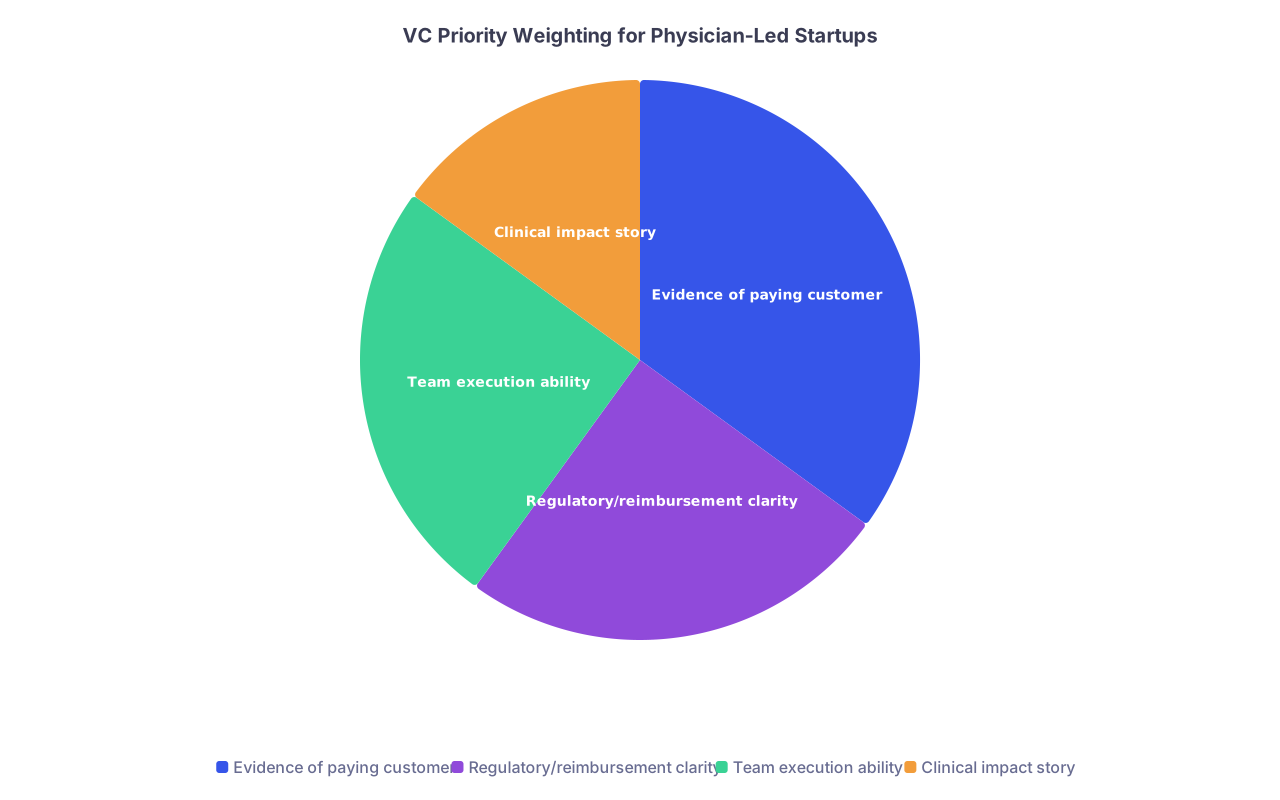
| Category | Value |
|---|---|
| Evidence of paying customer | 35 |
| Regulatory/reimbursement clarity | 25 |
| Team execution ability | 25 |
| Clinical impact story | 15 |
If your answer is:
- “Once we get multi-center RCT data we’ll approach payers” → you’re research, not a startup.
- “We’re piloting at my old residency program” → you’re in the friend zone, not the buyer zone.
- “We’re in late-stage procurement with X health system and here’s the pricing model” → now you have their attention.
Remember this: pilots are not revenue in the VC mental model. They are basically expensive customer discovery.
So they probe:
- “Who is the economic buyer?”
- “What budget line does this come out of?”
- “Who has veto power?”
If you stumble there, you’ve just told them you don’t know how hospitals actually buy.
Why Your Pedigree Helps and Then Suddenly Stops Helping
You think your path—top med school, elite residency, branded fellowship—is the golden ticket. And early on, it is.
Pedigree gets you the first meeting 3x more easily. It gives you a presumption of intelligence and discipline. But at some point in the conversation, there’s a sharp turn.
Around minute 20–25, the question becomes:
“Is this person an operator or just a high-achieving professional?”
They look for signals you can execute in chaos, not just excel on well-defined paths.
That’s where non-medical proof points matter far more than your academic CV:
- Have you hired anyone yet?
- Did you ship anything without a committee?
- Did you close any customer without a brand name helping you?
I’ve seen partners say, “She’s a UCSF-trained oncologist with a Stanford MBA… but the scrappy kid from nowhere already has 10 paying clinics. We back the latter.”
Harsh but true: pedigree is a door-opener, not a moat.
The Stuff That Spooks Them But They Won’t Say Out Loud
Let’s talk about the red flags they whisper about after you leave.
1. “This looks like a glorified consulting practice”
Physician-led “startups” have a bad habit of looking like boutique consultancies or services businesses dressed up with a token app.
Translation inside the room:
- “Where’s the tech leverage?”
- “Is there a product here or is this just the founder billing their time?”
If your model is:
- Custom implementations
- White-glove services
- You personally delivering value
…investors think “non-scalable, margin-constrained, key-person risk.”
You fix this by making the product the hero of the story:
- Clear feature roadmap
- Automation replacing manual steps
- Margins improving over time as software eats your service layer
2. “This is a malpractice bomb”
Sometimes your product walks too close to the clinical decision line.
Decision support that feels like autonomous decision making. Patient-facing triage that might get blamed when things go south. Anything that could show up in a lawsuit discovery process highlighted in bright yellow.
Most VCs do not want to underwrite malpractice risk they don’t understand.
They quietly screen for:
- Are clinicians just being “augmented,” or is the system effectively making decisions?
- Is there a clear chain of responsibility, with the clinician still on top?
- Is there a regulatory or legal opinion backing the approach?
If your story is “we reduce the need for specialists,” many investors hear “we put a target on our back.”
Be explicit:
- “The tool surfaces information and risk scores; the clinician always remains the decision maker. Here’s how the UI reinforces that. Here’s our counsel’s opinion.”
Don’t wait for them to ask; by then, they’ve already flagged it.
3. “This is a feature, not a company”
Classic problem.
Your startup solves one annoying workflow gap in a narrow way. In their heads, VCs are asking:
“Why won’t Epic/Cerner/Optum just build this in 6 months?”
If they believe you’re a feature that should exist inside a bigger platform, they may pass—or mentally reframe you as an acquisition bet, not a fund-returner.
To avoid that, you must frame:
- A wedge: the small entry point that gets you in the door.
- A platform vision: the logical expansion once you control that wedge.
Example:
Wedge – prior auth automation for radiology.
Platform – full revenue-cycle automation layer for all high-cost procedures across the health system.
If you can’t tell that “chapter 2 and 3” story clearly, they assume there isn’t one.
How They Quietly Compare Physician Founders vs. Non-MD Founders
Here’s the unfair scorecard they’ll never put on a slide, but absolutely use in their heads.
| Dimension | MD Founder – Default Assumption | Non‑MD Founder – Default Assumption |
|---|---|---|
| Clinical insight | Very strong | Needs validation |
| Business instincts | Weak / unproven | Neutral to strong |
| Coachability | Risky / ego-prone | Neutral |
| Network in healthcare | Strong but academic-heavy | Varies; sometimes stronger in C‑suite |
| Speed of execution | Slower, more cautious | Faster, more iterative |
| Credibility with clinicians | Very high | Depends on background |
Your job in every interaction is to flip three of those assumptions:
- Show hard-nosed business instincts
- Demonstrate coachability with real stories
- Prove you can move fast without violating clinical safety
The good news? When an MD founder flips those, they become incredibly compelling. You keep the clinical superpower and lose the physician baggage. That’s extremely backable.
How to Present Yourself So VCs Take You Seriously
Let’s get practical. Here’s how you walk into a room and sound like a founder, not “the doctor on the team.”
Talk like someone who has sat in a CFO’s office
Instead of:
“We save doctors time.”
Say:
“We reduce average length of stay by 0.3 days for DRG X and Y, which translated to $2.6M in incremental capacity value at our pilot site, validated by their finance team.”
Instead of:
“Patients like our app.”
Say:
“Our 90-day retention is 64%, and clinics using us saw a 17% reduction in no-show rates, which their COO tracks as a core KPI.”
Investors are not impressed by generic “better care” claims. They’re impressed by operational and economic wins.
Make your clinical story brutally concrete
Your personal “why” matters, but it has to sound like the beginning of a company, not a TED Talk.
Not:
“I’ve always been passionate about improving patient care.”
Try:
“On my first month as an attending hospitalist, I spent 3–4 hours per shift on prior auth, discharge paperwork, and redundant documentation. I timed it. That’s 20% of my day on work that doesn’t require an MD. Across our health system, that’s the equivalent of 40 full-time physicians doing clerical work. We’re giving that time back.”
Now your MD background is a weapon, not a decoration.
Show you’ve escaped the academic mindset
Investors get nervous when everything about your plan sounds like:
- Multi-year validation
- Multi-center RCT
- Grants and publications
You are not writing an R01. You’re building a business.
So emphasize:
- Scrappy experiments over formal trials
- Pilot-to-contract conversion rates
- Customer discovery interviews, not just advisory boards
You can absolutely do rigorous clinical validation. But you need a commercial story in parallel, not in sequence.
What Happens After You Leave: The Real Conversation
Here’s roughly how a partner meeting sounds after a strong physician-led pitch. I’ll translate the subtext.
“She’s clearly the right person for this space.”
(Subtext: Founder–market fit is great. Clinical insight is legit.)
“Do we think she can build a team around her?”
(They worry about you being the single point of failure, or micromanaging.)
“How fast can this get to $5–10M ARR?”
(If they can’t picture that in 3–5 years, they’re out.)
“Who kills this in a hospital?”
(They’re modeling internal resistance: IT, compliance, unions, entrenched vendors.)
“What’s the regulatory or legal landmine here?”
(If there’s a whiff of opaque FDA or malpractice risk, risk-averse funds will walk.)
Then someone will ask the killer question:
“If she didn’t have an MD, would we still fund this?”
They’re trying to separate your credential halo from the business. If the answer is “no,” you’re seen as a hero customer or advisor—not necessarily a venture-scale founder.
Your goal is to make that answer a strong “yes.” The MD should feel like a multiplier, not a crutch.
The Physician’s Advantage—If You Lean Into It Correctly
Despite all the skepticism, physician-led startups have a real edge when they play this right.
You:
- Understand workflows outsiders routinely screw up
- Can attract other clinicians as early adopters, champions, and advisors
- Can sniff out nonsense in “clinical AI” and overpromised outcomes
- Know where the skeletons are in documentation, billing, and patient safety
But you only win if you unlearn a few habits:
- Stop waiting for permission. No IRB is coming. Move.
- Stop gold-plating. V1 can be ugly if it solves a real pain.
- Stop optimizing for prestige. Optimize for paying customers.
And you must make one internal shift that VCs can feel within 5 minutes:
You’re no longer “Dr. So-and-so who’s building a startup.”
You’re a founder who happens to be a physician.
The moment they believe that, the whole tone changes.
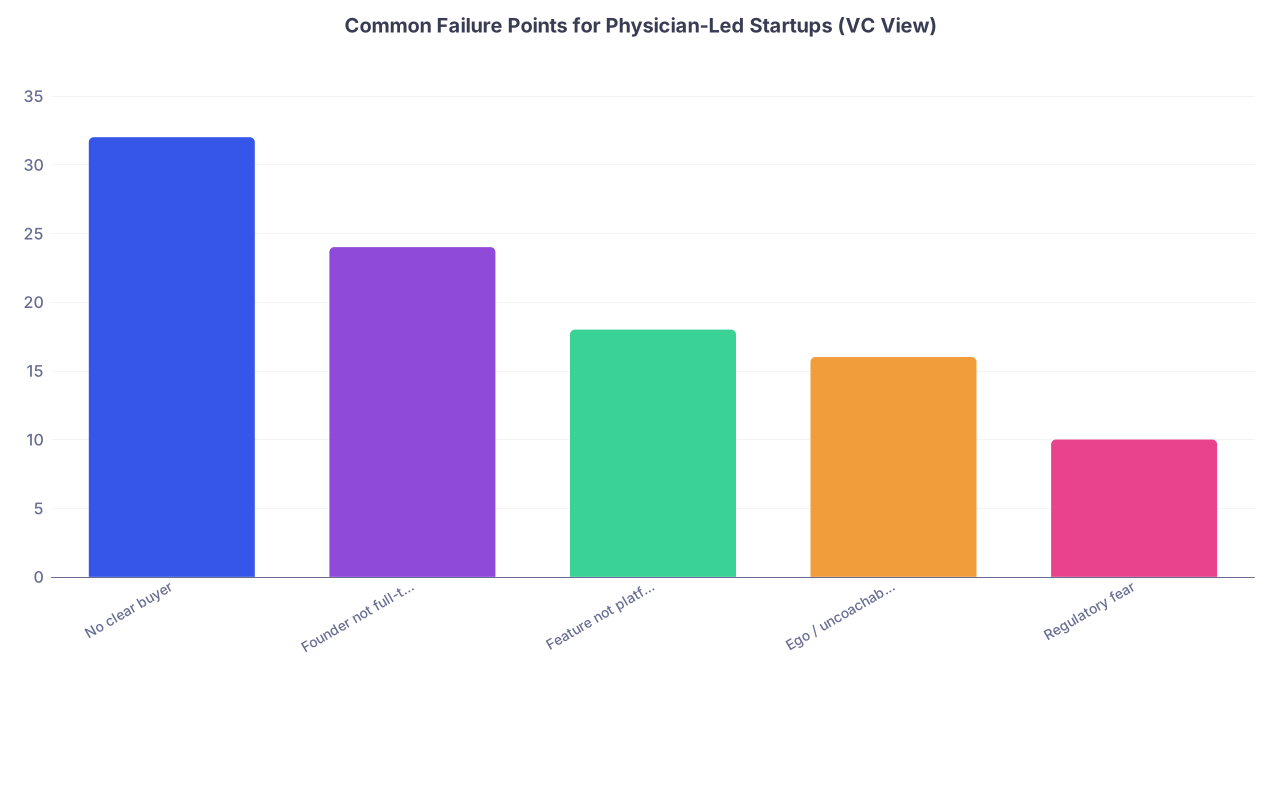
| Category | Value |
|---|---|
| No clear buyer | 32 |
| Founder not full-time | 24 |
| Feature not platform | 18 |
| Ego / uncoachability | 16 |
| Regulatory fear | 10 |
How This Fits Your Career After Residency
You’re post-residency, maybe just starting out as an attending, staring at a fork in the road.
On one path, you stack shifts, build a conventional CV, and complain about the EHR with everyone else. On the other path, you convert that frustration into a product, a team, and a company. Maybe you keep some clinical. Maybe you don’t.
VCs are not your enemy in this. But they are not your mentors either. They’re not here to help you “figure it out.” They’re here to place bets.
Your job is to walk into those rooms already understanding the unspoken rules they’re using to judge you:
- Show you’ve crossed the line from clinician to founder.
- Prove your insight is commercial, not just clinical.
- Turn your ego down and your learning rate up.
- Sound like someone who’s sat with CFOs, not just chiefs of service.
- Make it impossible for them to say, “It’s a great idea, but I don’t think this doctor can build it.”
Get that right, and your MD becomes a superpower, not a liability.
The mechanics of term sheets, board dynamics, and protecting yourself as a first-time physician founder? That’s the next layer of the game. And that’s a conversation for another day.


| Stage | Activity | Score |
|---|---|---|
| Clinical Frustration | See broken workflow | 4 |
| Clinical Frustration | Decide to build solution | 3 |
| Early Build | Nights and weekends prototype | 3 |
| Early Build | First pilot at home institution | 4 |
| Commitment Shift | Reduce clinical FTE | 2 |
| Commitment Shift | Incorporate company | 3 |
| Market Proof | First paying customer | 5 |
| Market Proof | Revenue milestones | 4 |
| VC Engagement | Warm intro to investors | 3 |
| VC Engagement | Partner meeting | 4 |
| VC Engagement | Term sheet | 5 |

FAQ: Physician-Led Startups and VC Judgment
1. Do I really need to quit clinical practice completely to be taken seriously by VCs?
Not always, but you need a credible path there. At pre-seed or seed, 0.2–0.4 FTE clinical can be acceptable if you’re clearly building full-time otherwise. By Series A, most serious funds expect the CEO to be all-in on the company. What kills deals is fuzziness: “I’ll see how it goes” or “I love medicine too much to give it up” without a clear plan. Spell out exactly how your clinical time will phase down as the company scales.
2. How much traction do I need before VCs will take a physician-led startup seriously?
For true institutional VCs (not angels), you usually need something beyond a pilot at your training institution. At minimum: multiple pilots in unaffiliated sites, strong engagement metrics, and a visible path to paid contracts. Best case: at least a few paying customers, even if small, with a repeatable sales process you can describe in detail. A “great idea” with no real-world use almost never gets funded, MD or not.
3. Should I lean heavily on my MD credentials in the pitch, or downplay them?
Lead with them to establish clinical authority, then quickly pivot to operating and commercial proof. A good pattern: 2–3 minutes of “why my background gives me unique insight,” then the rest on what you’ve built, what you’ve shipped, who’s paying, and what you’ve learned from the market. If you spend more time on where you trained than on what customers are doing with your product, you sound like a decorated advisor, not a founder.
4. Do I need a non-physician co-founder to reassure VCs about my business skills?
No, but it can help if it’s the right person. VCs like balanced teams: someone who owns product/clinical, someone who owns tech, someone who owns go-to-market. If you can cover one or two of those and hire for the rest, great. If you’re purely clinical with no product, tech, or sales chops, a co-founder who’s actually built and shipped products before can materially improve how investors view you. What they don’t want is you as “Chief Visionary” while someone else does all the hard execution work.
5. How do I handle questions about regulatory and legal risk if I’m not an expert?
You do not need to be a regulatory lawyer, but you do need to show you take it seriously and have done the homework. That means: knowing whether your product is likely to be considered a medical device, having at least a preliminary opinion from competent counsel, and being able to explain the risk boundaries (what your product does not do clinically). “We’ll figure that out later” is death. “We’ve scoped the likely regulatory pathway with X firm, here’s the plan and why it’s reasonable” is enough for most early-stage conversations.