

The pricing mistakes doctors make when selling to health systems are brutal—and they’re usually invisible until the deal dies or the contract bleeds you dry.
You spent years learning physiology, not pricing strategy. Health systems will not give you a pass for that. They will simply take the better deal—from you or from someone else.
Let me walk you through the landmines I’ve watched physician-founders step on over and over.
1. Pricing Without Understanding How Health Systems Actually Buy
The first catastrophic mistake: you price like it’s a clinic purchase, not a system-level decision.
Hospitals and health systems do not think in “price per license” or “nice-to-have feature bundle.” They think in:
- Budget buckets (IT, quality, service line, capital vs operating)
- Multi-year total cost of ownership
- Contracting constraints and rebate structures
- Risk and compliance penalties
If you ignore that, your price will look random, even if your math feels logical to you.
The wrong way most doctors do it
I’ve seen this dozens of times:
- Founder: “We charge $50 per user per month. That seems fair.”
- VP of Clinical Ops: “How does that map to our cost per case? Our service-line budget? Our DRG reimbursement?”
- Founder: awkward silence.
Health systems are not judging your product in a vacuum. They’re comparing:
- Your cost vs avoiding a nurse FTE
- Your cost vs readmission penalties
- Your cost vs Medicare reimbursement
- Your cost vs existing vendor renewals
If you can’t speak that language, you’ve already lost leverage.
How to avoid this mistake
Before you even sketch a pricing grid, answer these:
Who actually owns the budget for my product?
- CIO/IT?
- Chief Quality Officer?
- Service line director (e.g., cardiology, oncology)?
- Population health / value-based care?
Are they thinking:
- Capital expense?
- Operating expense?
- Shared savings / risk-based cost?
What unit of impact do they care about?
- Per bed?
- Per admission?
- Per member per month (PMPM)?
- Per physician or clinic?
Your price should be derived from their frame, not your gut.
If they live in PMPM, quoting “$500/month per provider” is a rookie move. Translate it: “That’s about $0.14 PMPM across your 300,000 covered lives.”
2. Pricing Based on Cost, Not Value (Classic Physician Trap)
The second mistake is almost universal with doctors: you price based on what it costs you to deliver, plus a “reasonable” margin.
This is how you price a private practice visit when Medicare has already set the rate. It is not how you price innovation to a health system.
Cost-plus pricing sounds rational. It’s lazy. And it will either underprice you into the ground or position you as a cheap toy instead of a strategic solution.
Value-based pricing: what you’re ignoring
You have to ask a harsher question: What expensive pain are we actually removing for this system?
It might be:
- Reduced readmissions
- Shorter length of stay
- Fewer ED revisits
- Higher throughput for an imaging suite
- Lower locums spend
- Fewer denied claims
Then you tie your price to a fraction of that value, not a markup on your AWS bill.
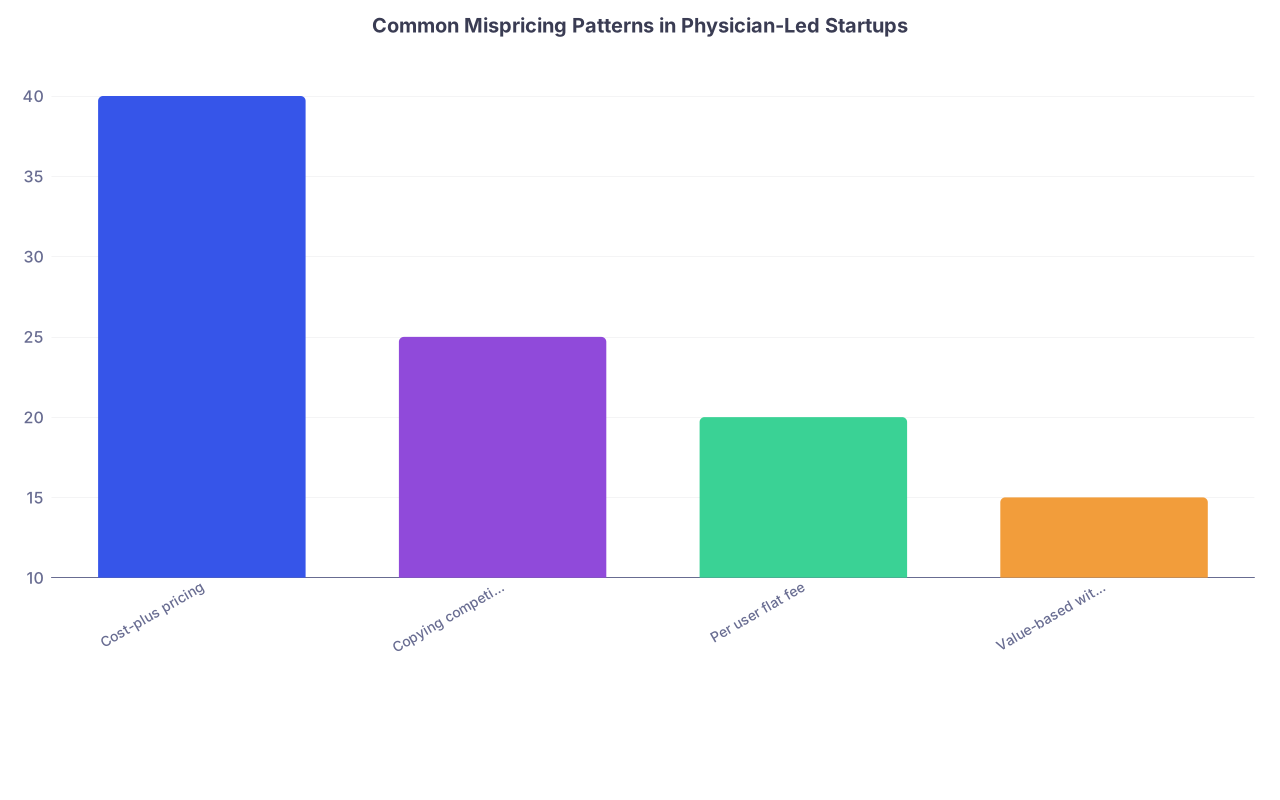
| Category | Value |
|---|---|
| Cost-plus pricing | 40 |
| Copying competitor | 25 |
| Per user flat fee | 20 |
| Value-based with ROI model | 15 |
A simple sanity check you’re probably skipping
If your product can conservatively save a 10-hospital system $5M/year in readmission penalties, and you’re charging them $120K/year because “that feels fair for a SaaS tool,” you’re doing charity work, not business.
This is the equation almost no one does:
- Annual impact (conservative): $X
- Take 10–25% of that: that’s your annual price band target
- Then structure it into:
- Base platform fee
- Volume tier (beds, encounters, PMPM)
- Optional performance-based component
Do not let “But we’re doctors, we shouldn’t overcharge” push you into underpricing your company into oblivion. Fair ≠ cheap.
3. Per-User Pricing: The Fastest Way to Get Stuck in Procurement Hell
Your instincts from EHRs and Doximity logins tell you: charge per user. That is exactly how to get hammered in a system deal.
Per-user pricing is one of the biggest structural mistakes physicians make.
Why it backfires with health systems:
- Forces them to count every user, every year → admin nightmare
- Creates internal political battles: “Why does cardiology get licenses and not hospitalists?”
- Triggers a ton of “Can we share logins?” behavior
- Makes your upside dependent on them adding users, which they resent
Most systems want predictable, simple line items that align with their scale: beds, discharges, clinics, covered lives.
Better pricing anchors for health systems
You’re usually safer tying your price to one of:
- Number of beds
- Annual discharges or encounters
- Number of facilities / sites
- Covered lives (for pop health / value-based tools)
- Service line volume (e.g., oncology cases/year)
| Model Type | Best For |
|---|---|
| Per bed per month | Inpatient workflow tools |
| Per discharge | Readmission / LOS solutions |
| PMPM | Population health / risk models |
| Per facility | Imaging, lab, or site-based tools |
| Hybrid (base + usage) | Platform plus add-on modules |
Per-user pricing can still work for small clinics or physician groups. But if “IDN,” “regional system,” or “enterprise” is anywhere in your pitch deck, rethink it.
4. Copying Competitor Pricing Without Understanding Their Strategy
This one’s deadly and surprisingly common.
I’ve watched physician-founders say: “Company X charges $1 PMPM, we’ll do $0.80 PMPM and be more competitive.”
You have no idea:
- Whether Company X is losing money on every contract
- Whether they’re subsidized by pharma, devices, or data sales
- Whether they’re playing a land-grab “grow at all costs” game
- What their true scope, service, and SLAs look like
Copying their number is like copying someone’s insulin dose without knowing their weight.
Why this mistake happens
Doctors are used to reference ranges:
- Normal K: 3.5–5.0
- Normal TSH: ~0.4–4.0
We unconsciously look for a “normal” price and try to sit in the middle of that lab range.
But market pricing isn’t a lab value. It’s strategy, cost structure, cash position, investor pressure, and long-term goals all mashed together.
If you simply undercut someone else:
- You signal “commodity” instead of “strategic partner”
- You invite being squeezed further each renewal
- You make it easy for procurement to say, “We’ll just get them to drop their price”
The right comparison questions
Instead of asking “What are they charging?” ask:
- Are they selling into the same buyer persona and budget line?
- Are they offering implementation and services or pure software?
- Are they taking risk or offering guarantees?
- Are they in the same data/IT/security burden category?
If your solution replaces nursing workflows, offers custom integration, and carries clinical risk, and you’re benchmarking against a lightweight communication app price, you’re setting yourself up for slow death.
5. Ignoring Procurement and Contracting Friction in Your Pricing
You know what kills a lot of health system deals? Not value. Not clinical skepticism.
Procurement friction.
You choose a pricing structure that:
- Doesn’t fit cleanly into existing contract templates
- Requires ongoing manual monitoring
- Has weird one-off rules (e.g., “only for certain clinics if they meet condition X”)
And the deal quietly dies in legal and supply chain.

| Step | Description |
|---|---|
| Step 1 | Clinician Champion |
| Step 2 | Service Line Leader |
| Step 3 | Finance Review |
| Step 4 | IT and Security |
| Step 5 | Procurement |
| Step 6 | Legal and Contracting |
| Step 7 | Executive Sponsor |
| Step 8 | Contract Signed |
If your price forces heavy customization at step E or F, every stakeholder suddenly has a reason to slow-walk your deal.
Friction-creating pricing patterns
Watch out for:
- Hyper-custom one-off deals with no clear scaling logic
- Too many tiers and add-ons (“Gold/Platinum/Enterprise/Custom/Research Edition”)
- Contracts requiring manual data pulls every month to compute your fee
- “Pilot pricing” that doesn’t map to any standard budget line for rollout
Your job is to make it as easy as possible for procurement to say, “This fits our patterns. We’ve seen this before. Let’s move.”
How to de-friction your pricing
- Limit tiers to 2–3 at most, with clear thresholds
- Tie metrics to data they already track (beds, discharges, covered lives)
- Avoid micro-usage fees that require complex reconciliations
- Design a conversion path: pilot → year 1 rollout → full system
You’d be amazed how many deals die because the pricing model produced a 10-tab Excel monster that no one wanted to own.
6. Underpricing Pilots and Never Recovering
Here’s a particularly painful pattern:
- System says, “We’ll try a 6-month pilot at a deeply discounted rate.”
- You agree because “we need the logo” and “this is our beachhead.”
- At renewal, any realistic price increase looks like highway robbery.
That pilot price will anchor their expectations for years.
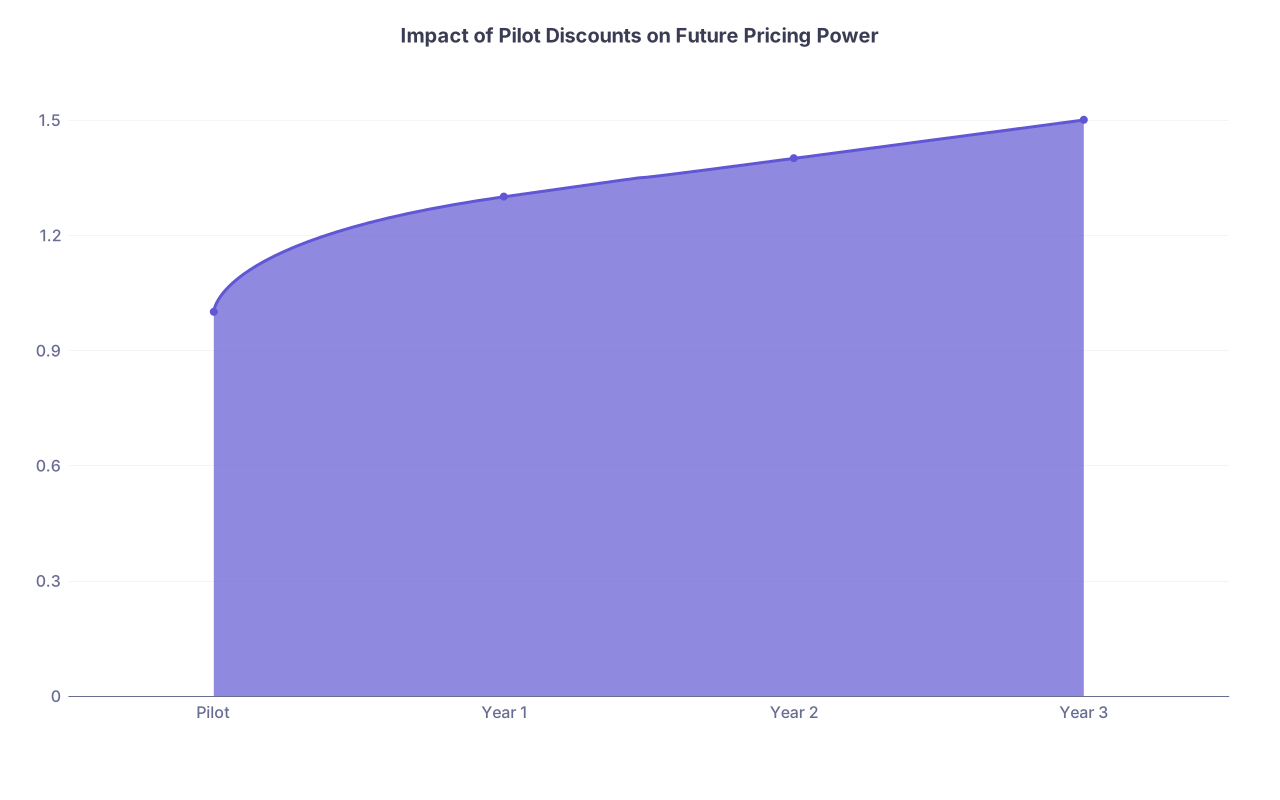
| Category | Value |
|---|---|
| Pilot | 1 |
| Year 1 | 1.3 |
| Year 2 | 1.4 |
| Year 3 | 1.5 |
If the pilot was $50K for one hospital, and real value for full rollout across 8 hospitals is $800K/year, be honest: very few executives will happily stomach a 16x jump, even if it’s justified.
Smarter pilot pricing structures
Better ways to do it:
- Charge near-normal price but limit scope
- One service line
- One campus
- Limited features
- Use a “credit” model
- “Pilot fee will be credited 50–100% against first-year enterprise contract if executed within X months.”
- Pilot with performance gates, not price collapse
- Modest discount only if you hit predefined outcome metrics
The key: don’t let “pilot” become code for “free work and permanent discount anchor.”
If a system truly won’t commit even a serious pilot fee, that’s data: they do not value the problem yet. Don’t pretend it’s progress.
7. Refusing Performance or Risk-Based Pricing—Out of Fear, Not Logic
Many physician-founders recoil at performance-based pricing:
- “Too risky.”
- “What if their implementation is bad?”
- “What if docs don’t use it?”
Sometimes those concerns are valid. Sometimes they’re just fear. And that fear costs you deals.
Executives are hammered all day with vendors promising outcomes. When you say, “We improve readmissions” or “We reduce no-shows,” and then refuse any outcome-tied structure, they smell weakness.
Sensible, controlled performance models
You don’t need to throw yourself into unlimited downside.
You can:
- Keep a base platform fee that covers your costs
- Add a performance kicker if metrics hit an agreed target
- Cap total downside and upside explicitly
For example:
- Base: $300K/year
- If 30-day readmissions in target DRGs fall >10% vs baseline, success fee of $200K
- If they don’t, no success fee
That structure:
- Signals confidence
- Aligns incentives
- Keeps your floor protected
Just do not be bullied into “We’ll only pay you if we see X% improvement and no base fee” unless you have truly extraordinary control over implementation and usage.
8. Forgetting the Cost to Serve: You Price the Software, Not the Reality
Another physician-founder classic: pretending your only cost is your dev team and cloud bill.
Health system deals are messy. Here’s what actually eats your margin:
- Endless InfoSec questionnaires
- Multiple on-site or virtual trainings
- Custom integration work with Epic/Cerner/Meditech
- Participating in their quality committees, governance calls
- Annual security audits and business reviews
- Custom reporting for service lines
If your pricing doesn’t cover these, you end up subsidizing each contract with founder time and burnout.
Where this shows up in the real world
I know a physician-led startup that landed a “huge” $150K/year system contract. They were thrilled—until:
- Integration took 9 months
- They spent 200+ hours on security and legal
- They had to support three different EHR instances
- They ran monthly steering committee meetings
On paper: $150K. In reality: marginal or even negative contribution.
Your price must explicitly account for:
- One-time implementation (can be a separate fee)
- Ongoing support and governance
- Integration complexity and maintenance
For high-friction, high-touch enterprise work, it’s often saner to:
- Charge an upfront implementation fee (e.g., $75–200K)
- Then layer on annual recurring fees based on scale
Don’t apologize for that. Health systems are used to paying Epic/Philips/GE implementation fees. You’re not the first.
9. Treating Every Deal as a One-Off Special Snowflake
Last mistake for today: bespoke everything.
- Custom pricing logic for each system
- Unique bundles, unique discounts, unique metrics
- Ten different contract templates by year two
You think you’re being flexible and “meeting them where they are.” What you’re really building is an unscalable mess that confuses your own team and destroys negotiating discipline.

Where this comes back to bite you
- Renewals become renegotiations from scratch
- Your sales team (or you) can’t remember what lever you pulled last time
- Investors start asking why similar-sized customers pay wildly different rates
- Procurement compares notes across systems and starts demanding “parity”
Health systems talk to each other. They sit on the same panels. Your weird pricing exceptions will surface.
Guardrails you need in place
- Clear list price and discount bands by segment (community hospital vs large IDN)
- Rules for when you’ll add pilots, risk, or credits—and when you won’t
- One or two standard packaging options that 80% of customers fall into
- Documented rationale for any meaningful deviation
Flexibility is fine. Chaos is not.
Putting It All Together: A Simple Pricing Design Checklist
Before you send another pricing proposal to a health system, sanity-check it against this list:
Is it framed in their unit of value?
Beds, discharges, PMPM, facilities—not “user count we made up.”Does it tie to a credible economic story?
“You spend ~$4M/year on X problem. Our fee is ~$800K/year to eliminate most of it.”Is it simple enough for procurement and legal to process?
One page, few tiers, clean measures.Does it cover your true cost to serve?
Implementation, integration, support, governance.Does it avoid pilot underpricing traps?
Pilot maps to future price, or credits roll forward.Do you have at least one performance or risk-tied option?
Even a small one, to show confidence.Is it consistent with your other deals?
Or do you have some random “friend price” that will haunt you later?
If you can’t answer “yes” to most of those, you’re walking into that negotiation vulnerable.
FAQs
1. How much should I discount for a pilot with a health system?
Do not give a 70–90% haircut “just to get in the door.” A reasonable pilot discount is usually in the 20–40% range off your expected steady-state price, and even then only if:
- Pilot scope is clearly limited (site, service line, duration), and
- There’s a written path for conversion with pre-agreed pricing bands.
Anything steeper should come with something big in return: design partnership, co-marketing commitments, or strong data rights. “Exposure” alone is not enough.
2. Should I ever offer my solution for free to a big-name health system?
Free is almost always a mistake. When they don’t pay, they don’t prioritize:
- No executive champion
- No IT resources assigned
- No urgency to go live
- No incentive to renew
If you absolutely must, make it brutally time-limited (e.g., 60–90 days), with a signed commercial terms sheet that auto-activates at a defined date unless they opt out. Free without a signed future framework is just unpaid consulting.
3. What if the health system says my price is too high compared to “industry standard”?
Push back by asking what they’re comparing you to:
- “Is that a communication platform price?”
- “Is that a generic analytics tool or a specialty clinical solution?”
- “Does that include integration, governance, and outcomes guarantees like we’re offering?”
Then re-anchor on value: “Your current readmission penalties are around $3M/year. Our total annual fee is under 20% of that, with clear outcome commitments. That is well within what other systems are paying for high-impact solutions.”
Don’t reflexively slash price just because someone throws “industry standard” at you.
4. How transparent should I be about my costs when negotiating?
Do not break down your internal costs. You’re not submitting a cost report to CMS. Health systems care about:
- Outcomes and risk
- Total cost vs their pain
- Predictability
If you start itemizing your AWS, dev, and staff hours, you hand them a weapon to argue your margins down. Talk about value, scope, and service—not your internal ledger.
5. What’s one pricing change that usually improves deals quickly?
Shift away from pure per-user pricing to a hybrid model:
- Base platform fee tied to beds/discharges/covered lives (predictable for them, stable for you)
- Optional add-ons per site or module (gives them choice and upgrade paths)
This alone usually:
- Reduces procurement anxiety
- Makes ROI conversations cleaner
- Simplifies renewal negotiations
Do not wait until you’ve signed 10 misaligned deals to fix this.
Open your current pricing sheet right now and circle every place you’ve used “per user” or “pilot discount” without a clear economic story behind it. That’s your starting list of mistakes to fix before your next health system meeting.


