
The brutal truth: most physician-led startups do not fail because the idea is bad. They fail the moment their product hits a real hospital’s IT review.
Not funding. Not “market timing.” The first serious InfoSec questionnaire from a mid-size hospital system. That is where a huge number of physician startups die quietly.
If you want to avoid being one of them, you need to stop thinking like a clinician selling to a colleague and start thinking like a vendor trying to get past an extremely overworked, paranoid, and rightfully skeptical hospital IT and security team.
Let me walk you through the mistakes I see again and again—usually when it is already too late.
1. Treating IT Review as a Formality Instead of a Gate
This is the core error. If you misunderstand this, everything else falls apart.
Physicians often assume:
- “The CMIO loves it, so IT will sign off.”
- “It is just a pilot, so security will be lighter.”
- “We are HIPAA compliant, so there is nothing to worry about.”
Wrong on all three.
For a hospital, your startup is:
- A potential breach headline.
- A potential Joint Commission or CMS problem.
- A potential ransomware entry point.
- A potential medical error liability.
Your pilot is not “small” to IT. To them, it is another piece of software they have to own, maintain, secure, audit, and defend when something goes wrong. And they remember the last vendor who promised “simple integration” and left them with a half-broken interface no one supports.
You must treat IT/security review as:
- A hard gate to revenue
- A separate decision-maker from clinical champions
- A long-lead, resource-intensive requirement
If you build your sales pipeline assuming quick IT approval, you are already dead. You just do not know it yet.
2. Underestimating the Complexity of Hospital IT Environments
You are used to the chaos of inpatient medicine. Good. Take that level of chaos and apply it to servers, EHR instances, integrations, and legacy systems.
Most physician-founders make the mistake of assuming hospitals have:
- One EHR version
- Centralized, clean data
- A single sign-on solution that “just works”
- A stable system landscape
Reality is messier:
- Multiple EHR instances (Prod, Test, Dev; sometimes different versions)
- Third-party bolt-ons (dictation, imaging viewers, custom alert engines)
- Old on-prem systems mixed with cloud components
- Woefully under-documented interfaces and one guy who “knows how that works” and is always busy
So where do startups blow this?
Promising tight EHR integration with no real strategy.
- “We integrate with Epic” is not a sentence. It is a fantasy if you have not:
- Implemented in at least one production Epic site
- Survived their App Orchard / Connection Hub scrutiny
- Dealt with a real HL7 / FHIR mapping conversation
- “We integrate with Epic” is not a sentence. It is a fantasy if you have not:
Designing solutions that assume modern infrastructure.
Things like:- Requiring the latest browser version when half the hospital runs IE mode in Edge because of old apps.
- Assuming staff can install a desktop client. Many cannot without an IT ticket.
- Assuming Macs are supported in clinical areas. Often they are not.
Ignoring performance and latency.
Your “snappy” demo on a local machine will crawl on a congested hospital WiFi with roaming between access points and ancient Citrix sessions.
If you cannot describe how your product fits into:
- The hospital’s EHR,
- Identity and access management,
- Network and endpoint landscape,
you are not ready for IT review. They will smell that within 5 minutes.
3. Being Sloppy or Naive About Security and Compliance
This is the mistake that kills deals fastest.
A typical hospital InfoSec questionnaire will ask 150–300 questions. Many physician-founders first see one of these and panic. Rightfully so.
The fastest path to “No” is half-answers like:
- “We plan to implement encryption at rest.”
- “We are working toward SOC 2.”
- “Our developers follow best practices.”
That is vendor death language.
Hospitals want specifics:
- Do you encrypt data at rest with AES-256?
- Is PHI segregated logically? Physically?
- Who is your cloud provider, and in which regions are data stored?
- What is your backup and disaster recovery RPO/RTO?
- Do you perform annual third-party penetration testing?
You need to have this mostly solved before your first enterprise pitch. Not afterward.
| Control Area | Expected Minimum for Serious Consideration |
|---|---|
| Data in Transit | TLS 1.2+ enforced, HSTS, modern ciphers |
| Data at Rest | AES-256 encryption, keys managed securely |
| Access Control | Role-based access, strong password policy |
| Logging & Auditing | Detailed access logs, retention ≥ 6–7 yrs |
| Backups | Encrypted, tested restores, offsite copies |
Common physician-startup security mistakes:
No formal policies.
“We are small, we do not need that yet.”
Hospital IT hears: “We do not take security seriously.”Production data in dev/test.
Using live PHI in your development environment or QA sandbox. Massive red flag.No vendor security documentation.
You will be asked for:- Security whitepaper / overview
- Data flow diagrams
- Access control model
- Incident response plan
If you do not have them, you look amateurish.
Bad sharing habits.
I have seen founders demo live patient data from one hospital in front of another hospital’s team. That is a fast way to get your meeting ended.
If you are touching PHI and you do not have at least a basic security posture, you should not be selling to hospitals yet. You are wasting everyone’s time and burning your own reputation.
4. Ignoring the Vendor Management and Risk Process
You think you are selling to “the hospital.”
You are not.
You are selling to:
- IT / Information Security
- Compliance / Privacy Officer
- Risk Management / Legal
- Supply chain / Purchasing
- Finance
Each of those groups can stop you.
And they all care about different things. Physician startups get blindsided by vendor management questions they never prepared for, such as:
- Do you carry cyber liability insurance? For how much?
- What is your uptime SLA?
- Do you have a documented business continuity plan?
- How many FTEs provide support? What are your support hours?
- What happens to our data if you go bankrupt or get acquired?
If your whole “company” is you, another physician, and one contractor developer, be honest with yourself. A big system will see you as a major business continuity risk.
You must come prepared with answers that are:
- Written
- Specific
- Defensible
Not just something you improvise during a call.
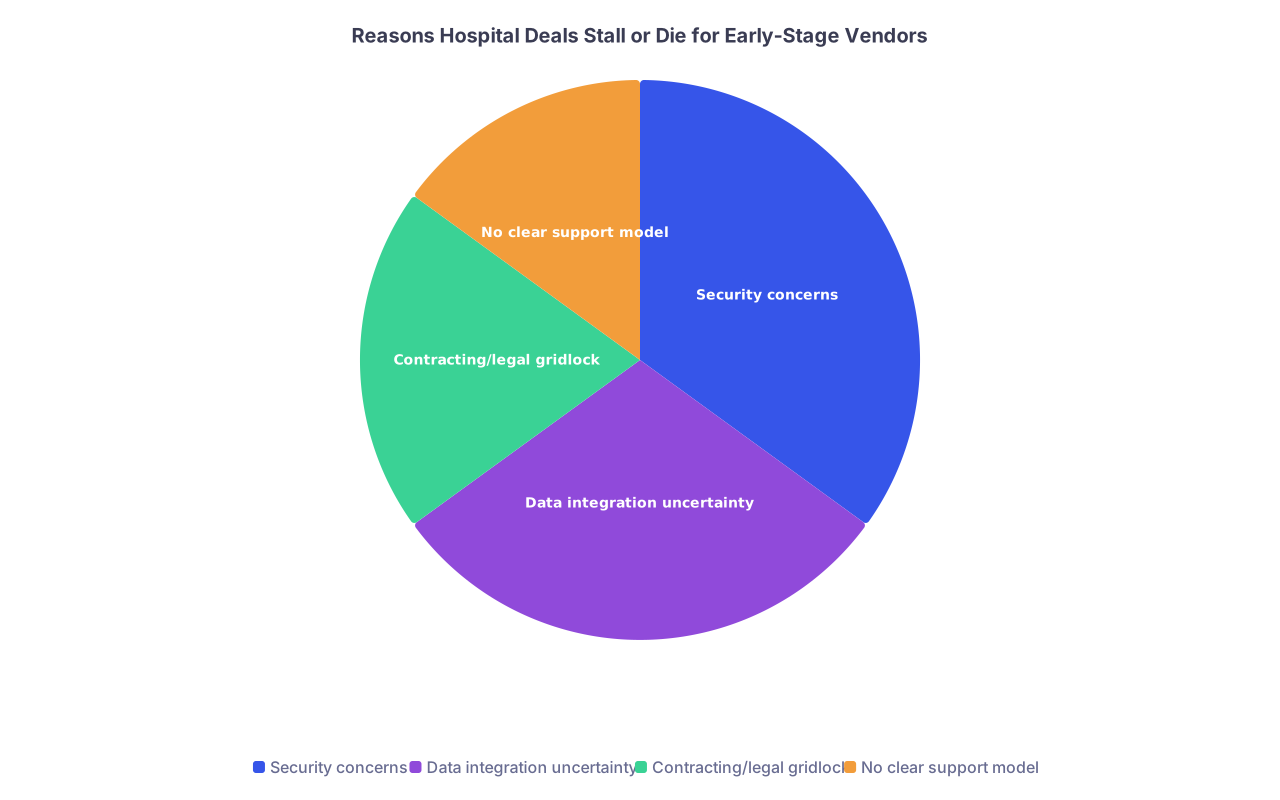
| Category | Value |
|---|---|
| Security concerns | 35 |
| Data integration uncertainty | 30 |
| Contracting/legal gridlock | 20 |
| No clear support model | 15 |
If you skip this prep, here is what happens in practice:
- Your clinical champion gets excited.
- You get a verbal yes for a “pilot.”
- Legal sends a BA agreement and MSA with 30 pages of obligations.
- InfoSec sends a 200-question security and risk assessment spreadsheet.
- You realize you cannot credibly answer half the questions.
- Everything goes quiet. “We are still reviewing internally.”
Translation: “We are not going to put this in production.”
You will blame “slow hospital bureaucracy.”
In reality, you were just not ready to be an enterprise vendor.
5. Building Consumer-Grade Products for Enterprise-Grade Environments
This mistake is subtle but lethal.
A lot of physician-founders build something that works beautifully:
- On their own laptop,
- For one clinic,
- With friendly staff who tolerate bugs.
Then they try to shove that same product into a 1,200-bed hospital and expect it to survive.
Enterprise-grade expectations include:
- High availability – planned downtime windows, maintenance strategy
- Monitoring – real-time alerts, logging, health checks
- User management – onboarding/offboarding, role changes, auditing
- Scalability – performance with 100, 500, 1,000 users concurrently
- Supportability – how IT can troubleshoot when something breaks
Physician startups often get burned here:
No robust logging.
When something fails, IT asks, “What happened in the logs?”
You have no answer because you did not build proper logging, correlation IDs, or error reporting.No clear deployment model.
SaaS only, no on-prem option. Or:- Not containerized
- No defined resource requirements
- No documentation for IT on how to deploy, patch, upgrade
Fragile integrations.
You wrote to exactly one EHR’s sandbox.
Real hospital has:- Different FHIR version
- Custom codes and workflows
- VPN requirements or specific network constraints
No proper environment separation.
Dev, test, staging, and prod all blurred together.
Hospitals want:- A non-prod environment for testing and validation
- Clear deployment paths and rollback options
If your architecture is “whatever my freelance dev hacked together that works,” IT will sniff that out quickly. They have seen too many prototypes masquerading as products.
6. Disrespecting IT’s Time, Language, and Priorities
This is where a lot of physician-founders shoot themselves in the foot.
I have watched talented doctors walk into IT review meetings and:
- Talk over the engineers.
- Interrupt when security raises concerns.
- Say, “We are all on the same team here. This is for patient care,” as if that nullifies risk.
It does not.
Hospital IT and InfoSec are under-resourced, overburdened, and constantly firefighting. They do not need another vendor who assumes:
- “Since I am a physician, you should trust me.”
- “This is clinically important, so your concerns are secondary.”
- “We will figure that technical stuff out later.”
You need to earn respect by:
- Coming with your own technical representative (CTO, lead engineer).
- Knowing the basics of your stack: hosting model, major services, data flows.
- Having pre-written docs: architecture diagrams, security overview, integration options.
And by not wasting their time.
If you show up unprepared, they will remember. Some hospitals maintain informal “never again” lists of vendors who were painful to deal with. You do not want to be on that list.
7. Mishandling PHI During Demos, Pilots, and Testing
This one deserves its own warning because it is shockingly common.
Common disaster scenarios I have personally seen:
- Founder uses screenshots with real MRNs and names in a slide deck for another hospital.
- Live production environment used for a sales demo with real patient searches.
- Data exported to a laptop or personal cloud drive “for testing.”
- QA tester using their personal Gmail or Dropbox for logs containing PHI.
Every time you do something like that, you:
- Prove you are not a serious steward of patient data.
- Hand IT and compliance an easy reason to kill the initiative.
- Increase your personal liability exposure.
During IT review, you should be able to state clearly:
- Exactly where PHI enters your system.
- Exactly where it is stored.
- Exactly who has access (by role, not just “our team”).
- Exactly how PHI is de-identified for demos and testing.
Have a separate, fully de-identified demo environment. If you cannot afford that, you are not ready to sell to hospitals.
8. Misjudging Timelines and Burning Your Champion
Even if you do every technical thing right, you can still fail by underestimating the calendar.
Typical mistake pattern:
- Founder: “We can probably go live in 6–8 weeks.”
- Champion tells leadership: “We will pilot this next quarter.”
- Vendor security review: 4–12 weeks.
- Contract and legal: 6–16 weeks.
- Integration and testing: 4–12 weeks.
- Training, change management, and go-live planning: 2–4 weeks.
Suddenly you are at 6–9 months, minimum.
If you promised 2 months, your champion looks foolish. Your credibility drops. Momentum dies.
You must:
- Double your optimistic estimates before you say them aloud.
- Communicate the stages clearly:
- Security review
- Contracting
- Integration build
- Testing/validation
- Training and rollout
- Prepare your materials early so you are not the bottleneck.
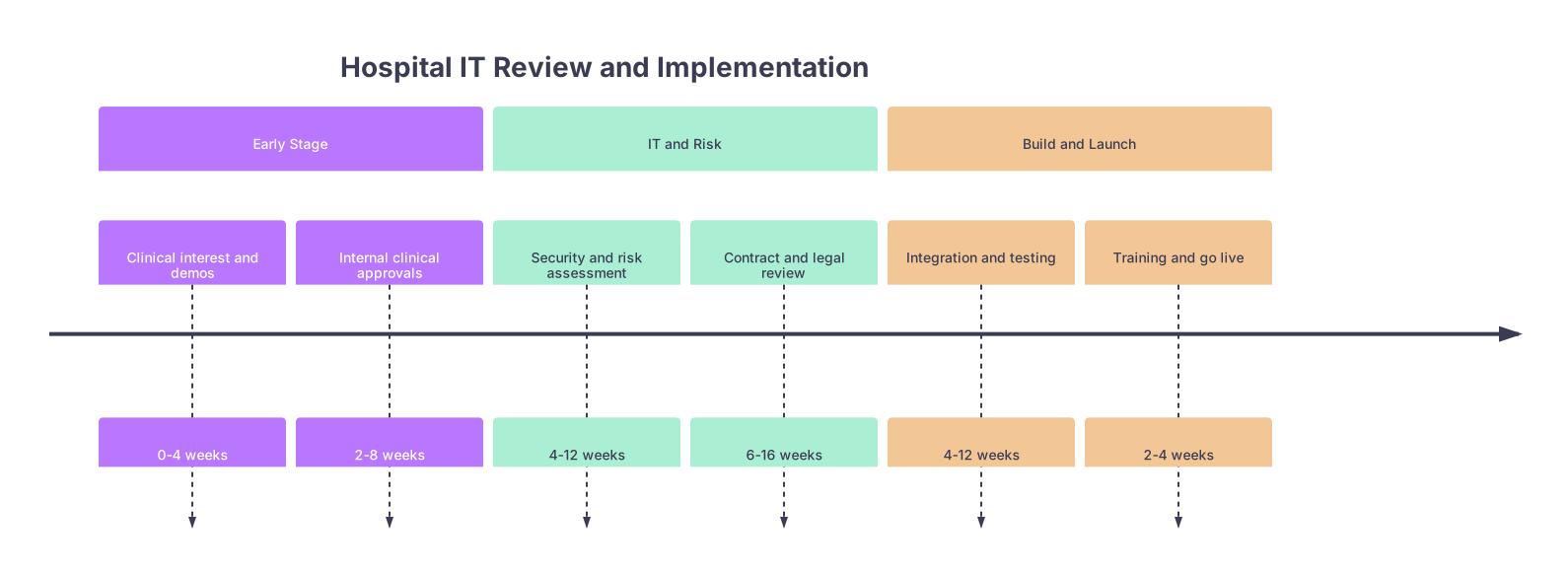
| Period | Event |
|---|---|
| Early Stage - Clinical interest and demos | 0-4 weeks |
| Early Stage - Internal clinical approvals | 2-8 weeks |
| IT and Risk - Security and risk assessment | 4-12 weeks |
| IT and Risk - Contract and legal review | 6-16 weeks |
| Build and Launch - Integration and testing | 4-12 weeks |
| Build and Launch - Training and go live | 2-4 weeks |
If you build your survival runway assuming “fast pilots,” you are setting yourself up for a very slow, very preventable death.
9. Not Aligning Your Product With Hospital Risk Appetite
One of the more painful patterns: strong product, strong idea, still blocked by IT because your risk profile is fundamentally misaligned with where hospitals are in 2026.
Examples:
AI that auto-writes clinical notes but stores a full copy of every note in your cloud.
Hospitals now ask:- Where is this stored?
- How do you prevent model inversion / data leakage?
- What happens if regulators change AI guidance?
Workflow tools that require broad EHR API access scopes when they only need a fraction of that data.
Hospital security: “Why are you reading the entire problem list and all medications for a simple scheduling app?”Solutions that require persistent VPN tunnels or firewall openings from hospital to your small startup’s cloud environment, with no zero-trust story.
You must prove to IT that you are:
- Accessing the minimum necessary PHI.
- Holding data for the shortest necessary duration.
- Built in a way that still works if future regulations get tighter.
If your entire value proposition depends on “give us all the data and trust us,” expect to lose.
10. Failing to Do Basic Homework on IT Requirements Before Selling
The last mistake is almost insulting in how avoidable it is.
Every hospital system has:
- A vendor onboarding process.
- Security and privacy requirements.
- Sometimes, published guidelines for cloud vendors, remote access, and BAAs.
But many physician-founders:
- Pitch widely before reading any of these.
- Discover requirements like “Must be SOC 2 compliant” after months of discussion.
- Realize the hospital flatly will not work with vendors who host data outside specific jurisdictions.
Before you ever schedule a demo with a serious prospect, you should:
- Find their vendor requirements (sometimes public, sometimes by asking).
- Understand their EHR and major tech stack at a high level.
- Confirm whether they require:
- SOC 2
- HITRUST
- ISO 27001
- On-prem options
If their baseline requirement is higher than your current security posture, be honest. Do not bluff and hope to “figure it out later.” You will not. And they will not forget.
What You Should Do Differently
To avoid failing your first hospital IT review, you do not need perfection. You need to stop making rookie mistakes that signal immaturity.
Start by:
Designing for hospital IT from day one.
- Build with PHI, compliance, and integration in mind.
- Separate environments (dev/test/prod).
- Real logging, monitoring, and access control.
Preparing enterprise-grade documentation before your first big pitch.
At minimum:- Security overview / whitepaper
- Architecture and data flow diagrams
- Incident response summary
- Backup and disaster recovery approach
- Clear deployment and support model
Respecting the IT review as a core part of your product-market fit.
Your product is not just what clinicians see. It is also:- What IT can support,
- What security can defend,
- What legal can sign without sweating.
If you treat hospital IT as an obstacle, you will keep losing.
If you treat them as a second “customer” you must earn—with evidence, not enthusiasm—you give your startup an actual chance to survive.