

You have a busy clinic day, an overflowing inbox, and a “simple” idea you are sure will fix a problem you see every single day in practice. You have a deck. You might even have a tiny bit of seed money. What you do not have is an engineer.
So now you are on Zoom at 9:30 p.m. post-call, talking with a smiling “full‑stack developer” who says they can build your MVP in eight weeks. For equity. They “love healthcare.” They “totally get HIPAA.” They nod when you mention FHIR but never spell out the acronym.
This is the exact moment where physician founders make culture mistakes they regret for years.
They think they are hiring “a coder.” They are actually hiring the person who will set the cultural DNA for their entire technical team. And if that DNA is wrong, it will fight them every single day—on speed, quality, ethics, and even basic respect for patients.
Let me walk you through the mistakes I see physicians make again and again when hiring their first engineer, and how to avoid walking into the same buzz saw.
Mistake #1: Treating the first engineer as a contractor, not a co‑founder of culture
Your first engineer might not have a co‑founder title, but functionally, they are one. They define what “good enough” means. They decide how corners get cut. They model how decisions get documented—or not.
The biggest cultural error physicians make here: they hire like they are outsourcing a website, not building a company.
You say things like:
- “I just need you to build this feature list.”
- “We do not need tests yet; this is just an MVP.”
- “We will worry about security later, once we have traction.”
What the engineer hears: This founder does not care about craft, quality, or safety. They care about fast demos. So they optimize around that. They hack things together. They do not write tests. They compromise on security. That mindset becomes the baseline for every engineer who joins later.
The subtle damage: you train your first engineer to think like a “vendor” instead of an owner. Vendors defend scope and hours. Owners defend outcomes and patients.
If the first engineer acts like a short‑term freelancer:
- They will not push back on unsafe or unrealistic timelines.
- They will not design systems that can be maintained by anyone else.
- They will not document tradeoffs for future hires.
Then, when you finally raise a seed round and bring in a seasoned CTO, they spend six months untangling a ball of string that was “good enough for the demo.” You pay for that mindset with equity, time, and your reputation in front of investors and customers.
How to avoid it:
- Frame the role as “technical founding member,” not “developer for my app.”
- Evaluate how they think about long‑term maintainability, not just speed.
- Ask: “If another engineer joins in six months, what will they thank you for? What will they curse you for?”
If their answer is basically “shipping fast,” that is not a founder mindset. That is a contractor with better branding.
Mistake #2: Hiring for tools instead of values
Physicians love credentials. You are trained to trust board scores, fellowship programs, and letters. So you get seduced by tech equivalents: FAANG logos, trendy frameworks, buzzwords like “microservices” and “serverless.”
You say: “We need a React engineer with AWS experience.”
You should be saying: “We need someone who respects patient safety, can handle ambiguity, and is not cavalier with data.”
Wrong filter, wrong hire.
In early‑stage medical startups, culture is not about ping‑pong tables. It is about moral comfort: what corners are you willing to cut? What tradeoffs do you refuse to make?
If your first engineer:
- Shrugs at “small” PHI leaks in dev environments.
- Dismisses clinicians as “non‑technical stakeholders.”
- Treats QA as “nice to have” because “it is just beta users.”
…you are building the wrong company, no matter how skilled they are with Kubernetes.
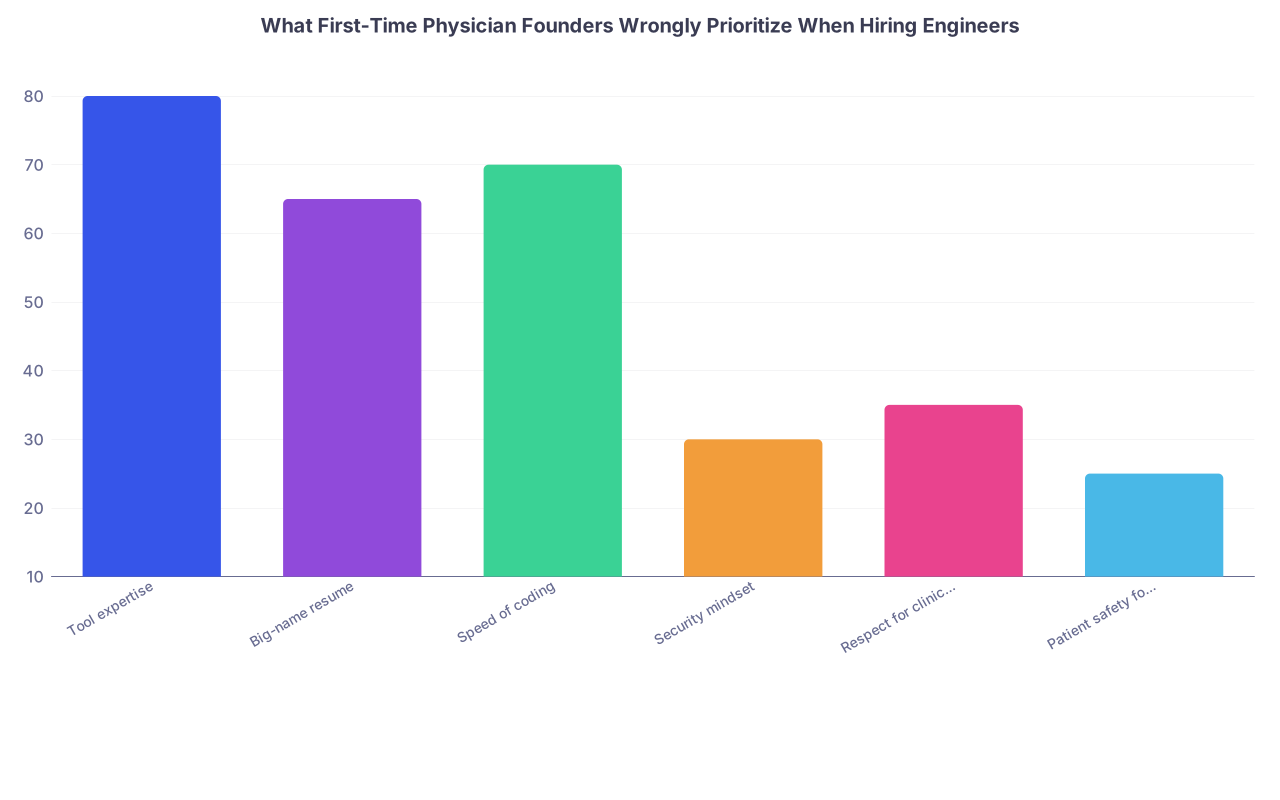
| Category | Value |
|---|---|
| Tool expertise | 80 |
| Big-name resume | 65 |
| Speed of coding | 70 |
| Security mindset | 30 |
| Respect for clinicians | 35 |
| Patient safety focus | 25 |
The pattern I see: founders optimize for the left side of that chart and treat the right side as “bonus.” Then they act surprised when product choices conflict with clinical ethics.
Red flags during interviews:
- They mock or minimize regulatory constraints: “HIPAA is really just a checkbox.”
- They push consumer patterns onto clinical workflows: “Let us just copy what fitness apps do.”
- They talk about “growth hacking” a product that touches prescriptions, diagnoses, or clinical documentation.
Better screen questions:
- “Tell me about a time you slowed down a product launch because of a safety or security concern. What did you do?”
- “Describe a disagreement you had with a non‑technical stakeholder. How did you resolve it?”
- “How do you decide when to ship something that is not perfect?”
If they have no examples of pushing back for safety, you are about to put them in charge of the digital equivalent of your prescription pad.
Mistake #3: Ignoring the MD–engineer power dynamic
Physicians enter this hiring process with a strange insecurity. You are an expert in the domain, but a novice in tech. Many engineers learn to exploit that. Not always intentionally, but it happens.
I have seen engineers:
- Dismiss physician feedback as “edge cases.”
- Insist “the data model cannot handle that” when they really mean “it is annoying.”
- Override clinical nuance because “users get confused by too many options.”
You are used to leading clinical teams where your authority is clear. In a startup, an overconfident engineer can quietly seize product control because they hold the “keys to the code.” If you are not careful, you slide into a pattern where your input is always “optional” and theirs is always “blocking.”
This sets a toxic culture: engineers on top, clinicians as decorative advisors. You end up with a product that works beautifully from a database perspective and fails miserably at real‑world care.

| Step | Description |
|---|---|
| Step 1 | Clinical Need Identified |
| Step 2 | Physician Suggests Feature |
| Step 3 | Engineer Says Hard or Confusing |
| Step 4 | Feature Dropped |
| Step 5 | Feature Built |
| Step 6 | Clinical Needs Underserved |
| Step 7 | Engineer Controls Product Direction |
Notice the missing step? There is no structured negotiation of tradeoffs. No shared decision‑making. Just “engineer veto = reality.”
How to avoid that pattern:
- Make explicit domains: you own clinical safety and regulatory boundaries; they own technical implementation. Product decisions live at the intersection.
- In early conversations, say clearly: “There are areas where I will not compromise—patient safety, clinical accuracy, regulatory compliance. We can flex everything else.”
- Listen carefully when they push back on complexity. But do not accept “too hard” as the final answer. Ask “What would it take?” and “What is the simplest safe version?”
And if you hear condescension or eye‑rolling about “doctors not understanding tech,” stop. That attitude does not magically disappear with more hires. It becomes your culture.
Mistake #4: Hand‑waving HIPAA, clinical risk, and data ethics
You are used to being personally liable. Your signature. Your NPI. Your malpractice coverage.
Your first engineer is often used to shipping consumer apps, where the worst‑case scenario is someone losing a photo or having their game progress reset.
Different world.
I see physician founders make a dangerous assumption: “I am the clinician. Of course we will handle data ethically.” Then they fail to check whether the engineer shares that mental model. Or even understands the basics.
So your MVP ends up with:
- PHI in unencrypted logs.
- Test accounts with real patient data.
- Admin dashboards with no audit trails.
- Slack channels where screenshots of live charts float around “for debugging.”
Then you talk to a hospital, they send you a security questionnaire, and everything stops. You are rebuilding half the stack because your first engineer had never touched a BAA or a security policy before.
| Shortcut | Short-Term Benefit | Long-Term Consequence |
|---|---|---|
| No audit logging | Faster MVP build | Fails enterprise security reviews |
| Hardcoded test patient data | Easy demos | Potential PHI exposure, legal risk |
| Shared admin account | Simpler access control | Zero traceability, compliance failure |
| Using non-HIPAA cloud tools | Cheap, easy integrations | Must be ripped out for hospital deals |
| Emailing CSV exports with PHI | Quick data access | Clear violation, reportable incident |
You must screen for this. Hard.
Ask your candidates:
- “Describe security measures you have used for sensitive data before.”
- “What is your understanding of audit logs and access control in regulated environments?”
- “How would you architect a system that might eventually need to pass a hospital security review?”
You are not testing whether they can quote HIPAA. You are testing whether they instinctively treat user data like a loaded syringe, not a toy.
And if they respond with phrases like “this is overkill for an MVP,” remind yourself: in medicine, there is no such thing as “MVP clinical ethics.”
Mistake #5: Over‑equity, under‑expectations (or the reverse)
Compensation is another culture landmine. Physician founders often overpay with equity and underpay with clarity. Or they lowball everything because “we are pre‑revenue,” then wonder why the engineer is half‑committed.
Here is the dynamic:
- You are comfortable with delayed financial gratification. Residency trained you for that.
- Engineers are not. Their market pays cash now.
- You try to solve that by tossing out large equity chunks with fuzzy expectations. “We will figure vesting later.”
You have just created a culture where:
- No one is clear what “good performance” looks like.
- The engineer learns that boundaries are negotiable if they push.
- Future hires sense chaos when they ask about ownership.
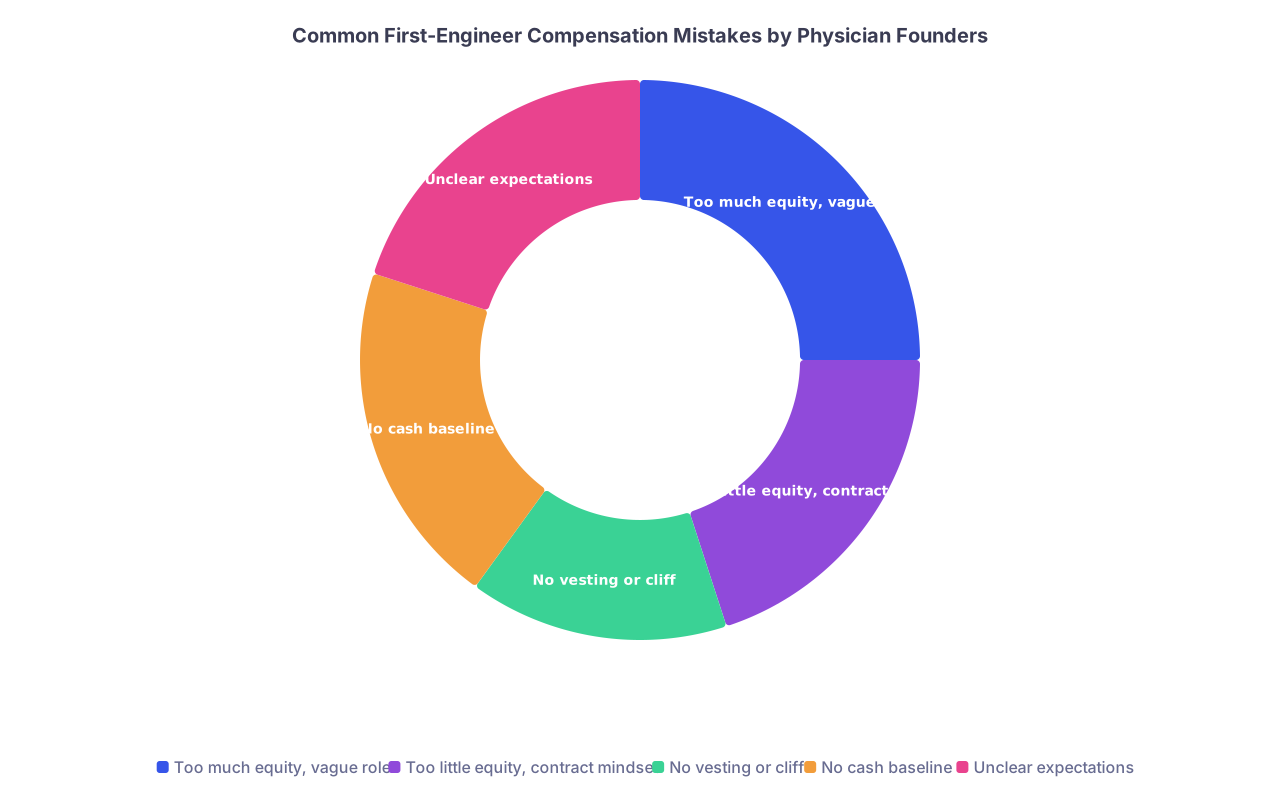
| Category | Value |
|---|---|
| Too much equity, vague role | 25 |
| Too little equity, contract mindset | 20 |
| No vesting or cliff | 15 |
| No cash baseline | 20 |
| Unclear expectations | 20 |
A few guardrails:
- If they are truly a founding technical partner, treat them like one: meaningful equity, a clear title, 4‑year vesting with a 1‑year cliff, and shared accountability.
- If they are not at that level, do not fake it. Give a normal early‑employee grant, reasonable cash, and clear scope.
- Never hand out equity without vesting and at least minimal documentation (even a basic lawyer‑drafted agreement). “We are friends” is not a policy.
The cultural mistake is not the number of shares. It is teaching people that the future of the company is negotiable in back‑channel conversations. That will come back to haunt you when you raise money and your cap table looks like a Jackson Pollock painting.
Mistake #6: Failing to test real collaboration before committing
Medicine has built‑in filters: board exams, OSCEs, letters of recommendation, background checks. Tech hiring, especially at the earliest stage, has none of that by default.
Physician founders often rely on:
- One or two interviews.
- A friend’s referral.
- A GitHub portfolio they do not understand.
Then they sign.
You would never let a new surgeon into your OR based on a single coffee chat and a resume. Yet many founders hand over their product—and implicitly, their patients’ data—exactly that way.
You need a “mini‑rotation” equivalent.
Ways to do it:
- A paid trial project: 1‑2 weeks, clearly defined scope, real code in your repo.
- A joint design session: you and the engineer whiteboard the architecture for a key feature. Look for how they explain, how they ask about clinical constraints, how they respond to pushback.
- A user story mapping session: put your actual workflow on virtual sticky notes (refills, scheduling, triage) and watch how they translate that into system components.
What you are looking for is not genius. It is alignment:
- Do they ask questions about edge cases that matter clinically?
- Do they get frustrated when requirements are not “clean,” or do they handle ambiguity?
- Do they propose shortcuts that maintain safety, or that gamble with it?
If a 7‑day collaboration is painful, a 4‑year vesting schedule will be catastrophic.
Mistake #7: Building a one‑person tech silo
This one is subtle but deadly. You finally hire an engineer you like. They are productive. You are relieved. So you hand everything technical to them. You stop asking questions. You do not ask them to document. You do not bring anyone else near the code.
You have just recreated the worst attending–EMR vendor dynamic inside your own company.
Symptoms:
- Only one person knows how the system actually works.
- Feature timelines become black boxes: you ask, they shrug, “it is complicated.”
- Every future hire must learn from tribal knowledge, not documentation.
Then that engineer burns out. Or leaves. Or you discover they were not as strong as you thought.
Now you are stuck with:
- A codebase no one understands.
- Zero documentation on architecture, decisions, or security.
- A reputation risk if there are hidden shortcuts around PHI handling.
That is not just a tech problem. It is a culture problem: you normalized opacity.
Even with your first hire, start like you plan to have a team:
- Ask for basic architectural diagrams (nothing fancy—just enough so another engineer could orient themselves).
- Require lightweight documentation for major decisions: why we chose X database, why we do not store Y field.
- Establish a norm that nothing lives only in one person’s head.
You are not micromanaging. You are protecting your patients, your investors, and your future employees.
Mistake #8: Confusing “nice” with “aligned”
Physicians are trained to pick residents and fellows partly on “fit.” Do I want to be in the call room with this person at 3 a.m.? Fair question.
In startups, that instinct can trap you. You meet an engineer who is:
- Charming.
- Enthusiastic about your mission.
- Flexible on comp “because I really believe in what you are doing.”
You interpret vibe as alignment. You hear “I love healthcare” as “I understand what happens when a software bug leads to a missed cancer diagnosis.”
Different thing.
A “nice” engineer who:
- Has a high tolerance for gray ethical zones.
- Loves trying hacks “to see what happens.”
- Treats patients like “users” whose data is a monetizable asset.
…will quietly tilt your company into the same cultural swamp as every generic consumer startup.
You are not building a social network. You are building a medical tool, even if the FDA does not classify it that way yet.
So push beyond “nice”:
- Ask what they think about off‑label use of software. “What if clinicians use this feature in a way we did not intend but could be unsafe?”
- Ask about data monetization boundaries. “Would you ever sell de‑identified patient data? Under what conditions?”
- Ask how they feel about being on call for critical issues that might affect real patient care.
If their answers sound like a growth‑hacker blog post, walk away. No matter how friendly they are.
Putting it together: a basic “do not screw this up” checklist
Before you make an offer to your first engineer, you should be able to answer “yes” to all of the following:
- Do they treat this as co‑building a company, not freelancing on an app?
- Have they demonstrated respect for clinical complexity and your expertise?
- Do they have a default bias toward security, auditability, and data minimization?
- Are compensation, equity, vesting, and expectations documented and understood?
- Have you seen them operate in a real working session or trial project?
- Can another engineer, six months from now, understand what they are building?
- Do their ethical instincts around patients and data actually match yours?
If any of those is “no,” that is not a minor issue. That is a culture bug at the root of your system.
FAQ (exactly 3 questions)
1. Should my first engineer be a formal co‑founder?
Not automatically. A co‑founder title and large equity grant should go to someone who brings more than coding: product judgment, hiring ability, long‑term commitment, and genuine ownership of the company’s trajectory. If your candidate wants co‑founder economics but behaves like a contractor—time‑tracking hours, resisting documentation, avoiding responsibility for outcomes—you will regret giving that title. Start with “founding engineer” unless they clearly operate as a true partner.
2. What if I cannot find an engineer with prior healthcare experience?
Healthcare experience is ideal but not mandatory. What is mandatory is humility around the domain, willingness to learn, and a strong track record of working in constrained or regulated environments (fintech, enterprise security, etc.). You can teach them what PHI is. You cannot teach basic ethics and respect for clinical risk to someone who fundamentally sees regulation as an obstacle to be gamed.
3. Is it safer to just outsource development to an agency for the MVP?
Outsourcing can feel safer because you get a “team” quickly, but it often creates worse cultural debt. Agencies optimize for deliverables, not for learning your clinical reality or owning long‑term risk. You end up with a shiny prototype no one wants to maintain, built by people who will not be in the room when a hospital CISO grills you or a clinician points out a safety issue. If you do use an agency, still identify a technical owner—internal or external—who thinks like a future team lead, not a vendor.
Open your current job description or LinkedIn post for that “first engineer” role. Right now, highlight every requirement that is purely about tools or frameworks. Then add at least three explicit expectations about clinical respect, data ethics, and long‑term ownership. If you do not change what you ask for, you will keep attracting exactly the wrong kind of engineer—and you will only realize it when it is very expensive to fix.


