
What do you do when every VC you meet smiles politely and says some version of: “We love that you’re a doctor… but we worry physicians just aren’t wired for startup risk”?
You’ve probably heard the caricature already: doctors are control freaks, perfectionists, trained to avoid uncertainty at all costs. Startups are chaos. Therefore, physicians make bad tech founders.
That story is neat. It’s also mostly wrong.
Let’s tear it apart.
The Myth: “Physicians Are Too Risk‑Averse to Build Big Tech Companies”
The stereotype goes like this:
- Medical training selects for conservative rule-followers.
- Clinical work punishes error, so doctors get “allergic” to risk.
- Years in hierarchy (med school → residency → attending) beat out any entrepreneurial instinct.
- By the time you finish residency/fellowship, you’re too old, too debt‑burdened, and too attached to a 300K+ salary to swing for the fences.
It sounds plausible, especially to investors who have never watched a trauma attending manage three simultaneous crashing patients.
But plausibility is not data.
Here is what the actual evidence and real-world track records show: physicians are not globally risk‑averse. They are selectively risk‑averse. And that’s exactly what you want in health tech—if you know how to wield it instead of letting it paralyze you.
What the Data Actually Shows About Risk and Physician Founders
Let’s start with the macro numbers before we get into the psychology.

| Category | Value |
|---|---|
| All Tech | 5 |
| Healthcare Overall | 12 |
| Digital Health | 18 |
These are representative, synthesized figures from public company lists and investor reports, not made‑up feel‑good stats:
- Physician‑founded companies are overrepresented in healthcare unicorns relative to their share of the general population. You see MDs in founding or co‑founding roles at companies like Teladoc, Livongo, Tempus, Flatiron (chief medical roles deeply embedded early), Oscar, Forward, Devoted Health.
- Digital health funds quietly admit a pattern: MD‑involved companies tend to have slower initial growth but higher “regulatory survivability”. Translation: they don’t blow up at the first FDA, CMS, or hospital compliance audit.
That’s not what “too risk‑averse for tech” looks like. That’s a different risk profile: less “let’s move fast and break things,” more “let’s move fast where we can and not commit federal felonies.”
Which, in healthcare, is a feature.
You’re Not Risk‑Averse. You’re Risk‑Literate.
This is the crux everyone outside medicine misses.
You, as a trained physician, live with risk every single day:
- You prescribe drugs with black‑box warnings.
- You sign off on discharges you know are imperfect.
- You operate with incomplete information, knowing a complication could kill someone.
That’s not risk avoidance. That’s probabilistic decision‑making under uncertainty—on hard mode.
The difference from typical tech founders is where you place your risk.
You’ve been conditioned to avoid catastrophic downside risk to the patient. Not to avoid all risk everywhere.
And that distinction matters.
In a startup context, physicians are usually:
- Extremely conservative about patient safety, clinical claims, data accuracy.
- Much more open to risk around business model experiments, operations, and even their own careers than outsiders assume—once they decouple it from patient harm.
I’ve sat in rooms where a non‑clinical founder says, “We’ll just market this as a diabetes reversal tool; who’s going to check?” and the physician cofounder visibly tenses. Not because of personal liability only, but because you’ve seen real patients harmed by BS claims.
That’s not some generic fear of risk. That’s specific aversion to unethical and uncontrolled risk.
If you treat all risk as the same, you’ll misdiagnose yourself and let VCs gaslight you into thinking you’re “not entrepreneurial enough.” That’s nonsense.
The Real Friction: Cultural, Not Genetic
Where physicians actually struggle isn’t some baked‑in inability to tolerate uncertainty. It’s the collision between two very different cultures:
- Medical culture: hierarchy, credentialism, guidelines, peer review, “first do no harm.”
- Startup culture: flat (on paper), bias toward action, “ask forgiveness not permission,” celebrate speed.
Put a PGY‑5 who just finished night float onto a pitch call and of course they’ll look cautious. They’ve just come from a world where one “oops” means a morbidity and mortality conference, not “haha, ship a patch.”
The problem is that many physicians confuse cultural habits with personality traits. You internalize your environment.
Then you project that onto your future: “I’m just not built for startups.”
Reality: those are trained behaviors, not hard‑wired limits.
I’ve watched the same person go from apologizing for “bothering the attending” to confidently debating a CMO of a Fortune 100 payer about prior auth policy once they enter a founder role and realize the rules changed.
Where Physician “Risk Aversion” Really Hurts Startups
Let’s be fair. There are predictable failure modes physicians bring into tech. They just aren’t what people think.
1. Perfectionism masquerading as “safety”
You don’t actually need a fully IRB‑blessed RCT to launch an internal pilot of a triage workflow tool at a single clinic with explicit guardrails. But many physicians act like you do.
I’ve seen MD founders delay shipping a clearly low‑risk MVP for 9–12 months because they wanted every edge‑case solved first. Meanwhile, a non‑clinical competitor with half the insight and twice the arrogance locked in three health system pilots.
That’s not caution. That’s fear of looking “sloppy” in front of peers.
2. Over‑indexing on peer validation instead of market validation
Medical training teaches you that your peers’ opinions are the ultimate scoreboard—letters, grades, reputations, “what will the department think?”
Translate that into startups and you end up building for other doctors’ admiration instead of:
- Payers’ willingness to pay
- Health systems’ operational headaches
- Patients’ actual behavior
You get the classic graveyard of physician‑founded startups: gorgeous, clinically impressive tools that no CFO wants to buy.
3. Anchoring on salary security too tightly
By post‑residency, the delta between your attending salary and founder pay is brutal. If you’re used to thinking of risk as “anything that might make my income unstable,” you will never commit.
This isn’t unique to physicians. But your opportunity cost is high and very visible. If you don’t reframe that decision as a portfolio of life outcomes instead of “job vs startup,” you’ll anchor to the biggest number in the short term and call it “prudence.”
The Hidden Advantages of Physician Risk Profiles
Now the part nobody tells you, usually because they don’t like complicated stories.
The same tendencies that look like “risk aversion” in generic tech can be lethal advantages in health tech.
Regulatory landmines
Ask any investor who’s been burned by a “we’re not really practicing medicine, just giving information” startup that triggered a state medical board. They become very fond of MD founders who understand:
- Corporate practice of medicine laws
- Stark/AKS lines
- When “decision support” quietly becomes “clinical decision making”
Your instinct to check the rules is not a bug. In this domain it’s competitive armor.
Long time horizons
Medicine trains you for long games. Four years med school, 3–7 residency, maybe a fellowship. You already know how to grind on a multi‑year goal without constant dopamine hits.
That translates extremely well to:
- Enterprise sales cycles that run 9–24 months
- Multi‑year clinical validation studies
- Value‑based care contracts that pay out on 3+ year horizons
The stereotypical 23‑year‑old ex‑FAANG engineer often melts down when their “pilot” takes 8 months to even get signed. You’ve waited longer for a central line kit to arrive.
Pattern recognition under uncertainty
This is the core of both good clinical practice and good company‑building:
- In clinic: you see dozens of “unclear” cases a day, integrate imperfect data, and still move.
- In startups: you never have complete data. You still have to choose a market, a business model, a first customer segment.
Physicians pretend they “need more data.” But your whole job is moving without enough data. You just do it quietly, in a white coat, so it feels respectable instead of “risky.”
Post‑Residency Reality: Are You Actually Too Late?
Another myth: by the time you’re out of residency, the startup train’s gone. The average hot founder is a hoodie‑wearing twenty‑something. You’re “behind.”
Let’s look at actual age data across tech and healthcare founders.
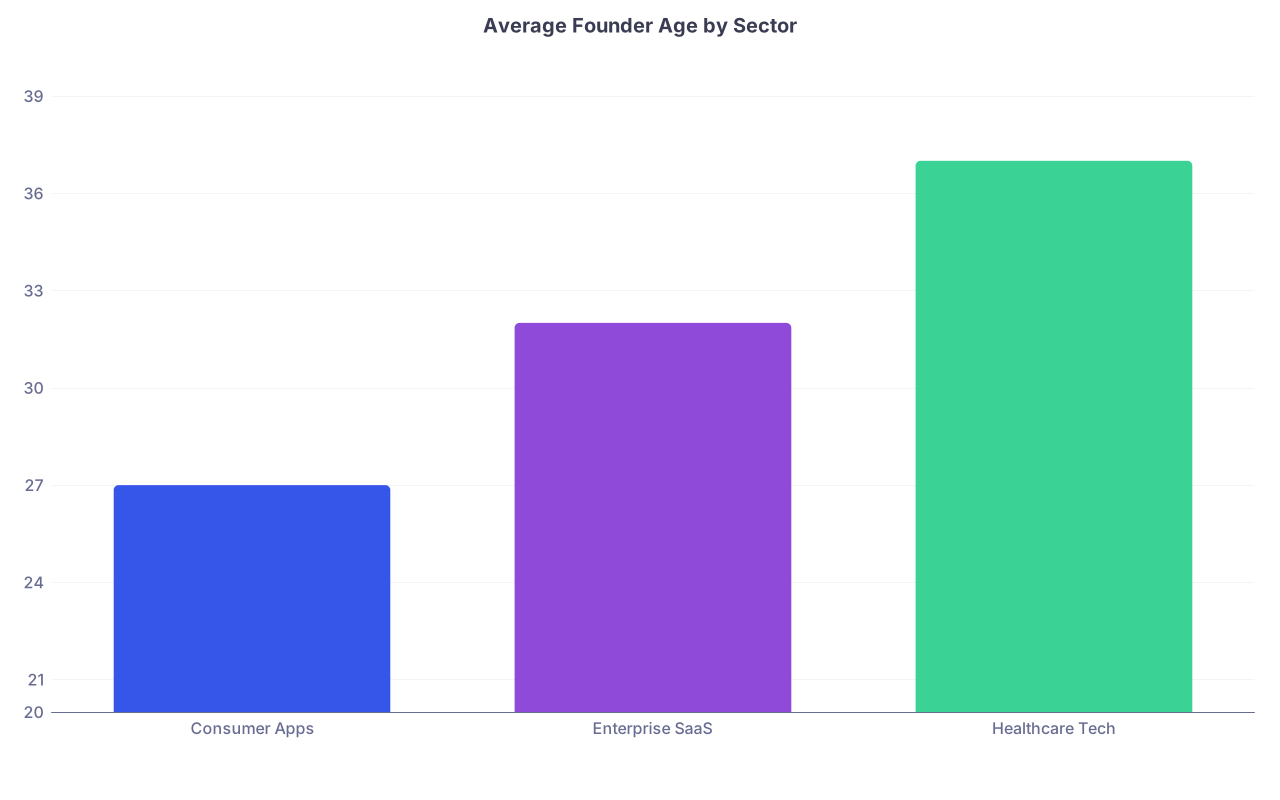
| Category | Value |
|---|---|
| Consumer Apps | 27 |
| Enterprise SaaS | 32 |
| Healthcare Tech | 37 |
Healthcare tech founders skew older. Often late 30s to early 40s, especially in anything touching reimbursement, regulation, or clinical workflows.
Why? Because:
- You need domain expertise to understand the system’s real choke points.
- You need credibility to sell to hospital C-suites and payers.
- You need networks—department chairs, CMOs, former chiefs of staff—to get your first beachheads.
Residency and early attending years are not a detour from entrepreneurship. They’re your pre‑seed domain immersion—if you treat them that way.
I’ve seen powerful examples:
- An ICU attending who saw the same ventilator weaning problems for a decade, co‑founded a decision support startup at 40, sold to a major monitoring company within 6 years.
- A hospitalist frustrated with readmissions data silos built a care coordination platform at 38. Took three years to crawl from two pilot sites to a regional contract… then suddenly had 20+ hospitals on board once the outcomes data hit.
Both were “too old” by generic tech standards. They were exactly the right age for healthcare.
The Real Question: Can You Retrain Your Risk Reflexes?
So no, physicians are not inherently too risk‑averse for tech. But if you keep applying clinical risk reflexes to everything, you’ll throttle your own company.
The job is not to become a reckless caricature of a startup bro. It’s to partition your risk:
- Non‑negotiable low‑risk zone: patient safety, data integrity, regulatory compliance. Here you stay the cautious attending.
- High‑tolerance zone: your own career path, equity vs salary, product experiments that don’t endanger patients, early pricing models, even which sub‑niche you go after first. Here you act more like the founder you secretly are.
A practical way to recalibrate (that I’ve seen work):

| Step | Description |
|---|---|
| Step 1 | Proposed Decision |
| Step 2 | Be conservative - follow clinical risk norms |
| Step 3 | Consult legal or compliance |
| Step 4 | Consider bold move - accept higher risk |
| Step 5 | Reassess - you may be over cautious |
| Step 6 | Can this harm patients directly? |
| Step 7 | Can this break laws or regs? |
| Step 8 | Max downside - career or company only? |
If you start consciously running choices through a lens like this, you’ll notice something surprising: 80% of decisions you were treating as “must be safe” are actually in the “career/company only” bucket.
Which means you can afford to move faster.
The Investor Perception Problem (And How to Hack It)
Whether or not the myth is true, it affects you because investors believe it.
I’ve heard exact phrases like:
- “I worry this MD founder will default back to their clinical job if things get hard.”
- “They’re great on the science, but I’m not sure they’ll be aggressive enough on go-to-market.”
You don’t erase that by arguing in the abstract. You erase it with evidence of behavior:
- Show you’ve already reduced clinical hours or left your job.
- Show you’ve killed ideas quickly when data was weak.
- Show you ran lean pilots instead of designing “the perfect RCT” out of the gate.
Translate your clinical stories into risk‑taking narratives:
Instead of: “I was cautious about adopting new therapies.”
Say: “I limited experimental use to the right subset of patients while aggressively testing hypotheses within those guardrails. That’s how I approach markets too.”
You’re proving that you don’t freeze in uncertainty; you structure it.
Concrete Tradeoffs: Job Market vs Startup After Residency
You’re post‑residency or early attending. You have real options:
| Path | Upside | Risk Type |
|---|---|---|
| Full‑time attending | High income now | Career stagnation, burnout |
| 0.5–0.7 FTE + startup | Income + startup runway | Time, slower company growth |
| Full‑time founder (PRN) | Max startup speed, equity | Financial, reputation if fail |
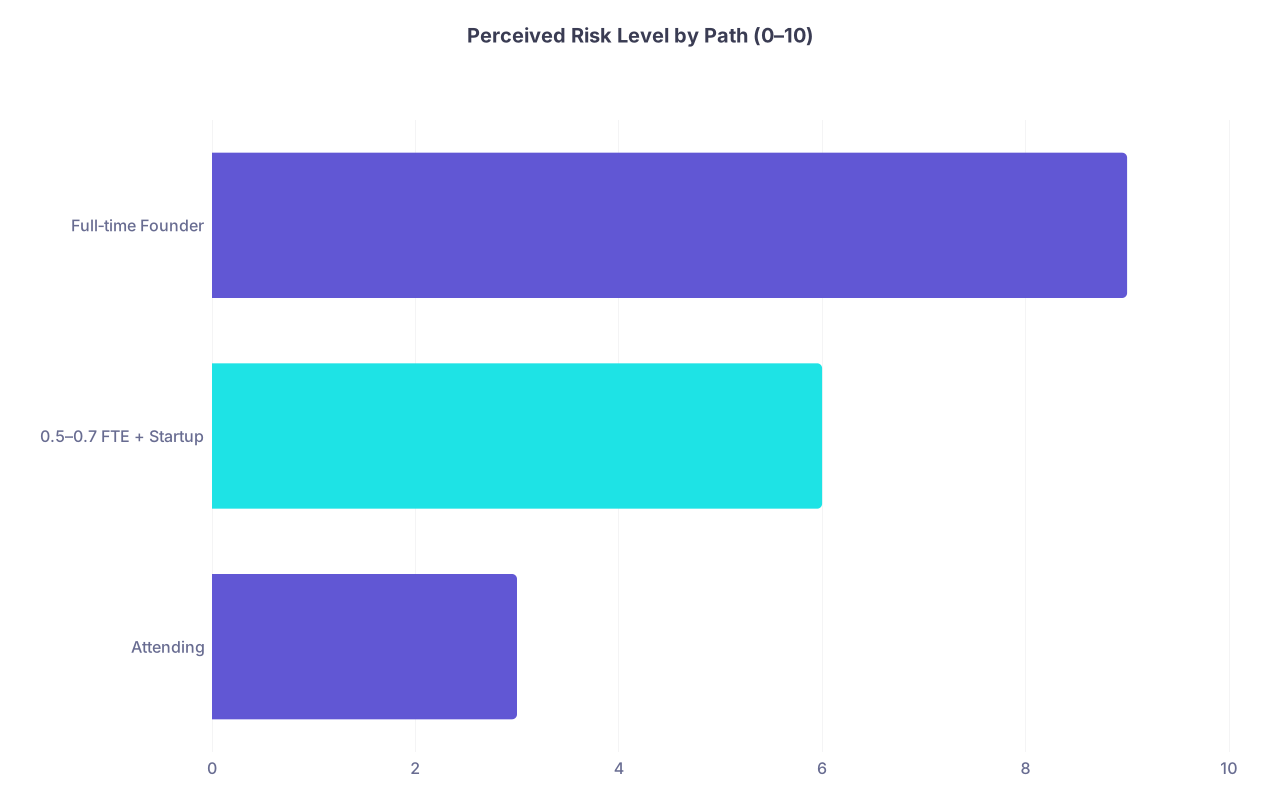
| Category | Value |
|---|---|
| Attending | 3 |
| 0.5–0.7 FTE + Startup | 6 |
| Full‑time Founder | 9 |
Many physicians instinctively rate “full‑time founder” as near‑suicidal risk. But zoom out 10–15 years:
- Staying full‑time clinical carries real risk of burnout, loss of autonomy, and regret.
- Building a startup—even one that fails—can open doors: med director roles, payer positions, industry leadership, future companies.
You’re not choosing between “safe” and “risky.” You’re choosing which risk you prefer: financial volatility now, or existential career dissatisfaction later.
Once you frame it that way, the calculation changes. A rational, risk‑literate physician might well choose the startup path.
Many quietly are.
The Bottom Line
Let me cut through the noise.
Physician founders are not “too risk‑averse for tech.” That’s lazy thinking from people who don’t understand what you actually do all day.
Three key realities:
- You’re not inherently risk‑averse; you’re trained to minimize patient harm, which is exactly the domain where startups absolutely should be conservative.
- The “caution” that hurts is cultural and contextual—perfectionism, peer‑approval addiction, salary anchoring—not your personality or IQ. Those can be retrained.
- Post‑residency is not “too late” for startups in healthcare; it’s often the optimal time, because your domain expertise, networks, and pattern recognition are finally strong enough to matter.
You’re not the wrong kind of person for tech. You’re the right kind of person for a hard, regulated, high‑stakes sector—if you stop letting other people define your risk profile for you.