

The belief that “if you improve outcomes, the business will take care of itself” is one of the fastest ways to kill a medical startup.
It feels noble. It feels “doctor-y.” It’s also wrong.
Plenty of clinically effective solutions die every year. Randomized controlled trials, glowing before‑and‑after graphs, patients who genuinely do better—and the company still runs out of cash, gets buried in procurement hell, or is quietly shelved after a “pilot.” As a post‑residency doc stepping into the startup world, you’re entering a system where clinical outcomes are necessary… and still wildly insufficient.
Let’s pull this apart like adults, with data, not vibes.
The Harsh Reality: Health Outcomes ≠ Business Value
Here’s the ugly truth: most US healthcare organizations do not get paid directly for “better health.” They get paid for codes, encounters, and contracts. Value-based care is growing, but fee-for-service isn’t exactly dead.
So when you say, “We reduce hospitalizations by 20%,” but your buyer’s revenue depends on hospitalizations, your “good outcome” is literally a financial threat.
Look at what the evidence actually says.
A 2022 review of digital health startups: the majority that survived past Series B had one thing in common—not just “strong outcomes,” but a clear, defensible path to revenue tied to how payers or systems actually make money or save money in ways they care about. The graveyard is full of startups that:
- Lowered readmissions without aligning with any penalties or contracts
- Improved A1c without helping a system hit a specific quality metric or bonus
- Reduced ED visits for a hospital that profits from ED volume
You think you’re selling clinical impact. The buyer is scoring you on revenue impact, margin impact, operational pain relief, and risk.
Those are not the same thing.
Why “But Our RCT Was Positive!” Does Not Impress the CFO
You’ve been trained for years that the pinnacle of proof is an RCT in NEJM or JAMA. In the hospital, that matters. In the boardroom, that’s like showing up to a construction site with a beautifully written novel.
It’s not the wrong skill. It’s the wrong tool for the job.
Most buyers—hospital executives, payers, large employers—are not asking, “Does it work?” They’re asking, “Does it work for us, in our context, and will it move the metrics that control our bonus and our survival?”
Let me be blunt: your clinical outcomes paper is marketing collateral, not a go‑to‑market strategy.
What actually moves the needle?
- A clear reduction in something they’re penalized for (e.g., readmissions for specific DRGs)
- A clear boost in something they’re bonused for (HEDIS, STAR ratings, shared savings, MA star ratings)
- Reducing a cost line that’s actually material to their P&L
- Helping them avoid regulatory or legal risk
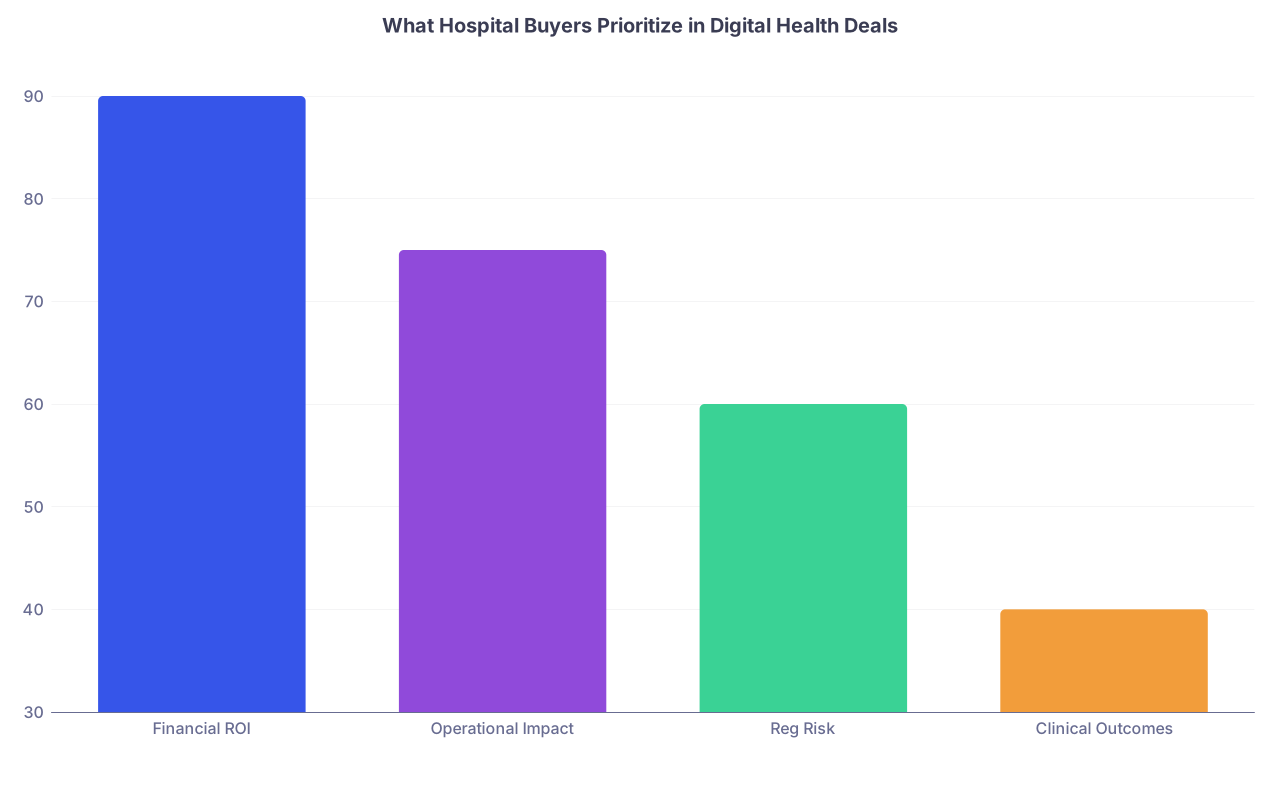
| Category | Value |
|---|---|
| Financial ROI | 90 |
| Operational Impact | 75 |
| Reg Risk | 60 |
| Clinical Outcomes | 40 |
That’s the mental stack. Clinical outcomes matter, but they usually come in fourth, not first. You can cry about how that’s broken, or you can design your startup around the reality.
The Incentive Mismatch Nobody Warned You About
You spent your entire training in environments where the “unit” of value was the patient in front of you.
Healthcare finance does not work that way.
Health plans, health systems, self‑insured employers, and digital health benefit managers all have different incentive structures. If you ignore them, your clinically beautiful product will die on the vine.
Let’s simplify a few common cases:
| Buyer Type | Your Product Lowers Hospitalizations | Likely Reaction |
|---|---|---|
| Fee-for-service hospital | Lowers revenue | Hostile or lukewarm |
| ACO / risk-bearing group | Lowers total cost of care | Very interested if savings clear |
| Self-insured employer | Fewer high-cost claims | Interested if it hits premiums |
| Medicaid MCO | Depends on state contract & metrics | Interested only if tied to bonus |
Same clinical outcome. Four different business stories.
I’ve watched startups brag “We cut admissions 18%!” while trying to sell to hospital executives whose surgical volume and bed occupancy were already slipping. They got politically iced out, no matter how many p-values were below 0.05.
You want your startup to succeed? Design the product and pitch around who financially wins with your success. Not what looks good in a journal abstract.
Product-Market Fit in Medicine Isn’t “Patients Like Us”
Another myth: if patients love it and outcomes improve, scaling is inevitable.
Not in this industry.
Patients are not your primary buyer for 95% of B2B medical startups. They can be users, advocates, and anecdote generators. But if you’re trying to sell to:
- Health systems
- Payers
- Employers
- Governments
…then the definition of product‑market fit is brutally simple:
- A repeatable group of buyers
- Who feel a painful problem
- That your product solves
- In a way they can pay for, implement, and justify internally
Patient satisfaction and NPS help with #2 and #4, but they are side supports, not the foundation.
I’ve seen patient‑loved solutions—beautiful UI, high engagement, lower symptoms—get killed because:
- “IT says this doesn’t integrate with our EHR and we can’t afford another silo.”
- “We don’t have the staff to support this workflow change.”
- “Our quality team is focused on readmissions and MA stars this year, not your metric.”
- “Legal is nervous about data sharing in your model.”
None of that shows up in your outcome graph. All of it decides your fate.
Execution, Not Efficacy, Is What Usually Fails
Here’s a pattern you start to see after a few cycles:
Most healthcare startups don’t fail because the medicine is wrong. They fail because:
- No one clearly owns implementation on the customer side
- Training is painful and adoption is shallow
- Data integration is a nightmare
- Reporting doesn’t match what the buyer needs to show their boss
Your outcomes study probably used a best‑case scenario: motivated clinicians, selected patients, tight protocols. That’s not real life.
Real life is:
- A burned‑out nurse manager who sees your product as “one more thing”
- A CFO asking, “How quickly do we see savings, and how do I know they’re real?”
- A CMIO suspicious of any system that adds clicks
- A medical director whose bonus depends on a different subset of metrics than you’re promising to move
You’re not just selling effectiveness; you’re selling friction reduction. Every extra login, extra click, extra meeting—those are taxes on adoption.
This is why solid clinical outcomes don’t guarantee survival: the adoption curve is governed by workflow, politics, and budget cycles, not clinical significance.
Data: Startups Win When They Speak Money and Risk
Let’s stop with the hand‑waving and be specific.
Look at some of the digital health companies that have actually broken through—Teladoc (telehealth), Livongo (diabetes), Oak Street Health (value-based primary care), etc. Yes, they all talk about outcomes. But what did they sell to buyers?
- Livongo: reduced diabetes complications → framed as total cost of care savings, with employer‑friendly ROI reports
- Oak Street: better primary care → pitched as risk‑bearing entity that could take on Medicare Advantage patients and own the downside risk
- Teladoc: convenient care → pitched to employers and plans as a claims/ER diversion and member satisfaction play
Contrast that with the long line of “we reduce physician burnout,” “we improve care coordination,” or “we track symptoms better” startups that never figured out where the money came from.
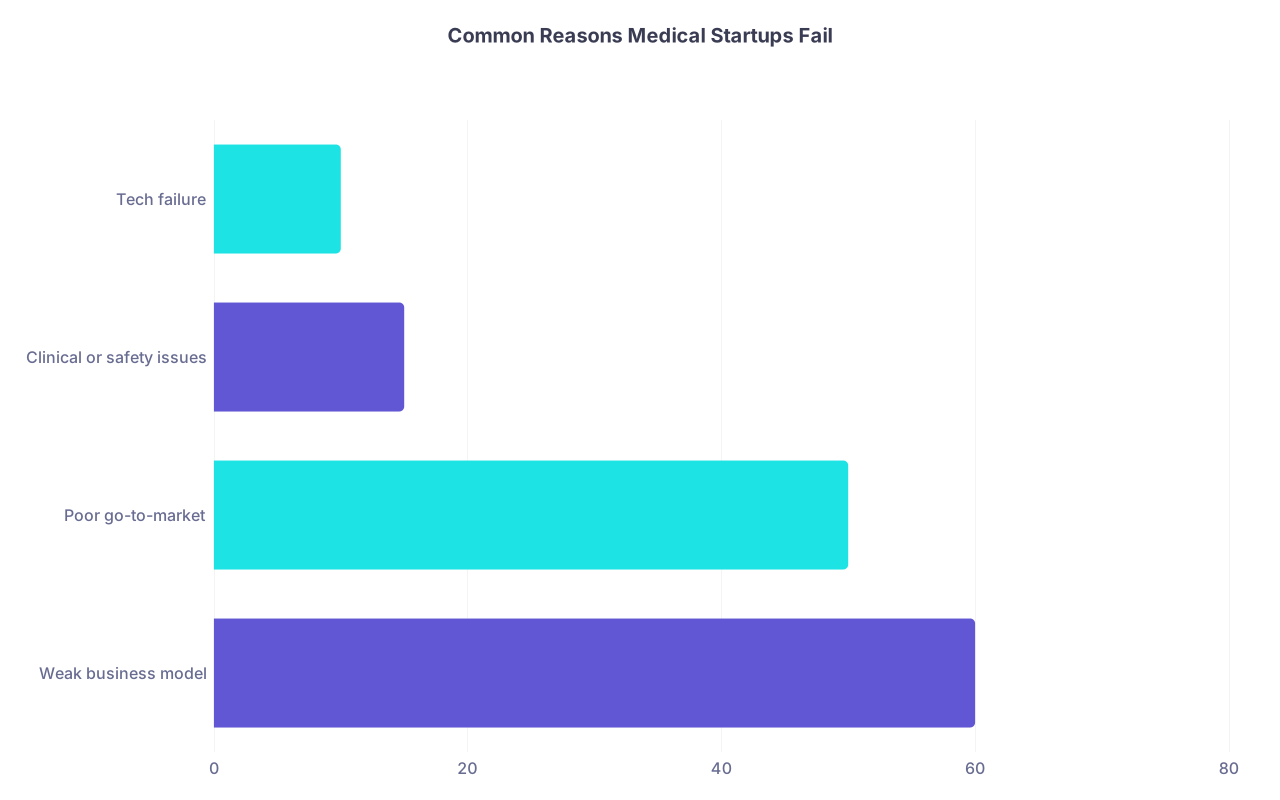
| Category | Value |
|---|---|
| Weak business model | 60 |
| Poor go-to-market | 50 |
| Clinical or safety issues | 15 |
| Tech failure | 10 |
Clinical or safety issues are not the top killers. Business model and go‑to‑market are.
You can hate that. But you cannot ignore it and expect to win.
Common Clinical Founder Myths That Kill Startups
Let’s hit a few myths I see over and over from physicians leaving residency or early in practice to build “impactful” companies.
Myth 1: “If we prove this works, the system will adopt it”
Evidence helps you cross the credibility threshold. It does not close deals.
I’ve watched founders spend two to three years chasing IRB approval, trials, and publications while their runway quietly burns and competitors race ahead with simpler, less “pure” evidence but a better business story.
You need enough evidence to not look like a scam. Beyond that, incremental p-values won’t fix a broken revenue model.
Myth 2: “We’ll get paid because we save the system money”
Savings are irrelevant if:
- You can’t attribute them clearly
- You can’t measure them in the buyer’s language
- The person paying doesn’t actually benefit from the savings
If your intervention saves a payer $10 PMPM but your contract is with the health system that loses admissions revenue, you’ve just created a political problem, not a value prop.
Myth 3: “We’ll charge per user / per patient because that’s fair”
Pricing is not about fairness. Pricing is about aligning with how budgets are actually structured.
Budgets are often annual, siloed, and built around:
- PMPM rates
- Per-member fees baked into admin budgets
- Project-based “innovation” line items
- Grants and pilot funds that disappear next year
So a clinically “reasonable” price per patient may be a non‑starter if there’s no budget owner who can sign it.
What You Actually Need Beyond Good Outcomes
So if “good outcomes” aren’t enough, what does a medical startup need to actually survive?
Here’s the uncomfortable checklist:
- A clearly defined economic buyer (title, department, budget line)
- A revenue story tied to their incentives: cost savings, revenue protection, bonuses, risk mitigation
- Implementation that reduces, not adds, friction to existing workflows
- Evidence that maps to their language: avoided admissions for penalty DRGs, improved MA star ratings, reduced PEPM cost, etc.
- A path from pilot to scale that isn’t just “if the pilot works, they’ll expand” (they won’t, unless the internal champion can justify it politically and financially)
That’s what separates clinically effective curiosities from real companies.

| Step | Description |
|---|---|
| Step 1 | Clinical Effectiveness |
| Step 2 | Grant Dependent Toy |
| Step 3 | Low Adoption |
| Step 4 | Endless Pilots |
| Step 5 | Scalable Contracts |
| Step 6 | Real Company |
| Step 7 | Business Case Clear |
| Step 8 | Workflow Fit |
| Step 9 | Economic Buyer Identified |
Notice where most teams die: no business case, terrible workflow fit, or no true buyer.
How to Think Differently as a Post‑Residency Founder
If you’re just coming out of residency or a few years into practice, you’ve been conditioned to optimize for:
- Diagnostic accuracy
- Treatment outcomes
- Documentation quality
- Peer approval
The startup world optimizes for:
- Unit economics
- Distribution channels
- Operational efficiency
- Investor and buyer approval
You don’t have to become a spreadsheet‑obsessed MBA caricature. But you do need to unlearn the idea that “the best clinical solution wins.” That’s simply not how markets behave.
Start asking different questions:
- Who loses money if my product works? Are they in the room?
- Which line item on the P&L does this move, and by how much, and in what time frame?
- Who personally looks good—or bad—if this fails or succeeds?
- What does my champion need to bring to their CFO to not get shot down?
That’s the real medicine of startups: treating the health system as the patient, with incentives as the disease.
The Bottom Line
Good clinical outcomes are table stakes, not a winning hand.
If you want your medical startup to actually survive—not just publish and die—you need to accept three uncomfortable facts:
- Health outcomes don’t automatically translate into business value; you must design around financial incentives, workflows, and risk.
- Most failed startups die from weak business models and poor go‑to‑market, not bad medicine. Your RCT will not save a broken revenue story.
- Success requires speaking the language of buyers—money, risk, and operations—just as fluently as you speak the language of p‑values and guidelines.
You already know how to improve patient outcomes. If you want a startup that lives, learn how to improve buyer outcomes too.


