

The default advice that “you need VC money to build a serious medical startup” is lazy, wrong, and often dangerous to physicians. Especially post‑residency.
If you’re a doctor stepping into the job market and thinking about a startup, “more funding” is not automatically better. In many cases, it is the single fastest way to lose control of your idea, your time, and your career.
Let’s cut through the mythology and get to what the data and real outcomes actually show.
The Funding Myth in Medical Startups
Medical founders get sold a story: raise a big round, quit clinical work, hire a team, “blitzscale,” then IPO or exit to Optum/United/Big Tech. The tech press amplifies this. Incubators reinforce it. Your non‑clinical MBA buddy tells you, “No serious investor will touch you unless you go all‑in.”
Here’s what actually happens to most venture‑backed health startups:
- The majority never reach profitability.
- Many are acquired for “acqui‑hire” prices that wipe out common shareholders (you).
- A chunk quietly die after burning through millions on sales teams and integrations that never fully deploy.
- A tiny minority become the success stories you keep hearing about.
And those headlines distort your risk perception.
Look at digital health funding data from Rock Health and similar sources over the last decade: dollars raised have exploded, but exits and sustainable profitability haven’t kept pace. There’s a huge graveyard of once‑hyped companies that you will never hear about, because “we burned $40M and sold assets for $2M” doesn’t make good PR.
For physicians, the cost is higher than just ego. You’re trading:
- Clinical income
- Hard‑earned credentials
- Professional reputation
- Years of opportunity cost
…for a bet that only works if you fit the VC growth pattern: massive market, fast adoption, scalable tech, and huge exit potential.
That is not what most real medical problems look like.
What Bootstrapping Actually Looks Like (For Doctors)
Bootstrapping isn’t “never raise money.” It’s starting with customer money and minimal outside capital so you control the pace, direction, and risk.
For post‑residency physicians, bootstrapping is uniquely viable because you already have:
- A six‑figure earning engine (your clinical job or locums)
- Deep domain knowledge
- Built‑in access to users (patients, colleagues, admins)
- A network for early pilots
You’re starting with advantages that most tech founders would kill for.
Typical bootstrap pattern I’ve seen work:
- You keep a 0.6–1.0 FTE clinical job for stability.
- You build a narrow product that solves a painful, specific problem in your own workflow or department.
- You sell to 1–3 customers before building a huge product roadmap.
- You use revenue plus small savings to fund incremental development.
- You only talk to investors after you’ve proven two things: repeatable use and someone is actually willing to pay.
This does not look glamorous on LinkedIn. No slick announcement of a $5M seed. No TechCrunch feature. No accelerator demo day clip with fake standing ovation.
What you get instead:
- Real product–market fit pressure from day one.
- Clearer control over your schedule—you’re not signing a 10‑year career over to a board.
- Time to figure out if you even like being a founder.
More importantly, you keep control of the cap table and decisions when your product is still fragile.
VC Money: What You Actually Trade Away
The standard pitch is: VC gives you fuel to go faster. True. But the part they don’t emphasize: faster toward what and on whose terms?
When you take significant VC money (say, $2–5M+), you are usually agreeing to:
- Aggressive growth expectations and timelines
- Preference stacks that put you last in a mediocre exit
- A board that can eventually fire you
- Strategic constraints (“No, we’re not going after that niche, it’s too small.”)
In medical startups, the mismatch gets worse because:
- Sales cycles to hospitals, payers, and health systems are 9–18 months.
- Integration and regulatory overhead are slow and expensive.
- Doctors can’t just hack around compliance “to move fast and break things” without risk.
So you get forced into a game where:
- You must show explosive growth in a system that intrinsically moves slowly.
- You’re pushed to chase large RFPs and national accounts before proving your product in a few small ones.
- You neglect depth of clinical value for shallow adoption metrics that look good in a deck.
The investor’s portfolio can absorb 8 out of 10 failures. Your career can’t.
Let me be blunt: for a physician founder fresh out of residency, owning 80–90% of a modest but profitable company is often far better—in money, autonomy, and sanity—than owning 10–20% of a highly dilutive, chronically unprofitable VC rocket ship that might, maybe, someday exit.
| Factor | Bootstrapped Path | VC-Funded Path |
|---|---|---|
| Control over decisions | High | Moderate to low |
| Time pressure | Lower, self-imposed | High, investor-driven |
| Risk to personal finances | Lower if you keep clinical | Can be high if you quit |
| Product scope early on | Narrow, focused | Broad, market-grab driven |
| Likely equity at exit | Larger % of smaller pie | Smaller % of bigger (maybe) |
Where VC Money Helps – And Where It Hurts
VC isn’t evil. It’s just a tool that’s misused and overprescribed.
There are health startup cases where outside capital makes sense early:
- Capital‑intensive tech: medical devices, implants, robotics, advanced imaging AI that requires large R&D teams and trials.
- Deep regulatory pathways: PMA devices, therapeutics, anything needing multi‑site trials before first revenue.
- Infrastructure heavy: building a new virtual specialty clinic network across multiple states with clinicians on payroll from day one.
If you’re trying to build the next Intuitive Surgical, bootstrapping isn’t going to cut it.
But most MD‑led startups I see post‑residency are not that. They’re:
- Workflow tools
- Niche telehealth models
- Analytics and dashboards
- Specialty specific care coordination
- Patient engagement software
- Subscription education or decision support
For these, you absolutely do not need millions in VC to find out whether anyone will use, pay for, and keep using your product.
And yet people raise giant rounds for:
- A care coordination app that could’ve started with 10 clinics and one dev.
- A “doctor marketplace” that has never actually matched more than a few dozen patients.
- A remote monitoring platform selling to hospital systems before proving it in a single motivated practice.
Result: pretty dashboards, nice PR, and then a slow bleed when the buyer (hospital) never fully deploys.
The Hidden Costs for Post‑Residency Founders
If you’re just finishing residency or fellowship, your situation is not the same as a 23‑year‑old founder with no dependents and nothing to lose.
You might have:
- Six‑figure loans
- Family responsibilities
- Visa complications
- A reputation in a relatively small specialty community
Throwing all of that into a single high‑risk VC bet on day one is reckless, not bold.
The supposed “opportunity cost” of staying clinical is wildly overstated in tech circles. A board‑certified physician working part‑time still has substantial earning power and reversible options. A founder who walks away from practice completely for 5–10 years often doesn’t.
There’s another cost: once you raise, you’re no longer building just a tool or a service. You’re building a financial product for a very specific buyer: your future acquirer. That buyer wants certain metrics and behaviors that may or may not line up with what’s actually good for patients and clinicians.
You’re not naïve. You know misaligned incentives run through the entire health system. Adding misaligned investor incentives on top of those is not automatically a win.
The Evidence: Outcomes Aren’t What You Think
Let’s quantify a bit.
VC funds operate on power laws: a tiny fraction of their investments drive almost all returns. In health tech specifically, post‑hoc reviews of digital health cohorts show:
- The majority of companies never reach $10M ARR.
- Time to exit, if it happens, is longer than the typical fund life cycle likes (bad for you when they push liquidity).
- Many “exits” are survival transactions—selling for less than capital raised.
Founders don’t advertise these outcomes, but you can see them buried in SEC disclosures, down‑round press releases, or LinkedIn job changes that suddenly skip mention of that “revolutionary platform.”
By contrast, bootstrapped and lightly funded health companies:
- Often grow slower.
- But are more likely to be profitable.
- Are more likely to remain controlled by original founders.
- Can be sold on sane multiples of profit or revenue without needing a unicorn valuation to “clear” a massive preference stack.
You’re not choosing between “raise and win big” or “bootstrap and stay small.” Most of the time, your actual choice is:
- Raise too early, lose control, and face a high chance of failure on someone else’s terms.
- Start small, validate, and then decide whether outside capital is fuel or a leash.
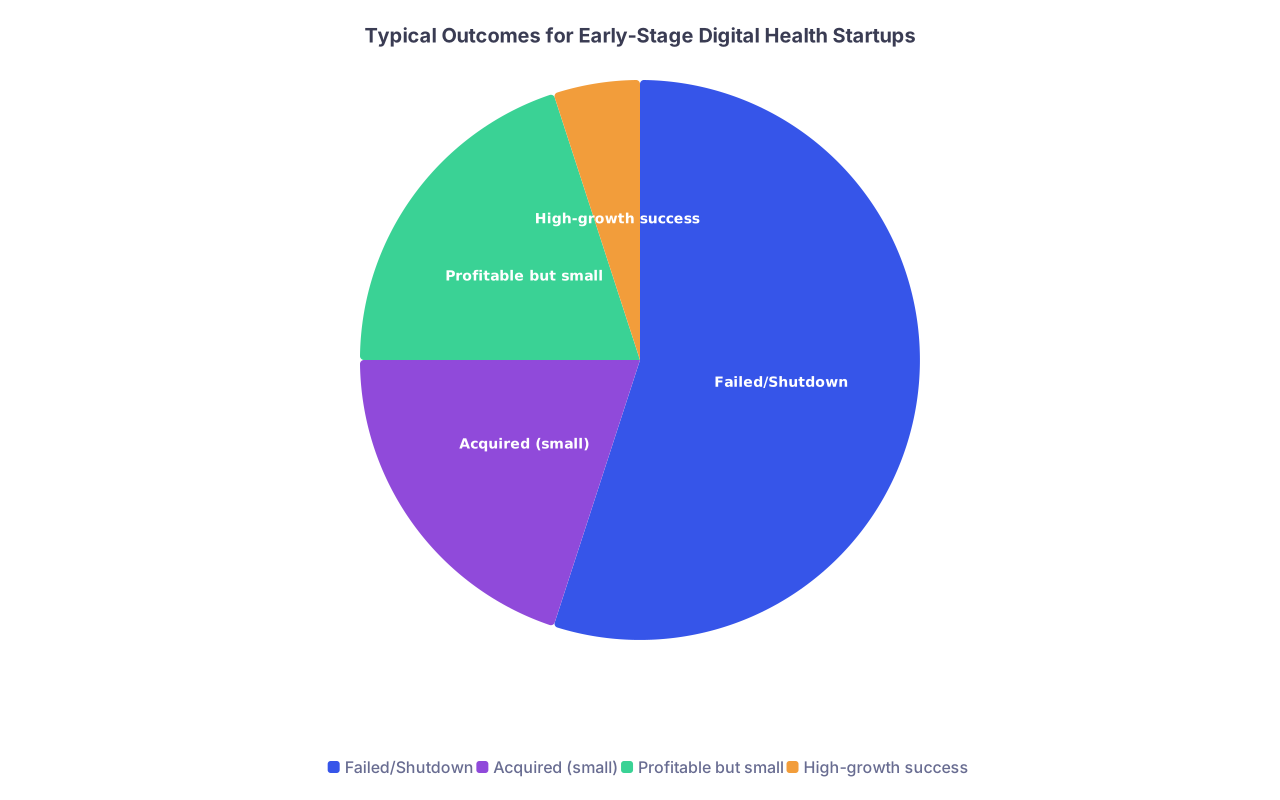
| Category | Value |
|---|---|
| Failed/Shutdown | 55 |
| Acquired (small) | 20 |
| Profitable but small | 20 |
| High-growth success | 5 |
No, this isn’t a precise dataset for your specific niche. But pattern‑wise, across multiple reports and analyses, this is the rough shape: lots of failure, some middling outcomes, very few huge wins.
And those huge wins? Often not started by people who raised giant checks on day one. Many scaled into VC only after grinding their way to clear product traction.
A Saner Playbook for Post‑Residency Founders
You’re not a Stanford CS undergrad with a hackathon app. You’re someone who has seen real clinical pain points and broken workflows up close.
Here’s a more rational sequence than “finish residency → raise $3M seed → quit medicine”:
Stay employed at first.
Go 0.8–1.0 FTE for 12–24 months and protect the income stream. Nights, weekends, or structured non‑clinical blocks are your startup time. Yes, it’s hard. It’s also less catastrophic if the idea dies.Pick one painful, narrow, billable problem.
“Improve healthcare” is fantasy. “Cut pre‑op clearance time by 50% in community hospitals” is something people might actually pay for.Charge early, even if it’s tiny.
If your colleagues “love it” but won’t pay $99/month from a departmental budget, they don't love it. They like the idea.Outsource ruthlessly before hiring.
Contractor devs, fractional compliance support, part‑time designer. Don’t build a 10‑person team to find out your idea doesn’t survive a real buyer conversation.Collect real‑world evidence before investors.
Not just “we have a pilot.” Numbers like: time reduced, readmission changes, staff hours saved, net new revenue generated. You’re a doctor—run it like a trial, not a vibe.Only talk to investors with a thesis that fits your market reality.
If someone’s asking you to promise 10x in 5 years in a market where contracting alone takes 18 months, wrong investor.Decide if you want to be a founder long term.
You might discover you hate vendor calls, sales cycles, and customer support. Better to realize that while you still have an OR block, not after you’ve burned the bridge.

| Step | Description |
|---|---|
| Step 1 | Finish Residency |
| Step 2 | Keep Clinical Job 0.8-1.0 FTE |
| Step 3 | Identify Narrow Problem |
| Step 4 | Build Minimal Solution |
| Step 5 | Get Paying Pilot |
| Step 6 | Iterate or Stop |
| Step 7 | Expand Customers |
| Step 8 | Stay Bootstrapped |
| Step 9 | Consider Targeted Funding |
| Step 10 | Traction? |
| Step 11 | Capital Needed? |
Notice: at no point does the diagram say “deck -> demo day -> term sheet -> success.” Because that’s not how this usually works in healthcare.
When You Should Raise — Even As a Contrarian
There are scenarios where, if you already have traction, I’m in favor of raising:
- You have 5–10 paying customers and can’t keep up with onboarding or support.
- A strategic partner (payer, health system, device manufacturer) wants deep integration and co‑development that requires a real team.
- You’ve proven strong unit economics and just need more sales capacity to replicate it.
At that stage, you’ll get better terms, give up less control, and know what you’re scaling. You’re using capital as a lever, not as a substitute for product–market fit.
Physician founders who start bootstrapped and then raise later often keep:
- More equity
- More board control
- More negotiating power with acquirers and investors
They’re also less likely to be bullied into clinically stupid decisions just to hit a quarterly metric.
Two closing points:
- More funding is not a badge of honor; it’s a liability you must justify. If your idea only “works” after burning millions you don’t have, it probably doesn’t work.
- As a post‑residency physician, your default advantage is optionality. Don’t surrender that to a term sheet before you’ve even proven someone will pay for what you’re building.


