
Most “disrupt healthcare” startups don’t fail because the tech is bad. They fail because they fundamentally misunderstand how hospitals actually work.
You can build a gorgeous app, slap some AI on it, sprinkle buzzwords like “interoperable” and “patient-centric,” and still get ghosted by every health system you pitch. Not because your idea isn’t clever. Because you’re selling into a world you haven’t bothered to understand beyond Twitter threads and TechCrunch headlines.
Let’s strip the mythology and talk about what the data and real-world behavior of hospitals actually show.
Myth #1: “If it Improves Outcomes or Lowers Costs, Hospitals Will Adopt It”
This is the foundational fantasy of most healthcare pitch decks.
The logic goes:
- Healthcare is inefficient.
- I have a product that saves money or improves outcomes.
- Therefore, hospitals will buy it.
That’s not how this game is played.
Hospitals Are Not Single-Rational-Actor Machines
Hospitals are political coalitions wrapped in a billing engine, sitting on top of technical debt. You’re not selling to “a hospital.” You’re selling into a messy ecosystem of:
- The CFO who cares about margins, payer mix, and capital budgets
- The CMO/CNIO who cares about quality metrics, readmissions, and malpractice risk
- IT leadership who cares about security, uptime, and not blowing up Epic or Cerner
- Service line chiefs who care about RVUs, staffing, and turf
- Compliance and legal who care about not getting the organization on the front page of the paper
Each one can kill your deal. None of them alone can guarantee it.
Improving outcomes or lowering theoretical costs is step one. It is nowhere near sufficient.
Your “Cost Savings” Don’t Map to Their P&L
Most founders pitch “saves $X per patient” as if that automatically translates into bottom-line improvement.
Large health systems do not work like a SaaS company reducing AWS spend. Savings need to hit one of a few very specific levers before anyone cares:
- Reduces variable cost in a way that actually reduces FTEs, supply use, or avoidable services
- Prevents penalties (readmissions, quality metrics, HACs, etc.)
- Improves throughput in profitable lines (OR, cath lab, imaging) so they can do more billable work
- Shifts revenue toward higher-margin procedures or payers
If your product “saves $500 per admission” but the savings come from things that don’t change staffing ratios, don’t reduce length of stay enough to free beds, and don’t impact penalty programs, those savings are imaginary from the CFO’s perspective.
This is why countless readmission-reduction pilots that “worked” never made it past year one. The clinical team loved them. The budget did not.
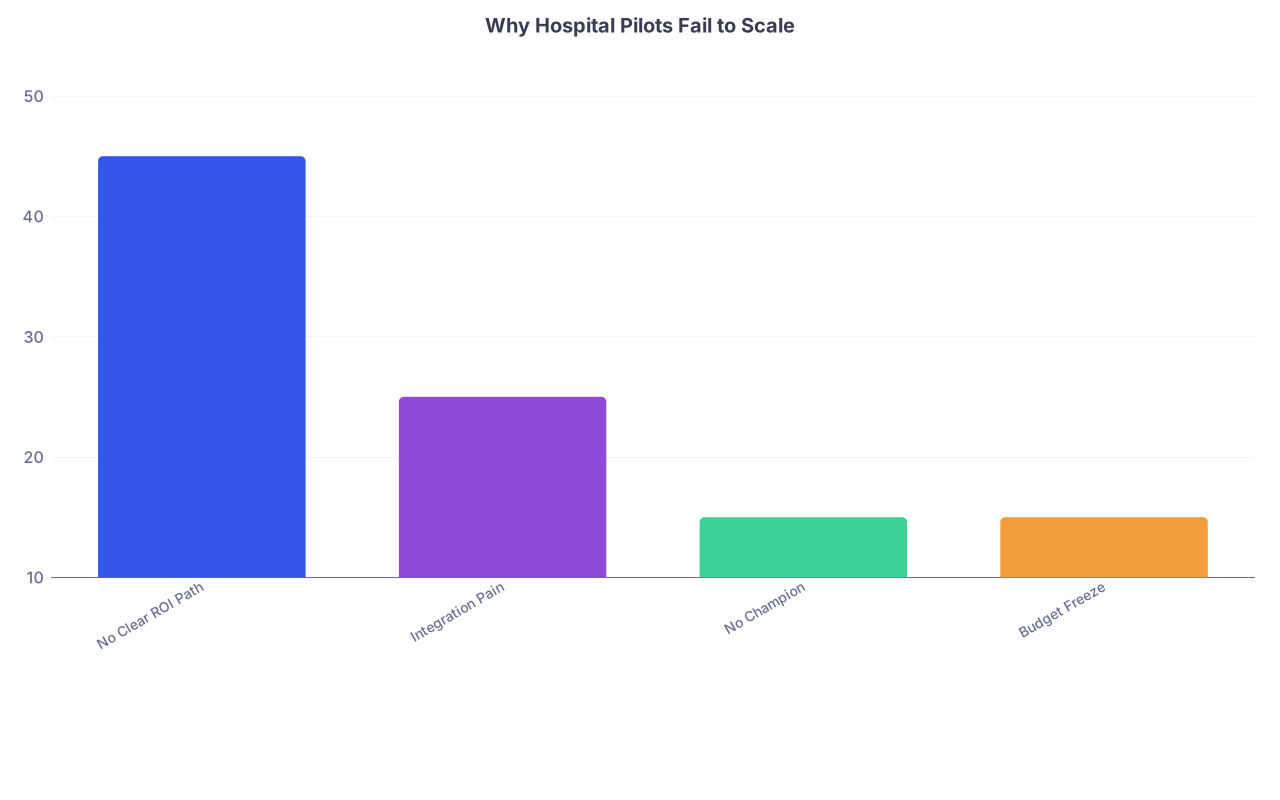
| Category | Value |
|---|---|
| No Clear ROI Path | 45 |
| Integration Pain | 25 |
| No Champion | 15 |
| Budget Freeze | 15 |
I’ve seen the same pattern play out over and over: beautiful case study, publications, happy physicians… and then the health system quietly lets the contract expire because the finance team could not find the dollars it allegedly “saved.”
You want hospitals to adopt your tool? Show exactly:
- Which budget line item drops
- Which FTEs or contracts go away
- Which penalties are avoided
- Over what timeline
If you can’t tie it to their actual financial engine, your “cost savings” are just a nice story.
Myth #2: “Clinicians Will Love This, So Hospitals Will Buy It”
This is the favorite myth of MD founders and ex-residents who’ve just broken into the startup world.
They’re not entirely wrong. They’re just half a step short.
Clinician Love Is Necessary. Not Sufficient.
Physician and nurse champions matter. They can carry your flag into committees you didn’t know existed. But there’s a brutal hierarchy of influence:
- A single enthusiastic frontline doc? Helpful, but easy to overrule.
- A well-respected service line chief? Now you have a serious voice.
- A CMO or service line dyad leadership team collectively backing you? That moves needles.
Even then, you run into the brick wall called IT, security, compliance, and finance.
The number of times I’ve heard some version of this from hospital leadership:
“We love what you’re doing. Clinicians are very positive. But we can’t support one more separate login, one more integration, or one more unfunded mandate.”
If your product:
- Adds clicks
- Requires another password
- Lives outside the EHR with clunky context switches
- Or requires shadow-IT workarounds
…then clinician enthusiasm will evaporate after a few weeks, and adoption statistics will look like a ghost town.
Usability and Workflow Eat “Innovation” for Breakfast
I’ve watched starry-eyed founders demo to physicians: lots of drag-and-drop, dashboards, and “intuitive” UX built for someone sitting at a 27-inch monitor.
Then we walk to the actual unit. Nurses are juggling three pagers, two computer-on-wheels carts, a critical lab result, and a family meltdown. No one has time for your new “care coordination canvas” that takes 5 clicks to open.
If your workflow doesn’t:
- Launch from Epic/Cerner/MEDITECH with SSO
- Autofill data without duplicate documentation
- Make someone’s day 30–60 seconds faster, not slower
…you’re dead on arrival. Even if everyone in the room told you they “love the concept.”
Stop confusing polite clinical interest with operational adoption.
Myth #3: “We Just Need to Get in Front of the Right Decision-Maker”
This one is straight out of VC-land. “We’ll just sell top-down: CEO, CMO, CIO.”
No. You will sell into a maze.

| Step | Description |
|---|---|
| Step 1 | Innovation Pitch |
| Step 2 | Clinical Champion |
| Step 3 | Service Line Leadership |
| Step 4 | IT Review |
| Step 5 | Security Review |
| Step 6 | Compliance |
| Step 7 | Value Analysis |
| Step 8 | Pilot Decision |
| Step 9 | Procurement |
| Step 10 | Rollout |
At each node, they can kill you. Many can delay you for 6–18 months without even consciously trying.
The Committee Gauntlet Is Real
Hospitals love committees. Some of them exist specifically to stop exactly what you’re trying to do: introduce yet another vendor with half-baked integration and unproved ROI.
Common chokepoints:
- Value analysis committee (often run by supply chain): “Does this really justify the spend?”
- IT governance: “Which projects are we already behind on that are more important than this?”
- Data governance: “Who owns this data, what’s the PHI exposure, where is it stored?”
- Security: “Show me your SOC 2, penetration testing, BAAs, and incident response plan.”
Founders often complain: “But this isn’t a security tool, it’s just scheduling.”
Doesn’t matter. If you ever touch PHI or plug into their network, you’re in security’s world.
There Is No Single “Yes”
Even the CEO can’t unilaterally ram through a new tool if IT is already at critical mass or if a union contract constrains workflow changes or if the budget cycle is locked.
You’re not looking for a decision-maker. You’re building a coalition, one pain point and one pilot at a time.
This is why relationship-heavy, unsexy enterprise salespeople outperform flashy founders who think a good deck will carry them. They understand that healthcare sales is not “closing.” It’s persistent coalition-building inside a bureaucracy that fears change for rational reasons.
Myth #4: “Hospitals Are Just Slow and Backward”
This myth is particularly popular among pure-tech founders who’ve never signed a death certificate or staffed a night float.
The story: “Hospitals are antiquated, resistant to change, locked into bad systems. We’re going to move fast and break things.”
You don’t get credit for moving fast if you break the thing keeping people alive.
Hospitals Aren’t Irrational. They’re Risk-Weighted.
Healthcare is one of the only industries where a UI bug can kill someone.
- An interface mismatch between your app and the EHR that drops a digit on a heparin drip.
- A timeout that loses a critical note from an overnight cross-cover.
- A system outage that hides a life-threatening lab value.
This is not theoretical. It’s happened. Major EHR vendors have scars to prove it.
So when IT and clinical leaders say “we’re not plugging in your beta-grade AI triage tool,” that’s not “backward.” That’s self-preservation.
The risk profile they’re balancing:
- Regulatory risk (HIPAA, CMS, OCR, OIG)
- Patient safety risk (med errors, missed follow-ups, documentation gaps)
- Cybersecurity risk (ransomware that shuts down the hospital)
- Operational risk (downtime in OR, ED, ICU)
Founders vastly underestimate how much prior tech has burned these systems. They come in saying “we’re different.” Hospitals hear “version 12 of the same movie.”
Legacy Systems Are Rational, Not Just Inertia
Epic and Cerner are clunky. Everyone knows this. But they do a few critical things reasonably reliably:
- Capture charges and code correctly enough to keep revenue flowing
- Maintain a legal medical record
- Support core workflows across thousands of clinicians
Replacing them or even heavily modifying them is like doing a liver transplant on a patient who’s running a marathon mid-surgery.
So yes, hospitals will default to:
- “Can Epic do this natively?”
- “Can we get this from an existing vendor?”
- “Can we wait 18–24 months for our EHR upgrade that might have this feature?”
You’re not competing with the status quo. You’re competing with: “Let’s see if our current vendor will do this later, with one less integration and one less security review.”
Myth #5: “If We Show Outcomes Data, We’ll Win”
Not quite. You need the right kind of evidence.
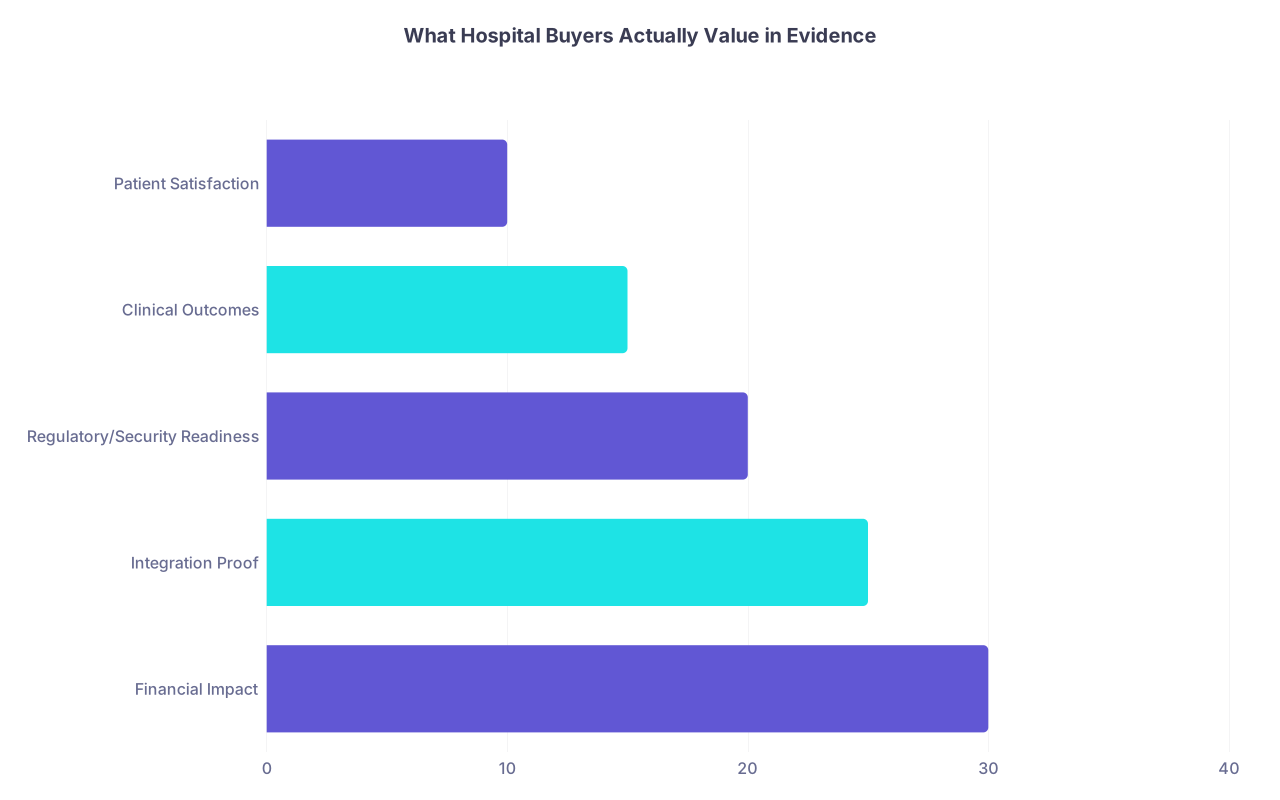
| Category | Value |
|---|---|
| Financial Impact | 30 |
| Integration Proof | 25 |
| Regulatory/Security Readiness | 20 |
| Clinical Outcomes | 15 |
| Patient Satisfaction | 10 |
Founders love randomized controlled trials and published results. They brag about “statistically significant reductions” like they’re holding a golden ticket.
Hospitals look at something else:
- Can you reproduce those results here, with our patient mix, our staffing, our EHR?
- Were those outcomes achieved with extra grant-funded nurses, analysts, or coordinators that won’t exist in real life?
- Did the intervention pile extra work on clinicians or external teams that were basically doing unpaid labor for the study?
A classic pitfall: You run a pilot on a single high-performing unit with hand-picked champions, extra check-ins, and constant vendor support. Metrics look great. Then you scale to 12 units with real constraints. The whole thing collapses under its own complexity.
Hospitals have been burned by this pattern repeatedly. They’re smarter now.
What they actually want:
- Multi-site, real-world, non-ideal implementations
- Clear explanation of required staffing, IT resources, and training
- Transparent description of failure modes and rollback options
If your data doesn’t come with that, it reads more like marketing than medicine.
Myth #6: “We Just Need the Right Pricing Model”
No, your pricing model is not the primary barrier. It’s usually an excuse layered on top of deeper issues.
That said, there’s a pattern.
| Model | Why Founders Like It | Why Hospitals Push Back |
|---|---|---|
| Per user per month | Simple, SaaS-friendly | Hard to budget, penalizes growth |
| Per bed per year | Ties to hospital size | Misaligned with actual usage |
| Per patient case | Outcome-aligned narrative | Contracting complexity, audit risk |
| Flat annual fee | Predictable revenu | Big upfront commitment |
| Shared savings | Sexy for investors | Hard to attribute, slow to realize |
Hospitals care less about your exact pricing structure and more about:
- Which cost center pays for it (IT, a specific service line, quality, “innovation,” etc.)
- Whether it fits into an existing procurement category
- Whether they can avoid capital expenditure classification
- How painful the multi-year commitment is
- Whether they can exit cleanly if outcomes do not materialize
“Shared savings” looks great in a deck. In reality, it means:
- Months of arguing about baselines
- Endless “but COVID changed everything that year” debates
- Finance teams refusing to write you a check for theoretical prevented admissions
If you can’t show value in their budget cycle (1–2 years), shared savings quickly turns into shared frustration.
What Actually Works: The Boring, Effective Path
So if the myths are wrong, what does work?
1. Start With a Specific Pain Point, Not a Grand Vision
“Disrupt healthcare” is not a value proposition. “Cut phone tag between hospitalists and SNFs by 50% on discharge days using Epic-integrated secure messaging” is.
The more concrete your pitch:
- The clearer the buyer
- The easier the internal champion’s job
- The less threatening your product looks
Pick something a VP actually gets paged about. Repeatedly.
2. Design for Integration First, Features Second
If you’re not already thinking:
- How does this launch from Epic/Cerner?
- How does this write data back?
- How do we handle downtime?
- How do we avoid duplicate entry?
…you’re already behind. Hospitals will choose a worse product that’s tightly integrated over a better product that lives in a silo. Every single time.
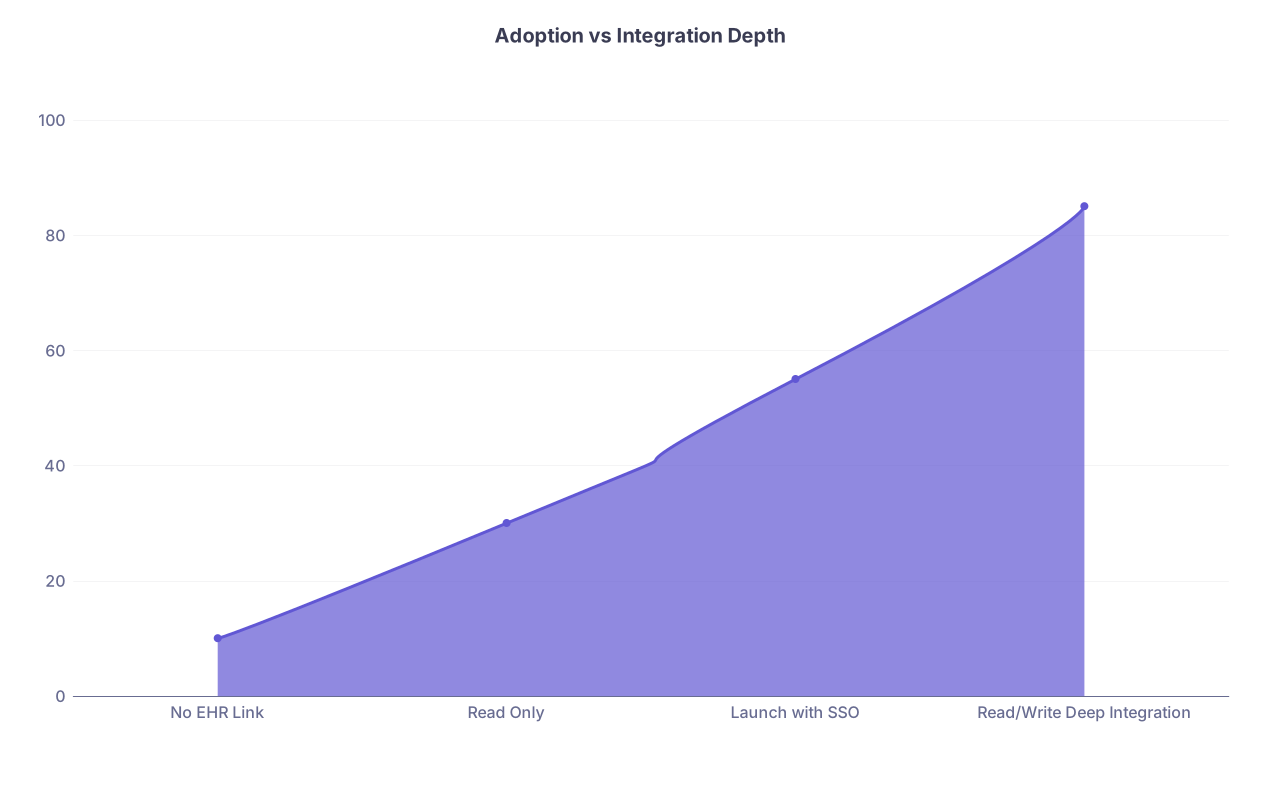
| Category | Value |
|---|---|
| No EHR Link | 10 |
| Read Only | 30 |
| Launch with SSO | 55 |
| Read/Write Deep Integration | 85 |
3. Align With an Existing Strategic Priority
Hospitals do not wake up each quarter and ask, “What cool startups should we buy from?” They work off a small set of strategic priorities:
- Reduce length of stay
- Improve ED throughput
- Optimize OR utilization
- Strengthen ACO performance
- Improve HCAHPS and Star ratings
- Prepare for specific regulatory changes
If you can’t map directly to one or two of those, you’ll end up in the “nice to have” bucket. That bucket is where pilots go to die when the budget tightens.
4. Make the Pilot Boringly Low-Risk
You’re trying to get past scar tissue from every previous vendor that underestimated rollout pain.
Smart founders:
- Start with a small, well-defined unit or service line
- Overinvest in implementation, training, and support
- Give the hospital a clear, low-friction exit ramp
- Measure a few agreed metrics tied to their priorities, not your vanity stats
You want the CIO to say, “Even if this fails, it won’t blow up my week.”
The Bottom Line
Most “disrupt healthcare” pitches fail with hospitals for boring, structural reasons, not because hospitals are dumb or your idea is too advanced.
If you take nothing else away, remember this:
- Hospitals do not buy features; they buy de-risked, integrated solutions to very specific operational and financial problems.
- Clinician enthusiasm and clinical outcomes help, but without tight integration, governance buy-in, and a clear line to the CFO’s worldview, you’re a nice pilot that will never renew.
- The winners in this space aren’t the loudest “disruptors.” They’re the ones who quietly respect healthcare’s constraints, design for them, and show value in the language hospitals actually use: throughput, penalties avoided, staffing pressure eased, and risk reduced.