
The obsession with patents is one of the most expensive distractions in early medical startups.
You’ve been trained to worship intellectual property. Attendings talk about “protecting your idea” like it’s a ventilator in a supply shortage. Hospital tech transfer offices whisper about “blockbuster patents.” Big medtech companies flaunt “robust IP portfolios” in every investor deck.
And so, right after residency, when you finally decide to build something, the first thing many of you do is call a patent attorney.
That’s backwards.
You probably don’t need a patent yet. You might not need one at all. And in some cases, rushing to get one will kill your startup faster than a bad FDA strategy.
Let’s separate myth from reality.
Myth 1: “You Need a Patent Before You Talk to Anyone”
This one is everywhere. The terrified whisper: “Don’t tell anyone, they’ll steal it.” I have lost count of the number of residents and fellows who sat on decent ideas for 2–3 years because they were “waiting until I can afford a patent.”
Here is what the data and actual startup outcomes show:
Most early-stage medical startups die from lack of customers and traction, not from IP theft.
Not because some giant company stole their idea from a coffee chat. Not because a VC ran off and cloned the product. They die because nobody really needed what they built, or the regulatory/reimbursement path was brutal, or the team never got past PowerPoint.
The “someone will steal my idea” fear is mostly an ego story. You’re imagining your idea is so obviously valuable that the world is just waiting to copy it. In reality, execution in healthcare is so painful that almost nobody wants your problems.
Does that mean you should blast your idea on Reddit? No. But here’s the reality of pre-patent conversations:
- Investors sign NDAs rarely, but they are in the business of backing founders, not stealing early ideas.
- Clinicians, nurses, and admins you need for problem validation are not going to drop everything and build a company out of your half-formed concept.
- Large medtech companies move glacially. The idea that they’ll hear a concept on Monday and file a sophisticated patent by Friday is fantasy.
What actually protects you early is speed, clinical insight, relationships, and learning faster than anyone else—not a piece of paper from the USPTO.
If you’re post-residency, juggling shifts and building on nights and weekends, your scarce resources are time, cash, and attention. Blowing $10,000–$20,000 and 3–6 months on a non-strategic patent before you even know if the problem is real? That’s malpractice on your own startup.
Myth 2: “Patents Equal Value”
You’ll hear this from two groups: patent lawyers and university tech transfer offices. Shocking.
The implicit claim: “More patents = higher valuation.” That’s not actually how investors think, especially at the seed and pre-seed stages in healthcare.
What investors actually care about early:
- Is this a real, painful clinical problem?
- Is your solution meaningfully better than standard of care?
- Can you get it through FDA and into the reimbursement system?
- Are you the right team to brute-force this into adoption?
Patents are one line item in “defensibility,” and even there they share space with trade secrets, data moats, workflow integration, contracts with health systems, and switching costs.
Let me be concrete. I’ve seen:
- A seed-stage digital health startup with zero patents get funded at an $18M valuation because they had 5 hospital pilots and strong outcomes data.
- A device startup with six issued patents struggle to get any interest—because their catheter slightly improved on something nobody was complaining about.
| Factor | Early-Stage Impact on Valuation |
|---|---|
| Strong clinical need | Very High |
| Regulatory clarity | High |
| Real-world pilots | Very High |
| Revenue or LOIs | Very High |
| Team track record | High |
| Single provisional | Low |
| Large patent portfolio | Moderate (later stages) |
A patent is an option on future defensibility, not a guarantee of value. The patent system does not care if anyone wants your product. It just cares if your claims are new, useful, and non-obvious on paper.
Investors know this. The graveyard of “patent-rich, traction-poor” medtech companies is large and quiet.
Myth 3: “Provisional Patent = Cheap Protection”
This is the favorite myth of bootstrapping clinicians.
You hear: “Just file a provisional, they’re cheap, like $150, and you’re protected for a year.”
Technically true. Practically misleading.
A strong provisional is not a scribbled paragraph and a sketch. It should describe the invention in enough detail that when you convert it to a full (non-provisional) patent, you can claim priority to that date for all the key features you care about.
I’ve seen too many founders do this:
- Spend a weekend drafting a vague provisional with generic language and no detailed embodiments.
- Brag that they’re “patent pending.”
- Do nothing for 11 months.
- Panic, then can’t afford a proper non-provisional and end up with a lapsed “protection” and a lost priority date.
Or worse, they treat that flimsy provisional as real leverage in partner discussions. It is not.
If you’re going to file a provisional, either:
- Work with a competent patent attorney and spend real money (low four figures to mid four figures) to get something detailed and strategic, or
- Treat it as a timestamp for a snapshot of your thinking, not as a fortress.
And do the math: If your total savings for the startup right now is $15,000 and you blow $6,000–$8,000 on patents before customer discovery, that’s not “smart protection.” That’s kneecapping your ability to run pilots, build prototypes, or even fly to pitch meetings.
Myth 4: “In Medtech, You Always Need Patents”
No. This one is just lazy thinking.
Different categories of medical startups have very different IP realities.
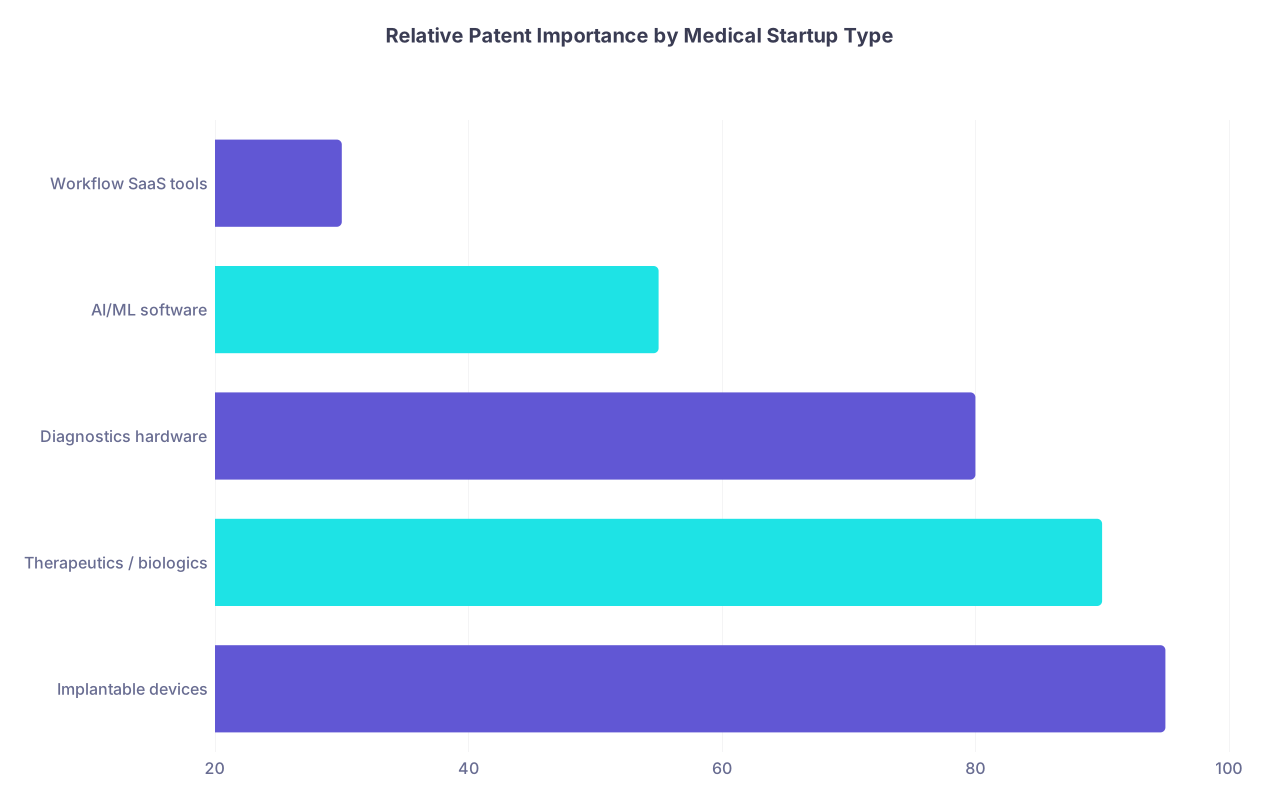
| Category | Value |
|---|---|
| Implantable devices | 95 |
| Therapeutics / biologics | 90 |
| Diagnostics hardware | 80 |
| AI/ML software | 55 |
| Workflow SaaS tools | 30 |
If you’re working on:
- An implantable device
- A new drug delivery system
- A unique sensor design
Then yes, patents matter a lot. The entire business model may depend on exclusivity and licensing, and big strategic buyers (Medtronic, J&J, Abbott) absolutely care about IP.
But what if you’re:
- Building a scheduling or triage platform for ED flow
- Using off-the-shelf sensors with clever analytics
- Creating better clinician UX on top of existing infrastructure
Your moat is not going to be patents. It’s going to be workflow integration, data, contracts, and the fact that hospital IT doesn’t replace systems lightly once they’re embedded.
I know a post-residency founder who spent $20k on a dubious software patent for a tele-derm triage workflow. No pilots, no health system interest yet. They thought the patent would impress investors. It didn’t. The first serious investor literally said, “I’d rather you spent that on getting three clinics live and collecting data.”
They were right.
So, do you “always need a patent” in medtech? No. In some verticals it’s table stakes; in others, it’s an expensive distraction.
Myth 5: “Without a Patent, Big Companies Will Just Copy You”
This is the classic David vs. Goliath fantasy.
It also misunderstands how big medtech companies work.
A few realities:
- They move slowly. Development pipelines are years long, deeply bureaucratic, and risk-averse.
- They rarely build from scratch if acquiring is cheaper and lower risk.
- They care a lot about clinical evidence, regulatory progress, and market adoption more than your idea on a napkin.
If you’ve de-risked a significant amount—prototype, early clinical data, some regulatory clarity—they may be interested even if your IP is weak, because you’ve proven market and clinical viability. If you have an impressive patent but no adoption, you’re just another item in the tech scouting inbox.
Most of the time, the risk isn’t “they’ll copy you.” It’s “they won’t care you exist.”
Also, enforcement is expensive. Having a patent and actually suing a multinational are two different universes. You are not going to war with J&J in federal court as a two-person startup. Your real leverage is often to be so far ahead in market knowledge and relationships that copying you is more painful than partnering or acquiring.

Myth 6: “Publishing or Presenting Will Kill My Patent Chances”
You’re a clinician; you’re trained to publish. You give grand rounds, present at conferences, write case series. Then someone tells you: “Careful—if you publish before filing, you lose all your patent rights.”
Reality is more nuanced.
In the United States:
- You have a 12-month grace period after your own public disclosure to file a patent.
- Outside the US, many jurisdictions are stricter: public disclosure before filing = no patent.
So if your ambition is US-only, presenting at a conference before filing does not instantly kill you legally. But it does complicate things and can affect non-US protection.
For a post-residency founder with limited cash, the smart move is usually:
- File a decent provisional (not garbage) before any big public disclosure if you’re working on something where patents clearly matter (devices, diagnostics hardware, therapeutics).
- Or, if you’re doing software/workflow products where exclusivity is probably not IP-driven, accept that you may never patent and stop letting “I need to protect this” delay your clinical feedback loop.
What you should not do is sit on your hands for two years refusing to talk to anyone “until the patent is in.” That’s how ideas die quietly.
Myth 7: “A Patent Is a Business Model”
No. A patent is a legal right to exclude others from practicing a particular set of claims. That’s it.
It doesn’t get you customers. It doesn’t get you FDA clearance. It doesn’t get you CPT codes or DRGs or pharmacy benefit manager formulary access. It doesn’t convince the hospital value analysis committee that they should buy.
I talk to early founders who say things like, “Worst case, I’ll just license my patent.” That’s fantasy-level thinking for most clinicians with one or two filings and no development work.
Licensing-only plays do exist, but they typically involve:
- Very strong, broad, well-drafted patents
- Tied to problems that specific, capital-rich players already know they must solve
- Often with some prototype or feasibility work attached
Tech transfer offices encourage the “we’ll patent, then license” narrative because that’s their career path. As an independent founder, you’re not running a patent farm—you’re trying to build a business.
Ask this brutally honest question:
If someone gave you your ideal patent tomorrow, but forbid you from speaking to customers, running trials, or building anything—could you still create a viable company? If the answer is no, then the patent is not the main event. The business is.
When a Patent Does Make Strategic Sense
Now for the part everyone misquotes if you only read half the article: I am not anti-patent. I am anti-reflexive-patent.
There are clear situations where you, as a post-residency medical founder, should seriously consider filing early:
- You’ve designed a novel physical device or implant with clear mechanical or functional uniqueness.
- You’re planning to raise from traditional medtech VCs who expect at least a provisional on file for core inventions.
- You’re collaborating with a university where IP and inventorship need to be formalized, and you want your share protected.
- You can see an obvious path where a strategic exit to a big device/diagnostics company depends on IP coverage.
In those cases, be adult about it:
- Budget realistically: Think several thousand for a good provisional and $10k–$20k+ over time for a full non-provisional and international strategy.
- Integrate IP into your product roadmap and clinical strategy, not as a side quest. Claims should match real product features you actually plan to ship, not just sci-fi ideas.
- Assume you’ll file multiple patents over time. Version 1, version 2, manufacturing tricks, algorithms, combinations.
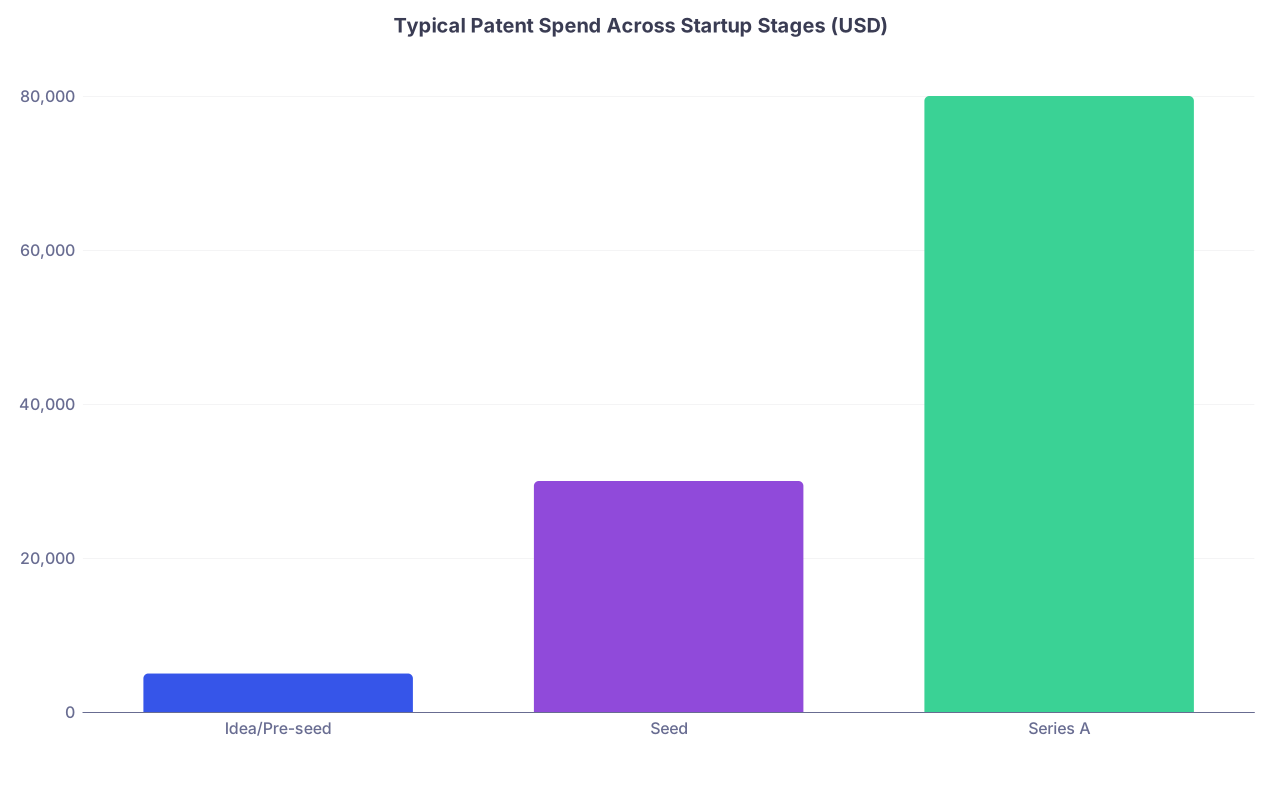
| Category | Value |
|---|---|
| Idea/Pre-seed | 5000 |
| Seed | 30000 |
| Series A | 80000 |
See those numbers? That’s why blowing your entire idea-stage budget on IP is a bad joke. Patents are a portfolio problem over years, not a one-time checkbox in month one.
What You Should Actually Do First
If you’re post-residency, working shifts, and thinking about your first medical startup, here’s the contrarian, boring, actually-correct order of operations:
Validate the clinical problem aggressively. Talk to 20–50 clinicians, nurses, admins, patients depending on who touches the workflow. Without NDAs. Without pitch theater. Just real conversations.
Map the regulatory and reimbursement path. If you can’t see a plausible route through FDA and getting paid, IP won’t save you.
Sketch a minimum testable product. Sometimes this is a Figma prototype. Sometimes it’s a 3D printed mock-up. Sometimes a manual workflow pilot.
Only then ask: Is there something here that’s technically novel enough where patents might matter, and can I afford to protect it without starving everything else?
For many digital health or workflow tools, the answer will be: “Not right now, maybe never.” And that’s fine.
For some med devices and diagnostics, the answer will be: “Yes, but I’ll file a targeted provisional on the truly unique part while still focusing 90% of my energy on clinical and commercial proof.”
That’s not as sexy as “lock down the IP then shop it around.” But it’s what actually works.

| Step | Description |
|---|---|
| Step 1 | Have medical startup idea |
| Step 2 | Validate clinical problem |
| Step 3 | Map regulatory and reimbursement |
| Step 4 | Assess novelty with expert |
| Step 5 | Focus on pilots and adoption |
| Step 6 | File targeted provisional |
| Step 7 | Raise capital and run pilots |
| Step 8 | Hardware or therapeutic innovation? |
| Step 9 | Strong novelty and clear device path? |
The Real Question: What Game Are You Playing?
Patents are a tool. Not a religion. Not a personality trait.
If your game is: “I want to be a surgeon with a couple of licensed device ideas on the side,” you’ll think differently about patents than if your game is: “I want to build and scale a company that changes standard of care.”
One is IP-centric. The other is execution-centric.
Most post-residency founders I see are accidentally playing neither game clearly. They half-pursue a company while fetishizing the patent as the main milestone. They get the worst of both worlds: no traction, and an expensive framed certificate they brag about at conferences.
Ask yourself, bluntly:
Would you rather have one issued patent and zero paying customers, or zero patents and ten hospitals actively using your product and begging for more features?
Most clinicians intellectually know the answer. Then they go call the patent lawyer first anyway.
Years from now, you won’t remember the exact claim language in your first filing. You’ll remember whether you had the courage to talk to real users early, risk being “unprotected,” and actually build something the healthcare system could not ignore.