

You do not have to burn your medical career to the ground to build a serious startup. The “all‑in or don’t bother” narrative is mostly tech‑bro mythology, not supported by how real healthcare companies actually get built.
I’m going to be blunt: way too many doctors are walking away from stable six‑figure careers based on Twitter threads written by 25‑year‑olds who have never dealt with prior auth, CMS, or a morbidity and mortality conference. Different game, different rules.
Let’s dismantle the biggest myths about “doctor or founder, pick one” and talk about what the data actually shows about physicians, startups, and risk.
The All‑In Founder Myth Is Great Theater, Bad Strategy
The Silicon Valley story goes like this: quit your job, move into a crappy apartment, code for 18 hours a day, eat instant ramen, hope for a unicorn. That template comes from consumer and pure‑tech startups.
Healthcare is not that world.
Look at who actually starts meaningful health companies:
- EHR players like Epic grew out of academic medicine and consulting, not someone rage‑quitting residency.
- Many digital health tools started as “side” QI projects or clinical tools that slowly spun out.
- A ridiculous number of med devices and workflow tools began as “we hacked this together for our own ICU/OR/clinic.”
Founders like Atul Butte (informatics), Arash Mostaghimi (digital dermatology), or any number of physician–founders in telehealth and specialty platforms? They didn’t all go cold turkey on medicine on day one. The pattern is usually:
- Notice a problem clinically.
- Tinker with a solution while still working.
- Get traction (real usage, pilots, early revenue, grants).
- Then, maybe, step down, reduce FTE, or transition roles.
The idea that a startup isn’t “real” unless you’re jobless and terrified every month is nonsense. The metric that matters is progress, not self‑inflicted pain.
What The Data Actually Shows About Risk
There’s this heroic narrative that the bravest founders are the ones who “bet everything.” The research says otherwise.
- Multiple entrepreneurship studies (including the classic one from the Kauffman Foundation) show part‑time founders are not statistically less likely to succeed than full‑time founders in the early phase. The big drivers are problem–solution fit and market, not how fast you burned your safety net.
- In healthcare specifically, physician‑founded companies are actually over‑represented in categories that succeed: clinically grounded, aligned with reimbursement, and integrated into actual workflows. That’s not magic. It’s domain expertise.
Now overlay that with your actual situation post‑residency:
- You likely have student loans in the high five or six figures.
- You may be at peak earning years or close to them.
- You’ve spent a decade plus getting here.
And some random YC blog post is telling you your commitment is suspect if you do not walk away from all of it on day one? No. That’s naivety dressed up as courage.
Here is the tradeoff you are actually making:
| Dimension | Quit Medicine Immediately | Keep Practicing While Building |
|---|---|---|
| Financial Runway | Short, depend on savings | Longer, income subsidizes build |
| Clinical Insight | Fades over time | Stays fresh, new problems appear |
| Burnout Risk | High, all pressure on startup | Moderate, load is distributed |
| Investor Risk Perception | “Committed but risky” | “De-risked, real-world insight” |
| Family/Loans | High stress, low cushion | More stable, predictable cash flow |
Notice something: almost every meaningful advantage for healthcare product quality is on the “keep practicing” side, especially in the early years.
The Hidden Asset You’re About To Throw Away
Investors love to pretend capital is the scarce resource.
In early‑stage medical startups, that’s usually wrong.
Your actual rare assets:
- Ability to generate stable six‑figure income without a boss breathing down your neck every hour.
- Direct access to patients, staff, and workflows most “health tech” bros can’t even see.
- Built‑in credibility with hospitals, payors, and regulators who barely tolerate generic SaaS kids.
Quitting medicine too early throws away all three.
Every week in clinic or on the ward is structured customer discovery if you stop sleepwalking through it. Watch what your MA curses about. Watch where nurses break protocol because the system is stupid. Watch what patients always misunderstand even after your “perfect” explanation.
I’ve literally watched a hospitalist pick up a $10M/year idea by noticing how often transitions of care notes got lost between hospital and SNF. That became a real product, not a hypothetical case study. And it started as a “we hacked together a better fax + structured template” side project, running quietly while she still worked 0.8 FTE.
You lose that stream of real‑world data when you pull out too fast.
But What About Time? “I Can’t Do Both.”
This is the most common, and the laziest, objection.
No, you can’t do a full‑time startup and full‑time clinical without imploding. That’s true. But the binary framing is wrong. Your knob has more than two settings.
Think like a portfolio, not a switch.
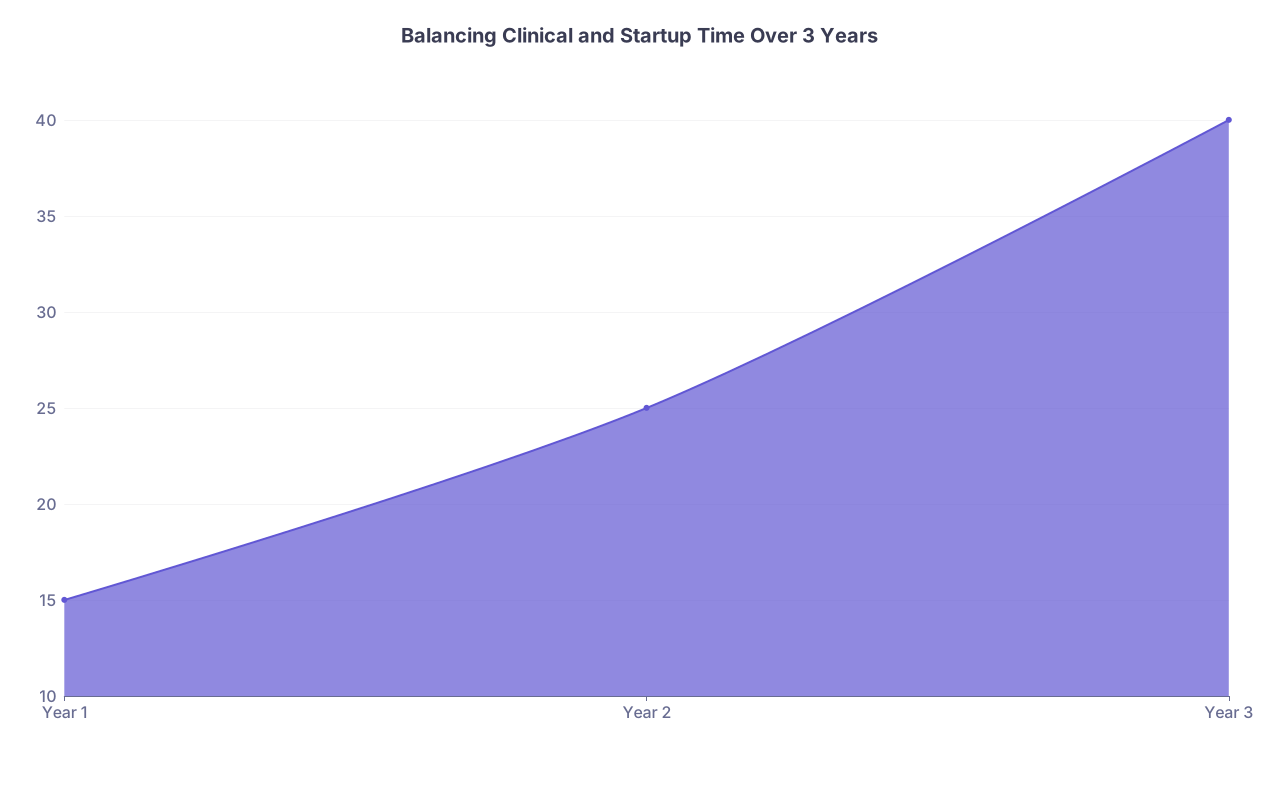
| Category | Value |
|---|---|
| Year 1 | 15 |
| Year 2 | 25 |
| Year 3 | 40 |
Let me translate that chart to reality.
Typical sustainable path for physician founders I’ve seen actually make it:
- Year 1:
- 0.8–1.0 FTE clinically.
- Startup is nights/weekends plus one dedicated “build” block per week (you pay for a lighter clinic schedule with your own lost income).
- Goal: Validate the problem, build a basic prototype, get 5–10 real users, maybe a pilot site.
- Year 2:
- 0.5–0.7 FTE clinically.
- Startup gets protected half‑days and full off‑days.
- Goal: Show usage, refine product, get initial revenue or strong LOIs, maybe a small angel/pre‑seed.
- Year 3:
- 0.2–0.5 FTE clinically, if and only if:
- Users exist.
- Someone besides your friends is paying.
- There’s a clear path to either profitability or real funding.
- 0.2–0.5 FTE clinically, if and only if:
That’s not theory. It’s how a lot of telemedicine, niche workflow tools, and specialty platforms have emerged from real clinicians.
You don’t need infinite time. You need:
- One or two high‑leverage clinical days (keep your insight and licensing).
- One or two deep work startup days (no half‑assed “I’ll code between consults” fantasies).
- Brutal clarity on what you’re building and who it is for.
If your startup “needs” 80 hours a week from you on day zero to even exist, it probably doesn’t have a tight problem definition yet.
What Actually Makes A “Real” Startup In Medicine
The macho narrative says: real startup = raised money + fancy accelerator + everyone full‑time in a WeWork.
Healthcare does not care how “startup‑y” your life looks. It cares about whether your thing:
- Solves a real, painful problem.
- Can be adopted without breaking workflows.
- Has a believable pathway to reimbursement or cost savings.
Here’s a quick reality check list.
If you can answer “yes” to most of these, you’re building something real, regardless of your FTE status:
- Do you have at least 5–10 clinicians or staff who would be annoyed if you turned your product off tomorrow?
- Has anyone paid anything for it (even a tiny pilot fee)?
- Is there someone on the team who actually writes code / builds / designs, and someone who deeply understands the clinical side? (You can be one of them, but not both if you’re lying to yourself about time.)
- Have you seen your product used in the wild, not just in your own clinic?
- Can you articulate, in one sentence, why a hospital CFO or medical director should care?
If the answers are mostly no, quitting medicine will not magically make those yes.
Funding Reality: VCs Don’t Need You Poor, They Need You De‑Risked
Another myth: “Investors won’t take you seriously until you quit your job.”
Sometimes true in pure tech. Much less true in health.
For early‑stage health investors, a practicing physician on the founding team can actually be a positive signal—if you show traction. They know:
- You understand the regulatory swamp.
- You can get to pilot customers faster.
- You’re less likely to waste a year building something that dies on contact with the OR/ED/clinic.
I’ve sat in meetings where investors explicitly said: “We like that she’s still part‑time in clinic—keeps the product grounded. We just need to see that she’ll scale back if this takes off.”
The objection is usually not “You must quit now.” It’s “If this becomes a real company, will you actually show up?” That’s a different question. And the answer is simple:
- Early: “I’m 0.6–0.7 FTE clinical. I have X days for the company. That’s been enough to get us to [traction].”
- Post‑seed or Series A: “With this raise, I’ll drop to 0.2–0.3 FTE and keep a narrow clinical focus that feeds product insight.”
That sounds deliberate, not half‑committed.
How To Design A Hybrid Post‑Residency Career That Actually Works
Let’s talk mechanics. You finished residency, you’re on the job market, and you want to build something real without setting your life on fire.
Here’s a practical architecture that I’ve seen work repeatedly.
1. Choose The Right Clinical Job, Not The “Best” One
Stop chasing prestige here. You’re not collecting another badge; you’re buying time and flexibility.
Better for a founder:
- 0.7–0.8 FTE hospitalist role with block scheduling and predictable shifts.
- Community emergency medicine groups that let you bunch shifts and buy time off.
- Outpatient roles that allow 3–4 long clinic days and one completely free day.
Worse for a founder:
- Academic roles that eat your time in meetings, committees, and unpaid teaching prep.
- Highly unpredictable call schedules that nuke your deep work.
- Leadership roles before your company needs that headspace.
You want a boring, predictable clinical job you can optimize around. Ego will push you towards “Director of X at Big Name Hospital.” Your startup does not care about your title; it cares about your time and cognitive bandwidth.
2. Carve Out Non‑Negotiable Build Time
Treat your startup days like call days. Non‑optional. Protected.
- Pick specific days: e.g., every Tuesday and Friday are startup days. Full stop.
- No clinic, no PRN coverage, no squeezing in locums “just this once.”
- Tell colleagues you’re “unavailable for other commitments on those days”—you do not need to justify why.
I’ve watched promising founders die by a thousand “Hey, can you cover this one clinic?” cuts. Say no. You already say no to extra calls when you’re post‑call. Same principle.
3. Mine Your Clinical Work For Startup Fuel
On clinical days, stop just surviving. Start observing.
Patterns to track:
- Repeated friction: “Why is this form always missing?” “Why do handoffs always break here?”
- Shadow workflows: spreadsheets, sticky notes, texts, back‑door hacks staff use because the official system is garbage.
- Recurrent patient confusion: the question you answer 20 times a week is a product clue.
Keep a running “annoyance log.” Ten lines a week. Over a few months, you will see patterns. That’s your startup’s roadmap.
When You Should Consider Quitting (For Real)
I’m not telling you to cling to your clinical job forever. I am telling you most people try to jump way too soon for ego reasons.
Here are reasonable triggers to step down significantly or fully:
- You have meaningful revenue or a signed LOI pipeline that you’re actually failing to execute because of time.
- You’ve raised a real seed round (not 50k “friends money”) and now owe your investors and team time.
- Your pilots are expanding, and customers are directly telling you your responsiveness is the bottleneck.
Even then, going straight to zero clinical isn’t always smart. A lot of the best founders stabilize around 0.1–0.3 FTE clinical for years. One afternoon clinic. One day a week on service. Enough patient/staff contact to stay sharp, not enough to dominate your calendar.
The Real Risk Most Physician Founders Underestimate
It’s not “What if my startup fails and I wasted my career?” You have a license. You can always go back to more clinical work.
The actual risk:
- Quitting so early you run out of money and quit both the startup and medicine out of sheer burnout.
- Building in a vacuum and waking up two years later with a gorgeous product no one in healthcare actually wants.
- Destroying your personal life because you let internet culture define “commitment” rather than results.
Moderate clinical work plus a focused, well‑scoped startup is not weak. It’s how adults manage risk.

| Step | Description |
|---|---|
| Step 1 | Post residency |
| Step 2 | Choose stable clinical job |
| Step 3 | Run small pilot while 0.8-1.0 FTE |
| Step 4 | Kill or pivot idea |
| Step 5 | Reduce to 0.5-0.7 FTE |
| Step 6 | Keep iterating with part time clinical |
| Step 7 | Consider 0.2-0.5 FTE clinical |
| Step 8 | Startup idea? |
| Step 9 | Real traction? |
| Step 10 | Revenue or funding? |
That is what disciplined, data‑driven career design looks like. Not jumping off a cliff because some podcast said you should.
FAQs
1. Won’t being part‑time make me a worse doctor or hurt my skills?
Not if you’re intentional. Plenty of physicians maintain competence at 0.5 FTE or less, especially in hospitalist, EM, and some outpatient fields. The key is staying in environments with enough volume and complexity to keep skills sharp, and avoiding “dabbling” in too many different settings. Narrow scope, consistent setting, and ongoing CME beat raw hours.
2. How do I talk about my startup with potential employers without scaring them?
Be clear and specific. Frame it as: “I’m committed to practicing X days per week and being fully present when I’m here. I also have a growing company that I work on outside those days. I’m not asking for favors—just predictable scheduling so I can do both well.” Good employers will actually like that you’re entrepreneurial. If they demand 100% mindshare forever, they’re probably wrong for you anyway.
3. Should I try to build my startup inside my hospital/health system first?
Usually, start outside, then bring back in. Big systems move glacially and can smother early products in committee meetings and compliance reviews. Better pattern: pilot with a small practice or friendlier site, de‑risk the product, then approach your system with evidence and a clear story. “We’ve already shown this reduces X by Y%” sells a lot better than “I have an idea and a slide deck.”
4. When is it actually too late to start a company as a doctor?
Functionally, never. I’ve seen attendings in their 50s and 60s launch meaningful products, especially B2B tools and specialized services. The real question isn’t age; it’s flexibility. If your life is locked into a rigid high‑expense lifestyle, zero time flexibility, and you refuse to adjust, then yes, it’s “too late.” But clinically active physicians with some control over their schedule can start at almost any point—if they’re willing to trade some income and prestige for autonomy.
Key points:
- You do not need to quit medicine to build a real, fundable, impact‑driven startup—especially in healthcare, where clinical proximity is an asset, not a distraction.
- Use your post‑residency years to design a hybrid career on purpose: controlled FTE, protected build days, and ruthless focus on real clinical problems.


