

The biggest shock for physician founders is this: investor meetings look nothing like grand rounds and nothing like journal club. They’re closer to a hostile curbside consult where you’re the intern, your patient is your startup, and everyone in the room is quietly deciding if they’d let you touch their family member.
Let me walk you through what really happens when you, a post‑residency doc, sit down with investors for the first time. Not the polished blog version. The version I’ve watched play out in conference rooms in SF, Boston, Houston, and on way too many Zoom calls.
The Reality Check Before You Walk In
Here’s the first dirty secret: most investors do not care that you finished residency. They care that you understand a market, can build something people use, and will not burn their money on “nice-to-have” academic toys.
Your MD buys you:
- Initial credibility that you know the clinical problem.
- Permission to talk about guidelines, workflows, payer dynamics without getting questioned to death.
Your MD does not buy you:
- A pass on business basics.
- Endless patience for hand‑wavy answers about revenue.
- Sympathy for your learning curve.
I’ve heard a partner at a healthcare-focused VC say this, verbatim, walking out of a physician founder pitch:
“Clinically brilliant. No idea how anything gets paid for. Would be a great CMO for someone else’s company.”
That is the line you’re balancing on in every investor meeting.
What Actually Happens In a First Investor Meeting
Forget the fantasy of walking in, telling your story, and everyone falling in love with your mission. A typical first meeting—Seed or Series A, post‑residency, medtech or digital health—looks much more like a speed scrubbing of you, your idea, and your grip on reality.
Let’s break down the flow.

| Step | Description |
|---|---|
| Step 1 | Warm intro or cold outreach |
| Step 2 | 30-60 min first meeting |
| Step 3 | Pass after call |
| Step 4 | Follow up deck and data |
| Step 5 | Partner meeting or second call |
| Step 6 | Term sheet discussions |
| Step 7 | Clinically credible? |
| Step 8 | Business credible? |
| Step 9 | Real deal or tourist? |
How they open
The investor will usually start casually:
“Hey, great to meet you. I read your deck but would love to hear in your own words what you’re building and why.”
Translation: “Prove to me in five minutes that this is not just another doctor with an app.”
Your job in the first 5–7 minutes:
- State the problem in ruthless, economic terms. Not “This is frustrating for providers,” but “This is a $450M annual leakage problem for IDNs with 20+ hospitals.”
- Show that you know how the money flows. Who bills. Who gets paid. Who’s left holding the bag.
- Make it obvious you’ve touched the problem personally at the bedside.
Bad opening from a physician founder:
“We built a better communication platform to reduce burnout.”
Good opening:
“When I was on nights at [Hospital X], I watched three ICU transfers get delayed because consults were paged to the wrong service. One of them coded. We’re building a system that auto-routes and documents consults across services and generates billable events—so hospitals reduce leakage and improve throughput without hiring more staff.”
They’ll let you talk for 5–10 minutes. Then the real meeting starts.
The shift: from story to interrogation
The atmosphere changes the moment they think, “OK, clinically this makes sense.” That’s when the questions start feeling less like curiosity and more like an attending trying to see if you actually read the chart.
Common pattern:
- They nod through your story.
- They ask “So how does this become a big business?”
- You give a soft answer.
- They start circling like sharks.
This is where physician founders often get exposed. Not because they’re not smart. Because they’ve over‑indexed on clinical detail and under‑prepared for basic business questions.
The Questions Investors Actually Ask (And What They’re Really Testing)
Let me show you what’s going through their heads. Here’s a simplified view of the “sub-scores” you’re being graded on, whether anyone admits it or not.
| Dimension | What They Look For |
|---|---|
| Clinical insight | Specific, non-obvious pain points and edge cases |
| Market understanding | Clear TAM/SAM/SOM, buyer identity, budget line |
| Business model | Who pays, how much, and why they renew |
| Execution chops | Evidence you can ship, sell, and iterate |
| Founder psychology | Grit, coachability, no god complex |
Now, the questions.
1. “Who’s your buyer? Who writes the check?”
You’d be amazed how many physician founders blow this.
Wrong answer:
“Well, multiple stakeholders: patients, providers, hospitals, and payers.”
That’s like saying “The entire hospital team is responsible” when the attending asks, “Who’s the primary?” It sounds inclusive. It makes you seem unfocused.
Right answer is specific.
“Primary buyer: VP Revenue Cycle at 200–1,000 bed hospitals. Budget line is under ‘revenue integrity / denials management.’ Champion is usually a physician advisor or medical director of utilization review.”
They’re testing: Have you actually talked to the person who signs contracts?
2. “Why now?”
This is the non-clinical question physicians underestimate.
They’re not asking “Why is this problem important?” They’re asking “What has changed in the last 2–5 years that makes this a venture-scale opportunity now?”
Examples that work:
- New CMS rules, penalties, or CPT codes that create fresh incentive.
- A tech shift (EHR FHIR mandates, 21st Century Cures, AI infrastructure) that makes your approach newly possible.
- A structural shift (hospital consolidation, rise of risk-bearing entities, GLP‑1 hell for payers) that changes who cares.
If you say, “This has been a problem forever,” you’ve basically said, “And yet no one has cared enough to pay for solving it.” Not the message you want.
3. “Walk me through a single customer journey.”
This is where your clinician brain should shine—if you’ve done the work.
They’ll ask: “So let’s say I’m the CMO of a 300-bed hospital. How do I hear about you, what does the sales cycle look like, what’s implementation, and when do I see ROI?”
If your answer is abstract—“We’d pilot and demonstrate value”—they will mentally downgrade you to “still at idea stage,” even if you’ve coded an MVP.
The founders who do well walk through a hyper-specific scenario:
- Who they talk to first.
- What the second meeting looks like.
- Who blocks them (IT, compliance, legal).
- How they get around the block.
- What goes in the contract.
- What the first 90 days of implementation include.
If you’ve never lived through an enterprise sale, practice this until you can say it without thinking.
The Power Dynamics You Don’t See But Definitely Feel
Here’s what no one tells you: investors are actively trying to decide if you’re a future CEO or a future “Chief Medical Officer” under a more business‑savvy co‑founder. They don’t say this to your face, but they talk about it when you leave.
The criteria are not formal. But I’ve sat in these post‑meeting debriefs. The subtext is consistent.
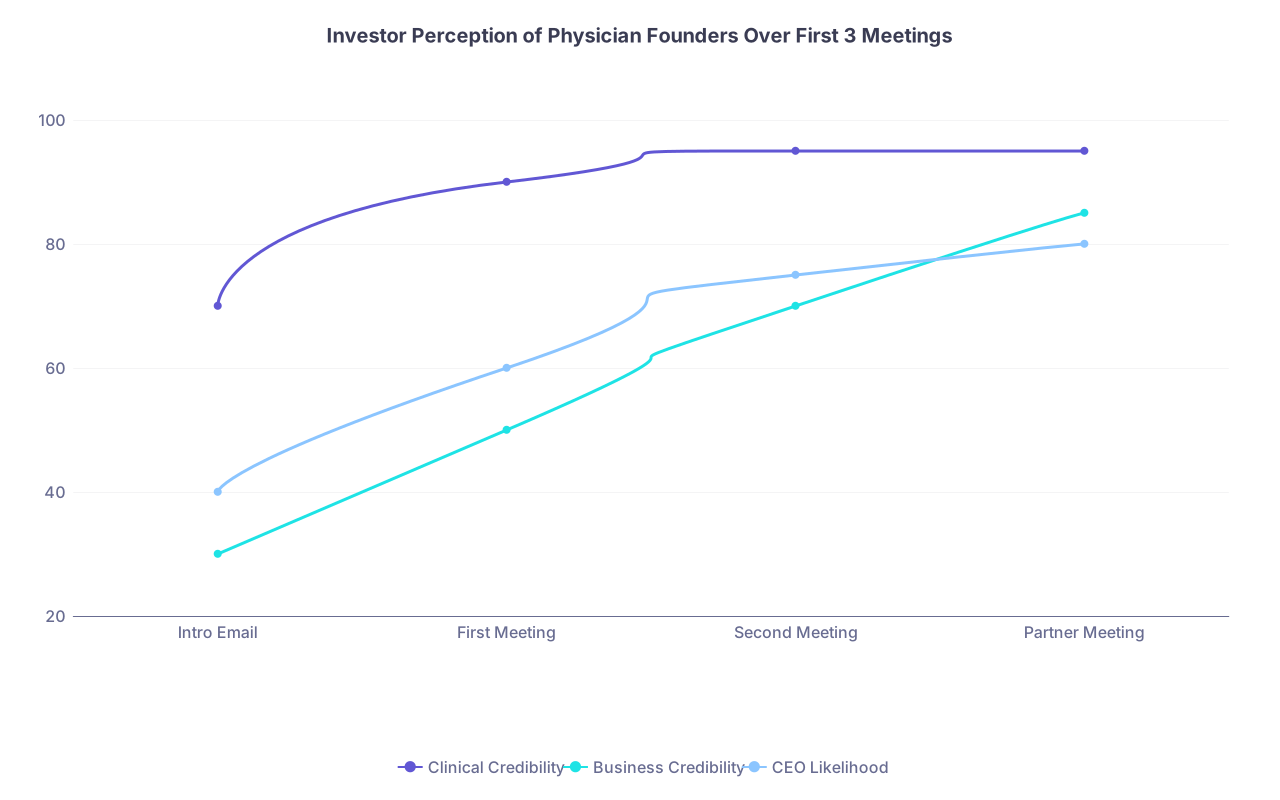
| Category | Clinical Credibility | Business Credibility | CEO Likelihood |
|---|---|---|---|
| Intro Email | 70 | 30 | 40 |
| First Meeting | 90 | 50 | 60 |
| Second Meeting | 95 | 70 | 75 |
| Partner Meeting | 95 | 85 | 80 |
How they “downgrade” you without saying it
Phrases you never want to be reduced to in a partner meeting:
- “Really strong clinically; might need a strong operator.”
- “Feels more like a product or medical founder than a CEO.”
- “Could be a great advisor/Chief Medical Officer for us.”
You start as “the doctor founder.” You want to leave as “the CEO who happens to be a doctor.”
How do you signal that?
- You talk markets as comfortably as you talk guidelines.
- You know your key metrics cold (CAC, LTV, ACV, gross margin) even if you’re early.
- You don’t oversell regulatory complexity as a moat. You explain it, but you don’t hide behind it.
I watched a cardiologist‑founder at a Boston fund meeting absolutely flip the room when, after 20 minutes of clinical talk, a partner interrupted and asked: “What’s the unit economics on a single site?” And the founder replied with:
“Average annual contract value $180k per site, gross margin 72% post‑implementation, 6‑month payback period on our CAC after year one. I can walk you through the assumptions if you’d like.”
Suddenly, the MD was not “the doctor.” He was “the CEO.”
What the Meeting Room Physically Looks and Feels Like
You’re post‑residency, maybe in your first attending job, used to hospital hierarchies. This world has its own hierarchies, and the cues are different.
In-person meeting
Picture this:
Glass-walled conference room. Four people from the fund, you and maybe a co‑founder.
- The junior associate or principal sits closest to you, laptop open, typing nonstop. They’re your note‑taking resident. Don’t perform for them.
- The partner (or two) is sitting slightly back, half-watching you, half-watching how the team reacts to you.
- There’s usually one person in the room who says very little. That’s the one who matters most.
They will be on email or phone during parts of your pitch. Don’t get thrown. They’re seeing if your business can survive as background noise in a partner’s life. That’s… honestly, about right.
Zoom meeting
On Zoom, it’s worse. You’re talking to a wall of half‑muted faces, watching for micro‑reactions. Two patterns:
- Cameras on, but they’re clearly multitasking.
- Cameras off “because I’m in transit,” while an associate smiles and nods at you.
You cannot control that. What you control: sharpness of narrative and ability to cut to the chase.
Common Ways Physician Founders Shoot Themselves in the Foot
I’ve watched this movie too many times. Here are the patterns that kill deals before they start.
1. Treating the meeting like M&M, not like a sales conversation
Doctors are trained to present balanced, nuanced views. Pros, cons, limitations. That is exactly what you do not do in an investor pitch.
You’re not doing an evidence review. You’re selling a vision with enough detail to be credible.
Deadly lines:
- “This may or may not work in all populations.”
- “We don’t really know what payers will think yet.”
- “We’re still trying to figure out our pricing.”
Those may all be true. But you say instead:
- “Early data suggests this works best in [defined cohort]; we’re focusing there first.”
- “We’ve had preliminary conversations with [X, Y payers]; here’s how they’re thinking.”
- “Our current pricing is [X]; we’re testing [Y, Z] with upcoming pilots.”
Same reality. Very different reaction.
2. Over-indexing on “clinical complexity” as your moat
Investors have heard “healthcare is complex” a thousand times. It’s white noise now.
You say: “The guidelines are complex, and integrating this into workflow is non-trivial.”
They hear: “This will be impossible to scale.”
If your entire moat is “doctors will only trust us because we’re doctors,” you don’t have a moat. You have a brand story. Maybe.
You want to talk:
- Data advantage (access to a unique dataset or workflow).
- Distribution advantage (channels into IDNs, payers, employers).
- Structural advantage (regulatory status that makes you hard to dislodge).
3. Signaling you’re not all-in
Post‑residency stage is tricky. You may still be working clinically. That’s fine. But the way you talk about it matters.
If you say:
“I’m going to keep my full clinical schedule while we see how this goes,”
you’re telling them this is a hobby.
What they want to hear is something closer to:
“I’m currently at 0.5 FTE clinically, primarily to keep my license and stay close to the problem. Our plan is to taper that down as we bring on additional capital and hit milestones X and Y. I’m fully committed to building this.”
There’s a difference between prudence and hedging. They can smell hedging.
What Happens After You Leave the Room
The real verdict doesn’t happen in front of you. It happens in the 10–20 minutes after you drop off Zoom or walk out.
That debrief is brutal and fast. Roughly like this:
- Associate summarizes: “They’re building X, early traction Y, raising Z.”
- People react with initial gut feelings. This matters more than you think.
- They ask: “Is this venture scale? Is this the right team?”
If there’s any enthusiasm, the next step is “Let’s see more data” or “Let’s put them in front of the partnership.”
Your job is to make it easy for your internal champion (usually the associate or principal) to sell you internally:
- Clear 1‑liner problem and solution.
- Concrete traction metrics, even if small.
- Sharp narrative about market size and why now.
- A founder story that makes your obsession obvious.
If they can’t repeat your pitch in 30 seconds to a skeptical partner, you’re done.
How Investor Meetings Evolve Over Time
Your first few investor meetings will be painful. That’s fine. The key is that your answers get sharper fast.
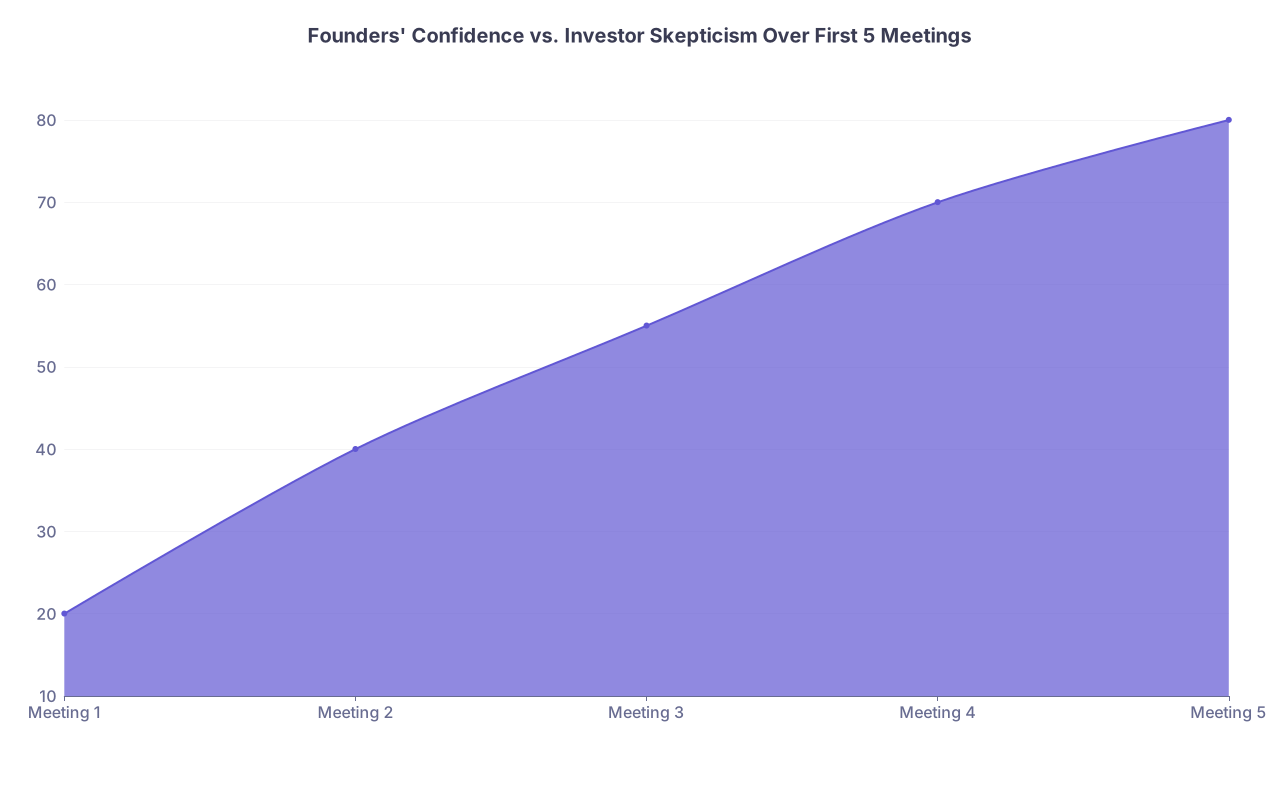
| Category | Value |
|---|---|
| Meeting 1 | 20 |
| Meeting 2 | 40 |
| Meeting 3 | 55 |
| Meeting 4 | 70 |
| Meeting 5 | 80 |
By meeting 5–10, if you’re paying attention:
- Your description of the problem is more economic than emotional.
- Your go‑to‑market story isn’t theoretical anymore; it’s based on actual conversations.
- Your answer to “How big can this be?” doesn’t wobble.
There’s a quiet leveling moment every good physician founder hits: the first time an investor challenges your clinical assumption and you slap it down, calmly, with data and real-world nuance—and then immediately pivot to how it affects pricing and churn.
That’s when you’re not just a doctor in a hoodie. You’re a founder.
Practical Prep: What You Should Walk In With
I’m not going to dump a generic checklist on you. But if you walk into a serious investor meeting without the following at your fingertips, you’re handicapping yourself.
You should be able to answer, clearly and specifically, without fumbling:
- What problem are you solving, in economic terms, and for whom?
- How big is that market, and what slice do you realistically capture in 5–7 years?
- Who exactly pays you, how much, how often, and why do they renew?
- What proof do you have today that anyone cares? (Pilots, LOIs, letters of support, usage data.)
- What are the 3 biggest risks, and how will this round of capital reduce them?
If you can’t answer those, fix that before you worry about your slide design.
FAQs
1. Do investors expect me to quit practicing medicine completely?
They expect you to behave like a full‑time founder, not a moonlighting attending. Early on, some clinical time is acceptable—especially for credibility and income—but the clear trajectory needs to be toward your startup being your primary professional identity. If your plan is “I’ll keep my full attending job and work on this on weekends,” serious investors will quietly pass.
2. How much does my residency training pedigree matter in investor meetings?
Less than you think, but it’s not irrelevant. Being from MGH, Stanford, UCSF, Hopkins—those names help at the margin in the first 5 minutes. They buy you an assumption of competence. After that, no one cares. I’ve seen plenty of community‑trained docs beat Ivy‑trained physicians in the fundraising arena because they spoke the language of business and execution far better.
3. Should I lead with my personal story or jump straight into the business?
Lead with the problem and the business, anchor it quickly with your personal story, then get back to the business. “I watched X happen during residency and it pissed me off so much I built Y” works. A five‑minute monologue about your training path doesn’t. Think 60–90 seconds of story, max, then into market and solution.
4. What if I don’t know an answer in the meeting?
You’re not being tested on omniscience. You’re being tested on precision and honesty. The worst move is to hand‑wave or bluff. The best move is: “We don’t know that yet; here’s the assumption we’re currently using, and here’s how we’ll validate it in the next 3–6 months.” Investors forgive gaps. They do not forgive bullshit.
5. How many investor meetings should I expect before I get a yes?
If you’re early and not already famous in tech, expect anywhere from 20 to 60 meetings before a real term sheet. That’s normal, not a sign you’re failing. The key is whether your story, metrics, and confidence are clearly improving as you go. If you’re having meeting number 15 and answering questions exactly the way you did in meeting number 3, you’re not learning—you’re just collecting rejections.
Here’s what to remember.
Investors are not grading your medicine. They’re grading your ability to turn clinical insight into a repeatable, scalable business.
Your MD is the door-opener. Your command of markets, money flow, and execution is what keeps you in the room.
And in every meeting, act like what you are trying to become: not “a doctor with a startup,” but the CEO of a real company that just happens to be fixing the parts of healthcare you know all too well.


