

The “brilliant doctor who single-handedly builds the next Epic or Teladoc” is mostly a fantasy. And a harmful one.
If you’re finishing residency and thinking about startups, you’re not crazy. But if you think you’re going to whiteboard your way from clinic to unicorn alone because you “understand the problem better than anyone,” you’re already off track.
Let’s talk about what the evidence actually shows about successful health-tech and medical startups founded by physicians—versus the heroic stories people tell at conferences and in breathless LinkedIn posts.
The Lone Genius Story Is Mostly Retconned Fiction
The retrospective narrative always sounds the same:
“I saw a problem on call one night, hacked a prototype, and the rest is history.”
What actually happened, for most real companies:
- There were non-clinical co-founders very early.
- Money, connections, and regulatory help came from outside medicine.
- The idea pivoted—sometimes multiple times.
- The “founder story” was polished after the fact to sound inevitable and individual.
Look at the physician-involved companies you know:
- Zocdoc
- Oscar Health
- Flatiron Health
- Omada Health
- Livongo
- Carbon Health
In nearly every case, the physician was one of several founders, or an early clinical leader, not some solo wizard coding while moonlighting in the ICU.
You know what you don’t see in the data? Solo MDs, with no serious technical or business partners, scaling a complex, regulated, multi-stakeholder product to national impact.
The myth survives because it’s emotionally appealing. It flatters the physician ego: “If I just work hard and care enough, I can fix this myself.” It’s also cleaner for PR and pitch decks to show one visionary face.
Reality: health care is brutal, regulated, and fragmented. No one person—clinical or not—has all the skills to win here.
What the Data on Startup Success Actually Says
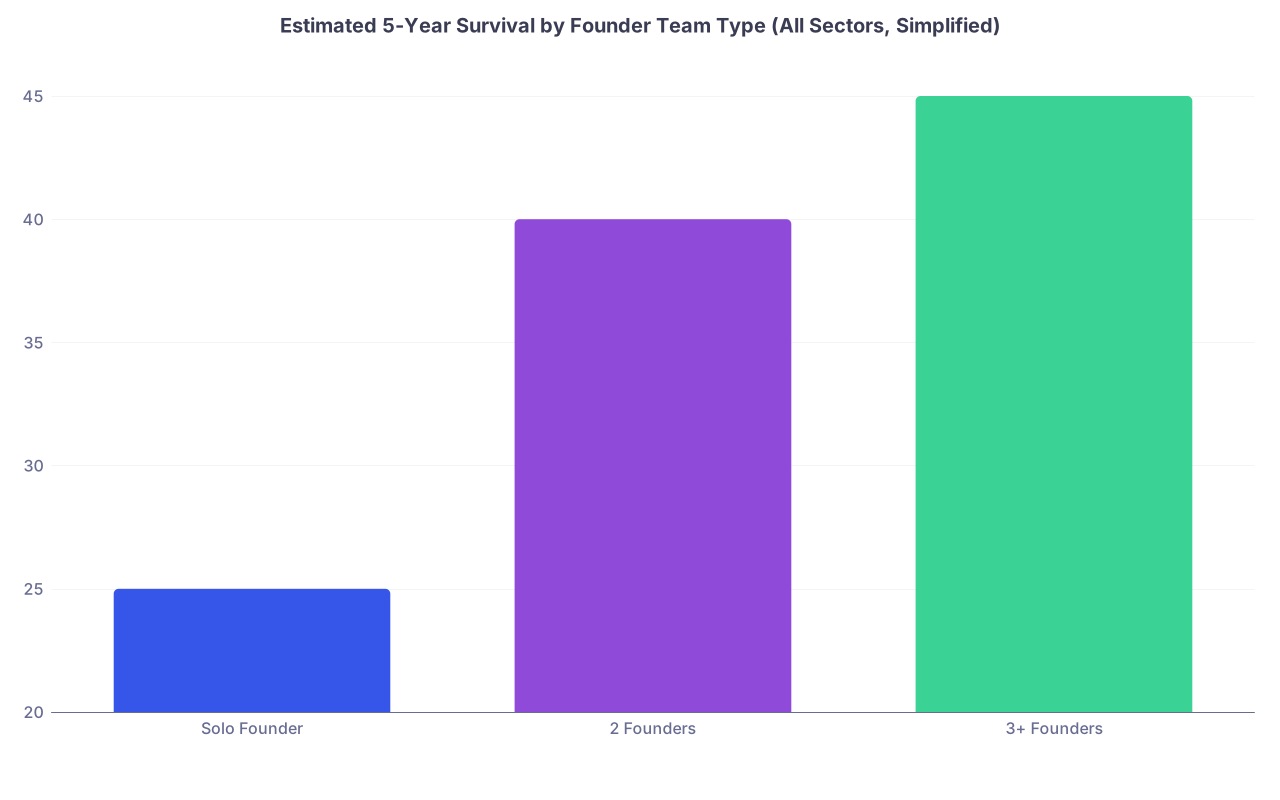
You don’t have to guess. There’s reasonably good data on who succeeds in startups. Not perfect, but better than vibes.
| Category | Value |
|---|---|
| Solo Founder | 25 |
| 2 Founders | 40 |
| 3+ Founders | 45 |
Multiple analyses (Y Combinator portfolio data, CB Insights, and several academic reviews of high-growth firms) converge on a few boring but consistent facts:
Solo founders underperform teams.
Rough ballpark: companies with 2–3 founders survive and grow at higher rates than solo efforts. Different studies give different exact numbers, but the direction is the same.Expertise diversity beats homogeneous teams.
The teams that mix product/tech, domain expertise, and commercial skills outperform groups of three people with the same background.Prior relevant experience matters, but not in the way doctors think.
Your residency in internal medicine helps you understand the problem. It does not automatically help you with:- fundraising
- building scalable software
- B2B enterprise sales to hospital systems
- FDA submissions
- payer contracting
In health care specifically, Rock Health, StartUp Health, and various venture reports show that successful digital health startups usually have:
- Mixed founding teams (tech + business + clinical).
- Early access to capital and networks outside traditional medicine.
- Iterative product-market fit work, not “I know the answer on day one.”
Notice what’s missing: “Single MD hero with a perfect idea from residency.”
Why Doctors Are Uniquely Vulnerable to the Lone Genius Trap
Physicians are actually primed to believe this myth.
Here’s the setup you’ve lived through:
- You’ve been told since premed that you’re “top percentile.”
- You became the default decision-maker on the ward.
- The culture rewards individual performance and punishes visible uncertainty.
- Academic medicine still fetishizes the solo PI, even though labs are giant teams.
So by PGY-3 or PGY-4, it feels normal to think: “If I don’t drive this, it won’t get done.” That’s adaptive in a chaotic ED shift. It’s awful for building a company.
Typical patterns I’ve watched play out:
The “I’ll just hire implementers” delusion
The MD founder believes they’ll come up with the product and strategy, then hire engineers and “a sales guy” to execute. This is backwards. In good startups, product and engineering co-create; sales shapes the product with customer feedback; the CEO doesn’t just hand down stone tablets.The “medicine is special, outsiders don’t get it” arrogance
Yes, medicine is weird. HIPAA, CMS, JCAHO, EMRs from hell. But guess what?- Cybersecurity is weird.
- Payment rails are weird.
- Logistics is weird.
The difference is, other industries don’t assume domain expertise makes you a natural founder. Tech people overestimate what they know about health care. Doctors overestimate what they know about tech and business. Both sides are wrong.
The “I can learn everything” fantasy
Could you learn:- Python
- product management
- SaaS pricing strategy
- enterprise sales
- regulatory pathways
in parallel with practicing clinically or right after residency? Theoretically yes. Practically? You’ll hit a wall. Time and cognitive bandwidth are finite.
The health-tech graveyard is full of MD-led, underpowered, overconfident solo projects that got to a prototype and then died quietly when they hit sales, integration, or regulatory complexity.
What Actually Works for Physician Founders
So, what does good look like for a doctor post-residency who wants to build something real?
1. Start With a Narrow, Painfully Specific Problem
Most physician founders start way too big. “Fix prior auth.” “Reinvent primary care.” These are mottos, not products.
Successful physician-involved startups usually start with something like:
- “We cut no-show rates in safety-net clinics by giving Medicaid patients a specific text/transport workflow.”
- “We help hospitalists identify high-risk readmissions 24–48 hours before discharge in one EMR-integrated dashboard.”
- “We provide fully compliant remote diabetic foot monitoring for SNFs, with billing workflows baked in.”
Notice the pattern: specific user, specific setting, measurable outcome, clear buyer.
You’ve probably seen nurses hack their own workflow fixes with sticky notes and unofficial Excel sheets. Those are better starting points than your grand theory of “fixing burnout.”
2. Build With Non-MD Co-Founders, Not Around Them
The solo MD model is weak; the “MD + serious non-clinical co-founder” model is strong.
You want at least one co-founder who can either:
- Own the product/technical side (CTO/product founder), or
- Own the commercial side (sales, BD, ops),
and preferably both across 2–3 people.
Not “some dev shop in Eastern Europe” you pay per hour. Not “my cousin who codes on weekends.” Real partners with equity, decision power, and skin in the game.

What I’ve consistently seen work:
- MD founder: owns problem definition, clinical credibility, early customer discovery, and early design of workflows that actually fit real-world care.
- Technical founder: owns architecture, iteration speed, and hard truth on what is actually buildable.
- Commercial/ops founder: owns how this becomes a business, not just a pilot—who pays, how much, how often, and how sales cycles actually work.
You may fit one of those non-clinical roles if you’ve put in the time (e.g., legit coding background, MBA + real commercial roles). Most graduating residents don’t.
3. Stop Pitching Ideas; Start Running Experiments
Health care founders—especially MDs—love big ideas and hate small, dirty experiments. But the companies that survive look almost embarrassingly scrappy at the beginning.
Instead of:
“I’m building an AI care coordination platform.”
Do this sequence:
Spend two weeks watching care coordinators or nurses do their job. Document the workflow in obsessive detail. Time steps. Count clicks. Notice the “shadow systems” (paper lists, hallway conversations).
Mock a solution with:
- Google Sheets
- Airtable
- basic messaging tools
- email + human-in-the-loop (you)
Get a tiny group (single clinic, one unit, one SNF) to use it. For free. Measure:
- time saved
- errors avoided
- readmissions or no-show changes
- staff satisfaction
Only when you have “this tiny thing improved X by Y%” do you earn the right to think about real product.
This is where good technical co-founders are gold. They’ll help you decide:
- what not to overbuild,
- when it’s time to move from hack to product,
- and how to instrument the product so you actually have data, not vibes.
4. Respect the Boring Stuff: Regulation, Billing, Integrations
Here’s where non-clinical expertise and experienced advisors save your company.
Health care startups die on:
- inability to integrate into Epic/Cerner without bleeding to death on services
- naive reimbursement assumptions (“we’ll just bill remote monitoring”)
- over- or under-building for HIPAA/FDA requirements
- terrible contracting terms with health systems or payers
| Area | Solo MD Typical Failure Mode | What Works Instead |
|---|---|---|
| Tech build | Over-scoped, under-architected | Senior technical co-founder |
| Sales | “Demo and pray” to CMOs | Structured pipeline, real sales leader |
| Regulation | Hand-wavy “HIPAA compliant” claims | Early legal/regulatory counsel |
| Reimbursement | Misreading CPT/coverage | Revenue cycle/billing expertise |
If you’re post-residency and serious, you need at least fractional access to people who live and breathe:
- health system contracting
- Medicare rules around your service area
- EMR integrations (HL7, FHIR, SSO, the fun stuff)
- data security and BAAs
The myth says: “You’re a physician, so you’ll figure it out.” The data says: the ones who survive treated these as first-class problems and brought in people who already know the landmines.
Career Reality: You’re Not Choosing Between “Clinician” and “Startup God”
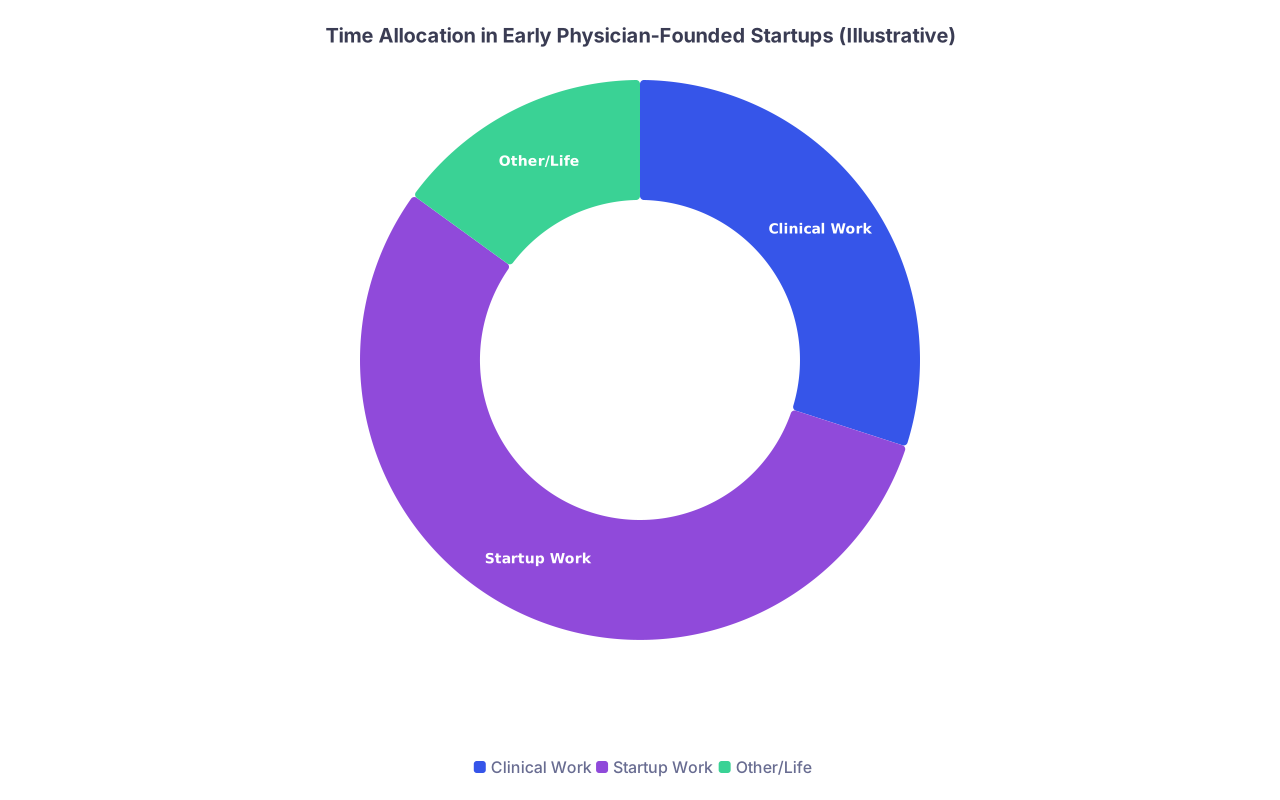
Another harmful myth: “If I do a startup, I must completely leave medicine and go all-in.” That’s sometimes true later. It’s rarely true at the start.
Real trajectories that work:
- 0.2–0.4 FTE clinical while you and co-founders test and iterate.
- Locums or shift-based work funding early-stage life costs while you avoid taking garbage terms from investors.
- Part-time academic positions in systems that actually support innovation (a minority, but they exist).
| Category | Value |
|---|---|
| Clinical Work | 30 |
| Startup Work | 55 |
| Other/Life | 15 |
The biggest pattern among MD founders who regret everything: they either:
- blew up their clinical career too early on a half-baked idea, or
- were too afraid to reduce clinical work at all and never gave the startup a real shot.
You need to be ruthlessly honest about financial runway, burnout risk, and family obligations. But the “all or nothing” narrative is simplistic. Many successful founders transitioned gradually.
Signals You’re Following the Myth, Not the Evidence
If you recognize yourself in these, recalibrate now, not after you’ve burned two years.
- Your deck has your face and credentials on half the slides, and no clear co-founder list.
- You tell people, “I’ve already validated the problem during residency,” but you haven’t sat down with 20+ paying stakeholders post-residency to dissect their buying constraints.
- You say, “I already have developers,” but cannot name a single person who owns product decisions and software architecture beyond you.
- You talk more about how big the market is than about the exact workflow you’re changing for an exact persona.
- When someone asks who will sell this, you say something like, “Well, I’ll talk to my old program director and then maybe expand.”
That’s not a plan. That’s wishful thinking in a white coat.
So What Should You Actually Do Next?
If you’re post-residency and serious about building a medical startup:
Get brutally narrow.
Define a problem small enough you can radically improve it for a specific group within 6–12 months.Find real co-founders, not assistants.
Look for people whose skills make you slightly uncomfortable because they see things you don’t. Tech, sales, operations—pick your missing limbs.Run real-world, low-tech experiments.
If you cannot improve an outcome with spreadsheets and duct tape, your app won’t fix it either.Build your network outside medicine.
Join health-tech founder communities. Talk to investors, product managers, health system innovation leads. Listen more than you talk.Treat regulation and reimbursement like product features, not annoying afterthoughts.
If you’re building something that depends on getting paid in the U.S. health system (hint: that’s almost everything), design your business around that from day one.
The Bottom Line
Three things, stripped of romance:
- The lone genius doctor founder is basically a story we tell for ego and marketing. The companies that matter are built by teams with complementary skills, not solo MD heroes.
- Your clinical experience is valuable—but it’s only one piece. The physician founders who win pair that experience with serious technical, commercial, and regulatory partners from the start.
- The path that works is boring up close: narrow problem, small experiments, mixed founding team, and ruthless focus on workflows, payment, and integration. Everything else is noise.


