
The way physician teams get ranked inside accelerators has almost nothing to do with what you put on your slides—and almost everything to do with the whispered comments after you leave the room.
Let me walk you through what actually happens once the Zoom call ends or the demo-day lights go down. Because by the time you get your “we’re excited to move you to the next stage” email (or the standard rejection), your fate was usually sealed in five to ten brutal minutes of discussion you’ll never hear.
What’s Really Going On in Ranking Meetings
I’ve sat in those rooms and on those Zooms. Partners at medical-focused accelerators and generalist accelerators with “health verticals” argue over physician teams like they’re fantasy football picks.
On the outside you see “selection criteria” pages: innovation, traction, market size, team quality. Looks clean. Rational. Fair.
Inside, the mental scorecard looks more like this:
“Is this a real doctor-entrepreneur or a tourist?”
“Will this person quit when they realize it’s hard?”
“Can I put this founder in front of my LPs without being embarrassed?”
“Are we buying into a product or into a Rolodex?”
And here’s the part most physicians never realize:
Your MD or DO is not a free ticket. It’s actually a filter that makes them more suspicious. Because they’ve been burned by too many “side project” doctors who try to founder from the OR lounge.
So they rank physician teams with a different, harsher rubric than the generic SaaS kids.
Let me break down how that rubric really works.
The Hidden Ranking Rubric for Physician Teams
Officially there are scorecards. In practice, they’re modified in real time based on who’s in the room and what they’ve seen before.
Here’s the unspoken framework most accelerators use for physician-led startups, whether they admit it or not:
| Dimension | Weight Class | Gut-Level Question |
|---|---|---|
| Founder Risk Profile | Heavy | Will they actually jump, or stay employed? |
| Execution Signal | Heavy | Have they shipped *anything* yet? |
| Clinical Credibility | Medium | Does their expertise match the problem? |
| Market & Business Sense | Heavy | Do they understand buyers and economics? |
| Coachability & Ego | Medium | Will they listen, or lecture us? |
Note: nobody in the room calls it this. They just use it.
1. Founder Risk Profile: Are You for Real or Just Playing Startup?
This is the first thing they talk about after you leave.
“Are they still full-time attending?”
“Protected time or real time?”
“Did they take a pay cut yet?”
If you’re a PGY-3 looking at post-residency options, or a fresh attending, this is where they start ranking you up or down.
Here’s the mental ladder:
Top rank:
Physician founder who has already gone part-time or left clinical, has skin in the game, and can speak clearly about personal financial runway. They’ll say things like, “I took a 0.6 FTE hospitalist role for 12 months to extend our runway while we hit X milestones.” That sounds like commitment plus realism. Partners love that.
Second tier:
Still full-time clinical, but with concrete, near-term transition plans—and meaningful evidence of execution despite the job. As in: “We’ve signed 2 pilot LOIs, implemented in one site, and built v1 with 30 weekly active users… while doing nights.” That level of pain buys you credibility.
Bottom tier (and this is most physician applicants):
Full-time attending, vague about timeline, talking about “seeing how it goes” before reducing shifts. The subtext is “I want upside without risk.” That team gets ranked below a scrappy pair of 25-year-old non-clinician founders 9 times out of 10.
2. Execution Signal: You Get Scored on What You’ve Done, Not What You Know
Physicians are used to being “impressive on paper.” In accelerators, no one cares about that once you hit a certain baseline.
They care about velocity.
In ranking discussions, you’ll hear lines like:
“They’ve already got 200 patients through the platform with no marketing.”
“They convinced XYZ community clinic to run a pilot without paying them.”
“They built this with literally no budget, nights and weekends.”
Your publications, h-index, clinical awards? They might get a polite nod. But ranking jumps happen when someone on the committee can say: “They did this already with nothing.”
And here’s the trap: a lot of physician decks are heavy on TAM slides and light on traction. They read like grant proposals.
Accelerator people don’t rank grants. They rank momentum.
The Closed-Door Flow: What Actually Happens After You Pitch
You pitch. They smile. They nod. Maybe someone asks a smart question about prior authorizations or CPT codes and you think, “Nice, they get it.”
Then your Zoom ends.
Within 30 seconds, the tone shifts.

| Step | Description |
|---|---|
| Step 1 | Pitch Ends |
| Step 2 | Champion Gives Summary |
| Step 3 | Fast Dismissal |
| Step 4 | Rank Upper Tier |
| Step 5 | Rank Middle Tier |
| Step 6 | Conditional - Needs More Proof |
| Step 7 | Rank Lower Tier |
| Step 8 | Invite to Next Round |
| Step 9 | Debate vs Other Teams |
| Step 10 | Rejection Template |
| Step 11 | Champion in Room |
| Step 12 | Perceived Commitment |
The part you never see: if there’s no “champion” in that room—one partner or EIR willing to go to bat for you—you’re dead before the number scoring even starts.
The champion doesn’t just say “good team.” They translate you.
They say things like:
“Look, you’re all underestimating how insane it is that they got a 20-hospital system’s CMIO to sign a pilot as a nobody PGY-3.”
or
“Yes, their deck is ugly, but they’ve been oncall all week and still got LOI signatures. That’s signal.”
No champion? You become “interesting, but early,” which is just code for “I’m not spending my political capital on this.”
The Unspoken Biases: How Physician Teams Get Tilted Up or Down
Let me be blunt. There are patterns.
And accelerators do not publish these, because it would piss people off and invite lawsuits. But the patterns exist.
Specialty Bias
Some specialties get a silent boost or penalty.
Emergency medicine and hospitalists? They often rank higher for “scrappy, systems-thinking, broad exposure.” Surgeons? Split. Either “relentless executors” or “rigid, control freak, can’t ship an MVP.”
Psychiatrists and neurologists pitching B2B enterprise SaaS to health systems? Often ranked lower unless they have a cofounder with clear business chops. The stereotype (fair or not) is “great clinician, weak operator.”
And yes, proceduralists who are still pulling $500k+ clinically and refuse to step away? They get down-ranked on “commitment.” Because everyone in the room knows that walking away from that money is hard. If you haven’t done it yet, they assume you won’t.
Academic vs Community Background
Academic physicians love to lead with their institution.
At accelerators, that plays… ok. But not as strongly as you think.
Founders from MGH, Stanford, Hopkins get an initial credibility bump—but they lose that edge fast if the deck smells like “academic digital health” instead of a business. Too slow, too grant-y, too focused on outcomes papers before revenue.
The surprise winners? Community docs who already run a practice, a service line, or some operational unit and can talk P&L without blinking. They get ranked higher because they speak the same language as hospital executives and payers.
Why Your CV Impresses Them Less Than a Single Pilot Contract
Let’s talk about what moves you from “interesting” to “top third of the batch” during ranking.
Not:
– Your fellowship
– Your 50+ PubMed citations
– Your resident of the year plaque
Instead:
A signed pilot LOI with a real institution
A paying early adopter, even tiny
Evidence you’ve navigated one actual procurement or legal process
In the closed-door ranking conversation, someone will literally say:
“Cool bio, but what have they done on this company?”
If your answer is a PDF prototype and five “great conversations,” you’re competing against teams who already integrated into an EHR sandbox or closed a pilot with a FQHC.
I’ve watched physician teams from “fancy places” lose rank to two non-clinician founders from nowhere because the latter just had cold-call grit and a live, ugly v1 that real nurses were already using.
You want to jump tiers? You need evidence of pain solved, not just expertise about the pain.
How Different Accelerators Secretly Score Physician Teams
Not all accelerators treat you the same. And yes, those internal differences matter a lot.
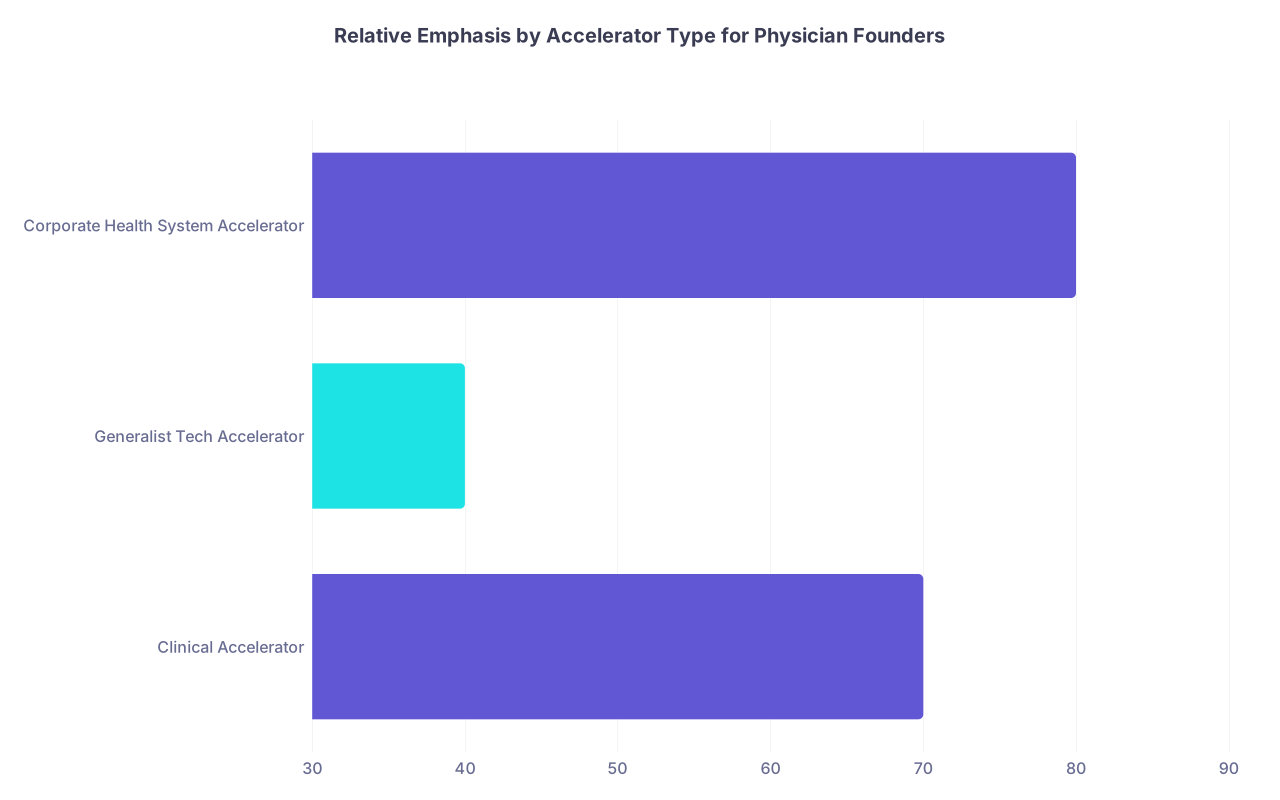
| Category | Value |
|---|---|
| Clinical Accelerator | 70 |
| Generalist Tech Accelerator | 40 |
| Corporate Health System Accelerator | 80 |
That chart’s simplified, but the nuance is this:
Clinically-Focused / Healthcare-Specific Accelerators
Think of health system-backed or health-only programs: Cedars-Sinai, Mayo, Jump, etc.
They overweight clinical insight and feasibility… but they underweight wild, non-consensus ideas. They love “EHR optimization,” “care coordination,” “population health,” and anything that smells like lower readmissions.
Ranking discussion sounds like:
“Can we pilot this in our cardiology service line this year?”
“Will compliance freak out?”
“Will this reduce length of stay or prevent a nurse union complaint?”
Physician founders with real inpatient battle scars rank higher here, especially if they speak “hospital politics” fluently. But if your idea is truly disruptive or requires workflow upheaval, you get dinged as “hard to implement.”
Generalist Tech Accelerators (YC-style, TechStars, etc.)
They care less about your MD and more about whether you can act like a default-yes founder.
You get ranked higher if:
You ship fast
You talk clearly in numbers and hypotheses
You sound more like a product manager than a guideline committee chair
In post-meeting ranking, someone will say, “Does this feel like a YC team who happens to be a doctor, or a doctor trying to cosplay as a YC founder?” That’s the line.
Corporate / Health System “Innovation” Programs
These are the trickiest. They often say “accelerator,” but function like glorified vendor onboarding plus PR.
Ranking is massively skewed by internal politics:
“Will this make our chair of medicine happy?”
“Will this help with a press release next quarter?”
“Does this threaten any existing vendor relationships?”
Physician founders with big names and non-threatening, “innovation theater” pilots can rank surprisingly high here. If you come in wanting real structural change, you’ll hear warm words and get quietly ranked low.
The Biggest Mistakes Physician Teams Make That Kill Their Rank
I’m going to be blunt, because sugarcoating this doesn’t help you.
Mistake 1: Talking Like a Clinician, Not a Founder
You lead with guidelines, evidence hierarchies, disease burden. You sound smart, sure. But in the ranking room people ask: “Do they understand who buys this and why now?”
You need to talk:
– Budget lines
– Decision-makers
– Procurement steps
– Reimbursement and margin impact
If you can’t say “Here’s who signs the check, here’s their incentive, here’s the cycle length,” you get ranked below non-clinicians who can.
Mistake 2: Selling “Clinical Rigor” Before You Sell “Speed and Learning”
Accelerators reward learning velocity.
When you spend precious pitch time talking about IRB processes and statistically powered RCTs, you trigger a fear: “This will be slow and overbuilt.”
What they want to hear: “We ran three scrappy pilots across different settings, learned X, killed Y, doubled down on Z, and changed our product twice based on nurse feedback.” That screams adaptability.
You can be rigorous later. Early on, if you lean too hard into “we’ll run a massive trial,” your rank drops.
Mistake 3: Hiding Your Risk Aversion
This one’s crucial.
Physicians are trained to avoid risk. Founders are rewarded for controlled, intelligent risk. When you subconsciously signal “I want certainty before I move,” they smell it.
Signals that tank you:
“I’ll see how this goes before cutting shifts.”
“I’m considering a faculty job and will decide between that and this.”
“I want to maintain my full clinical load at least for now.”
In the ranking room what they actually say is: “This is a project, not a company. We’d be a nice line on their CV; they won’t build a real business.”
You don’t have to quit entirely on day one, but you must show a clear, time-bound commitment path.
What Actually Pushes You Up the List
Now the constructive part. Here’s what, behind closed doors, consistently pushes physician teams into the top tier.
1. Evidence You Can Win Outside Your Home Turf
They expect you to navigate your own hospital or specialty.
They rank you higher when you show traction in an environment where you have zero status: a different health system, a rural clinic, a non-academic setting.
If you’re a cardiology fellow at a big-name center, and your only pilot is in your own cardiology division, that’s “expected.” If you have a pilot at a random community practice in another state you found through cold outreach, that’s signal.
2. A Co-Founder Who Complements, Not Mirrors, You
The best-ranked physician teams have one of two setups:
Physician + strong technical/product cofounder
Physician + operator with real P&L / sales / growth experience
What kills you: three physicians, all from the same academic department, trying to do a B2B SaaS product with no one who’s built software or sold into a hospital.
Behind closed doors, the comment is brutal and accurate: “Who in this team has shipped anything that someone paid for?”
3. True “Founder Voice” From the Physician
This part is subtle but critical.
The physician founder who ranks high doesn’t sound like “chief resident giving grand rounds with a slide deck.” They sound like: “I own this problem, I’ve been obsessed with it, and I’ve reversed-engineered the system from the payer to the front line.”
They say things like:
“We thought XYZ was the problem. Then we sat with 30 nurses across 3 hospitals and realized admin time wasn’t the actual bottleneck—it was the second log-in forcing workarounds.”
That’s founder talk. It’s obsessive, specific, and system-aware. That’s the voice that wins allies in the room when you’re not there.
How to Read a Rejection (Or a Lukewarm Acceptance) Correctly
One last reality: the email you get almost never reflects the real reason for your rank.
Common lines and what they actually mean:
“We think you’re too early for our program.”
→ “We did not see enough execution for the risk profile we sensed.”
“We’re not sure this is the right fit for our network.”
→ “No one in the room was willing to champion you.”
“We’re focusing on other verticals this batch.”
→ “You ranked in the bottom half and we had limited slots.”
Even the “yes” can be misread.
If you get in but feel like they’re putting you on a pedestal for being a doctor, watch out. Sometimes you’re admitted for brand optics, not because they believe you’ll be a top outcome.
Here’s the test: see how much they push you. If mentors challenge you hard on business mechanics, pricing, and GTM, they see you as a real founder. If they mostly ask you to “explain healthcare” to them, they see you as a subject-matter mascot.
FAQ: Inside Accelerators and Physician Founder Ranking
1. Should I quit my job before applying to an accelerator as a physician founder?
Not blindly. What helps your rank is a credible commitment plan, not reckless resignation. The strongest signal is often a deliberate reduction—moving from full-time to 0.6–0.8 FTE with a clear runway and execution milestones. In selection meetings, we like to hear you’ve already taken one irreversible step that hurts a little financially and socially, but you’re not gambling your family’s survival on a fantasy.
2. Does having a prestigious institution (MGH, Stanford, Mayo) really help my chances?
It gets you past the initial sniff test faster, yes. But past that, it stops mattering almost completely. In ranking meetings, the phrases that win are about pilots, usage, and revenue, not logos. I’ve watched unknown community docs with working products outrank “celebrity” academic physicians who had zero non-grant traction. Prestige is a key; traction is the lock.
3. How much traction do I need before applying?
More than most physicians think, less than perfect. For a B2B health startup, one or two serious pilots (with clear metrics and real users) can move you into the upper tier. For a direct-to-patient product, hundreds of users with at least some paying you is compelling. What kills you is being in the “idea plus mockups” phase while still fully clinical. If you haven’t sacrificed time or comfort to test it in the wild, ranking committees can tell.
4. Do accelerators actually value clinical rigor or just growth at all costs?
They value growth first, but they do not ignore rigor—especially in regulated or high-risk areas. The highest-ranked physician teams are the ones who frame rigor as a competitive advantage that doesn’t paralyze speed. For example: “We built a minimal product, tested it in low-risk scenarios, collected safety and outcomes signals, and used those to accelerate sales conversations.” If you demand a five-year RCT before selling anything, you’ll be ranked as an academic project, not a startup.
Key points to carry with you:
- You’re not being ranked as “a good doctor.” You’re being ranked as “a founder who happens to be a doctor,” and most accelerators are ruthless about that distinction.
- Commitment, execution, and business realism outrank prestige, publications, and perfect clinical reasoning every single time behind closed doors.