
What happens when the “2% equity” you were promised as a founding physician ends up being worth nothing… even though the company just sold for $200 million?
If that sounds dramatic, I can tell you it is not hypothetical. I have watched physicians walk away with zero because of sloppy, one‑sided, or completely misunderstood equity agreements. They thought they were “co‑founders.” Legally, they were not.
You spent a decade learning medicine, not cap tables, vesting schedules, and liquidation preferences. That is exactly why you are at high risk. Early‑stage founders and investors are used to this game. You are not.
Let me walk you through the most common, expensive mistakes physicians make in startup equity deals—especially in the post‑residency / early‑career phase when the wrong “opportunity” can quietly wreck your financial trajectory.
Mistake #1: Confusing “Percent of Something” With Actual Ownership
The classic trap:
“You’ll get 2% of the company. That’s easily $2–3 million if we exit at $150 million.”
Sounds great. Feels like a huge win for someone right out of fellowship.
There are at least four ways that “2%” can be a legal illusion:
- It is 2% of current shares, not fully diluted shares.
- It is 2% of an option pool that can later be expanded.
- It is 2% subject to vesting that you never fully earn.
- It is 2% of common stock that is paid last, behind multiple layers of preferred stock.
If you do not know which one you are being offered, you are not getting 2%. You are getting a story.

| Category | Value |
|---|---|
| Initial Offer | 2 |
| After Option Pool | 1.5 |
| After Investor Round | 0.8 |
| After Exit | 0.2 |
Here is the mistake: assuming a verbal “percentage” equals a locked‑in ownership stake.
You avoid this by demanding specifics in writing:
- What is the current fully diluted cap table?
- What class of shares am I getting (common vs preferred)?
- Is this % before or after current and planned option pools?
- What is the exact number of shares or options, not just a percent?
And then checking that against the actual capitalization table. Not a slide deck. Not a casual email. The real cap table.
If they cannot or will not show you the cap table, that is not a minor red flag. That is a siren.
Mistake #2: Ignoring Vesting, Cliff Periods, and Termination Terms
Physicians are trained to think in job contracts: salary, call schedule, PTO. Startup equity agreements live in a different universe: vesting.
Vesting is where many physicians lose everything.
The usual structure in tech:
- 4‑year vesting
- 1‑year cliff
- Vesting monthly or quarterly after the cliff
If you join as “Chief Medical Officer” or “Founding Physician” on this schedule and leave at 11 months, you may get nothing. Zero. Even if you worked every weekend to build the clinical model.
The bigger trap: acceleration language—or the lack of it.
Founders and key executives often negotiate:
- Single‑trigger acceleration (some or all unvested equity vests on an acquisition), or
- Double‑trigger acceleration (acquisition + termination without cause, or role materially diminished)
Most physicians… never ask. So here is how it plays out:
Company gets acquired. Your new corporate parent brings in their own medical leadership. You are “reorganized” into a smaller role or pushed out. Because you did not negotiate acceleration, most of your unvested equity evaporates exactly when the payoff was supposed to happen.
To avoid this:
- Demand to see a clear vesting schedule in the contract.
- Understand the cliff. If there is a 1‑year cliff and this is a side role, ask yourself whether you will realistically hit that year.
- Push for at least double‑trigger acceleration if you are truly core to the company’s value (clinical IP, relationships, regulatory framework).
If they tell you “we do not do acceleration for anyone,” ask bluntly: “Do the founders have it?” If yes and you do not, you just learned where you sit in the hierarchy.
Mistake #3: Signing Away IP and Clinical Data Rights Without Thinking
This one is subtle and brutal.
You come in as the “clinical founder” of an AI‑driven diagnostic startup, or a workflow platform built around your novel clinic process. You contribute:
- Protocols you personally developed.
- Templates and documentation.
- De‑identified data or structure for data collection.
- Guidelines or frameworks based on years of practice.
The agreement you sign may say, in one line, that all such contributions are “work made for hire” or “assigned to the company in full.” What does that mean in the real world?
It means:
- You cannot reuse your own tools for a future startup.
- You may be blocked from licensing “your” protocol elsewhere.
- You cannot later claim ownership of the core algorithm logic or pathway you designed for them.
I have seen physicians who thought they were “co‑creating” IP discover they had actually donated it. Permanently. For a small equity stake that never paid out.
The mistake: treating IP clauses as boilerplate and not deeply understanding what you are giving up.
You must read, or have counsel read, every clause that mentions:
- Intellectual property
- Inventions assignment
- Work made for hire
- Moral rights
- Data ownership or usage
If your clinical methods or data are central to your value, you negotiate. You might insist on:
- Joint ownership of certain IP.
- A license‑back for your own use in clinical practice or future ventures.
- Narrow field‑of‑use restrictions (e.g., company uses in digital health app; you retain rights for education, research, or in‑person care models).
Do not let anyone tell you “everyone just signs this.” Everyone is not bringing the same IP to the table. Investors know that. You should too.
Mistake #4: Not Understanding Liquidation Preferences and Exit Waterfalls
This is the big one almost no physician understands until it is too late.
You see a giant exit number on TechCrunch. Your friends congratulate you. Then your payout check arrives and… it is tiny. Or non‑existent.
Why? Liquidation preferences.
Investors often get “preferred” stock that includes:
- 1x, 2x, or higher liquidation preference (they get their money back first, sometimes multiplied)
- Participation rights (“participating preferred”) where they get their preference and share in the remaining pie with common holders
If you hold common stock or options (which is typical for physicians), you are at the bottom of the waterfall.
| Scenario | Total Exit | Investor Money In | Investor Preference | Left for Common |
|---|---|---|---|---|
| Small Exit | $30M | $25M | 1x | $5M |
| Larger Exit | $60M | $40M | 1x + participation | Very limited |
| Big Headline Exit | $200M | $150M | 2x | Possibly $0 |
That last line is not a typo. A 2x preference on $150M in can consume the first $300M of proceeds. If your “big” exit is $200M, there is nothing left for you.
The mistake: judging an offer purely by the % equity, with no idea where you sit in the capital structure.
You must ask:
- What class of shares am I getting?
- What liquidation preference do the preferred shares have?
- Are they participating or non‑participating?
- What is the total money invested to date and the expected next round sizes?
If the answer is “we are still working that out,” you need to assume the most protective structure—for investors, not for you.
Mistake #5: Ignoring Dilution and Future Financing Rounds
Your “2%” today can be 0.25% five years from now even if you stay fully vested and committed. That is the quiet erosion that catches physicians off guard.
Each new funding round often issues new shares:
- To investors
- To expand the option pool
- To bring in key executives
Your slice of the pie gets smaller, even if the pie is growing.
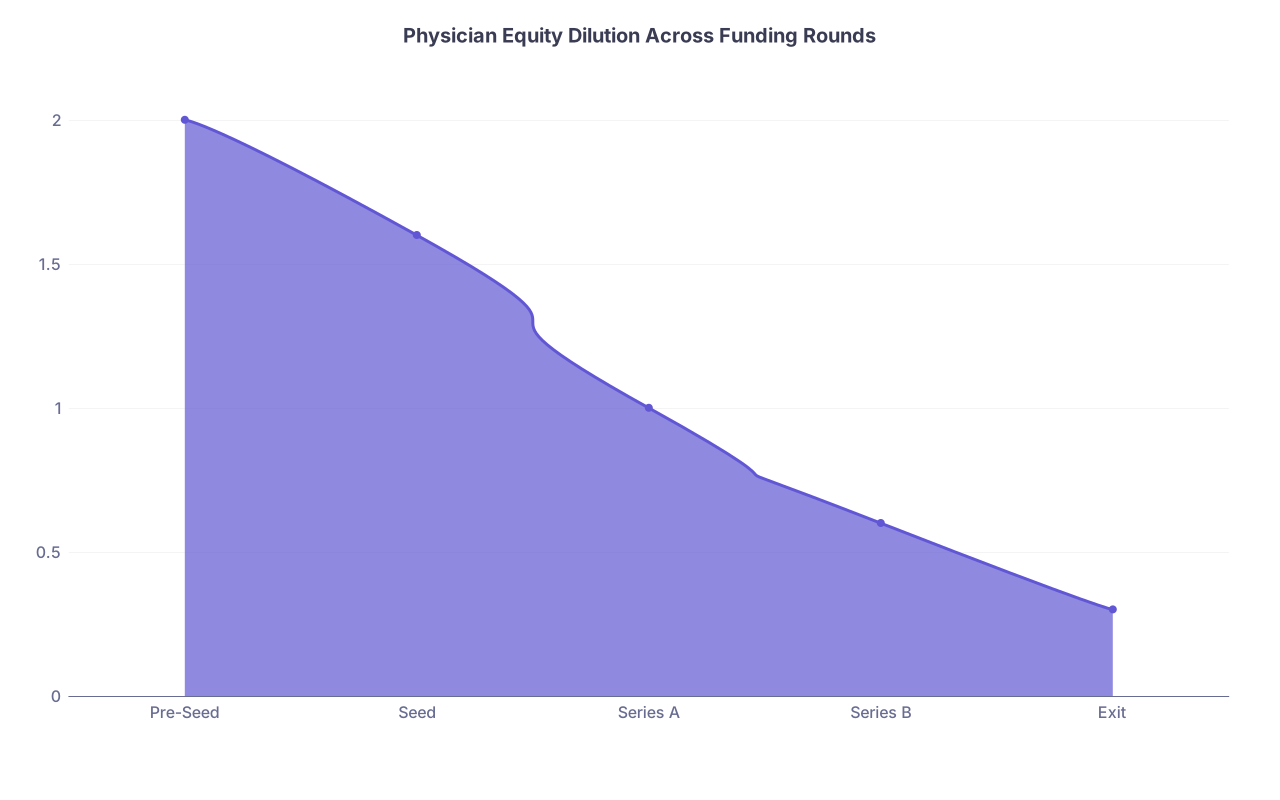
| Category | Value |
|---|---|
| Pre-Seed | 2 |
| Seed | 1.6 |
| Series A | 1 |
| Series B | 0.6 |
| Exit | 0.3 |
Sometimes that shrinking slice is still very valuable. But only if:
- The company hits a large enough exit, and
- Your class of stock shares proportionally in the upside.
Physicians make two errors here:
- They never ask what dilution to expect from planned financing rounds.
- They underestimate how often option pools get “refilled,” which primarily hits common shareholders.
You are not just betting on today’s 2%. You are betting on what that stake looks like after:
- Seed
- Series A
- Series B
- Possibly more rounds or bridge notes
If you are coming in as a very early clinical founder, you can ask for broad‑based anti‑dilution protection or at least clear disclosure about expected dilution scenarios. Many will say no. Fine. But at least you are making an informed decision, not a fantasy‑based one.
Mistake #6: Treating Advisory Roles Like Founder Roles (They Are Not)
Post‑residency physicians are catnip for startups: fresh, energetic, still idealistic, hungry to “be part of something big.” So they load you up with titles:
- “Founding Clinical Advisor”
- “Chief Medical Advisor”
- “Strategic Medical Partner”
Then they pay you in what I call decorative equity. A tiny advisory grant with minimal impact.
The mistake is thinking this makes you a “founder” in any legal, economic, or reputational sense. Advisory equity is usually:
- Small (often 0.1–0.5%, sometimes less)
- Vesting quarterly over 1–2 years
- Tied to vague, easily terminated advisory agreements
- Common stock or options, subject to all the waterfall pain we just discussed
Advisory roles are not bad. They can be useful, low‑intensity ways to learn the startup world. But they are not the same as:
- Being on the founding team
- Holding a true C‑suite executive role with meaningful equity
- Having real governance power (like a board seat)
Where physicians go wrong is overcommitting clinically relevant IP, heavy time, or brand risk for what is essentially an honorarium measured in shares.
If you are purely an advisor:
- Do not sign heavy non‑competes that block future ventures.
- Do not hand over broad IP rights unrelated to those specific advisory tasks.
- Do not be guilted into putting in founder‑level effort for advisory‑level equity.
You can always escalate later. Harder to claw back what you already gave away.
Mistake #7: Overlooking Non‑Compete, Non‑Solicit, and Conflicts With Your Day Job
This is where physicians stumble into license‑threatening territory.
You accept equity in a startup that:
- Operates in the same clinical space as your employer
- Competes with your hospital’s digital tool
- Wants access to your hospital’s data or patients
Then you casually sign:
- A non‑compete clause restricting practice in certain areas or with certain technologies
- A non‑solicitation clause prohibiting you from recruiting staff or patients
- A conflicts clause that your main employer might interpret very differently than you do
Meanwhile, your physician employment contract probably includes:
- A broad IP assignment clause (anything you develop “related to your field” belongs to them)
- A conflicts of interest policy you have not read since orientation
- Requirements to disclose outside financial interests
You can easily end up in a position where:
- Your main employer claims ownership of your equity‑generating work.
- You are accused of violating conflict policies for steering patients/data.
- You sign contradictory agreements that cannot all be honored.
This is not a theoretical risk. Health systems are increasingly aggressive about digital tools and data rights.
You must:
- Cross‑check startup agreements against your main employment contract.
- Disclose appropriately (and strategically) to your employer’s compliance or legal department.
- Narrow any non‑competes to realistic, specific scopes and geography.
- Avoid language that claims ownership over “all related inventions” in your specialty.
If the startup’s lawyers refuse any modification and your hospital is strict on conflicts, you may have to walk away. That is painful. It is still better than a board complaint or a lawsuit.
Mistake #8: Trusting Verbal Promises Instead of Enforceable Terms
I have lost count of how many times I have heard some version of:
“They told me they would update my equity after the next round.”
Or:
“They said the contract was just a formality and we would fix it later.”
If it is not in the signed documents, it is not real. That is not cynicism. That is how contract law works.
Common physician‑level fantasies:
- “They will add me as co‑founder later.”
- “They said they will give me more equity if the product uses my algorithm more.”
- “They promised a board seat once we raise Series A.”
Founders are often not intentionally lying. Early‑stage chaos is real. Priorities shift. Investors push back. But your recourse when things change is only what the documents say, not what the CEO remembers telling you two years ago.
If anything important to you is “we will do that later,” assume it will never happen.
You lock in:
- Equity amount and class
- Vesting and acceleration
- Role and title (if it matters to you)
- Compensation (cash + equity) structure
- IP and data rights
- Non‑compete scope and duration
Then you sign.
If they say “our lawyer told us to keep this simple and generic,” that usually means simple and favorable—for them. Not you.
Mistake #9: Treating This Like a Side Hustle Instead of a Serious Legal and Financial Decision
This one is more psychological but just as dangerous.
A lot of physicians think:
“It’s just some extra equity on the side. If it hits, great. If not, no big deal.”
Then they:
- Skip hiring their own lawyer because “it’s not that much money yet.”
- Skim the contract instead of reading it closely.
- Underestimate how these agreements can limit future opportunities.
That is how you sign something that:
- Locks you into a broad non‑compete.
- Transfers valuable IP you did not think of as IP.
- Makes you uninvestable in your own future startup because the first company has rights to your ideas.
The irony: You would never rush consent with a complex, high‑risk procedure because “it is just a side thing.” But people talk about startup equity like it is lottery tickets, not binding, enforceable obligations.
Treat every equity agreement as if it might be the one that actually hits. Because if it does, the difference between a poorly negotiated contract and a well‑negotiated one can be millions of dollars and years of your freedom.

| Step | Description |
|---|---|
| Step 1 | Equity Offer |
| Step 2 | No Clarity - High Risk |
| Step 3 | Understand Ownership |
| Step 4 | Hidden IP and Noncompete Risk |
| Step 5 | Informed Decision |
| Step 6 | Sign or Walk Away |
| Step 7 | Review Cap Table |
| Step 8 | Check Legal Terms |
Mistake #10: Not Having Independent, Startup‑Savvy Legal Counsel
This is the thread running through all of the above.
Hospital attorneys do not work for you. Startup’s attorneys definitely do not work for you. Your cousin who does real estate closings is not the right person for this either.
You need someone who has actually:
- Reviewed term sheets and equity incentive plans
- Negotiated vesting and acceleration
- Read dozens of liquidation preference structures
- Understood conflicts between physician employment contracts and startup roles
Yes, good counsel costs money. But you are not buying documents. You are buying someone who can see three moves ahead and tell you:
- “This looks fair—take it.”
- “This is acceptable if you treat it as a lottery ticket, not retirement.”
- “This is predatory—walk away now.”
I have seen physicians try to save a few thousand on legal fees and lose millions later. That math never works.
What You Should Do Today
Open whatever startup‑related documents you have: offer letters, advisory agreements, equity grant notices, consulting contracts.
Pick one that involves equity. Just one.
Now do this, in order:
- Highlight:
- The exact number of shares or options.
- The vesting schedule and any cliff.
- The class of stock (common vs preferred).
- Circle:
- Any mention of IP, inventions, or data.
- Any non‑compete or non‑solicit language.
- Write in the margin:
- “What happens to my equity if I am fired?”
- “What happens if the company is sold?”
- “What happens if they raise 2–3 more funding rounds?”
If you cannot answer those questions clearly from the document itself, not from memory of conversations, you are flying blind.
Your next move is straightforward: send that single document to an attorney who understands startups and physician contracts and get a one‑hour paid review.
Do that once, with one agreement, and you will never look at “2% equity” the same way again.