

The fastest way to quietly kill a promising academic career is not plagiarism or bad teaching. It is a conflict‑of‑interest mistake that you did not take seriously enough.
I have watched excellent clinician‑innovators lose leadership roles, grants, and tenure tracks over things they thought were “just paperwork” or “everyone does this.” Wrong. Once your institution, a journal, or the NIH decides you are sloppy or evasive about conflicts, you are radioactive. Especially if you are in medical startups, post‑residency, trying to straddle academia and industry.
You want to build a company, publish, and get promoted. Good. Just do not blow it with avoidable conflicts you should have managed upfront.
Let us walk through the main landmines.
1. Pretending COI Forms Are Just Annoying Formalities
This is the root mistake. Treating conflict‑of‑interest (COI) disclosures as a compliance annoyance instead of a survival tool.
Here is what actually happens:
- You join the faculty as an assistant professor.
- You spin out a startup around year 2–3.
- You start filling out COI forms at:
- Your institution (annual COI, outside professional activities, consulting forms)
- Journals (when you submit papers)
- Conferences (speaker disclosure slides)
- NIH/NSF or other funders (current and pending support, foreign ties)
You get tired. You copy‑paste. You “simplify.” You “forget” to include equity or options because “the shares are worthless anyway.”
That is where careers die.
Typical bad habits I see:
- Inconsistent numbers:
- Listing $10k consulting income on your university COI…
- But the company’s SEC filing later shows you received $75k in cash + equity that year.
- “Rounding away” equity:
- Ticking “no equity” because your options are not yet vested.
- Selective disclosure:
- Listing your company on your institutional COI…
- But not disclosing it as a conflict when you submit a paper about the same technology.
Here is the harsh truth:
Your real risk is not having a conflict. It is being caught hiding or minimizing a conflict.
You can have:
- Equity
- Consulting income
- Board roles
- Royalties
and still survive in academia. You probably cannot survive:
- One public investigation showing you repeatedly under‑disclosed or misrepresented those ties.
Rule:
If a reasonable person might think it might be a conflict, you disclose it. Fully. Everywhere.
2. Blurring the Line Between Your Lab and Your Startup
The sloppiest mistake post‑residency founders make: acting like their academic lab is their startup.
It is not. And your institution will come after you hard if they think you are using their resources to privately enrich yourself without a clear agreement.
The red flags:
- Using institutional:
- Lab space
- Technicians
- Graduate students
- Core facilities
For company work, without a documented sponsored research or service agreement.
- Having your startup host its Git repo, data, or IP on:
- University servers
- University Box/Drive/OneDrive
- Lab computers
- Paying students with “experience” instead of pay for company projects, then calling it “research mentoring.”
What this looks like in real life:
- A junior critical care doc develops a ventilator AI algorithm in her lab.
- She forms a startup with the IP office.
- She continues to refine the product using:
- Her postdoc’s time (paid by an NIH R01)
- ICU nurses doing “data collection” on hospital time
- Institutional REDCap for the company’s regulatory dataset
- A few years later, she raises a Series A. Someone sues. Discovery reveals that half the code base and training data were created under federal grants with no proper agreement.
Now you have:
- Potential federal grant non‑compliance
- IP ownership disputes (institution vs company)
- COI violations (unapproved use of trainees and resources)
The institution will not protect you. They will protect themselves.
How to not be that person:
Draw a hard operational line.
- Lab work: clearly academic, clearly funded, clearly owned by the institution.
- Company work: done on company time, with company contracts, on company infrastructure.
Formalize the relationship.
- Sponsored research agreements (SRA)
- IP licensing deals
- Core facility service agreements paid by the company
Keep a simple table for your sanity:
| Area | Academic Side Only | Startup Side Only |
|---|---|---|
| Data storage | Institutional systems | Company-controlled systems |
| Personnel | Trainees, staff on grants | Employees/contractors |
| Funding | Grants, department funds | Investor/ revenue funds |
| IP ownership | As per university policies | As per license/ company |
| Time | Protected academic time | Outside effort / approved |
If you cannot honestly fill this out for your situation, you are already at risk.
3. Letting Your Startup Pollute Your Clinical Judgment
This one will not just end your academic career. It can pull in your medical license and malpractice carrier too.
Here is the pattern:
- You co‑found a digital health startup.
- The pilot site? Obviously, your own hospital.
- You are the PI. You are also a shareholder and maybe CMO.
You:
- Nudge colleagues to enroll patients.
- Recommend your own tool in clinical notes.
- Advocate for your own product in internal guidelines.
Now layer in:
- A bad clinical outcome in a patient exposed to your product.
- A plaintiff’s lawyer who discovers:
- Your equity stake.
- That you never clearly documented the conflict in the chart or consent.
- That your patients were never told their doctor partially owns the device/app being used.
I have seen:
- Faculty removed from leadership positions.
- Institutional reviews of every paper and grant tied to that product.
- Quiet non‑renewal of contracts.
Academic medicine can forgive bad ideas. It does not forgive the appearance that you pushed a technology for personal gain.
Guardrails you ignore at your own risk:
- Never be the sole decision‑maker on whether your hospital adopts your product.
- If you are both:
- A treating physician, and
- A financial stakeholder in a device/app being used in care
Get formal guidance from:- Your COI office
- Legal
- Risk management
You will likely need:
- Independent medical review committees.
- Clear patient‑facing disclosures.
- Possibly recusal from certain purchasing or guideline committees.
If your internal voice says, “This might look bad if it was on the front page of the newspaper,” that is the time to stop and escalate. Not later, when a regulator or journalist calls.
4. Publishing Without Owning Your Conflicts (Journals Will Bury You)
You want to be a physician‑founder and publish in NEJM, JAMA, or Nature Medicine. Many have done it. The way they stay in good standing is simple: ruthless, transparent disclosure.
The career‑ending behavior:
- Under‑disclosing to journals.
- Or worse, disclosing differently than you disclosed to your own institution or funders.
Journals now routinely:
- Google your company.
- Check clinicaltrials.gov.
- Read your LinkedIn and investor press releases.
- Look at SEC or funding announcements.
If your paper says:
- “No relevant conflicts of interest.”
But your Series A announcement says:
- “Dr. X, co‑founder and Chief Medical Officer, developed this technology in his lab at Big Academic Medical Center…”
You are done.
The damage:
- Retraction.
- Editorial expression of concern tied to your name forever.
- Internal investigation back home.
Non‑negotiables when you publish about your own product:
Always list:
- Equity ownership (even if tiny, even if options, even if you think it is worthless).
- Roles (co‑founder, consultant, CMO, SAB member, etc.).
- Patents (pending and issued) related to the work.
Keep a personal COI file:
- One document where you list:
- All current companies you are associated with.
- Your roles.
- Approximate financial relationship (salary, consulting, equity, royalties).
- Use this to fill out every COI form so you do not “forget” something.
- One document where you list:
Make your disclosure statements at least slightly overinclusive.
- If you are debating whether to list something, that is your answer. List it.
5. Misunderstanding Institutional Rules About Outside Work and Time
New attendings with startups consistently underestimate how seriously institutions take “outside professional activities” and “effort commitments.”
Common self‑inflicted wounds:
- You sign:
- A 1.0 FTE faculty contract.
- A grant where you are committed to 30–50% effort.
- Then you also:
- Serve as CMO of your startup.
- Fly out for investor meetings.
- Do 10–15 hours/week of company work, unreported.
When:
- Your department chair learns about your CMO title from LinkedIn.
- Or NIH asks for effort reporting.
- Or a journalist writes a piece on your company and calls you “full‑time faculty AND full‑time CMO.”
You will be portrayed as:
- Double‑dipping.
- Misusing protected research or clinical time.
- Possibly misrepresenting effort on federal grants.
That is how people lose grant eligibility and tenure tracks.
What you should have done:
- Negotiated:
- Protected “startup” time (e.g., 0.2 FTE) from day one.
- Explicit written approval for:
- Board or officer roles.
- Consulting contracts.
- Logged:
- Outside hours and income as your institution requires.
- Updated:
- Your department chair whenever your role or time commitment with the company changed.
Every institution has some variant of:
- Maximum number of days per year for outside activities.
- Requirement that outside activities:
- Do not interfere with your institutional responsibilities.
- Are pre‑approved if they involve officer roles or board service.
If your mental model is “I will just do startup work at night and on weekends, so it does not count,” you are already in non‑compliance territory.
6. Getting Cute With IP Ownership and Side Deals
I have seen more than one promising founder‑academic lose everything because they tried to outsmart their own tech transfer office.
The dangerous story line:
- “I developed this on my own time.”
- “The idea came before I joined the faculty.”
- “We will just put the IP in a separate LLC and not mention the university.”
Then, years later:
- The product succeeds.
- An acquirer does diligence.
- They discover:
- Early code written on university machines.
- Prototypes built in university labs.
- Emails showing collaboration with trainees.
- Early grant applications describing the same technology.
The acquirer’s lawyers see a messy chain of title. They either:
- Walk away, or
- Demand your institution sign off—at which point your institution discovers you tried to cut them out.
Outcomes you do not want:
- Being labeled “untrustworthy” by the tech transfer office.
- Having your deal restructured with punitive terms.
- Being excluded from future spinouts.
This is preventable.
Basic rules you ignore only if you enjoy risk:
If your work:
- Used institutional resources, or
- Was funded by institutional or federal grants, or
- Involved institutional employees or trainees
Assume the institution has some claim to the IP.
Go early to:
- Tech transfer / innovation office.
- COI office.
- Department leadership.
Tell them:
- Exactly what you are building.
- Who is involved.
- What resources are used.
You want a clean, documented license or spinout agreement. Not a retroactive, hostile one forced by an angry general counsel.
7. Dragging Trainees Into Your Conflicts
If you want to get on the fast track to “investigated by the dean,” exploit trainees in your startup.
Patterns that get reported (and they do get reported):
- Telling residents or fellows:
- “You can help our startup, it will be great for your CV,”
And then: - Not paying them.
- Not being clear whether they are working for you as PI or for you as CMO.
- “You can help our startup, it will be great for your CV,”
- Coercive “volunteering”:
- Implying that research opportunities or letters depend on participating in company projects.
- Blurring credit:
- Data gathered for a company project ends up in a paper.
- Authorship and credit are muddled.
- Trainees feel used.
You are creating:
- Power imbalance issues.
- COI violations (using your academic authority for private benefit).
- Title IX and HR complaints waiting to happen.
If trainees are involved with your startup:
- Put everything in writing:
- Role (academic vs company).
- Pay (if company work).
- Authorship expectations (for academic projects).
- Give them:
- A clear option to decline without penalty.
- Run it by:
- Your COI office.
- GME leadership if they are residents/fellows.
If the relationship with a trainee would look bad under a harsh spotlight, it will be a problem later.
8. Ignoring Foreign Ties and “Small” Side Collaborations
This one has blown up a lot of research careers in the last decade.
The scenario:
- You partner with an overseas hospital or data science group.
- You get:
- A visiting professorship.
- A small stipend.
- Maybe some honorary title.
- You do not disclose:
- Foreign appointments.
- Foreign bank accounts.
- Foreign in‑kind research support.
Then you apply for NIH funding. Your “Other Support” and “Foreign Component” sections say nothing about this.
If anyone:
- Files a complaint.
- Or the NIH cross‑checks other databases.
- Or your foreign collaborator brags about your “role” on their website…
You become a compliance project.
You cannot separate:
- “My academic career.”
- “My startup.”
- “That minor foreign thing.”
Federal funders now view all of this as one ecosystem of potential undisclosed influence.
If you have:
- Any foreign:
- Appointments
- Stipends
- Equity
- Lab space
- Data access
Get it on: - Your institutional COI.
- Your NIH “Other Support” documents.
- Your biosketch, if relevant.
The worst phrase in a federal investigator’s report is “pattern of non‑disclosure.” That is the kind of language that makes future grants vanish.
9. Believing “Everyone Does It” Will Protect You
The most dangerous sentence I hear from young physician‑founders:
“Everyone I know is doing it this way.”
Maybe. Or maybe everyone you know is playing with fire and you are the one who will get burned because:
- Your paper gets more attention.
- Your startup raises from higher‑profile investors.
- Your hospital gets a whistleblower complaint.
- A patient gets harmed and a lawyer goes fishing.
Enforcement in COI is not uniform. It is opportunistic. People are often “fine” until they are suddenly not.
You cannot justify:
- Under‑disclosed equity.
- Misuse of trainees.
- Double‑dipping effort.
- Shady IP maneuvers.
By pointing at others who have not yet been caught.
10. A Simple Conflict‑Avoidance Workflow That Actually Works
You want to be aggressive in innovation and conservative in conflicts. Here is a minimalist process that keeps you out of most trouble.

| Step | Description |
|---|---|
| Step 1 | New startup idea |
| Step 2 | Check institutional IP policy |
| Step 3 | Talk to tech transfer and COI office |
| Step 4 | Set up formal agreements SRA, license |
| Step 5 | Document separation of resources |
| Step 6 | Disclose roles, equity, income on all COI forms |
| Step 7 | Before each paper or grant, update COI and Other Support |
| Step 8 | Revisit time/effort with department chair annually |
| Step 9 | Using institutional resources? |
Add two more habits:
Before any:
- Major paper.
- Grant submission.
- Big funding round.
- New title (CMO, board member).
Ask yourself: “If our COI office and a journal editor read everything about this online, would my current disclosures look complete and consistent?”
Review your own online footprint:
- LinkedIn titles
- Company website bios
- Press releases
Make sure they align with what your institution and funders think your roles and time commitments are.

11. What Actually Ends Careers (And What Does Not)
Let me be blunt.
Things that do not necessarily end an academic career:
- Owning equity in a startup.
- Being a co‑founder.
- Serving as CMO.
- Leading clinical trials of your own technology.
- Licensing IP from your institution.
People do this successfully all the time.
Things that do end or severely damage academic careers:
- Repeatedly under‑disclosing financial interests.
- Misrepresenting effort or outside commitments on grants.
- Using institutional resources or trainees for private gain without agreements.
- Publishing with false or misleading COI statements.
- Allowing personal financial gain to clearly contaminate clinical judgment.
Most of the worst cases I have seen came down to arrogance and laziness:
- Arrogance: “I am too important; the rules are for others.”
- Laziness: “I will clean up the paperwork later.”
Both are avoidable. If you are serious about a dual path in academia and startups, you cannot treat compliance as an afterthought. It is part of the job.
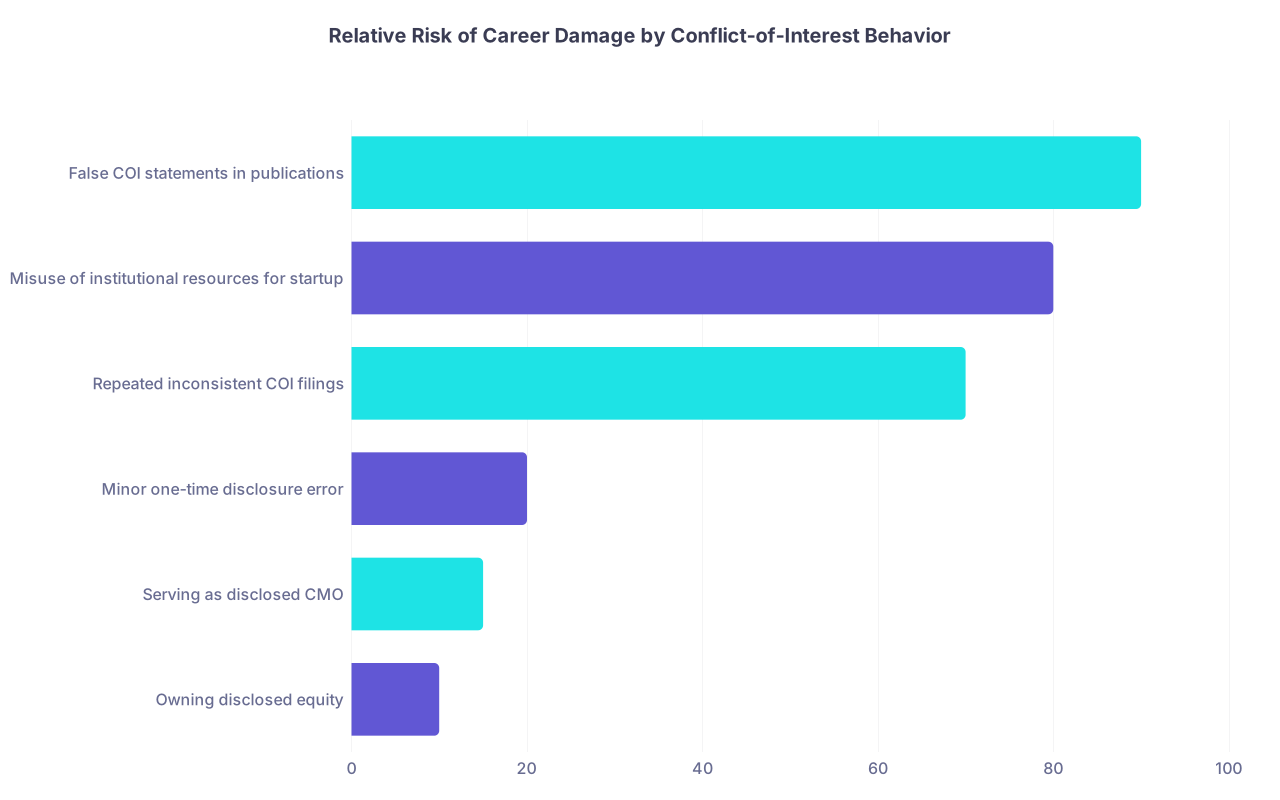
| Category | Value |
|---|---|
| Owning disclosed equity | 10 |
| Serving as disclosed CMO | 15 |
| Minor one-time disclosure error | 20 |
| Repeated inconsistent COI filings | 70 |
| Misuse of institutional resources for startup | 80 |
| False COI statements in publications | 90 |
The Bottom Line
Three points to keep front and center:
Disclosure is not the threat; non‑disclosure is.
You can survive big conflicts. You probably will not survive being caught hiding them.Keep your worlds cleanly separated and documented.
Draw hard boundaries between your lab, your clinical work, and your startup. Put agreements and approvals in writing before money and publicity show up.When in doubt, over‑communicate early, not defensively later.
Talk to your COI, tech transfer, and department leadership before you act. The uncomfortable 30‑minute meeting now is much cheaper than the career‑ending investigation three years from now.


