
It is 10:30 p.m. You just finished a telemedicine shift, you open your startup’s landing page on your phone, and your stomach drops.
You know the product is clinically sound. You have protocols, IRB approval, maybe even early pilot data.
But you also know exactly what a risk-averse hospital CIO or malpractice attorney would see:
A logo that looks like it was built in PowerPoint.
Vague phrases like “AI‑powered health solutions” and zero explanation of who is responsible for patient outcomes.
A “HIPAA compliant” badge you copied from Google Images five months ago.
You are not losing leads because your idea is bad. You are losing them because your branding quietly screams: “This might not be safe.”
Let me walk you through the five biggest branding errors I see post‑residency founders make in medical startups. These are the things that make your company look unsafe before anyone reads your white paper or talks to your CMO. And they are all preventable.
Error 1: Hiding Clinical Accountability Behind “Tech” Branding
This is the classic trap: branding your medical company like a generic SaaS tool.
You lean hard on:
- “Cloud-based”
- “AI-driven”
- “Data platform”
- “Healthtech”
And barely mention:
- Who the responsible clinicians are
- How clinical decisions are made
- What guidelines or standards you follow
- Where the clinical risk actually sits
To a lay consumer, this feels vague.
To a clinician, it feels dangerous.
Red flags you are sending (even if you do not realize it)
- No clear named medical leadership (CMO, Medical Director, clinical advisory board)
- “Our algorithm” is referenced everywhere, but you never say whether a physician reviews high‑risk results
- Copy focuses on “optimization,” “productivity,” and “efficiency,” but never once uses words like “safety,” “validation,” or “governance”
- Your About page lists engineers, marketers, and a “health strategist,” but no one with a medical license
This is not just a marketing issue. Hospitals, payers, and even savvy patients read this as: No one is clearly on the hook if something goes wrong.
How to fix it before it sinks you
Name your clinical adults in the room.
Put your CMO, Medical Director, and clinical advisors on the website. Credentials visible.- “Jane Smith, MD – Board‑Certified in Emergency Medicine, former Associate Professor at UCSF, Clinical Safety Lead.”
Explain the clinical decision boundary.
Spell out what your product does not do. That actually increases trust.- “This tool flags patients at high risk for sepsis and suggests guideline‑based actions. Final clinical decisions remain with the treating physician.”
Use real guideline language, not buzzwords.
Refer to:- ACC/AHA, ADA, GOLD, KDIGO, etc.
- FDA frameworks (SaMD where relevant)
- Internal safety committees or review processes
Make your escalation path visible.
For patient‑facing products, explicitly state:- “If you are experiencing an emergency, call 911.”
- “Our clinicians respond within X minutes; this is not a substitute for emergency care.”
If your branding does not make it crystal clear who is medically responsible and what the tool’s limits are, people will assume the worst. And they are not wrong.
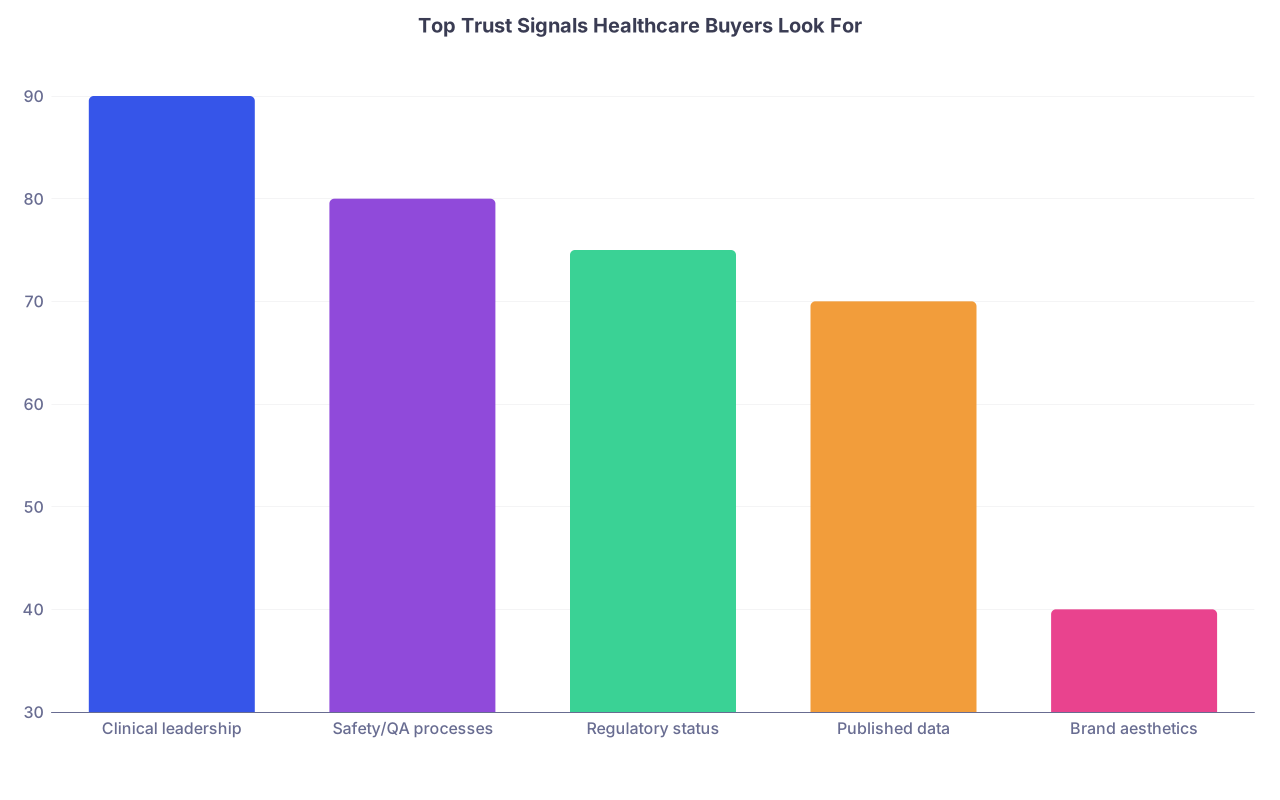
| Category | Value |
|---|---|
| Clinical leadership | 90 |
| Safety/QA processes | 80 |
| Regulatory status | 75 |
| Published data | 70 |
| Brand aesthetics | 40 |
Error 2: Amateur Visual Design That Signals “Prototype” Not “Patient-Safe”
I am going to be blunt: ugly, inconsistent branding looks unsafe in healthcare.
You can sometimes get away with that in general tech. In medicine? No.
Hospitals and patients are trained to associate certain visual cues with legitimacy and safety. When you violate these, alarms go off.
What “unsafe” design looks like in practice
I have seen all of these live on production sites for medical startups trying to sell into hospitals:
- Clashing colors, neon gradients, or dark backgrounds with red accents (accidentally mimicking “error” UI states)
- Inconsistent fonts across pages, suggesting copy‑paste templates and rushed changes
- Pixelated logos or off‑center icons on app splash screens
- Stock photos of “doctors” without badges or obviously fake stethoscopes
- App screens where critical information (dose, result flags, warnings) is small, low‑contrast, or buried in clutter
None of this technically violates any law. But it triggers a very real, very rational thought in decision makers:
“If they cut corners on their front‑facing design, what corners did they cut in their clinical validation?”
What safe, competent design actually looks like
You do not need to win design awards. You do need to look like you take safety seriously. That means:
- Clear hierarchy:
- Critical values and warnings in high‑contrast, consistent colors
- Non‑urgent information visually secondary
- Consistency:
- Same typography, colors, button styles across web, app, and docs
- A style guide that an adult actually maintains
- Restraint with colors:
- Avoid using red for anything except error, danger, or critical alerts
- Calm, clinical palettes: blues, grays, muted accents, high contrast where needed
- Readable in real life:
- Test your screens in bright light, low light, and on mediocre monitors (yes, hospital workstations from 2014 still exist)
If your product involves dose information, triage decisions, or critical labs, and your UI looks like a gaming app, you are asking people to distrust you.

Error 3: Overstating Compliance and Regulatory Status
This one makes me wince because I know how often it backfires.
You slap “HIPAA compliant,” “GDPR compliant,” “FDA approved,” or “CE certified” on the homepage.
You add three padlock icons and a shield logo.
You feel safer.
A hospital privacy officer or regulatory consultant sees it and immediately thinks: “I want to see the documentation. All of it.”
The branding mistakes that look downright dangerous
Using “HIPAA compliant” as a logo or badge.
HIPAA is a law, not a certification program. There is no real “HIPAA certified” stamp. Lawyers know this. Many CISOs do too.Vague FDA language:
- Saying “FDA approved” where the real status is “we are a Class II exempt device”
- Implying FDA status when you are clearly in “general wellness” territory
Security buzzword soup:
“Bank‑level encryption,” “military‑grade security,” “blockchain‑secured health records” — with zero details about:- Encryption at rest vs in transit
- Access controls
- Audit logging
- Vendor risk management
You think you look impressive. To serious buyers, you look either naïve or deceptive. Both read as unsafe.
How to talk about compliance without stepping on a landmine
Be precise, not grandiose.
- “We sign Business Associate Agreements (BAAs) and follow HIPAA security and privacy rules.”
- “Our cloud infrastructure is hosted on HIPAA‑eligible services from [Vendor].”
Describe your actual posture instead of screaming “compliant.”
- “All PHI is encrypted at rest and in transit (AES‑256, TLS 1.2+).”
- “Access is role‑based and logged; audit logs retained for X years.”
If you have real certifications, name them clearly.
- “SOC 2 Type II report completed in 2024; available under NDA.”
- “ISO 27001 certified via [Auditor] as of [Date].”
Be humble about FDA and similar bodies.
- “This product is not intended to diagnose or treat disease and is not a medical device.”
- Or, if it is: “Class II device, 510(k) cleared under KXXXXXX.”
There is no faster way to lose institutional trust than to oversell your regulatory posture. People who understand this space will test every word you publish.
| Risky Claim | Safer Alternative |
|---|---|
| HIPAA certified | We sign BAAs and follow HIPAA security and privacy rules |
| FDA approved | 510(k) cleared Class II device (KXXXXXX) |
| Military grade security | PHI encrypted at rest (AES‑256) and in transit (TLS 1.2+) |
| 100% secure | We follow industry‑standard security practices and undergo regular audits |
| GDPR compliant | We support GDPR data subject rights (access, deletion, export) and use EU-based data centers when required |
Error 4: Vague, Inflated Claims Instead of Concrete Evidence
Nothing makes a medical startup look more unsafe than grandiose promises with no numbers behind them.
You have seen this:
- “Revolutionizing patient outcomes”
- “Transforming chronic disease management”
- “Reducing readmissions and improving quality of life”
Zero:
- Baseline metrics
- Study design
- Time horizon
- Context
This is how snake‑oil vendors talk. And clinicians know it.
The specific messaging mistakes that scream “unvalidated”
- “Clinically proven” with no link, no citation, no journal name
- Percentages with no denominator:
- “50% reduction in errors” (From what to what? In which population? Over how long?)
- Cherry‑picked N=12 pilot data presented like a Phase III RCT
- Marketing claims that exceed the conservative language in your own IRB or protocol
When I review pitch decks for health systems, this is the slide that always gets them: the one with 3 giant numbers and 0 methodology. I have seen more than one deal die there.
How to present evidence like a serious medical company
You do not need a NEJM paper on day one. You do need to respect the audience’s intelligence.
Always anchor your numbers.
- “In a 6‑month pilot at a 300‑bed community hospital (N=850 admissions), we observed a 17% relative reduction in 30‑day readmissions for heart failure patients (from 22% to 18%; p=0.04).”
Separate “early data” from “expected impact.”
- “Early pilot data (N=50) suggests…”
- “We are currently running a prospective study to further evaluate…”
Use language that matches the strength of your evidence.
- Observational data → “associated with,” “correlated with”
- RCT → “reduced,” “improved”
Link or reference your sources.
Even if it is a poster or preprint. Name it.
Your branding either tells clinicians “we understand evidence hierarchies” or “we do not know the difference between a case series and a multi‑center RCT.” Do not fall into the second category.
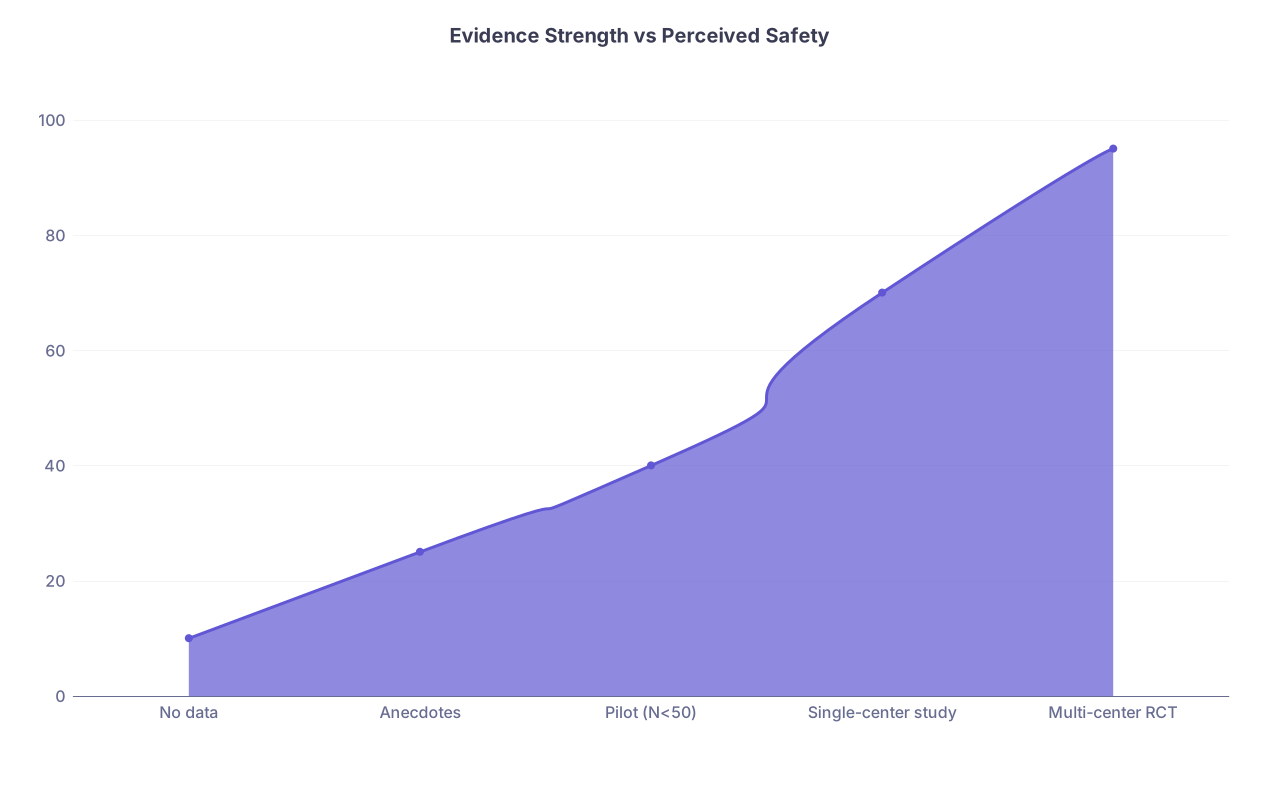
| Category | Value |
|---|---|
| No data | 10 |
| Anecdotes | 25 |
| Pilot (N<50) | 40 |
| Single-center study | 70 |
| Multi-center RCT | 95 |
Error 5: Ignoring Risk, Edge Cases, and Failure Modes in Your Messaging
This one is subtle but deadly.
Founders are so afraid of scaring buyers that they try to pretend risk does not exist.
The branding shows only happy paths:
- Successful diagnoses
- Perfect adherence
- Cheerful dashboards of “lives saved”
No discussion of:
- False positives
- False negatives
- Alert fatigue
- When not to use the tool
- How to respond to system failures
In clinical medicine, we are trained to think in worst‑case scenarios. When your branding refuses to acknowledge them, we assume you have not thought them through. That is unsafe.
Dangerous omissions I keep seeing
Triage or decision‑support tools with no published sensitivity/specificity ranges
Remote‑monitoring devices with no clear escalation plan for data gaps or technical failures
Chat‑based health apps that never clarify:
- Is this an AI, a nurse, a doctor, or a random contractor?
- What happens if they miss something major?
No mention of:
- Incident reporting
- Post‑market surveillance
- How users can report safety concerns
The silence is loud.
How to brand yourself as safety‑minded instead of reckless
You do not scare buyers by talking about risk. You reassure them you understand it.
Explicitly acknowledge limitations.
- “This tool is intended as an adjunct to, not a replacement for, clinical judgment.”
- “Not validated in pediatric or pregnant populations.”
Show you have thought about failure modes.
- “If we cannot reach the patient after multiple attempts, we notify the ordering clinician.”
- “System downtime: data is queued locally and synced on reconnection; critical results are also sent via SMS alert.”
Share your risk philosophy in plain language.
- “We prioritize avoiding missed critical events, even at the cost of some additional false alerts.”
Make it easy to report issues.
- Dedicated safety email (e.g., safety@yourcompany)
- Simple in‑app reporting mechanisms
Here is the trick: the more your branding resembles how actual clinicians talk about risk, the safer you look.

| Step | Description |
|---|---|
| Step 1 | Draft Brand Messaging |
| Step 2 | Clinical Review |
| Step 3 | Add named clinicians |
| Step 4 | Dial back or add data |
| Step 5 | Add limitations and failure modes |
| Step 6 | Compliance review |
| Step 7 | Design and UX safety pass |
| Step 8 | Publish Messaging |
| Step 9 | Mentions accountability? |
| Step 10 | Evidence supported claims? |
| Step 11 | Clear on risk and limits? |
Pulling It Together: What Safe Branding Actually Looks Like
Let us stack this up.
A medical startup that looks safe from a branding standpoint will:
- Show real clinicians, with real credentials, visibly accountable for the product
- Use clean, consistent, restrained visual design where critical info is impossible to miss
- Describe compliance and regulatory status precisely, without invented badges or inflated claims
- Present outcomes data with denominators, time frames, and humility about study design
- Talk openly about risk, limitations, and what the system deliberately does not do
A medical startup that looks unsafe does the opposite:
- Hides behind “AI” and “platform” language with no named medical adults
- Ships inconsistent, cluttered UI that feels like a hackathon prototype
- Plasters “HIPAA compliant” and “FDA approved” without backing details
- Uses big numbers and “clinically proven” rhetoric with no methodology
- Pretends risk does not exist and never mentions edge cases or failure modes
The market is already full of healthtech vaporware and overpromises. Clinicians, CIOs, and patients have developed a strong radar for this. You will not sneak past it with clever copy.
You built this company because you care about patient care and system improvement. Do not let sloppy branding accidentally put you in the same bucket as the unsafe actors.

What You Should Do Today
Do not just think about this and move on. Open your own public presence right now:
Pull up:
- Your homepage
- Your About/Team page
- Your main product page
- One or two core app screens
Ask, in order:
- Where is the named clinical leadership, and what are they on the hook for?
- Do the visuals look careful enough for a product that can hurt someone if misused?
- Are any compliance or regulatory claims overstated or vague?
- Are we making any outcome claims we cannot support with published or shareable data?
- Where do we explicitly state limitations, risk, and failure handling?
For every “I am not sure,” write it down. That is your branding risk list. Prioritize it like a clinical safety issue, not a cosmetic tweak.
Your next step is simple and concrete:
Schedule a 60‑minute joint review with your most skeptical clinician and your most honest designer. Put your website and app on a shared screen and let them tear it apart from a safety‑perception standpoint. Then fix what they flag.