
The smartest angel investors in healthcare quietly bias toward second-time physician founders—and they’re usually right to do it.
You won’t hear this in public panels or on Twitter threads. But in partner meetings, on late-night Zooms, and in the back channel Signal groups, the phrase they use is simple: “Great. They’ve already been blooded.”
Let me walk you through what that really means.
Why Angels Don’t Like “First-Time Hero Doctors” As Much As You Think
There’s a fantasy that the perfect founder is the brilliant chief resident who just finished training and had a “eureka” moment on rounds. Investors smile at that story on stage. On diligence calls, it’s a different tone.
Behind closed doors, experienced angels say things like:
- “They still think hospital politics work in the real world.”
- “They haven’t been punched in the face by procurement yet.”
- “They’re still allergic to selling.”
I’ve sat in those meetings. The pattern is consistent.
First-time physician founders, especially right out of residency, often show the same blind spots:
They confuse clinical authority with market authority.
They assume that, because they know the guidelines cold and can run a code blue half-asleep, they must also know how a CFO thinks about risk, or how an IT director thinks about prioritizing integrations. They don’t.
Investors see this in very specific ways:
- Decks full of clinical logic and no pricing model.
- “We’ll just get IRB and publish a paper” as the primary go-to-market lever.
- “We’ll start with the big academic centers” as if those are not the slowest, most political customers on Earth.
That doesn’t mean first-timers never work. It means that angels with scars on their own backs know how expensive those naïve errors are. Time is money. And in healthcare, time is political capital, regulatory runway, and burn.
Second-time physician founders have usually already paid that tuition.
What Second-Time Physician Founders Have That First-Timers Don’t
The difference is not age. It’s scar tissue.
A second-time physician founder—whether they “failed,” exited modestly, or spun down a project after two years—shows up differently in a room with serious angels. The investors feel it before the first slide.
They’ve already:
- Been ignored by a hospital executive who claimed to be “very excited.”
- Had a product pilot killed by a new CMIO after months of work.
- Watched burn creep up while usage stayed flat.
- Lied awake wondering if they made a mistake leaving a safe attending job.
So they pitch differently. They’re more specific. Less romantic. More dangerous in the good way.
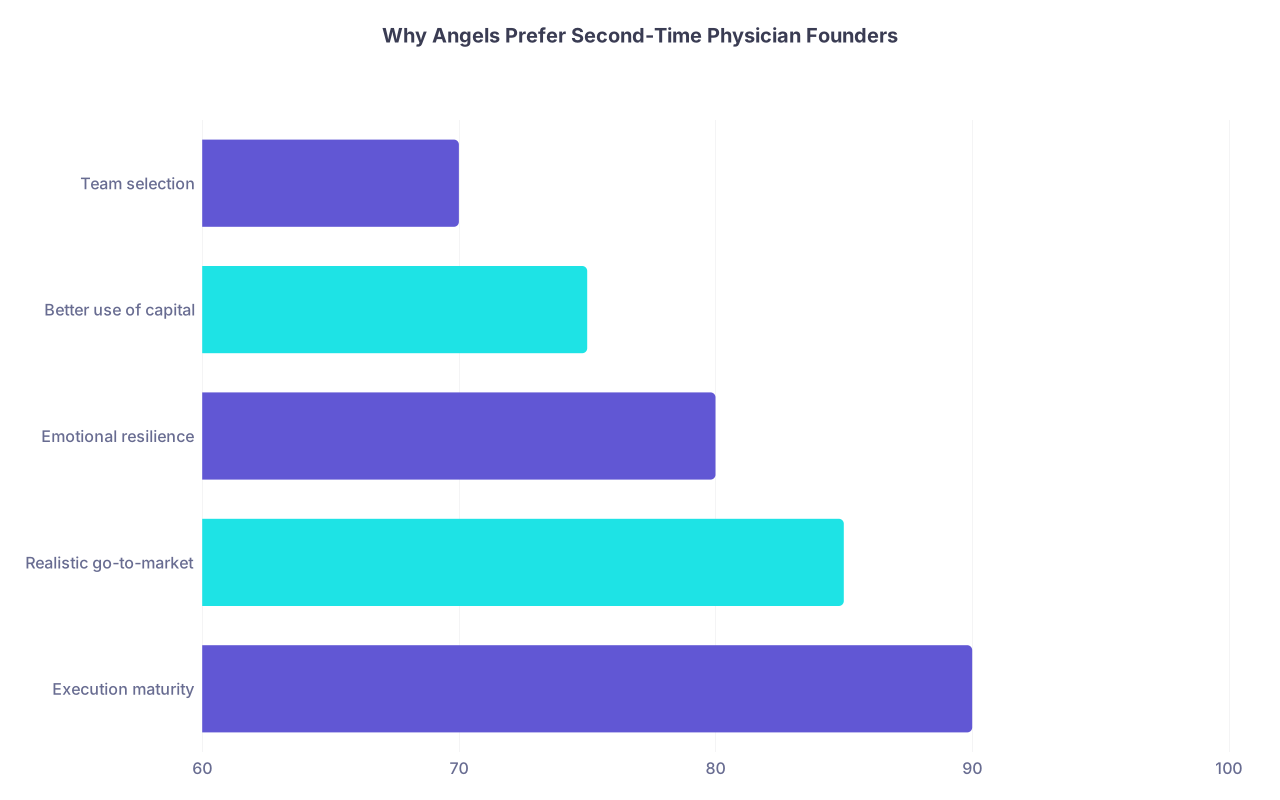
| Category | Value |
|---|---|
| Execution maturity | 90 |
| Realistic go-to-market | 85 |
| Emotional resilience | 80 |
| Better use of capital | 75 |
| Team selection | 70 |
Let me spell out the main “quiet advantages” angels see.
1. They’ve Already Been Humbled By The System
First-timers talk like this:
“We’ll get buy-in from leadership.”
“Clinicians will love this—the workflow is better.”
“Patients obviously want this.”
Second-timers talk more like this:
“We’re not selling to ‘the hospital’—we’re selling to the VP who owns LOS metrics this quarter.”
“Med staff culture here will kill this unless we make the champion look like the hero.”
“Patients say they want this, but they won’t actually change behavior without a reimbursement hook.”
Angels listen for that language. It signals a simple truth: you no longer believe the system is rational. You believe it’s human, political, and often irrational. That is the only kind of system you can successfully sell into.
The subtle investor math:
A founder who thinks the world is rational will burn 18 months discovering it isn’t. A second-time founder starts on day 1 with a politically realistic go-to-market plan.
2. They’re No Longer Intimidated By “Non-Clinical” Work
Here’s something physicians almost never say out loud: most of you are initially terrified of selling. You call it “business development” and hide it under layers of jargon.
After the first startup, that fear gets downgraded to annoyance—and that’s a massive improvement.
Second-time founders:
- Don’t flinch at cold outreach to a VP at Optum.
- Aren’t weirdly deferential to MBAs on their own team.
- Understand that “I’m an MD” is not a replacement for a pipeline.
The first time around, many physicians cling hard to “clinical founder” identity. They over-index on product accuracy, safety, or guidelines alignment, and under-invest in distribution. After they’ve watched a weaker product win because it had better sales, they don’t repeat that mistake.
Investors see this in the calendar. One founder has a week packed with “internal strategy discussions.” The other has it loaded with prospect calls, customer discovery, and partner meetings. Angels back the second.
3. They’ve Learned To Translate Between Clinical and Capital
First-time physician founders often talk in stories—patient cases, tragic failures of the system, frontline pain. Good for narrative. Weak on capital allocation.
Second-time founders still tell those stories, but they translate them into investor language:
- “This failure point creates a 5–8% avoidable readmission rate.”
- “This is already coded—payers are bleeding money and know it.”
- “This workflow change automates what 0.5 FTE nurse does per 100 beds.”
And then they do something first-timers almost never do: they tie that directly to pricing and ROI, not just “impact.”
When a second-time physician founder says, “We price at 20–30% of realized savings, and here’s how we verified the baseline,” angels lean in. That’s not theory. That’s from getting beaten up the first time.
4. They Use Capital With A Level Of Meanness
This is the piece people don’t like to say on podcasts.
Angels prefer second-time founders because they’ve already felt the slow-motion horror of a dwindling bank account. They don’t romanticize runway. They treat money like oxygen, not like confetti.
You see it in decisions:
- That “nice to have” feature that engineers want? It gets cut.
- The glitzy conference sponsorship that strokes ego? Declined.
- The “we should hire a VP of X” impulse? Replaced with, “What milestone requires that?”
I watched a second-time physician founder in Boston (IM-trained, had done a clunky remote monitoring startup that fizzled) push back hard on a designer asking for brand overhaul pre-revenue. His line to the team: “We are not building a shrine to ourselves. We are building a tool someone will pay for.”
Angels love that. It tells them this person will not waste their check on vibe.
The Scar Tissue Portfolio Angels Quietly Track
What experienced angels really track isn’t just specialties or schools. It’s career arcs.
They look at a founder and mentally sort them into patterns:
- Pure clinician → founder (no prior attempts)
- Clinician → intrapreneur → founder
- Clinician → startup #1 (meh outcome) → startup #2
- Clinician → industry role → founder
The “clinician → startup #1 → startup #2” group is where a lot of checks quietly land.
Because that first startup—no matter the outcome—forces them to confront things medical training never prepared them for: firing people, mis-hiring, regulatory blowback, security audits, payer games, legal threats, and the humbling reality of sales cycles.

The conversation angels have among themselves sounds like:
- “She did that remote patient monitoring company that never got past pilots, right?”
- “Yeah. But she survived three hospital committees and a payer data audit. She’ll be deadly this time.”
They’re not spooked by a failed first company. They’re reassured by it. As long as you show you’ve integrated the lesson instead of hiding from it.
Typical First vs Second-Time Founder Mistakes (And Fixes)
Let’s be concrete. I’ve seen the same play run dozens of times.
| Area | First-Time Behavior | Second-Time Behavior |
|---|---|---|
| Customer focus | “Academic centers first” | “Mid-market systems with urgent KPIs” |
| Validation | IRB study as proof | Signed LOIs and pilots as proof |
| Product scope | Overbuilt, many features | Ruthlessly narrow, revenue-aligned |
| Team | Over-titled early hires | Lean team, contractors when possible |
| Timeline | Conference-driven milestones | Contract/renewal-driven milestones |
Angels look at your plan and immediately clock which column you’re in.
Classic First-Time Move: Academic Center Obsession
First-timers love aiming at big-name academic centers. Feels prestigious. Familiar turf. Looks great in a deck.
But on the investor side, the quiet translation is:
“Ok, so… 2-year sales cycle, ten committees, an IRB, and a 60% chance leadership turns over before anything scales.”
Second-timers have usually been burned there. They aim at community and regional systems where:
- There’s less politics per dollar of budget.
- The CEO actually feels pressure from readmissions, staffing, or margins.
- IT is not drowning in overlapping pharma and vendor “innovation pilots.”
Angels flag that as a positive immediately. It’s a sign you’ve been out in the wild, not just the ivory tower.
Classic Second-Time Move: Less Romance, More Mechanism
After you’ve watched your “innovation” die in a beautifully written white paper, you stop fetishizing research as your primary wedge. You start caring about process.
You say things like:
- “We’re going in through the service line director, not the CMO.”
- “We’ll ride on top of their existing Epic build, not ask for new workflows.”
- “We scoped our implementation to 2–3 weeks, not 6 months.”
That’s the language of someone who has already burned themselves and isn’t interested in relighting the same fire.
Post-Residency: Why This Bias Matters For You Right Now
You’re in the post-residency / job market phase. That’s exactly when these dynamics become real.
Here’s the uncomfortable truth:
If you’re a physician pitching a startup as your very first move after residency or fellowship, you are asking angels to fund your tuition in a second, unaccredited training program: startup school.
Some will do it. Usually the ones who are:
- Less experienced.
- More enamored with your MD.
- Or have some non-monetary reason to back you (alumni pride, social impact angle, etc.).
The serious angels, the operators, the ones who’ve been through acquisitions and down rounds—they’re thinking:
“Do I really want to pay for this person to discover all the basic mistakes the hard way?”
When you’re a second-time founder, the conversation flips.
Now, implicitly, you’re saying: “Someone else already funded my tuition. I’ve already made the stupid, expensive mistakes. Your money goes into playing the game, not learning the rules.”
That’s why experienced angels quietly prefer you.
How To “Look” Like A Second-Time Founder Even If You’re Not
Here’s the part you actually care about: what to do if you’re about to finish training and you haven’t had a first company yet.
You can’t fake scar tissue. But you can compress the learning.
You do it by stealing someone else’s scars through proximity and ruthless exposure:
- Join an early-stage health startup for 12–24 months post-residency instead of jumping straight into your own idea. Go to every board meeting if you can, even as a fly on the wall.
- Lead a revenue-tied initiative inside your hospital that forces you to work with finance, IT, and legal—not a “quality improvement” project that dies in a PDF.
- Shadow the sales team on calls if your current employer has one. I don’t care if you’re “the medical director”—sit in.
When you later pitch your own company, you talk differently. You have stories like:
“We rolled out an ED algorithm at [specific health system] that hit legal, IT security, and med staff. Here are the three landmines we hit and what I’ll avoid this time.”
That’s the kind of line that makes angels think, “Ok, this one might as well be second-time from a risk standpoint.”

| Step | Description |
|---|---|
| Step 1 | Post Residency |
| Step 2 | High tuition in mistakes |
| Step 3 | Borrow scars |
| Step 4 | Learn politics |
| Step 5 | Found later with experience |
| Step 6 | Which path |
If you’re already a genuine second-time founder, you should make that scar tissue visible instead of hiding it behind sanitized CV lines.
Spell out:
- What went wrong operationally.
- Where you misread stakeholders.
- Which GTM experiments failed.
Investors do not punish that. They punish denial.
What Angels Say About Second-Time Physician Founders When You’re Not In The Room
Let me give you a sample of the real, slightly impolite commentary that drives term sheets.
Talking about a first-timer straight out of fellowship:
“Super smart. Naïve as hell. If we invest, we’re signing up for a lot of hand-holding.”
Talking about a second-time physician founder whose first company flat-lined:
“Got roughed up on the first one. Still wants to play. That’s what I want—someone who’s had the dream kicked out of them but kept the drive.”
Another investor I know in SF has a simple rule:
“I’d rather back a founder with a failed prior startup and a clean cap table than a shiny first-timer with delusions of inevitability.”
They’re not looking for less idealism. They’re looking for idealism that has passed through reality and survived.
The One Real Advantage Only You Have As A Physician
I’ll say something that VCs dance around: physician founders, even on their first try, often have one massive advantage over “pure business” founders.
You’ve seen firsthand where the bodies are buried.
You know:
- Which workflows are actually killing people.
- Where documentation is pure theater.
- Which “care pathways” are silently ignored.
- How often backdoor hacks and workarounds carry the system.
Second-time physician founders are lethal because they combine that insider knowledge with execution discipline earned the hard way.
You don’t lose your clinician eye. You just stop believing that “if we build the right thing, adoption will come.” You start believing that if we build the right thing, package it politically correctly, price it sanely, integrate it minimally, and sell it ruthlessly, adoption might come.
That shift—from medicine brain to market-aware medicine brain—is exactly what angels are buying.
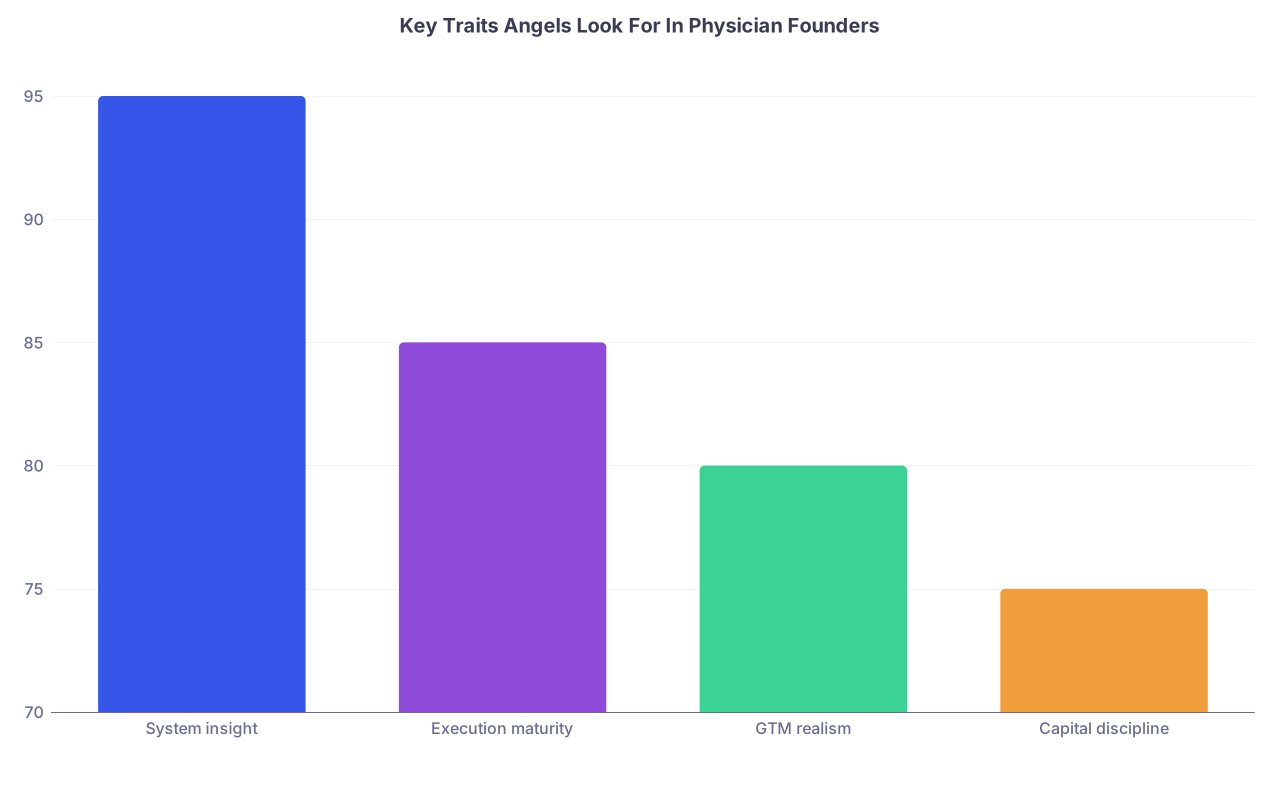
| Category | Value |
|---|---|
| System insight | 95 |
| Execution maturity | 85 |
| GTM realism | 80 |
| Capital discipline | 75 |
Second-timers hit all four. First-timers usually only hit the first one.

FAQ: Second-Time Physician Founders & Angels
1. Does my first startup need to have “succeeded” for angels to value it?
No. In fact, a clean, honestly failed attempt can be more attractive than a tiny, ambiguous “acquihire.” What angels want is evidence you’ve run the real gauntlet: sales attempts, pilots, contract negotiations, maybe even layoffs. If you can describe clearly what you misjudged and how you’ll act differently now, that’s gold. Hiding the failure or pretending it was a win is what actually spooks them.
2. I’m finishing residency now—am I screwed if I start something immediately?
You’re not screwed. You’re just more expensive risk. If you insist on starting now, compress your learning: get brutal with customer interviews, ship something embarrassingly small, and put yourself in sales calls from day one. Or spend 1–2 years inside someone else’s startup, ideally close to the founders and sales team. That can effectively “simulate” a first-attempt learning curve without you burning your own cap table.
3. How do I present my first failed startup in a pitch without tanking myself?
You present it like a post-mortem, not a eulogy. Three parts: what you tried, what the outcome was (clearly), and what you learned in operational terms—sales cycle length, wrong buyer, overbuilt product, misaligned incentives. Then you show exactly how the new company’s GTM, product scope, and target customer reflect those lessons. If you can point to a specific decision you’re making the opposite way this time, most serious angels will actually trust you more, not less.
Strip it down to the essence:
Experienced angels quietly prefer second-time physician founders because you’ve already been humbled by the system, you’ve learned to treat capital like oxygen instead of status, and you finally understand that distribution beats elegance.
If you’re about to step out of residency, you either need to earn that scar tissue fast—or borrow it from people who already have it.