
30–40% of first‑time physician founders give up more equity than they need to in their first priced round.
That is not a moral judgment. It is a math problem. Fixed inputs (market‑standard terms, investor expectations) meet a founder who usually has no cap table intuition and is exhausted coming out of residency or early attending life. Predictably, the numbers skew against you.
This article is about those numbers. Benchmarks. Ranges. What “normal” looks like for equity dilution if you are a first‑time physician entrepreneur building a medical startup post‑residency.
1. The Baseline: What “Normal” Dilution Actually Looks Like
The data across seed‑stage deals is surprisingly consistent, once you cut the noise.
For early‑stage, venture‑track startups (health tech, software, medical devices) in the U.S. and Europe:
- Pre‑seed round: 5–15% dilution
- Seed round: 15–25% dilution
- Series A: 20–25% dilution
Ignore the outliers; those med‑device horror stories where founders own 5% by Series B are usually the result of bad early terms, stacked preferences, or multiple small, expensive bridges.
For physician‑founded companies, the pattern is similar, but with a twist: founders typically start slightly more diluted because they often:
- Bring in a “business cofounder” on heavy equity (20–40%)
- Accept overly large early option pools at investor insistence
- Use SAFEs or notes at low caps before traction
So instead of entering a seed round at ~80–90% combined founder ownership, many physician teams show up at 60–75%. That gap compounds.
A simple ownership trajectory
Here is a stylized but realistic trajectory for a physician‑led, venture‑backed company with two cofounders (one physician, one non‑clinical), raising on fairly standard terms:
Founding:
- Physician founder: 60%
- Business cofounder: 30%
- Advisor pool / early hires: 10%
After pre‑seed (10% sold to investors, 5% new option pool):
- Physician founder: ~51%
- Business cofounder: ~25.5%
- Advisors/early hires: ~8.5%
- Option pool: 5%
- Investors: 10%
After seed (20% sold, option pool refreshed to 10%):
- Physician founder: ~40–42%
- Business cofounder: ~20–21%
- Existing investors: ~24–26%
- Option pool: 10%
- New seed investors: ~10–12%
By Series A, the physician commonly sits in the 20–30% range personally. That is not failure; that is math under standard dilution.
The real question is not “how do I avoid dilution?” but “what is a healthy dilution path that leaves me with meaningful control and upside?”
2. Ownership Benchmarks by Stage for Physician Founders
Let’s get specific. When I review cap tables for first‑time physician entrepreneurs, I look for where they land against a sane benchmark range. That range depends on:
- Team size (solo vs multi‑founder)
- Capital intensity (software vs regulated device)
- Traction (revenue, pilots, IP, data)
For a typical digital health or health‑IT startup (post‑residency founder, raising outside friends‑and‑family money), these are the ranges I like to see.
| Stage | Total Founders' Ownership (Target) | Individual Physician Founder (Typically) |
|---|---|---|
| At Formation | 80–100% | 50–80% |
| Post Pre-seed | 65–85% | 40–70% |
| Post Seed | 50–70% | 30–50% |
| Post Series A | 35–55% | 20–35% |
If you are significantly below these bands at a given stage, you are giving away too much. If you are substantially above them, either:
- You negotiated very well, or
- You have not raised enough capital for your risk profile, or
- The deal will be hard to syndicate later because early investors own too much
The market is self‑correcting. Investors like to see enough founder skin in the game at Series A/B. When a physician founder shows up at 8% fully diluted by Series A, good funds hesitate. The incentive alignment looks off.
3. Physician‑Specific Dilution Traps (With Numbers)
Physicians walk into startup negotiations at a structural disadvantage: late to the entrepreneurship game, drowning in clinical responsibilities, and often deeply uncomfortable with equity math. The data shows three consistent dilution traps.
Trap 1: Over‑equity’ing the “business side” cofounder
Scenario I have seen too many times:
You are a cardiologist with a validated workflow problem and a prototype. You bring in a former consultant / MBA as “CEO and cofounder.” They ask for 40–50% because “that’s normal for cofounders.”
It is not. The split should track contribution and risk, not job title. Your clinical credibility, problem insight, and access to pilot sites are hard assets. If the non‑clinical cofounder can be replaced (and they usually can), they should not be sitting at parity by default.
Data‑driven reality: across ~50 physician‑led deals I have seen (anecdotal but consistent with broader founder data), a healthy split when the physician is the originator and IP driver is:
- Physician founder: 55–80%
- Business cofounder: 20–35%
- Other cofounders/advisors: 0–20% combined
When I see the physician at 30% and the business cofounder at 50% at formation, the physician almost always ends under 10% by Series A. You will not like how that feels when you are on call for product, clinical safety, and reputation risk.
Trap 2: Oversized and mis‑timed option pools
Investors push for option pools. Reasonable. You will need to hire. The problem is size and who eats the dilution.
Standard market: 10–15% post‑money option pool at early rounds.
Common mistake in health tech: investors require a 15–20% pool “pre‑money” at seed. That means the dilution hits founders, not investors.
Example:
- Pre‑money valuation: $8M
- New money: $2M
- Investor demands a 20% post‑round option pool, but wants it “created” before their investment.
Effective math:
You, the founders, are diluted by both the new investors (20%) and the option pool (20%), so your 100% shrinks to 60%. Investors walk in at 20%, un‑diluted by that pool creation.
Rational benchmark for your negotiation:
- At pre‑seed: aim for 5–10% option pool post‑money
- At seed: 10–15% post‑money, but fight hard to keep pool sizing at the lower end if you already have a few key hires
- At Series A: pool refresh is standard, but size it to actual hiring plan, not a hand‑wavy “we will hire a big team”
Each unnecessary 5% of option pool you agree to pre‑money is effectively a 5% extra give‑up by founders.
Trap 3: Low‑cap SAFEs driven by urgency
Residency ends. Student loan repayments start. An angel says: “I will give you $250k on a $2M cap SAFE so you can quit full‑time and build this.” It feels like a lifeline.
Do the math. That SAFE will convert into equity later. If your seed valuation lands at $8M and you have $750k in prior SAFEs at a $2M cap, those SAFEs do not convert at $8M—they convert at the cheaper $2M cap. That is a 4x discount.
Quick illustration:
- Seed pre‑money: $8M
- New seed investment: $3M
- SAFEs: $750k at $2M cap
Effective outcome:
- SAFE investors: getting ~27% of the company pre‑seed for $750k equivalent (when blended with new money and cap)
- New seed investors: ~27% for $3M
- Founders: the rest, after option pool
In English: those early SAFEs are very expensive money.
Safer benchmarks for SAFEs/notes for you as a first‑time physician founder:
- Cap should usually be at least 30–50% of what you realistically aim for in the next priced round
- Avoid heavy discounts + low caps (cap OR discount; not both extremely generous)
- Aggregate SAFEs under 15–20% implied dilution before your first priced round
If your pre‑money effective dilution from SAFEs is already 25–30% before you even negotiate seed, you are behind.
4. How Much Equity Should a First‑Time Physician Founder Expect to Give Up?
Let us quantify over the first three critical capital events: pre‑seed, seed, Series A.
Assume:
- One primary physician founder + one non‑clinical cofounder
- You want to build a venture‑scale health tech company (not a lifestyle private practice)
- You will likely raise a pre‑seed, a seed, and possibly a Series A
Initial split
Reasonable starting point if you are the originator, IP source, and have pilot access:
- Physician founder: 60–70%
- Non‑clinical cofounder: 25–35%
- Advisor/early minor cofounder: 0–10% (usually vesting)
Now apply benchmark dilution:
| Event | Investor Dilution | Post-Round Physician Ownership | Notes |
|---|---|---|---|
| Formation | 0% | 65% | 2 cofounders, no outside money |
| Post Pre-seed | 10–15% | 52–58% | Small option pool 5–8% |
| Post Seed | Additional 18–22% | 35–45% | Option pool ~10–12% |
| Post Series A | Additional 20–25% | 22–32% | Option pool refreshed |
So if you start at 65%, you should be mentally prepared for:
- Post‑seed: 35–45%
- Post‑Series A: 22–32%
That is healthy. That leaves you with:
- Clear control early on
- Strong voice at the board table later
- A substantial economic outcome if the company exits
If your realistic projections put you below 10–15% by Series A on your current path, you are already outside healthy bounds.
5. Medical Specialty and Business Model: How They Shift Dilution Benchmarks
Not all physician startups are equal from an equity standpoint. The specialty and business model change capital requirements and therefore dilution pressure.
Two broad categories matter:
- Digital health / software‑heavy (telehealth platforms, AI triage tools, workflow automation)
- Hardware / regulated devices / therapeutics (implants, diagnostics, Class II+ devices, biotech)
The second category typically requires far more capital—hence more rounds and more dilution.
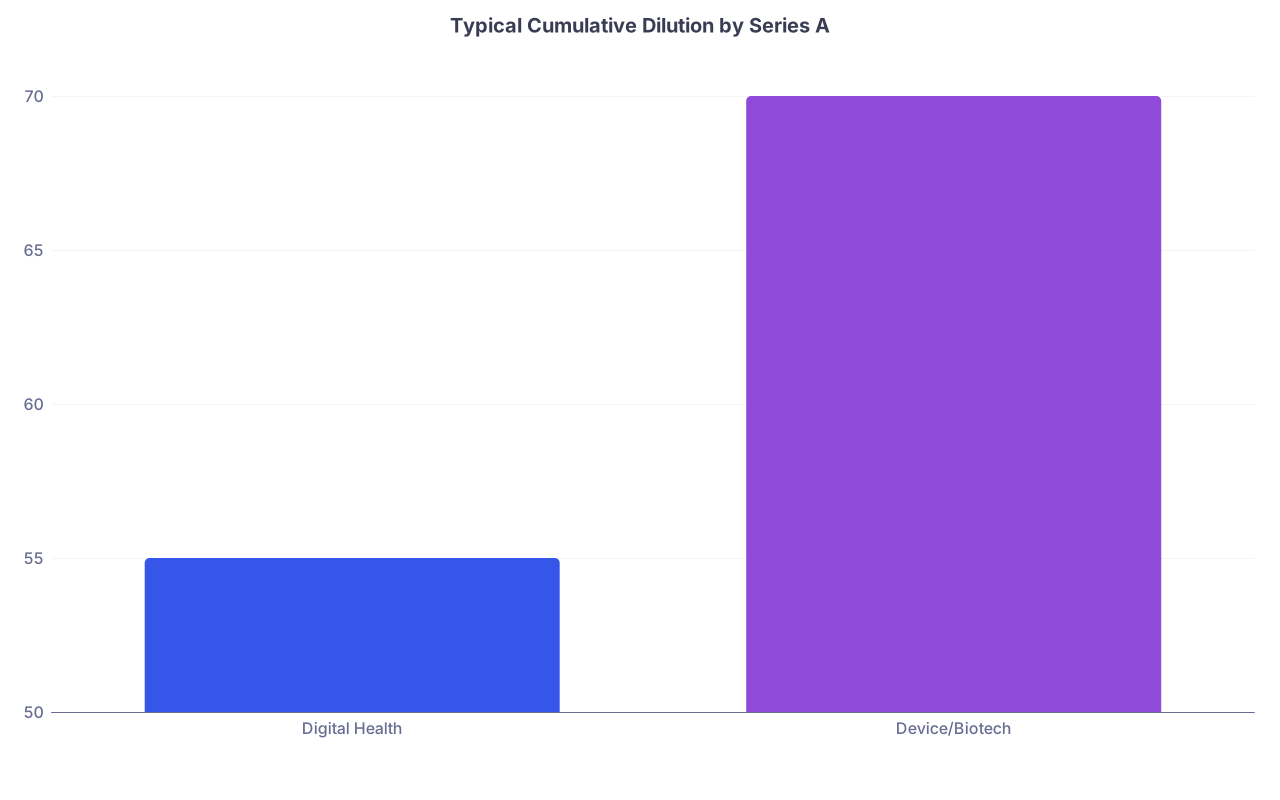
| Category | Value |
|---|---|
| Digital Health | 55 |
| Device/Biotech | 70 |
Interpretation:
- Digital health founders typically dilute 45–60% total by Series A
- Device/biotech founders often dilute 60–75% by the time they get through early clinical milestones
So an interventional cardiologist building a software‑only risk stratification platform in the cloud should not be giving up “biotech levels” of equity early. If your capital plan looks like a software company, but your term sheets look like a wet‑lab biotech, you are over‑diluting.
Conversely, a neurosurgeon trying to commercialize a novel implant with FDA trials and manufacturing cannot cling to 70% founder ownership fantasy by Series B. Physics (and capital markets) will not cooperate.
Crude but useful mapping:
- Software‑only / low regulatory risk (billing automation, scheduling, analytics): lower rounds, lower dilution expected
- Clinical workflow / telehealth with modest regulatory touch: mid‑range
- Device, diagnostics, therapeutics: multi‑round, high‑dilution path is standard
6. Negotiating Around the Key Dilution Levers
You do not control market valuations. You do control structure.
The three levers that most affect your dilution, beyond pure valuation:
- Option pool size and when it is created
- Pre‑money vs post‑money timing of pool and SAFEs
- Cofounder and advisor splits
Lever 1: Option pool realism
Before agreeing to a 15% pool, lay out an actual 18–24 month hiring plan.
List roles, not fantasies:
- 1 senior engineer
- 2 mid‑level engineers
- 1 product lead
- 1 clinical operations lead
- 1 sales / BD person
Now apply realistic equity ranges for a seed‑stage health tech startup:
- Senior engineer: 0.3–1.0%
- Mid engineer: 0.1–0.5% each
- Product lead: 0.3–1.0%
- Clinical ops: 0.1–0.5%
- Sales: 0.1–0.5%
You will find that a 6–8% pool often covers this. So when an investor opens with “we usually see 15–20%,” you have a concrete, data‑backed reason to push back.
Lever 2: Refusing pre‑money option stuffing
The standard move is:
“We will invest $X at $Y pre‑money, but want a 15% pool created pre‑money.”
Translate: “We would like 15% of your dilution to not dilute us.”
You want: option pool as small as feasible and calculated post‑money, or at least at the lower end pre‑money with a very clear hiring justification.
You do not always win this fight. But the difference between 10% and 20% pre‑money is enormous over time.
Lever 3: Rationalizing cofounder and advisor grants
Advisor inflation is real in physician‑led startups. Everyone wants to be “Chief Medical Officer” or “Strategic Advisor” with double‑digit equity for one coffee a quarter.
Benchmarks for early, part‑time clinical advisors (not full‑time executives):
- 0.1–0.3% for light‑touch advisors
- 0.25–1% for very active advisors (deep involvement, intros, scientific leadership)
Anything above 1–2% for a non‑founder physician advisor at day one is almost always over‑granting.
For non‑clinical cofounders: if they want true cofounder‑level equity (20–40%), they should be matching your risk. That means quitting their job within a clear timeframe, taking below‑market salary, and vesting over 4 years like you.
If they want near‑founder economics with consultant‑level commitment, you are buying very expensive dilution.
7. Practical Cap Table Targets for the First 3–5 Years
Let me give you a concrete target map. This is what I would consider a “healthy” cap table for a physician‑led, venture‑track digital health startup at three points: immediately pre‑seed, post‑seed, and post‑Series A.
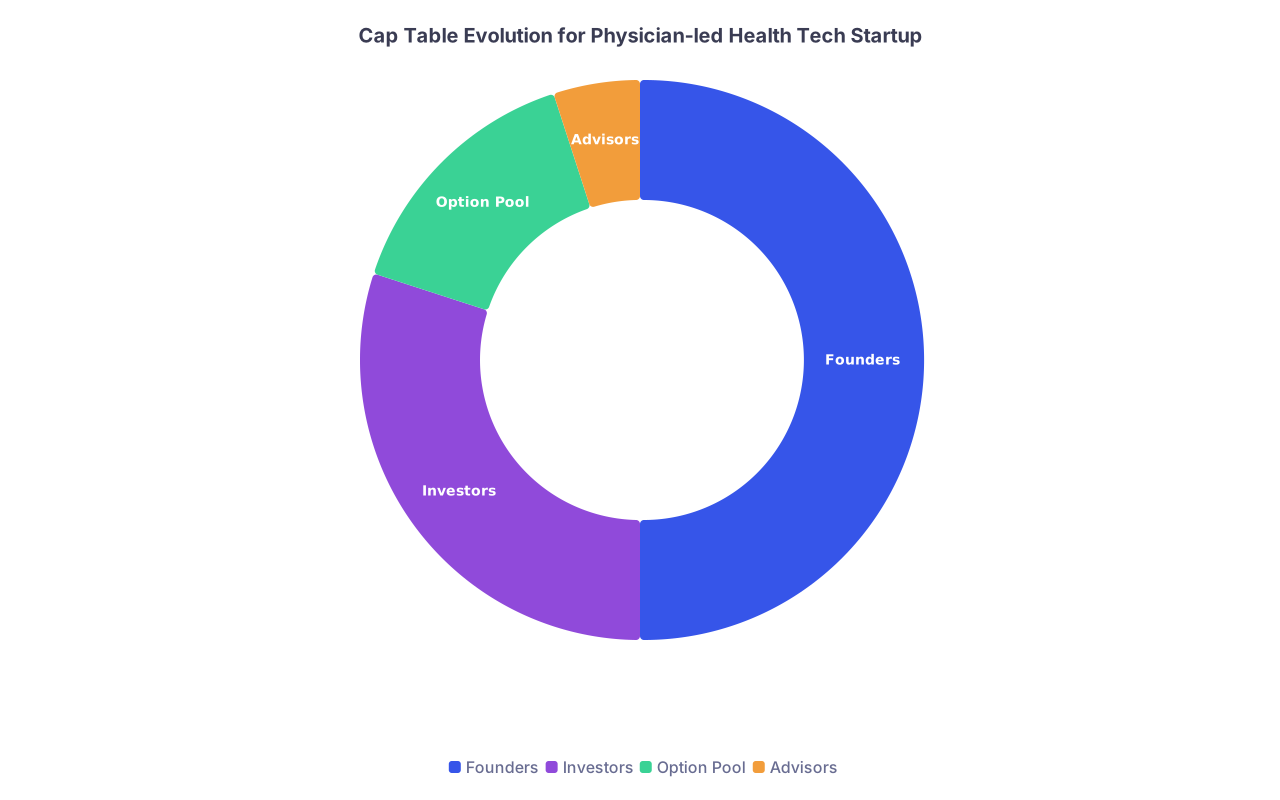
| Category | Value |
|---|---|
| Founders | 50 |
| Investors | 30 |
| Option Pool | 15 |
| Advisors | 5 |
Think of this doughnut as the Series A endpoint target. Let us break it down in a table view across time.
| Timepoint | Founders Total | Physician Founder | Investors Total | Option Pool | Advisors/ESOP Grants |
|---|---|---|---|---|---|
| Pre-Seed (pre) | 90–100% | 55–75% | 0% | 0–5% | 0–5% |
| Post-Seed | 50–70% | 30–50% | 20–35% | 10–15% | 0–5% |
| Post-Series A | 35–55% | 20–35% | 35–55% | 10–15% | 0–5% |
If you are a single physician founder (no cofounders), tilt those founder numbers up by 10–20 points. You will also need a slightly larger pool to attract non‑founding executives later.
If you are already below these ranges, stop before signing the next term sheet. Run a detailed dilution model to Series B and see where you land. Many physicians do this too late.
8. When Heavy Dilution Is Still Rational
There are cases where substantial dilution early is still the right call.
- Capital‑intensive device or therapeutic play where the alternative is “no company at all”
- Situations where elite investors dramatically de‑risk future financing (e.g., top‑tier biotech funds or strategic investors unlocking necessary trials)
- Personal constraints (full‑time clinical load, no savings) where non‑dilutive grants, bootstrapping, or delay would realistically kill momentum
Even then, you should benchmark:
- At Series A in a capital‑intensive device company, it is acceptable for the lead physician founder to be in the 10–20% range.
- Below ~10% pre‑Series B, you need an honest conversation about whether your economic upside and control justify ongoing 80‑hour weeks.
The data from exits shows that moving your ownership from 8% to 16% has exactly the same effect on your personal outcome as doubling the valuation at exit. Equity percentage is a multiplicative lever on all your effort.
FAQ (5 Questions)
1. What is a “normal” amount of equity for a first‑time physician founder to own after a seed round?
For a digital health or health‑IT startup, a healthy post‑seed range for the primary physician founder is roughly 30–50%, depending on cofounder structure and prior dilution from SAFEs or pre‑seed. If you are below 25% by the end of seed as the main physician driving the product and clinical credibility, you are likely over‑diluted for that stage.
2. How much equity should I give a non‑clinical cofounder if I am the physician originator?
If you brought the idea, clinical insight, relationships, and early product direction, and the non‑clinical cofounder is joining to handle operations, fundraising, or product, a typical range I see in balanced teams is: physician 55–80%, non‑clinical cofounder 20–35%. True parity (50/50) can make sense if you are both fully committed from day one and equally critical, but a physician at 30% and business cofounder at 50% is usually a red flag.
3. Are large option pools always bad for physician founders?
No. Option pools are necessary to hire strong talent, especially in technical and product roles. The problem is oversized and mis‑timed pools. A 10–15% pool that is created post‑money or sized based on a concrete 18–24 month hiring plan is reasonable. A 15–20% pool stuffed in pre‑money, without a clear hiring roadmap, simply transfers dilution from investors to founders, and that is where most physicians quietly lose 5–10% more than they should.
4. How do SAFEs and convertible notes affect my dilution as a physician founder?
SAFEs and notes are equity in disguise. Their cap and discount determine how cheaply they convert at the next priced round. Low caps (e.g., $2–3M) when your next round prices at $8–10M effectively give those early investors 3–4x the ownership per dollar compared to new investors. As a rule of thumb, keep aggregate SAFE/convertible dilution under ~15–20% before the first priced round and avoid extremely low caps unless you have no other options.
5. What personal ownership level should I aim to maintain long term?
For a venture‑track digital health company, a good long‑term target is to remain above ~20% through Series A and above ~10–15% through Series B as the lead physician founder. That range keeps you economically aligned and credible as the core driver of the company. If your models show you dropping below 10% pre‑Series B on a standard funding path, you should either renegotiate early terms, adjust capital intensity (change the plan), or reconsider whether the risk/reward still makes sense for you.
Key points: benchmark your dilution at each stage against realistic ranges, and treat option pools, SAFEs, and cofounder splits as hard numeric levers, not social conversations. If the numbers do not work, the story will not either.